How to Extract Data From a Website to Excel: 7 Methods That Actually Work


The fastest way to extract data from a website to Excel is Excel's own From Web tool: open the Data tab, choose From Web, paste the address, and load the table it finds. That covers most simple pages. But websites are not all simple, and the right method depends on how much data you need and how often you need it. This guide walks through seven ways to get web data into a spreadsheet, from a quick copy-paste to a fully automated pipeline, and helps you pick the one that fits.
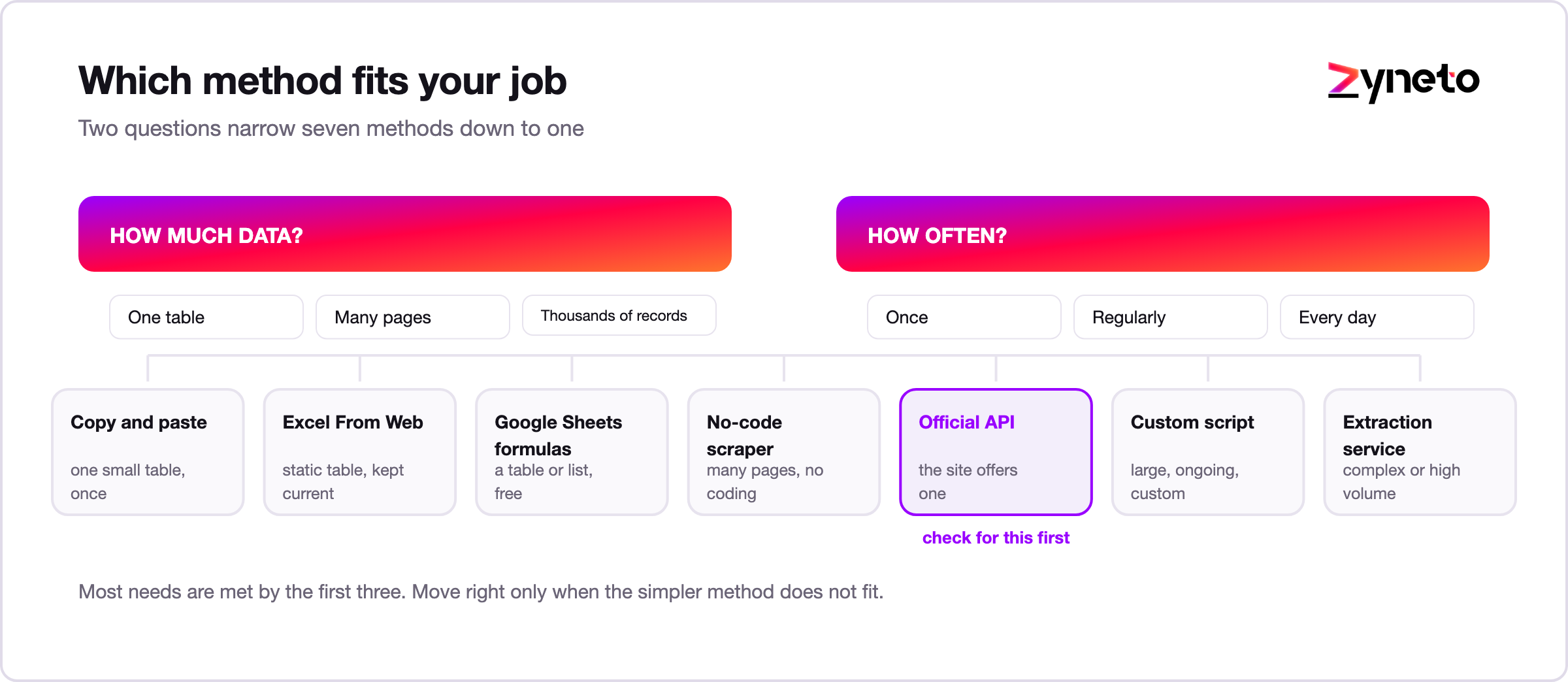
You do not need every method. You need the simplest one that works for your case, and two questions narrow it down fast.
How much data? A single table on one page is a different job from a thousand product listings across hundreds of pages.
How often? A one-time pull is different from something you need refreshed every morning. If you will repeat it, lean toward a method that can update on its own.
Keep those answers in mind as you read. They point you to the right row in the comparison table later.
Do not overlook the obvious one. If you need a small table once, select it on the page, copy it, and use Paste Special in Excel to drop it in as text or as a table.
Paste Special matters here. A plain paste often drags in the site's fonts, colours and link formatting, and you spend longer stripping that out than you saved. Choosing text or CSV as the paste format gives you the values and nothing else.
Best for: a single small table, one time. Not for: anything you will repeat, or data spread across many pages.
This is the method most people are looking for, and it is built right into modern Excel.
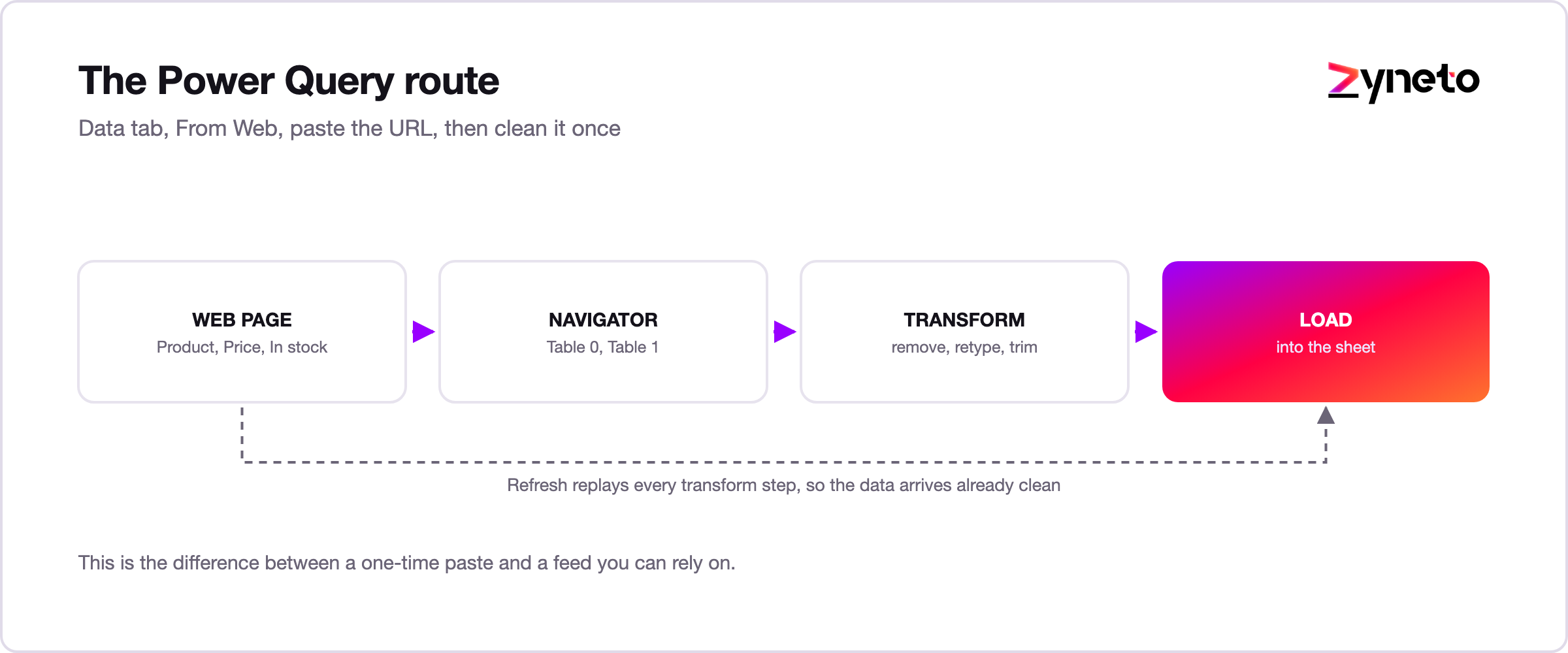
The real advantage is refresh. Because the data stays connected to the source, you can right-click the table and choose Refresh to pull the latest values, or set it to refresh on a schedule. That turns a manual chore into a button.
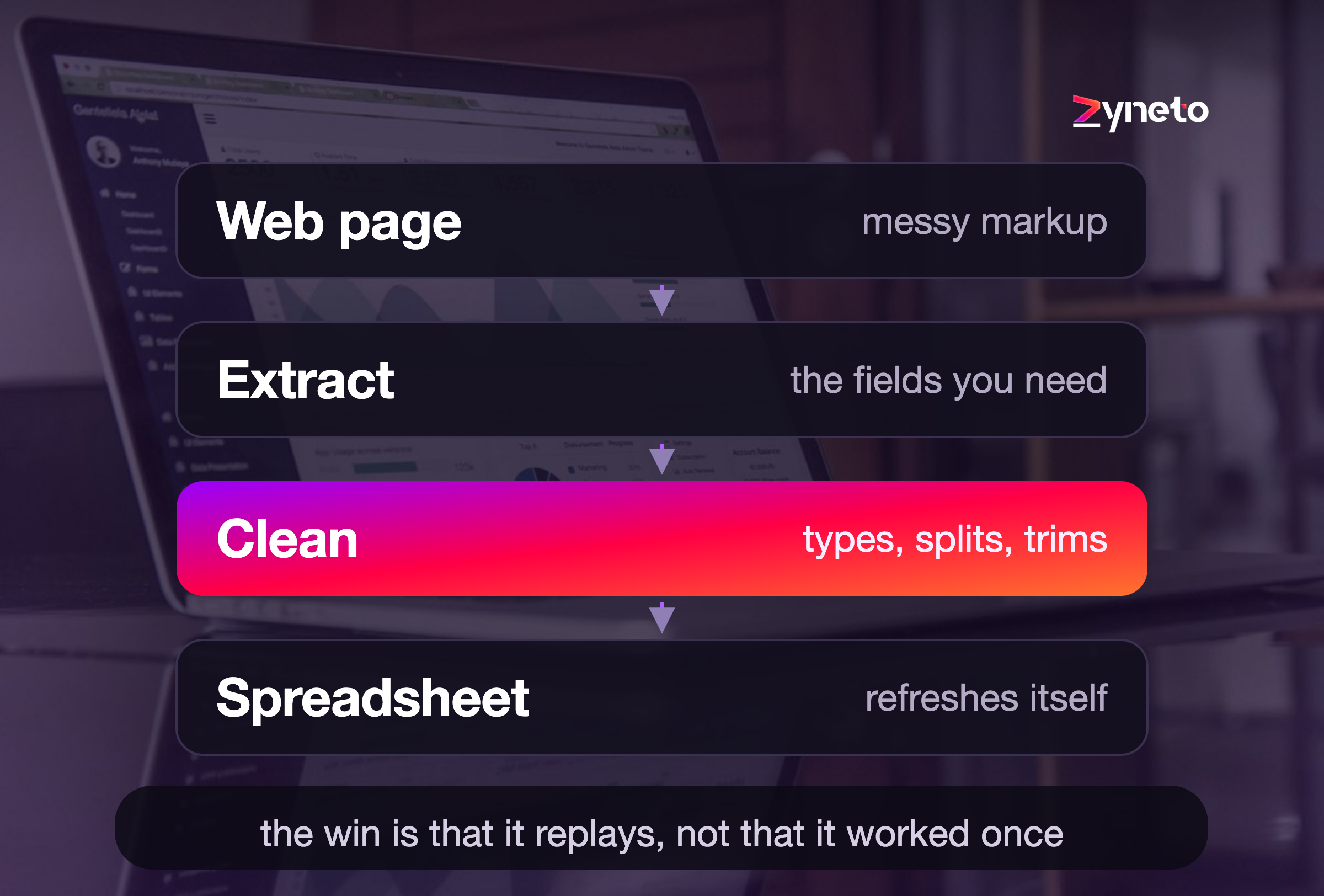
If the table comes in messy, click Transform Data instead of Load. That opens Power Query, where you can delete columns you do not need, split combined fields, fix data types, and drop blank rows before the data ever reaches your sheet. Doing the cleanup here means every future refresh arrives already tidy, which is the difference between a one-time paste and a repeatable, clean feed.
Best for: static HTML tables you want to keep current. Not for: pages that build their content with JavaScript, which often show up empty in the Navigator.
If the data lives in a clean table or list, Google Sheets can pull it with a single formula, and you can then download the result as an Excel file.
=IMPORTHTML("URL", "table", 1). Change "table" to "list" for lists, and the number to pick which table on the page.=IMPORTXML("URL", "xpath query"), where the XPath points at the part of the page you want.Once the data lands in Sheets, choose File, then Download, then Microsoft Excel to get an .xlsx file. This route is free, quick, and refreshes on its own while the sheet is open.
One practical limit worth knowing: these formulas have a cap on how many can run in a single spreadsheet, and they re-fetch periodically rather than instantly. For a handful of tables that is fine. For fifty, the sheet slows to a crawl.
Best for: tables and lists, and anyone who prefers a formula to a tool. Not for: heavy JavaScript pages or very large jobs.
When the data spans many pages or the built-in tools come back empty, a point-and-click scraper is the next step. Tools like Octoparse, Web Scraper, and Instant Data Scraper let you click the fields you want, follow pagination, and export straight to CSV or Excel.
These handle a lot that Excel cannot, including pages that load content as you scroll and data spread across dozens of pages. Most have a free tier that covers small jobs.
The trade-off is that you are teaching the tool where each field lives on the page. That mapping is what breaks when the site is redesigned, so budget a little time to re-point it occasionally.
Best for: repeatable jobs across many pages, without writing code. Not for: one-off tiny tasks, where the setup is more work than the result.
Many sites that look hard to scrape actually offer the data cleanly through an official API. If the site or service publishes one, that is almost always the better path, because you get structured data made for machines rather than parsing a page built for people.
Excel's Power Query can pull from a web API directly through From Web using the API address, and it can refresh the same way. Check the site's developer or documentation section before you assume scraping is the only option.
An API also survives redesigns. A visual refresh of the website changes the HTML your scraper depends on, but the API keeps returning the same fields, which is why an hour spent looking for one often saves days later.
Best for: sites with an official API, and data you need reliably and often. Not for: sites with no API, where you fall back to the other methods.
For large or ongoing jobs, a short script gives you the most control. In Python, pandas.read_html can pull tables from a page in one line, and libraries like requests with BeautifulSoup handle more complex pages. The output writes straight to Excel or a database.
This is the route when you need thousands of records, a job that runs on a schedule, or logic that no point-and-click tool can express. It needs someone comfortable with code, and it needs maintenance when the target site changes.
Best for: scale, automation, and custom logic. Not for: a quick pull by someone who does not code.
When the site is difficult, the volume is high, or the data feeds something important, handing the job to a team is often cheaper than fighting it yourself. A data extraction service deals with the parts that break do-it-yourself methods: dynamic pages, changing layouts, scale, and the maintenance that comes with all of it, and delivers clean data on a schedule.
Zyneto's web scraping and data extraction services fit teams that need reliable data flowing into their tools without owning the plumbing, especially when the source is complex or the job has to run every day.
Best for: complex sources, large volume, and pipelines you depend on. Not for: a one-time table you can grab in two minutes.
Your situation | Best method |
One small table, once | Copy and paste |
A static table you want kept current | Excel From Web |
A table or list, free and quick | Google Sheets IMPORT formulas |
Many pages, no coding | No-code scraper |
The site offers an API | Connect to the API |
Large, ongoing, custom | A script |
Complex or high-volume, hands-off | A data extraction service |
Start at the top and move down only when the simpler method does not fit. Most needs are met in the first three rows.

Excel's From Web tool works on straightforward pages, and then one day it returns nothing. Here is why that happens and the honest fix for each.
The pattern is simple. When a page resists a spreadsheet tool, move to a purpose-built tool or a service, and stay on the right side of the site's rules while you do it.
This is the part almost nobody warns you about, and it catches everyone eventually. Your extraction runs perfectly for four months, then one Tuesday it returns empty columns or nonsense.
The cause is nearly always the same: the site changed. A redesign moved the table, a class name changed, an extra column appeared, or what used to be one field became two. Every method except an official API depends on the page looking the way it looked when you set it up.
Three habits make this survivable.
Fail loudly. A scheduled pull that quietly returns zero rows is worse than one that errors, because the empty result flows into your spreadsheet and someone makes a decision on it. Add a simple check: if the row count drops below what you expect, raise a flag.
Keep a sample of the good output. When something breaks, comparing today's result against a known-good copy tells you in seconds whether the shape changed or the data genuinely did.
Pin down what you actually need. An extraction that grabs six specific fields is far more robust than one that grabs the whole table, because there is less surface area to break.
Most people set this up once by hand, then quietly repeat it every month. Automating the refresh is usually a ten-minute job and it is the difference between a task and a feed.
In Excel, once a query is loaded, right-click the table and choose Table, then External Data Properties. You can set it to refresh every so many minutes and to refresh when the file opens. For a workbook someone opens each morning, refresh-on-open alone removes the manual step entirely.
Power Query queries can also be chained. If you pull from three pages, you can append them into a single table, and one refresh updates all three.
Google Sheets refreshes IMPORT formulas on its own periodically while the sheet is open. If you need it on a schedule rather than on a whim, a small Apps Script trigger can force a recalculation at a fixed time.
For scripts and services, scheduling is the normal case rather than an extra. A script runs on a cron job or a scheduled task; a service delivers on an agreed cadence.
Two things to get right whichever route you take. Refresh at a sensible rate rather than constantly, both to be a good citizen and because most sources do not change as often as people assume. And make sure whoever depends on the data knows when it last updated, because a stale sheet that looks current causes more damage than one that is obviously old.
Raw extracted data is rarely usable straight away, and the cleanup is where the time goes if you do it by hand every time.
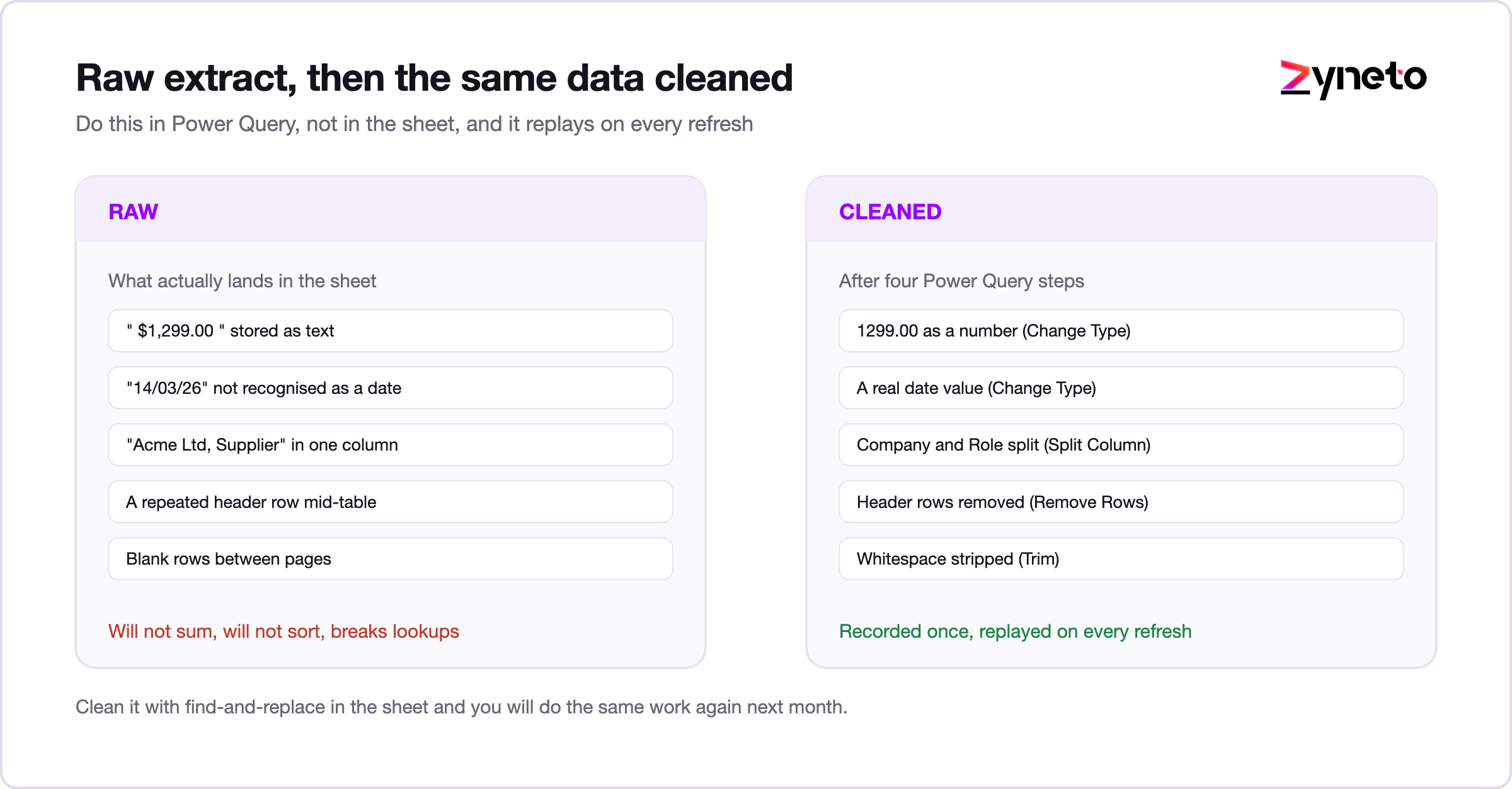
The usual problems are predictable. Numbers arrive as text with currency symbols or thousands separators still attached, so they will not sum. Dates come in the site's format rather than yours. Whitespace and non-breaking spaces hide at the ends of values, which quietly breaks lookups and matching. Two pieces of information sit in one column, like a name and a job title separated by a comma. Header rows repeat every time pagination adds a new page.
Do this work in Power Query rather than in the sheet. That is the single most useful habit in this whole guide. Steps you record in Power Query are saved and replayed on every refresh, so the cleanup happens once and then keeps happening. Clean it in the sheet with find-and-replace and you will do the same work again next month.
The steps worth learning first are Trim and Clean for stray whitespace, Change Type for numbers and dates, Split Column for combined fields, and Remove Rows for repeated headers and blanks.
Web scraping sits in a gray area, and this is not legal advice, but a few principles keep you safe and fair.
Two distinctions are worth holding onto. Publicly visible is not the same as freely reusable, so a page being open to anyone does not settle what you may do with the data afterwards. And what you do with it matters as much as how you collected it: pulling public pricing to inform your own strategy sits very differently from republishing someone's content as your own.
Staying within these lines protects you and keeps the open web usable for everyone.

Getting web data into Excel is rarely one method for everyone. For a small table, copy and paste or the built-in From Web tool is enough. For tables and lists, Google Sheets formulas are quick and free. When the job grows to many pages or dynamic content, a no-code scraper or the site's API takes over, and for large or recurring pipelines a script or a data extraction service is the reliable choice.
Two things separate a one-off pull from something you can rely on. Set the refresh to happen on its own, and do the cleanup in Power Query so it replays every time rather than being redone by hand. Then expect the source to change eventually, and make sure it fails loudly when it does.
Start with the simplest option, move up only when you have to, and respect the rules of the sites you pull from.
If your data lives on complex sites or the job has to run every day, Zyneto can build and run it for you. Learn more about our web scraping and data extraction services or book a free consultation.
Use Excel's From Web tool on the Data tab for simple tables, Google Sheets IMPORTHTML for tables and lists, or a no-code scraper like Octoparse for many pages. None of these need code.
Yes. The From Web tool keeps the data connected to the source, so you can refresh it with a click, set it to refresh on a schedule, or have it refresh whenever the file opens.
Usually because the page loads its data with JavaScript, so the content is not in the raw HTML Excel reads. Use a scraper that renders the page, or connect to the site's API instead.
A no-code scraper that follows pagination, or a short script, is the practical way. Excel's built-in tool handles one page at a time, though Power Query can append several queries into one table.
The site almost certainly changed its layout. Every method except an official API depends on the page structure staying put. Re-point the fields, and add a row-count check so an empty result raises a flag instead of passing silently.
A script or a data extraction service. Both can run on a schedule and handle scale and site changes that break manual methods.
It depends on the site and the data. Respect the site's terms of service and robots.txt, avoid personal data, and prefer official APIs. When in doubt, get legal advice.

Vikas has around fifteen years of experience building software and now builds generative AI systems at Zyneto. His work covers retrieval augmented generation, agentic AI, knowledge graphs, AI memory, and the evaluation and guardrails that decide whether any of it is safe to put in front of customers. He has shipped enterprise copilots, document AI, chatbots and predictive analytics for e-commerce, fintech and marketing teams, and works day to day in Python, JavaScript and SQL. He follows multimodal models, business process automation and enterprise AI security closely, and mentors engineers moving into AI. He writes about architecture, inference cost and the failure modes that only show up at production scale.
Share your details and we will talk soon.
Be the first to access expert strategies, actionable tips, and the trends actually shaping the digital world. No fluff - just practical insights delivered straight to your inbox.
Dive into our blog and stay ahead of the curve with expert perspectives, future-ready trends, and tech tips written for decision-makers and doers alike.