Frequently Asked Questions
What does an AI development company actually do?

It works out which technique fits your problem, gets your data into a usable state, builds and evaluates a model, and deploys it somewhere it can serve real traffic. In practice the data and deployment work is the majority of the effort. The modelling step, which is what people picture, is often the smallest part of the project.
Do we need a language model or conventional machine learning?
If you have labelled historical data and the task is well defined, such as classifying, scoring or predicting, conventional machine learning is usually faster, cheaper and more accurate. Language models earn their place when inputs are unstructured and varied, when the task needs reading and reasoning, or when you have no labelled data to learn from. Plenty of production systems use both, with a small model on the hot path and a large one for the cases it cannot settle.
How much data do we need?
Less than most people assume for simple classification, where a few thousand well-labelled examples per category is often workable. More for anything involving rare events, since a fraud model needs enough actual fraud to learn from and imbalance is the usual obstacle. Label quality matters more than volume: a smaller consistently labelled set beats a larger noisy one nearly every time.
What if our data is messy or incomplete?
That is the normal starting condition and much of the work. Missing values, inconsistent formats and changed definitions over time are all manageable. What is not manageable is data that never captured the thing you want to predict, and that is precisely what a feasibility review is for. We would rather establish it upfront than discover it after a build has started.
How accurate will the model be?
Nobody can answer that honestly before seeing your data, and a vendor who quotes a figure upfront is guessing. What we can do is establish a baseline quickly and tell you early whether the ceiling is likely to clear your threshold. The more useful question is usually what accuracy would make this worth deploying, because that number is often lower than teams assume.
How is this different from your other AI services?
This page covers applied AI where the output is a prediction, a category or a score. Our AI agent development service covers systems that take autonomous action, generative AI covers systems that create content, and predictive analytics goes deeper on forecasting specifically. If you are unsure which fits, our AI solutions overview compares them side by side.
Can you explain how the model reached a decision?
Depends on the model class, and it is worth deciding early because it constrains the choice. Linear models and decision trees are inherently interpretable. Gradient-boosted models support attribution techniques that are usually good enough for regulators. Deep networks are hardest. Where explainability is a requirement we treat it as a design constraint rather than something to bolt on later.
How long does an AI project take?
A feasibility review takes one to two weeks. A first deployed model on a well-scoped problem with usable data typically runs eight to sixteen weeks, with data preparation the largest and most variable component. Projects that overrun almost always do so on data access and quality rather than on modelling.
How much does AI development cost?
The build is driven by data readiness more than by model complexity. Clean accessible data in a warehouse is a very different project from data spread across systems with inconsistent definitions. Running cost for conventional models is mostly infrastructure and is low per decision, which is a significant part of why they beat language models at volume.
What happens after the model is deployed?
It starts degrading, slowly, because the world changes and your data changes with it. Monitoring catches that: prediction distributions, input drift and accuracy against outcomes as they arrive. Most models need retraining periodically, and the sensible plan is to schedule it rather than wait for someone to notice something is off.
Can AI work with our existing systems?
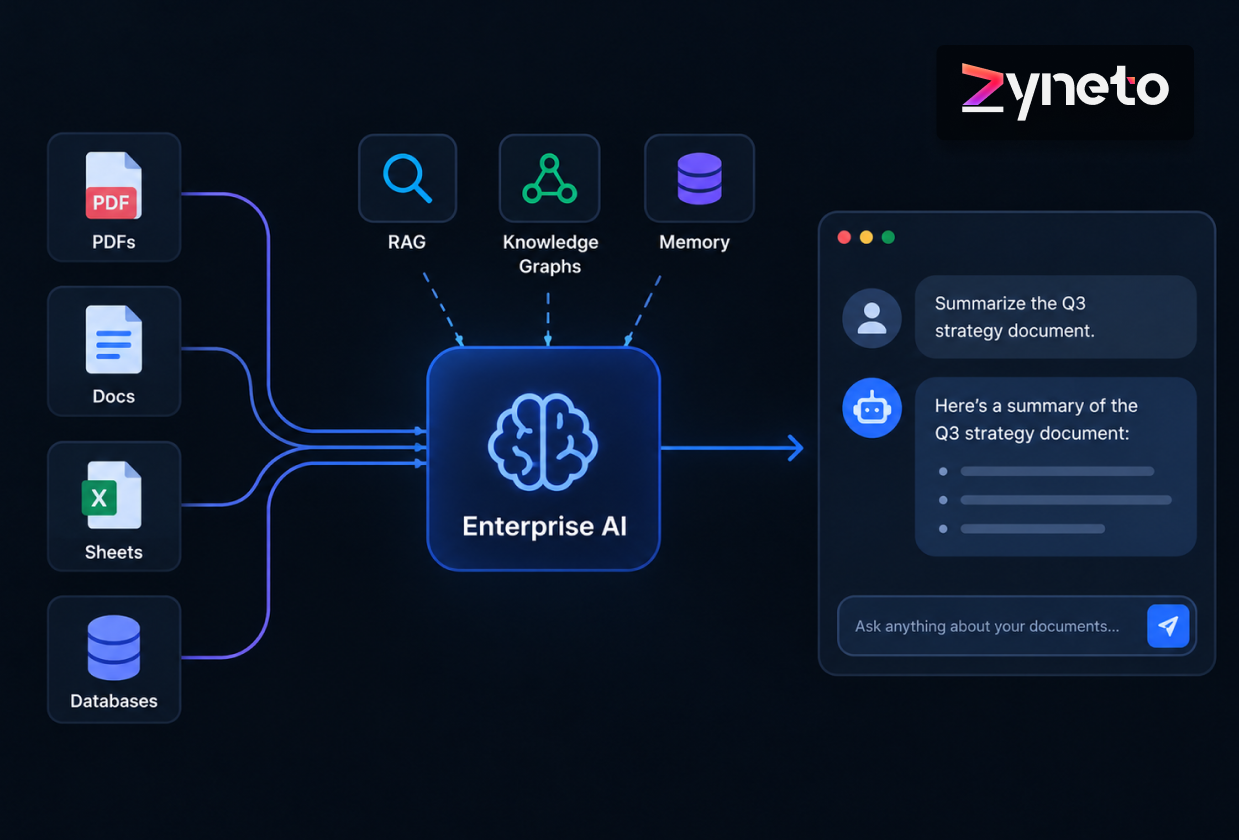
Yes, and integration is a large share of the work. Models need data from your warehouse, CRM or operational systems, and predictions have to reach whatever acts on them. We build the pipelines in both directions, including the monitoring and fallback behaviour for when a model or a feed is unavailable.
Do you handle data security and compliance?
Data residency, access control, retention and audit logging are decided at architecture stage. Conventional machine learning has an advantage here: models can run entirely inside your infrastructure with no third-party API involved. To be precise about our position, Zyneto builds compliance-ready systems and does not hold SOC 2 or ISO 27001 certification itself.
Why choose Zyneto for AI development?
We assess feasibility against your real data before proposing anything, and we recommend the smaller model when it wins, which is more often than the market suggests. We tie evaluation to a business outcome rather than to accuracy in isolation, design against your actual latency budget, and build drift monitoring in from the start. And we will tell you when your data cannot support the goal, which saves far more than it costs.