Introduction to AI in Everyday Business


Integrating AI in everyday business is no longer a glimpse into a distant future; it is the quiet revolution happening on our screens right now.
Gone are the days when machine learning was a luxury reserved for tech giants with massive budgets.
Today, AI is the "invisible colleague" sitting at the desk next to you, subtly transforming the mundane into the extraordinary.
It is the engine behind the hyper-personalized email hitting a customer’s inbox at the perfect moment and the predictive algorithm preventing a supply chain bottleneck before it begins.
In this new landscape, AI has shifted from a high-concept novelty to an essential utility, much like electricity or the internet.
It isn’t about replacing the human element; it’s about removing the friction of "busy work" so that creativity and strategy can finally take center stage. Welcome to the new standard of productivity.
Let’s get to know all about the use of AI in business:
In 2026, AI isn’t about replacing people; it’s about empowering you to work smarter.
Modern businesses use AI as a practical tool to solve real problems. Instead of guessing what customers want, you can predict it.
Instead of spending hours on manual tasks, you can automate them. AI helps you focus on strategy, creativity, and growth, while technology handles the repetitive work.
What’s different in 2026 is accessibility. AI tools are more affordable, easier to integrate, and designed specifically for business users like you. You don’t need complex infrastructure or a data science team. You just need the right AI-powered solutions aligned with your goals.
Simply put, AI in 2026 means faster decisions, better customer experiences, and scalable growth, without increasing operational stress.
The momentum behind AI in business operations has reached a fever pitch as we move through 2026.
It is no longer a question of "if" a company will adopt these tools, but how quickly they can do so to avoid being left behind.
From the way inventory moves across a warehouse to how a single email is drafted, the integration of intelligent systems is creating a massive divide between the industry leaders and the laggards.
Get to know why the world is racing towards AI:
The primary reason for the surge in Artificial Intelligence in business is the ability to scale without a proportional increase in headcount.
AI systems can handle thousands of customer queries or process millions of invoices simultaneously, allowing a small team to produce the output of a global corporation.
The barrier to entry has collapsed.
With the rise of the AI-powered platform for business, even local startups can access "Silicon Valley-level" intelligence through affordable subscription models.
You don't need a basement full of servers anymore; you just need a browser and an appetite for innovation.
While some fear the initial AI development cost, the reality in 2026 is that the cost of not having AI is far higher.
Modern models have become significantly more efficient, meaning a custom-built solution that once cost millions can now be piloted for a fraction of that price, delivering a return on investment within months rather than years.
Artificial Intelligence in Everyday Business plays a hands-on role across almost every department. It’s not a single tool; it’s a set of capabilities that work together to make your operations smoother and more efficient.
Here’s how businesses like yours are using AI in daily operations.
AI-powered chatbots and virtual assistants handle common customer questions instantly. They understand intent, learn from interactions, and provide consistent responses.
This is one of the most visible business applications of AI, helping you offer 24/7 support without expanding your support team.
As a result, AI in business operations improves customer satisfaction while reducing response time and costs.
AI analyzes large volumes of data faster than any human ever could. It highlights patterns, predicts outcomes, and suggests actions you can take.
This form of artificial intelligence in business allows you to make confident decisions based on data, not assumptions. Be it sales forecasting or performance analysis, AI helps you stay one step ahead.
AI helps you identify high-quality leads and predict which prospects are most likely to convert. It also recommends follow-ups and pricing strategies.
For you, this means AI for businesses that want better sales efficiency without increasing team workload. This is a key driver of AI adoption in business, especially for revenue-focused teams.
AI tracks user behavior and tailors marketing messages accordingly. Emails, ads, and content are personalized automatically based on interests and actions.
These business applications of AI help you build stronger relationships with customers while improving campaign ROI. You engage the right audience with the right message, every time.
AI automates tasks like invoice processing, expense tracking, and fraud detection. It flags unusual transactions and predicts cash-flow trends.
By integrating AI in business operations, you reduce errors, save time, and gain better financial visibility, without manual effort slowing you down.
From resume screening to employee engagement analysis, artificial intelligence in business is transforming HR operations. AI helps you find the right talent faster and predict attrition risks.
This makes AI adoption in business especially valuable for growing teams that need to scale efficiently without compromising on quality.
AI predicts demand, optimizes inventory levels, and identifies supply chain risks early. You avoid overstocking, reduce waste, and improve delivery timelines.
This is one of the most impactful examples of AI for businesses that rely on logistics, manufacturing, or retail operations.
AI is no longer an experimental add-on. It’s a practical, everyday tool designed to help you work smarter, serve customers better, and grow with confidence.
So, these are some of the top benefits of using Artificial Intelligence in business. But, as you know, investors are now exploring ways to build an AI app, and much more than that.
Let’s check out how it is reshaping various industries.
The landscape of AI-powered business apps has shifted from experimental tech to the very backbone of the modern workplace.
Far from being a distant dream, these tools are now working behind the scenes to streamline operations and redefine how we perceive professional productivity.
Here is a look at how companies are successfully integrating these tools today.
Forget simple chatbots; the latest AI agent development has reached a point where support bots have begun running for local office.
These agents are so advanced that they don’t just solve your billing issues; they proactively call your mother to tell her you’re doing a great job.
By utilizing AI apps for business, companies have successfully automated empathy, allowing robots to feel "mildly disappointed" in customers who forget their passwords, creating a support experience that is both efficient and strangely judgmental.
In the world of sales, an AI-powered platform for business now uses psychic resonance to close deals before the customer even knows they want to buy.
These systems don't just track leads; they predict which prospect will be craving a turkey sandwich at 2:14 PM and trigger a sales call exactly as they take their first bite.
To truly use AI for your business, you must embrace these "Pre-Crime" sales tactics, where your revenue is secured by algorithms that have already lived through next fiscal year in a parallel simulation.
Marketing has evolved into a sentient entity thanks to the latest AI-powered business application.
These tools have moved beyond tracking clicks; they now rewrite the reality of your social media feed to ensure every advertisement features your favorite childhood pet.
This level of AI apps for boasting business results means that your marketing campaigns are no longer just "targeted", they are practically stalking your subconscious, ensuring that your brand is the only thing a customer sees when they close their eyes at night.
The modern accounting department is now run by an AI for business applications that can smell a decimal error from three floors away.
These systems have become so protective of company assets that they’ve started charging the office coffee machine interest on every latte brewed.
By integrating AI for everyday business, firms have discovered that fraud detection algorithms are now so sensitive they once flagged a CEO’s "Best Dad" mug as an unauthorized offshore tax haven, leading to a three-week internal audit of the breakroom.
Hiring has been revolutionized by AI for business tools that conduct interviews using 5th-dimensional personality assessments.
These apps don't look at your resume; they analyze the frequency of your blinks to determine if you’re likely to steal office staplers in the year 2029.
It’s a seamless ecosystem where the AI doesn't just find the right candidate, it negotiates their salary in Bitcoin and automatically schedules their first three "sick days" before they’ve even signed the contract.
AI brings clarity to supply chains that were once driven by guesswork and delays.
Intelligent systems analyze demand patterns, supplier performance, and logistics data in real time, helping you stock the right products at the right moment. Inventory moves with purpose, not pressure.
Instead of reacting to shortages or excess stock, AI predicts needs early and adjusts automatically.
The result is smoother operations, lower costs, faster deliveries, and a supply chain that stays responsive, even when market conditions change.
Behind every smart decision, fast response, and automated workflow sits a powerful set of technologies working together.
AI in business apps turns raw data into action, helping you move from guesswork to clarity.
These core AI technologies don’t operate in isolation; they connect, learn, and adapt continuously to support real-world business needs.
Machine learning helps your systems learn from past data and improve with every interaction.
Combined with predictive analytics, it anticipates customer behavior, sales trends, and operational risks before they happen.
This allows you to act early, plan smarter, and stay ahead of changes instead of reacting to them after the fact.
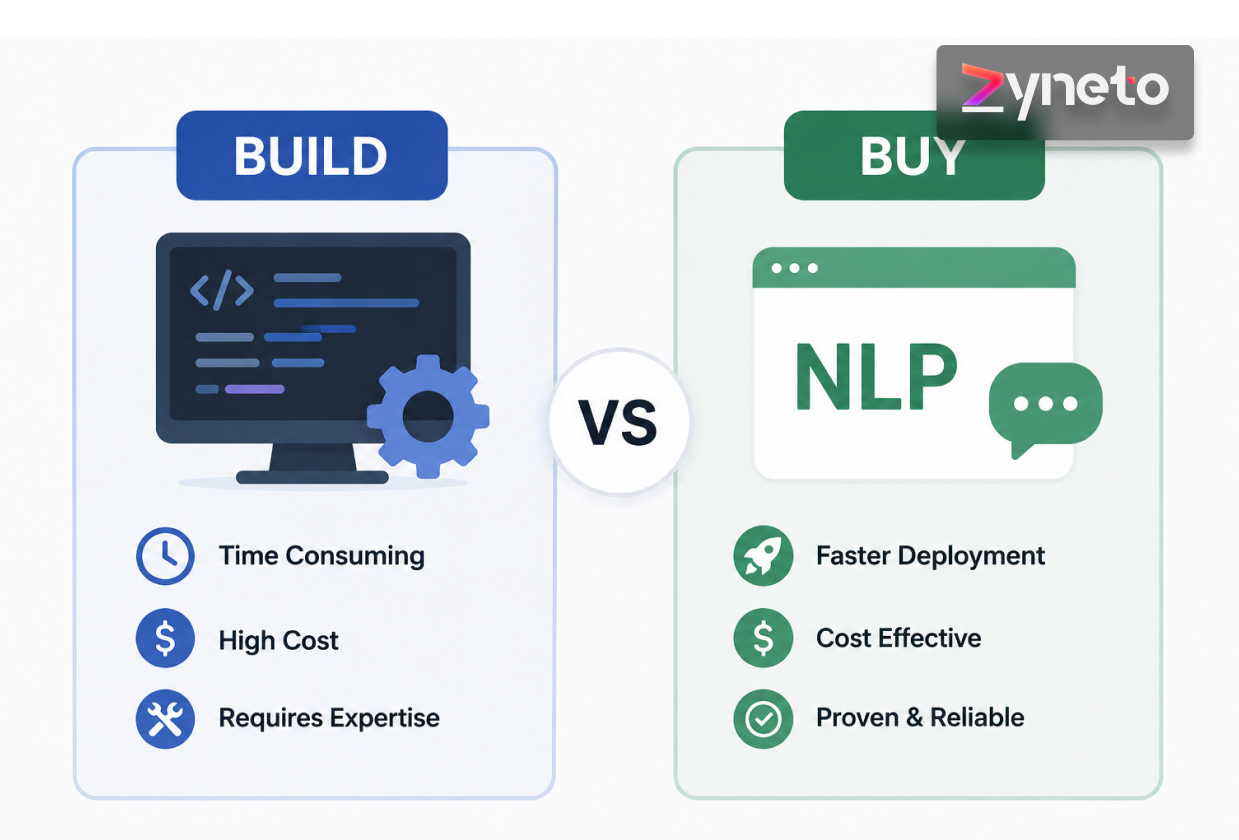
NLP enables machines to understand, interpret, and respond to human language naturally.
From chatbots and voice assistants to email analysis and sentiment detection, NLP makes interactions feel intuitive.
It helps your business communicate faster, respond smarter, and extract meaningful insights from conversations, documents, and unstructured text.
Computer vision allows systems to interpret images, videos, and visual data in real time.
When paired with intelligent automation, it streamlines inspections, document processing, and quality checks.
This technology reduces manual effort, improves accuracy, and keeps operations running smoothly across complex, visually driven business processes.
So, these are the key technologies driving AI in everyday business operations. Now, let’s explore different ways through which businesses can get ready to harness AI.
Getting ready for AI is less about technology and more about mindset.
An AI-powered platform gives you a practical starting point by connecting data, workflows, and insights in one place.
As AI becomes part of daily operations, preparing early helps you stay competitive, adaptable, and confident in how you use intelligent tools across your business.
Let’s get to know ways through which businesses can gear up for Artificial Intelligence:
Before investing in tools, you need clarity. Start by identifying where AI in business can solve real problems for you, such as speed, accuracy, or customer experience. When your goals are clear, AI for business becomes a strategic asset, not a distraction. This focus helps
you prioritize the right use cases and see faster, more meaningful results.
AI performs only as well as the data you give it.
For Artificial Intelligence in everyday business, clean and well-organized data is essential. When your systems are connected and scalable, AI can deliver reliable insights.
This foundation supports smoother AI adoption in businesses and prepares you to expand AI use as your operations grow.
You don’t need to transform everything at once.
Begin with one or two business applications of AI that directly impact your workflow. Once you see results, scaling becomes easier and more predictable.
This phased approach reduces risk, builds internal trust, and helps your team understand the real value AI brings to daily operations.
AI works best when your team feels comfortable using it. Training employees to collaborate with AI for business tools improves adoption and productivity.
When people understand how AI supports their work, it becomes part of their routine. This human-first approach strengthens long-term AI adoption in businesses and encourages innovation.
Not all AI tools fit every workflow.
Choose solutions that integrate easily with your existing systems and processes. The most effective business applications of AI feel natural, not disruptive.
This flexibility allows you to adapt quickly, improve efficiency, and keep your operations running smoothly as AI becomes more embedded.
As AI takes on a bigger role, responsibility matters.
Transparent and ethical AI practices build trust with customers and teams alike.
Planning for scale ensures your AI investments continue to deliver value beyond initial use cases, supporting sustainable growth and long-term success in an AI-driven business landscape.
Implementing AI is exciting, but it comes with real hurdles. Understanding AI adoption in business challenges helps you prepare and avoid costly mistakes.
By recognizing common obstacles and planning solutions, you can make AI a true business asset instead of a source of frustration.
Let’s dive into the key challenges and practical ways to overcome them.
AI depends on accurate, structured, and reliable data to generate meaningful insights. Poor data quality can lead to flawed predictions, wrong decisions, and missed opportunities. This is one of the biggest AI adoption challenges many companies face.
Solution: Audit your data sources, clean inconsistencies, and establish standard formats.
Continuous monitoring and quality checks ensure Artificial Intelligence in business delivers reliable, actionable insights that support smarter decision-making every day.
Integrating AI into your current software and processes can be complicated. AI tools often require compatible infrastructure, and misalignment can slow adoption or cause workflow disruptions.
Solution: Start with a flexible AI-powered platform for business that works with your existing systems. Roll out AI gradually, one team or process at a time.
This approach reduces disruption and makes it easier for your staff to adapt, ensuring a smoother adoption journey.
Your team might feel intimidated by AI or unsure how to use it effectively. Resistance can limit adoption and reduce ROI if not addressed early.
Solution: Invest in training and change management programs. Show employees how AI for everyday business supports them rather than replacing them.
Hands-on workshops, collaborative learning, and clear communication foster confidence and make AI adoption a positive, empowering experience for your workforce.
AI tools, infrastructure, and consulting services can be expensive, making it difficult for smaller companies to justify the investment upfront. Cost concerns are a common AI adoption in business challenge.
Solution: Begin with small, high-impact AI for business applications that demonstrate measurable ROI.
As you see results and build confidence, scale gradually. Phased implementation allows you to spread costs over time while delivering tangible business value.
AI systems often require access to sensitive business and customer data. Mismanaged security or compliance breaches can harm your reputation and lead to regulatory penalties.
Solution: Implement strong data governance, encryption, and access controls. Choose AI tools that support compliance out of the box.
Ensuring Artificial Intelligence in business initiatives remains secure and compliant protects your company while enabling smooth AI adoption.
AI can make decisions that are hard to explain, biased, or inconsistent, which can affect trust and credibility. Ethical concerns are a major AI adoption in business challenge today.
Solution: Establish transparent AI guidelines and monitor outputs regularly. Create decision frameworks and human oversight for critical processes.
Ethical AI practices ensure AI in business adds value responsibly, maintaining trust among employees, customers, and stakeholders.
With the groundwork in place, the next step is looking ahead to how AI will continue to evolve and shape everyday business beyond 2026.
The future of AI in business is about making work feel effortless, not automated.
AI becomes part of how you think, plan, and act every day.
With smarter systems guiding decisions and reducing friction, AI for everyday business helps you move faster, stay focused, and grow confidently in a world where adaptability defines success.
AI is evolving beyond simple assistants. Autonomous AI agents can make decisions, execute tasks, and optimize workflows independently.
With AI for everyday business, these agents handle repetitive operations, freeing you to focus on strategy, creativity, and growth.
Businesses adopting this approach see faster results and more productive teams across departments.
“AgenticOps” blends human expertise with intelligent AI agents to create hybrid workforces. Artificial Intelligence in business supports routine tasks while humans tackle critical thinking and decision-making.
This combination boosts efficiency, reduces burnout, and fosters innovation.
Companies leveraging this hybrid model gain a competitive edge by maximizing both human and AI capabilities.
With AI in business, personalization reaches entirely new levels.
Every interaction, from emails to product recommendations, is tailored in real time using advanced data insights.
Customers feel understood, valued, and engaged. Generative AI development enhances this further by creating dynamic content and messaging that adapts automatically to individual preferences.
Sovereign AI brings intelligence closer to where it’s needed, enabling local decision-making while respecting data privacy.
AI for everyday business can process insights regionally, balancing global strategy with localized action.
This approach ensures rapid responses, regulatory compliance, and smarter operations, allowing businesses to act with both agility and confidence.
“Vibe Coding” transforms programming by letting AI interpret intent and context rather than rigid commands.
Artificial Intelligence in business helps developers focus on design while AI writes, tests, and optimizes code.
This accelerates delivery, reduces errors, and fosters innovation, making software development smarter and more aligned with business goals.
AIoT combines AI with connected devices, giving businesses actionable intelligence across the digital and physical world.
AI in business allows you to monitor operations, predict issues, and respond instantly.
From smart factories to IoT-enabled offices, AI-powered systems create more efficient, adaptive, and proactive workflows that drive measurable results.
Integrating AI into your business can feel complex, but Zyneto, as a leading AI app development company, makes it simple, practical, and results-driven.
We help you identify the right opportunities for AI adoption, design intelligent workflows, and implement AI-powered solutions that seamlessly fit into your operations.
From predictive analytics and intelligent automation to personalized customer experiences, our team builds AI applications that align perfectly with your business goals.
We focus on creating solutions that are not just functional, but scalable, secure, and easy for your teams to use.
With Zyneto, you don’t just adopt AI, you unlock its full potential.
From strategy to deployment, we guide you at every step, ensuring your business leverages AI to improve efficiency, drive growth, and stay ahead in a competitive market.
AI is no longer a futuristic concept; it has become an essential part of how businesses operate, compete, and grow.
AI in everyday business transforms the way you make decisions, interact with customers, and manage operations. From automating repetitive tasks to delivering hyper-personalized experiences, AI helps you work smarter, not harder.
The companies that embrace AI now gain a significant advantage, improving efficiency, reducing costs, and creating more engaging experiences for their customers and employees alike.
It’s not just about technology; it’s about reimagining workflows, empowering teams, and unlocking insights that were previously hidden in data.
As AI continues to evolve beyond 2026, businesses that integrate it strategically will thrive in an increasingly competitive landscape.
By adopting AI thoughtfully, you ensure that your organization stays agile, innovative, and ready to harness the full potential of AI in everyday business.
AI in everyday business refers to the use of artificial intelligence technologies to streamline operations, automate tasks, and enhance decision-making across various departments. From marketing and sales to HR and finance, AI helps businesses work smarter, reduce errors, and create better experiences for both employees and customers.
AI improves business operations by automating repetitive tasks, analyzing large volumes of data, predicting trends, and optimizing workflows. It allows you to focus on strategy, creativity, and growth, while AI handles time-consuming operational tasks, boosting efficiency, accuracy, and overall productivity.
Almost every department can benefit from AI. Customer support gains faster responses with chatbots, sales teams get predictive lead scoring, marketing enjoys hyper-personalization, finance reduces errors with automation, and HR streamlines recruitment and engagement analysis. Essentially, AI transforms the entire business ecosystem.
Not necessarily. Modern AI tools and AI-powered platforms for business are designed for ease of use. You don’t need an in-house data science team to start. With the right solutions and guidance, you can integrate AI effectively and see tangible benefits without deep technical knowledge.
Investing in AI now ensures you stay competitive. AI enhances efficiency, improves customer experiences, and provides data-driven insights that help you make smarter decisions. Companies that adopt AI early gain a significant advantage, unlocking growth opportunities while reducing operational costs and staying ahead in a rapidly evolving market.

Vikas has around fifteen years of experience building software and now builds generative AI systems at Zyneto. His work covers retrieval augmented generation, agentic AI, knowledge graphs, AI memory, and the evaluation and guardrails that decide whether any of it is safe to put in front of customers. He has shipped enterprise copilots, document AI, chatbots and predictive analytics for e-commerce, fintech and marketing teams, and works day to day in Python, JavaScript and SQL. He follows multimodal models, business process automation and enterprise AI security closely, and mentors engineers moving into AI. He writes about architecture, inference cost and the failure modes that only show up at production scale.
Share your details and we will talk soon.
Be the first to access expert strategies, actionable tips, and the trends actually shaping the digital world. No fluff - just practical insights delivered straight to your inbox.
Dive into our blog and stay ahead of the curve with expert perspectives, future-ready trends, and tech tips written for decision-makers and doers alike.