Frequently Asked Questions
What is an AI agent?

An AI agent is a system that takes a goal, decides which steps to take, calls tools or APIs to carry them out, and continues until the goal is met or a limit stops it. The defining feature is that the sequence of actions is decided at runtime rather than written in advance by a developer.
How is an AI agent different from a chatbot?
A chatbot responds. An agent acts. A chatbot can tell a customer the refund policy. An agent can check the order, confirm eligibility against that policy, issue the refund in your payment system and update the ticket. The difference is tool access and multi-step reasoning, which is also why agents need controls a chatbot does not.
What does agentic AI mean?
Agentic AI describes systems with enough autonomy to plan their own steps rather than follow a fixed script. In practice it is a spectrum. A single agent calling one tool sits at the low end, and a multi-agent system that decomposes a goal and delegates sits at the high end. More autonomy means more capability and more that can go wrong, so the right level is a design decision per workflow, not a default.
What is MCP and why does it matter?
Model Context Protocol is an open standard for connecting AI systems to tools and data sources. Before it, every integration was custom glue rewritten per project. With MCP you expose a system once as a server and any agent can use it with scoped permissions. It matters commercially because it makes integrations reusable across agents and much easier to audit, since permissions are declared rather than buried in code.
How do you stop an AI agent from hallucinating?
You reduce it rather than eliminate it, through several layers. Retrieval grounds answers in your actual documents. Output schemas force responses into validated structures. Tool results are checked before being acted on. Anything high-consequence goes through human approval. The residual rate is then measured against your evaluation suite so you know the real number instead of assuming it is zero.
How do you test an AI agent before it goes live?
We build a golden dataset of real tasks with known-good outcomes and run the agent against it as a regression suite on every change. Deterministic checks cover anything verifiable, such as whether the right tool was called with the right arguments. Judgment-based outputs are scored by a model and spot-checked by a person. Without this, a prompt edit that fixes one case and breaks nine others reaches production unnoticed.
What happens when an AI agent fails?
Common failures are looping without progress, calling a tool with malformed arguments, exhausting context on a long task, and confidently completing the wrong task. We handle these with step limits, retry logic with backoff, schema validation on tool calls, state checkpointing so a run can resume rather than restart, and explicit escalation to a human when the agent cannot proceed. Failures get logged with full traces so they become test cases.
How much does AI agent development cost?
Build cost depends on how many systems the agent integrates with, how complex the decision logic is, and how much oversight the workflow needs. Integration count is usually the biggest driver, more than model choice. A narrow single-purpose agent against two or three systems is a matter of weeks. A multi-agent system across a department is months. Model usage is a separate ongoing cost that scales with volume, which we model during design rather than after launch.
How do you control ongoing model costs?
Route tasks to the cheapest model that handles them reliably, which usually means a strong model for planning and a smaller one for extraction and classification. Cache anything repeated. Trim context aggressively, since most agents carry far more history than they need. Set per-task budget ceilings. These decisions are made against real usage traces, because the expensive step is rarely the one teams expect before they measure.
Which models and frameworks do you use?
LangGraph for stateful orchestration where runs need to be inspectable and resumable, and MCP for tool and data access. For models we stay deliberately provider-agnostic and typically mix, using frontier models from providers such as Anthropic and OpenAI where reasoning quality matters and smaller or open models where it does not. Being able to switch providers is itself a design goal, since pricing and capability shift frequently.
Should the agent be allowed to act without human approval?
It depends entirely on the cost of being wrong. Drafting a reply, summarizing a document or preparing a record for review can run unattended. Sending money, contacting a customer, deleting data or changing an account should sit behind an approval gate, at least until the evaluation data justifies loosening it. We usually start with more gates and remove them as measured accuracy supports it.
How long does it take to build an AI agent?
A narrow agent on a well-scoped task with a small number of integrations typically reaches a working pilot in a few weeks. Production hardening, meaning evaluation, guardrails, monitoring and edge case handling, usually takes as long again. Multi-agent systems spanning several departments run to a few months. We aim to have something real running early, because agent projects surface their hard problems through contact with actual data.
Can AI agents work with our existing systems?
Yes. Agents connect to CRMs, ERPs, help desks, databases and internal APIs, and MCP makes those connections reusable across agents rather than rebuilt each time. Legacy systems without clean APIs are common and workable, though they add integration effort. We assess this during scoping because integration surface is usually the largest single factor in both cost and timeline.
How do you keep our data secure?
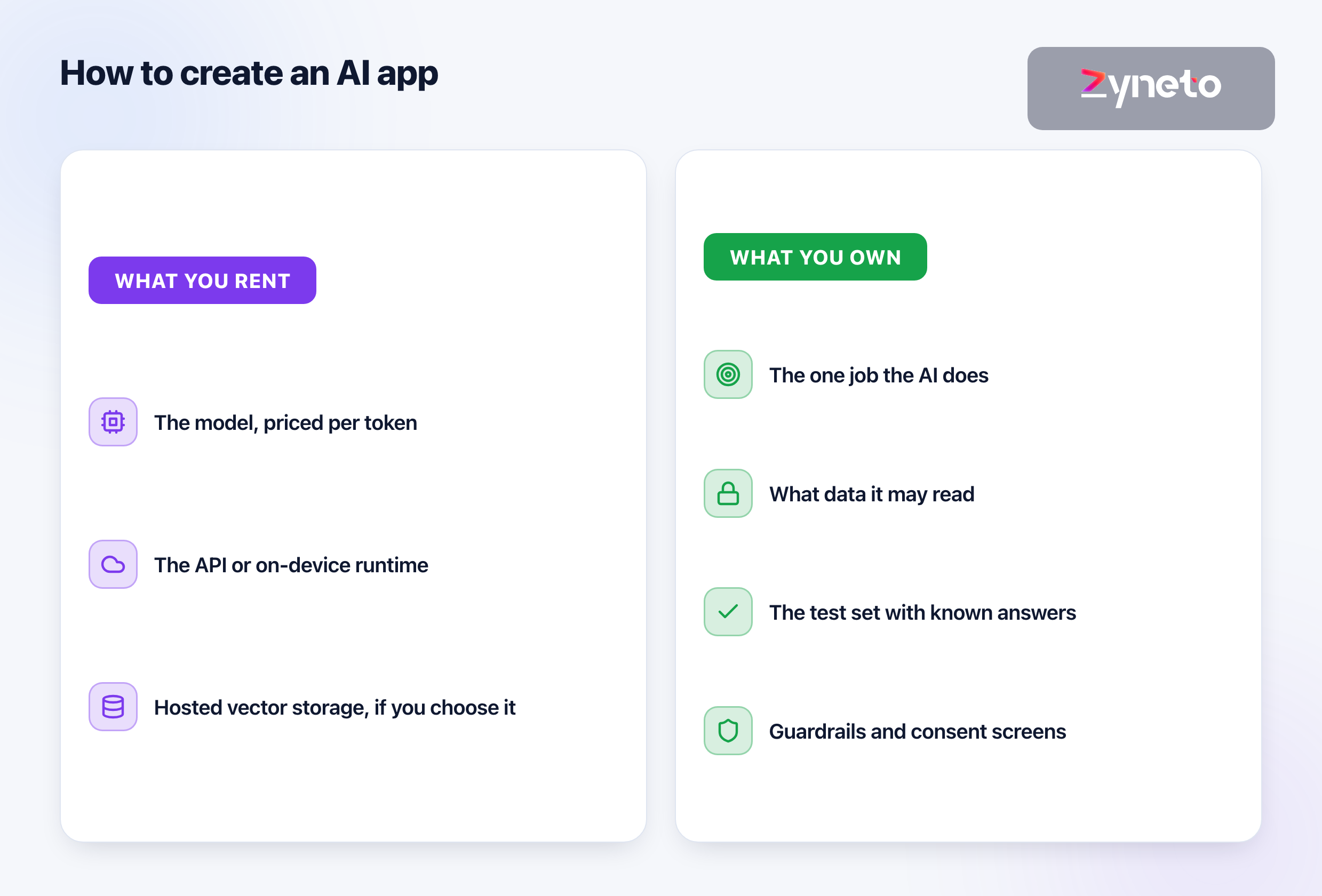
Agents get least-privilege access, scoped per tool, so an agent that reads records cannot modify them unless that is explicitly granted. Data boundaries are defined at architecture stage, covering what may be sent to a model provider and what must stay inside your infrastructure. PII handling, encryption, retention and audit logging are specified before a line of integration code is written.
Can you build agents for regulated industries?
Yes. We build systems designed to meet the requirements your auditors apply, including data residency, access control, audit trails and retention. To be precise about what that means: Zyneto builds compliance-ready solutions and does not itself hold SOC 2 or ISO 27001 certification. The compliance obligation remains yours, and our work is engineering the system so it can satisfy it.
What observability do we get after deployment?
Full traces of every run showing each reasoning step, tool call, argument, result and retry. Token consumption and latency per task rather than aggregated monthly. Accuracy tracked continuously against the evaluation suite so drift is visible. Alerting on failure rate, cost per task and escalation volume. You should be able to answer why the agent did something specific three weeks ago, and this is what makes that possible.
Should we build a custom agent or use an off-the-shelf tool?
If your workflow is standard, an existing tool is usually cheaper and faster, and we will say so. Custom work earns its cost when the process is specific to how you operate, when it touches internal systems no vendor integrates with, or when the workflow is close enough to your core business that owning it matters. A scoping call generally settles this in one conversation.
What do you need from us to start?
A clearly described workflow including its edge cases, access to the systems the agent will touch or a sandbox equivalent, examples of the work done well by a person, and one person who can decide what the agent is and is not allowed to do. The examples matter most, since they become the evaluation dataset that everything afterwards is measured against.
Who owns the agent once it is built?
You do. Code, prompts, evaluation datasets, infrastructure configuration and any fine-tuned artifacts transfer to you. There is no proprietary runtime and no requirement to keep us engaged to change how the agent behaves. Ongoing support is available and frequently useful, but it is a choice rather than a dependency.
Why choose Zyneto for AI agent development?
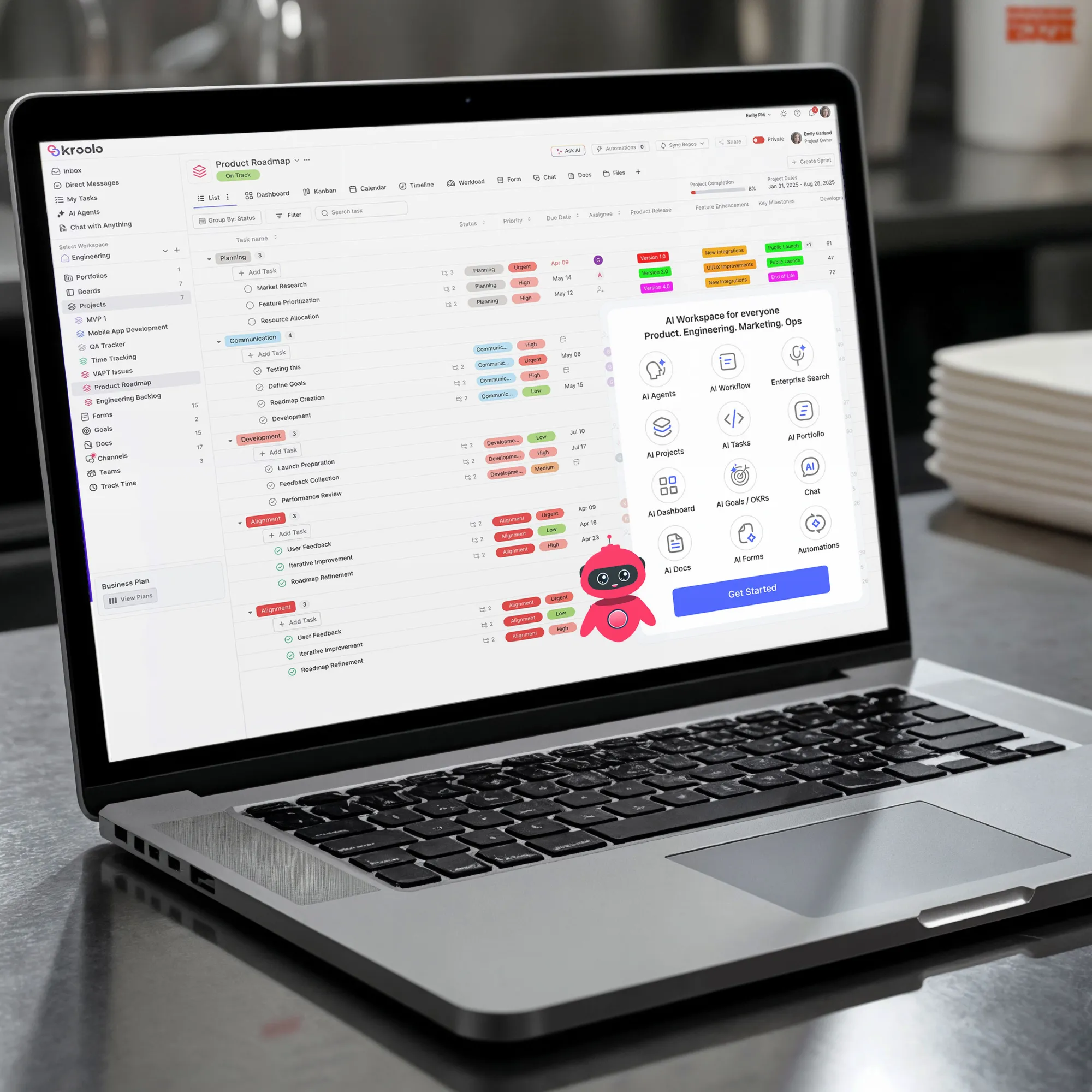
We build the evaluation suite, guardrails and cost model alongside the agent rather than after it, which is the difference between a demo and a system you can operate. We have shipped AI features inside real products, including the GenAI agents in Kroolo, the AI work operating system we engineered. And we will tell you when a workflow does not need an agent, which is a more useful answer than it sounds.