Frequently Asked Questions
What does an iOS app development company do?

It takes an iPhone app from design through build, testing and App Store release, and most often builds the backend the app talks to. Zyneto builds iOS apps in native Swift or React Native, sets up the Apple Developer account in the client's company name, runs TestFlight betas, handles App Store review, and updates the app for each September iOS release.
What are the stages of iOS app development?
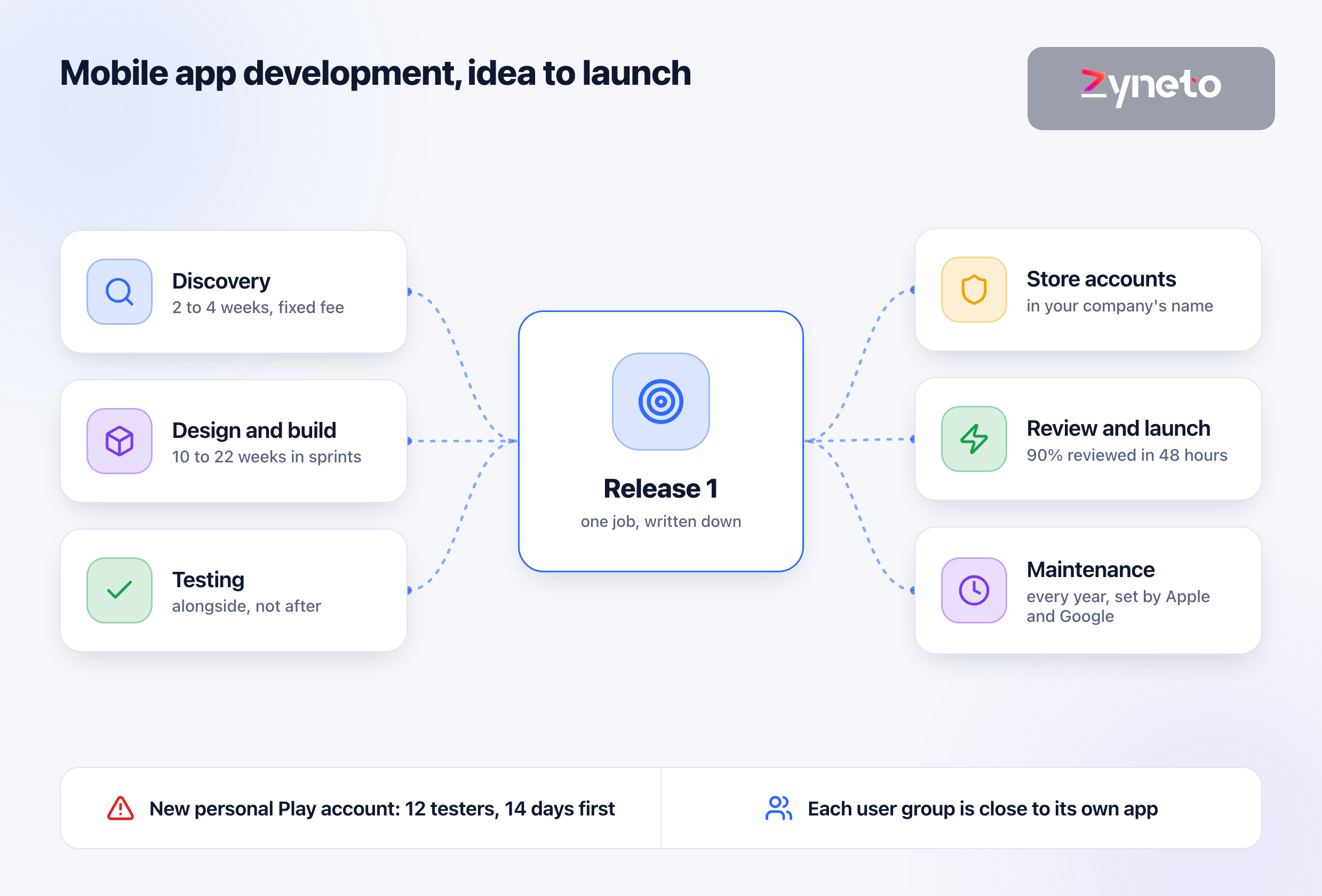
Zyneto runs iOS projects in 5 stages. Stage one is discovery, priced at one fixed fee and lasting 2 to 4 weeks, and it hands over three things: the target architecture, a costed phase one and a register listing each integration. Then come design and build, and the cut list for release one is written on their first day. Testing gets its own line in the quote, equal to 20 to 25 percent of your build hours. Release covers the Apple Developer account, privacy manifest, TestFlight beta and App Store review. Maintenance then follows Apple's major iOS release each September.
How many weeks does an iOS app take to build?
Once a 2 to 4 week discovery is done, plan on 10 to 16 weeks before most iPhone MVPs have real users on them. Bigger first phases run longer. We once scoped a gym and studio platform, its member app included, at 1,260 hours, a load one squad carries in 14 to 22 weeks. Review adds little: Apple says 90% of App Store submissions are typically reviewed inside 48 hours. Allow time before the first submission to set up an organization developer account, which needs a D-U-N-S number.
How much does iOS app development cost?
For iOS work, the hourly figure depends on role and seniority and spans $40 to $100. Blend the team and it averages $60 to $70. On the first call you get an hour band; a fixed price waits until discovery is done. The main cost drivers are native Swift versus React Native (iOS only, or iOS and Android from one codebase), the number of integrations, in-app purchases, and the backend. A member app with self service is a published example at 160 to 280 hours. QA for the iOS app is billed as its own line, 20 to 25 percent on top of the build hours, and Apple's Developer Program adds US$99 a year.
Should I build my iOS app in native Swift or cross-platform?
Pick native Swift if you only need iPhone, if the app leans hard on device features, or if the iOS experience is itself what you sell. Pick React Native if iPhone and Android users need the same screens and you want a single team to own them. The price is a steady upgrade cycle: our 6 October 2026 count put the average gap between React Native minor releases at 59.7 days. Zyneto has shipped both: Tvam in native Swift and Al Amri Express on iOS through React Native.
Is it better to launch on iOS before Android?
Launch first where your customers are. Measured by page views rather than installed phones, StatCounter's September 2026 mobile data puts iOS at 53.59% for the United States and 51.6% for Saudi Arabia, but the United Kingdom at only 46.88%, the United Arab Emirates at 26.68% and India at 6.05%. Worldwide it sits at 30.81%. An iOS-first launch makes sense in the first 2 markets. In India or the UAE, Android has the larger share, so Android first or both together is the stronger plan.
What do I need to open an Apple Developer account for my company?
Membership is US$99 a year. For a company account, Apple wants a D-U-N-S number, a registered legal entity (a trade name is refused) and a public website hosted on your company's own domain. Open it in your company's name, not a developer's personal name, so the App Store listing belongs to your business.
How long does App Store review take?
Apple says at least half of App Store submissions get reviewed inside 24 hours, and 90% inside 48. An urgent bug fix or a dated event can ask for an expedited review. A TestFlight build for external testers is reviewed by Apple too, so leave room for it before your public beta opens.
Which App Store rules should a new iOS app plan for?
Plan for 5 rules from the start. Under guideline 4.2, your app must do more than repackage a website. Guideline 5.1.1(v) says that if people can sign up in your app, they must be able to delete the account there too. Since 1 May 2024, Apple has also wanted a privacy manifest giving approved reasons for listed APIs, SDK usage included. Your uploads need Xcode 26 and the iOS 26 SDK as of 28 April 2026, and a minimum target of iOS 13 or later as of 9 September 2026.
Which Xcode and iOS versions does Apple require in 2026?
From 28 April 2026, an App Store upload is rejected unless Xcode 26 built it with the iOS 26 SDK. Since 9 September 2026, iOS uploads must target iOS 13 or later. If your iPhone app has sat untouched for a while, its next release starts with a move to the current Xcode, because older toolchains are refused at upload.
What is an Apple privacy manifest?
A privacy manifest declares the approved reasons an iOS app uses certain listed APIs, and it covers the SDKs inside the app as well as your own code. Apple has required it since 1 May 2024. Every third-party library in an iOS app should be checked for its own privacy manifest before it is added, because the requirement covers SDKs as well as your own code.
Does my iOS app need in-app account deletion?
Yes, if users can create an account in it. Apple guideline 5.1.1(v) requires apps that support account creation to offer account deletion inside the app. Google Play asks for an in-app path too, plus a web link for deletion, so if your app is in both stores, build one deletion flow that satisfies each.
How does TestFlight work, and what are its limits?
TestFlight is Apple's beta testing service. You can invite as many as 10,000 external testers and 100 internal ones. Each build lapses after 90 days, and Apple reviews external builds before your testers can install them. A beta longer than 90 days therefore needs fresh builds on a schedule.
How much does Apple take from in-app purchases and subscriptions?
Apple's standard commission is 30%. If your proceeds the prior year were under US$1M, the Small Business Program brings that down to 15%. Auto-renewing subscriptions are charged 15% after the first year. These rates should be modeled before a subscription price or purchase flow is set.
When is the next major iOS release, and what does it mean for my app?
A new major version of iOS arrives from Apple each September. iOS 27 arrived on 14 September 2026, so the next major version follows that September pattern. Each release means testing your app against the new version, fixing anything it breaks and, over time, moving to the Xcode and SDK versions Apple requires for uploads.
Who owns the iOS app code and the App Store listing?
The client does. The code is yours, and so are the store listings and hosting accounts, for every Zyneto client. Al Amri Express has its hosting account and both store listings under its own name; Tvam has its store listings, its domain and its hosting. Open the Apple Developer account in your company's name from the start, so the listing is yours from day one.
What maintenance does an iOS app need after launch?
At minimum, a yearly update for Apple's September iOS release and the upload rules that follow it, such as the Xcode 26 and iOS 26 SDK requirement in force since 28 April 2026. TestFlight builds expire after 90 days, so ongoing betas need new builds. React Native apps add framework upgrades, which by Zyneto's 6 October 2026 count arrived every 59.7 days on average. Server-side fixes and SDK updates fill the rest.
Can Zyneto build the backend for an iOS app?
Yes. Tvam's iOS, Android and web apps all draw on one chart calculation service we built on the server, and a regression set of birth data, each with a known correct output, checks it. Tvam's stack is PHP and MySQL. For Al Amri Express, the iOS app sits on a Laravel, Elasticsearch, MySQL and AWS backend with live order tracking over websockets. Keeping logic on the server means fixes ship without waiting for App Store review.
What should we bring to kick off an iOS app with you?
Tell us who the iPhone app is for and the single task they must finish in release one. Add the systems it has to connect to, any designs you already have, and one person with authority over scope. For the Apple Developer account, a legal entity, a D-U-N-S number and a public website on your own domain. Discovery then turns that brief, over 2 to 4 fixed-fee weeks, into an integration register, the target architecture and a phase one with a cost attached.
Why choose Zyneto for iOS app development?
Zyneto has shipped iOS apps you can check in the App Store: Tvam in native Swift and Al Amri Express through React Native, and each case study names the decisions and trade-offs. Apple's account, privacy manifest, account deletion and Xcode rules go into the plan from the start. Our $40 to $100 hourly rates are public, every estimate reserves 20 to 25 percent of build hours for testing as a line of its own, and the code and store listings stay with you.