Frequently Asked Questions
Is React Native still worth choosing for an app in 2026?

Yes, if your team already writes React and you are building a typical product app. Since version 0.82 the New Architecture is the only one React Native runs on, and your screens use the platform's own native views. Look elsewhere if your app centres on custom rendering, targets a single platform or is mostly third-party native SDKs, or if nobody on your team can fix a broken native build in Swift and Kotlin.
When should I choose native iOS and Android instead of React Native?
Choose native Swift and Kotlin when the product is a custom renderer such as a drawing tool, a game loop or a camera pipeline that processes every frame, when the app lives on 1 platform only, or when most of it is glue around third-party native SDKs such as payment terminals or Bluetooth hardware. In those cases most of the hard code is native anyway and a shared React Native layer adds an abstraction to upgrade without saving much work.
Should I choose React Native or Flutter?
Both build iOS and Android apps from 1 codebase. React Native renders the platform's native views and uses JavaScript or TypeScript, so it suits teams that already write React. Flutter uses Dart and renders its interface itself, through its own rendering engine. In the 2024 Stack Overflow Developer Survey, the last that asked, 9.4% of respondents had used Flutter and 8.4% React Native. The case studies on Zyneto's site were built in React Native or native code, not Flutter.
Why did Shopify decide to leave React Native?
On 10 September 2026 Shopify said its apps are going back to native Swift and Kotlin. Its reasoning: coding agents now make it cheap to build each feature twice, once for each platform, so at Shopify's scale a shared codebase stops paying for itself. The same post still describes React Native as an excellent framework. The argument assumes mature native teams on both platforms and an internal agent pipeline with its own review gates, which most smaller teams do not have, as Zyneto's React Native app development post explains.
Should my app use Expo, or bare React Native?
Use Expo for a new React Native app unless there is a specific reason not to. React Native's own documentation tells you to begin new apps on a framework like Expo. With 3 Expo SDKs a year, each tied to a React Native version Expo has tested, your team upgrades 3 times a year rather than following every single React Native release. Go bare if you are putting React Native screens into a native app that already exists, if a native SDK conflicts with Expo's build process, or if native engineers on your side will run the Xcode and Gradle projects.
What is the React Native New Architecture, and does my app need it?
The New Architecture replaced the old asynchronous bridge between JavaScript and native code. It became the default in React Native 0.76 in October 2024, and from 0.82 in October 2025 the settings that turned it off are ignored. Expo SDK 54 was the last Expo release with legacy architecture support. Every supported React Native release now requires it, so an app still on the old architecture has to migrate before it can upgrade.
How often does React Native release, and how long is a version supported?
Counting npm registry publication dates from 0.76.0 through 0.87.1, Zyneto found a new React Native minor version every 59.7 days on average. Only the newest 3 minor series get support from the React Native team. On 7 October 2026 the active pair is 0.87 and 0.86, with 0.85 at end of cycle. Patch windows vary a lot between versions: 0.82 got its final patch just 12 days after it shipped.
What does it cost to maintain a React Native app?
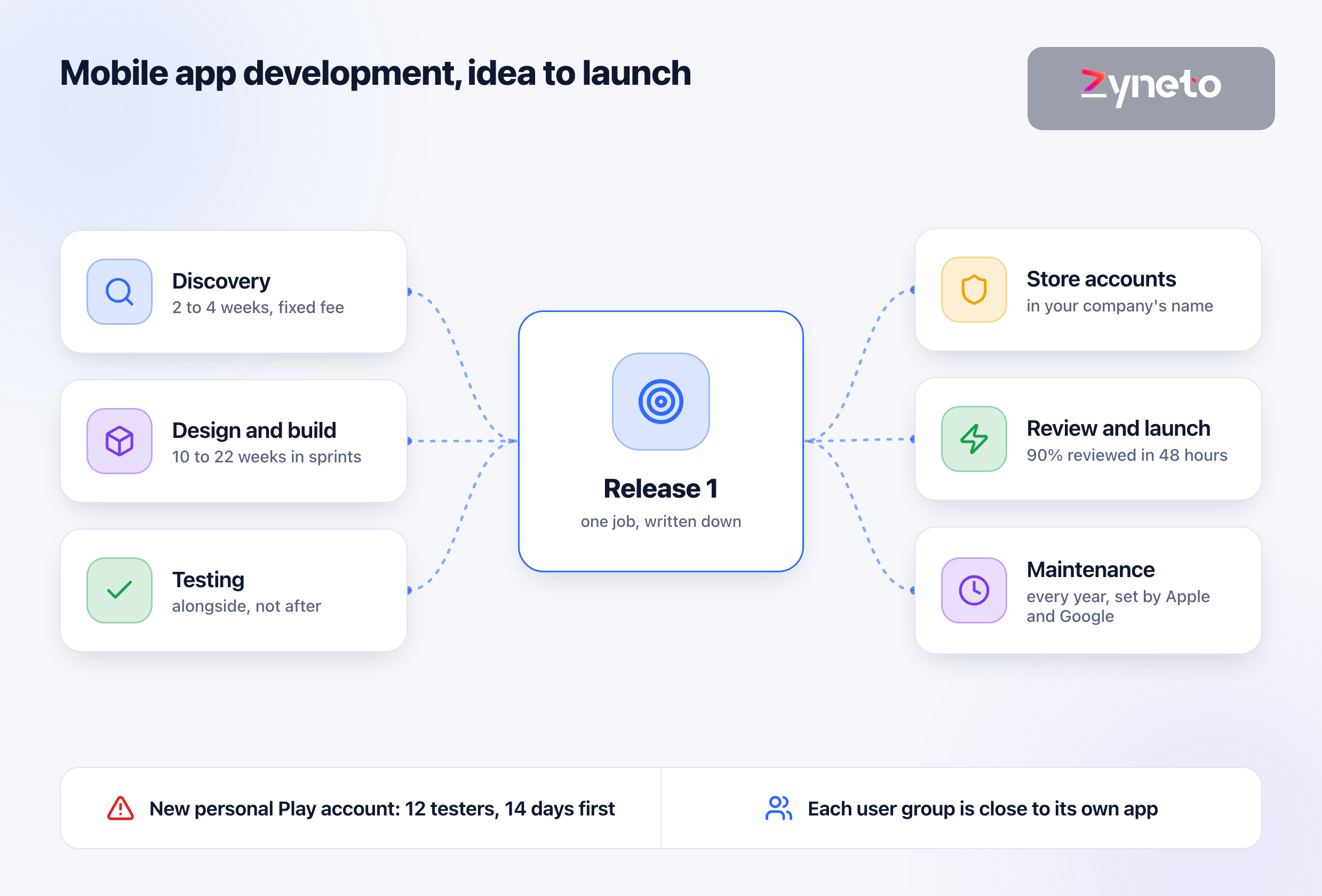
Upgrades are the main recurring cost of a React Native app. A new minor version ships about every 60 days, only 3 are supported, and each upgrade has to be checked against every package with native code; the default Expo template alone has 28. On Expo that means 3 SDK upgrades a year. Zyneto bills upgrade work at its published $40 to $100 an hour, depending on role, with a blended $60 to $70, and schedules it ahead so no store deadline pushes you into a rushed upgrade.
How much does React Native app development cost?
Each hour on a React Native build costs $40 to $100 at our published rates, with role and seniority deciding where in that range a person sits, and a team that mixes them comes out at $60 to $70. The first call ends with an hour band, and no fixed price is given until discovery is done. Your price depends mostly on screen count, integrations, how many native SDKs the app needs, and testing. Our published examples put each payment provider at 80 to 200 hours and a self-service member app at 160 to 280 hours, and testing goes on the bill as a separate 20 to 25 percent of build hours.
How many weeks does a React Native app take to build?
Plan on 2 to 4 weeks of fixed-fee discovery, then 10 to 16 weeks until most React Native MVPs at Zyneto are in real users' hands. A bigger first phase needs more time. One of our published examples, a member app plus a platform for gyms and studios, is sized at 1,260 hours, 14 to 22 weeks for a squad. Store setup adds its own time. Shipping from a new personal Google Play account means a closed test first, with at least 12 testers over 14 consecutive days, before production is open to you. Apple says it reviews half of submissions inside a day and 9 in 10 inside 2 days.
Can React Native apps be updated without app store review?
Yes, for JavaScript and asset changes. Section 3.3.1(B) of Apple's Developer Program License Agreement lets an app download interpreted code, provided that code leaves the app's primary purpose unchanged, does not get around OS security and does not set up a store for other code. On Google Play, interpreted code such as JavaScript is exempt under the Device and Network Abuse policy. Change the native code, add a permission or bump React Native itself, and you are back to a full store release.
How does app store review work for a React Native app?
Apple and Google review a React Native app like any other app. Apple's figures show half of all submissions reviewed in under a day and 9 in 10 in under 2 days. Guideline 4.2 says an app has to offer more than a repackaged website, and every upload since 28 April 2026 has to come from Xcode 26 with the iOS 26 SDK. Google Play wants API 36 as the target for every new app and update from 31 August 2026, a Data safety form from virtually every app, and, where users have accounts, a way to delete them both in the app and from a web link.
What team does a React Native project need?
A React Native project works best with mostly React engineers and 1 native owner. The React engineers build features in TypeScript. Your native owner takes Gradle builds, signing, push entitlements, provisioning profiles, store rejections, background task limits and the upgrade calendar, since each of those fails with native error messages. That person needs to be comfortable in both Swift and Kotlin, not a senior specialist in each.
How many packages does a React Native app depend on?
Zyneto measured fresh Expo apps on 6 October 2026, using Expo 57.0.26 and React Native 0.86.3. The blank TypeScript template installs 477 packages, 5 of them with native code. The default template installs 617 packages, 28 with native code: 21 maintained by Expo, React Native itself, and 6 third-party. Real production apps then layer on authentication, push, crash reporting, analytics and payments. The number with native code is the single best predictor of what your upgrades will cost.
What happens if a React Native app falls behind on versions?
The app stores stop accepting its updates. Every new app and update on Google Play has needed an API 36 target from 31 August 2026 onward, though extensions run to 1 November 2026, and the official React Native template first reached API 36 in version 0.81. From 28 April 2026 Apple only takes builds compiled in Xcode 26 against the iOS 26 SDK. An app several versions behind cannot ship a small fix until it is upgraded, and skipping versions stacks every breaking change into 1 large upgrade.
Can Zyneto take over an existing React Native app and upgrade it?
Yes. Zyneto starts by listing every dependency with native code and checking the app's React Native version, its architecture and its Android target API against current store rules. If the app is on the old architecture, it has to migrate, because from 0.82 the setting that disabled the New Architecture is ignored. The upgrade then goes 1 minor version at a time, so each breaking change can be traced to the step that caused it.
Who owns the code and the app store accounts?
The client does. Store listings stay in your name, as they do for Al Amri Express and Tvam, and the code and build configuration are handed over to you. To enrol as an organization in Apple's Developer Program, at US$99 a year, you need a D-U-N-S number, a public website on your own domain and a legal entity. Google Play charges a one-time US$25, and an organization account asks for a website and a D-U-N-S number.
Can React Native also build our website?
Only iOS and Android are part of React Native's core. Web support comes from react-native-web, a community project, and Expo documents web support built on it. That can work for an app-like tool. For a marketing site or content you want found in search, a separate web build that shares the app's backend and API is usually the better choice.
Should staff and customers share one React Native app?
Not always. Al Amri Express in Oman got 2 separate React Native apps from Zyneto on 1 backend: a storefront for customers and an operations app for staff with admin, packer and delivery roles. The 2 audiences have almost no screens in common and release on different cadences. The trade-off was a second release process plus duplicated shell code. If your operation is smaller, 1 app with a role-gated staff section is a sensible setup.
Why choose Zyneto for React Native app development?
Zyneto counts native dependencies before quoting, starts new apps on Expo, and puts upgrades on a calendar from day 1, because upgrades are the real recurring cost of React Native. Its React Native proof is Al Amri Express, 2 apps on 1 backend on iOS and Android. It also builds native, as it did for Tvam, and will say when React Native is the wrong choice. Its hourly rates of $40 to $100 are public, and every client keeps its own store listings.