Frequently Asked Questions
What is multimodal AI?

A system that processes more than one type of input together, such as text with images, audio or video, and reasons across them rather than handling each separately. The practical difference is that the relationship between formats is preserved, so a model can compare what a photograph shows against what an accompanying document says.
How is this different from OCR plus a language model?
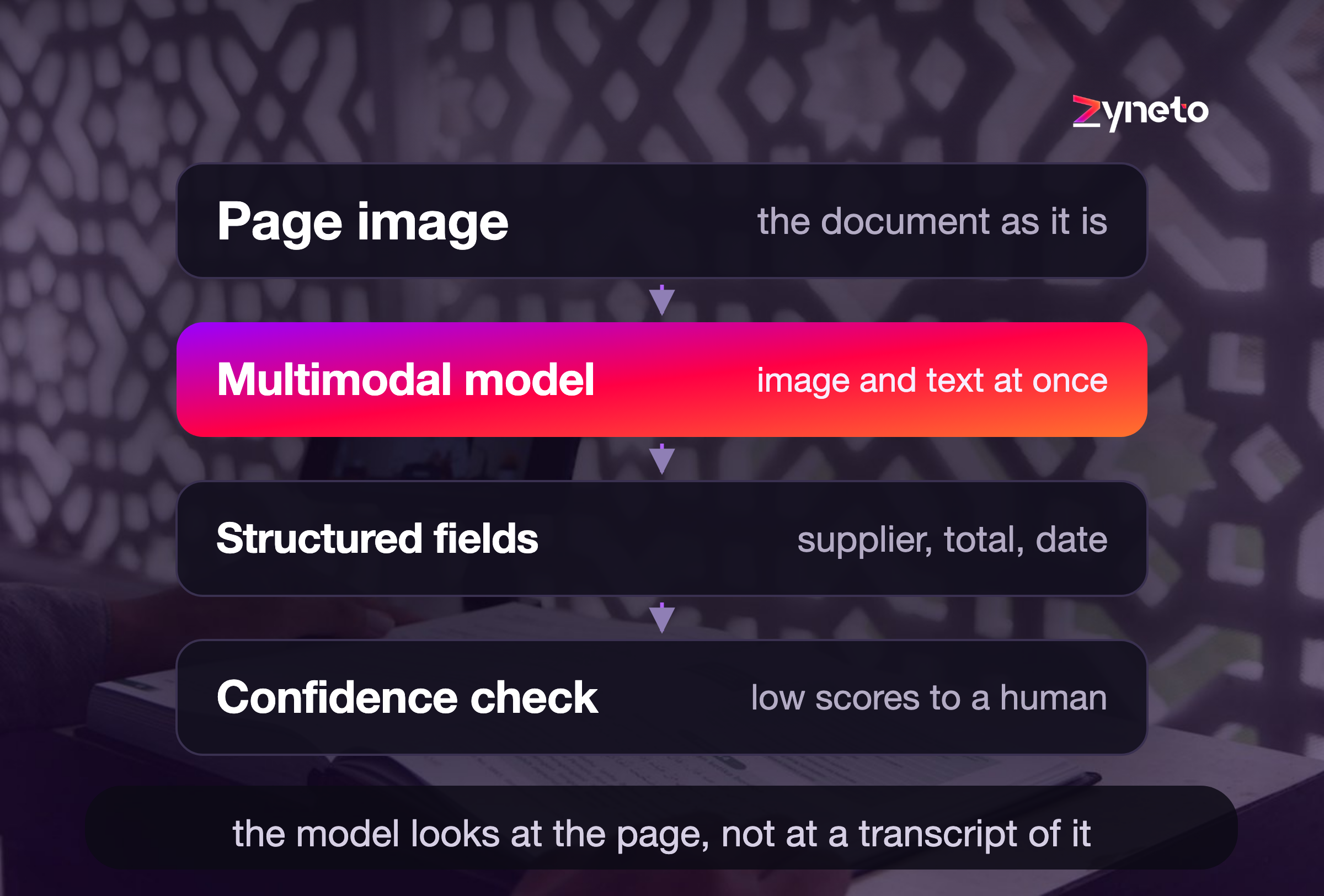
An OCR pipeline converts a page to characters and discards everything else: layout, position, tick marks, stamps, signatures, image quality. A multimodal model sees the page. For clean uniform documents the two perform similarly and OCR is cheaper. For varied layouts, handwriting or photographs of paper, the gap is substantial and grows as inputs get messier.
Do we actually need multimodal, or would extraction do?
If your documents share a consistent layout and the content you need is printed text, conventional extraction is cheaper, faster and usually more accurate. Multimodal earns its cost when layouts vary, when handwriting or images carry meaning, or when the task requires comparing visual evidence against a written claim. Sending us a sample of your real documents settles this quickly.
How accurate is it on real-world images?
Highly dependent on input quality, more so than any text-based system. A flat scan in good light performs very differently from a phone photograph taken at an angle. Dense handwriting remains genuinely hard. This is why we build the evaluation set from your actual inputs including the poor ones, and why we treat any accuracy figure quoted without reference to input quality as meaningless.
Why is multimodal AI more expensive to run?
Images consume far more tokens than equivalent text, and higher resolution consumes more still, so cost per item can be an order of magnitude above a text-only equivalent. The levers are resolution tuning, cropping to the region that matters, pre-filtering with a cheap check before invoking the expensive model, and routing straightforward cases down a cheaper path.
Can it handle handwriting?
Reasonably well for clear printing and short annotations, and unreliably for dense cursive or poor-quality scans. If handwriting recognition is central to your use case rather than incidental, that needs proving on your own samples before anyone commits to a build. We would rather establish that in week one than discover it late.
What about video?
Video is processed as sampled frames with audio, so cost and latency scale with duration and sampling rate. It works well for identifying events, changes and content across a sequence. Anything requiring frame-level precision throughout a long recording becomes expensive quickly, so sampling strategy is usually the design decision that determines feasibility.
Can it work with our existing document workflow?
Yes, and that integration is most of the project. Documents arrive by email, upload, scanner or API, and results have to reach your claims, ERP or case management system with review state attached. We build the intake, the confidence-based review queue and the downstream write as part of the work.
How do you handle cases the model is unsure about?
Confidence thresholds per field or per decision, with anything below the line routed to a person alongside the source image so they can judge quickly. This is more important in visual work than in text, because a model reading a blurred figure incorrectly gives no linguistic signal that anything went wrong.
How long does a multimodal project take?
A focused use case on one document or image type typically reaches a working prototype in a few weeks, with accuracy on your real inputs established early because it determines whether the project should continue. Production hardening, meaning the pipeline, review interface and integration, usually takes longer than the model work itself.
Which models do you use?
Vision-capable models from the major providers, selected per use case, with open-weight options where data cannot leave your infrastructure. Capability here is moving faster than in text, so we build to allow model changes and reassess periodically. Tasks that were not viable eighteen months ago frequently are now.
Why choose Zyneto for multimodal AI development?
We establish accuracy on your worst inputs rather than your cleanest, model cost per item before you commit to volume, and recommend conventional extraction when that is genuinely the better answer. We build the pipeline around the model, which is where most of the engineering actually is, and we are straight about where current vision models still fall short.