Frequently Asked Questions
What is an AI copilot?

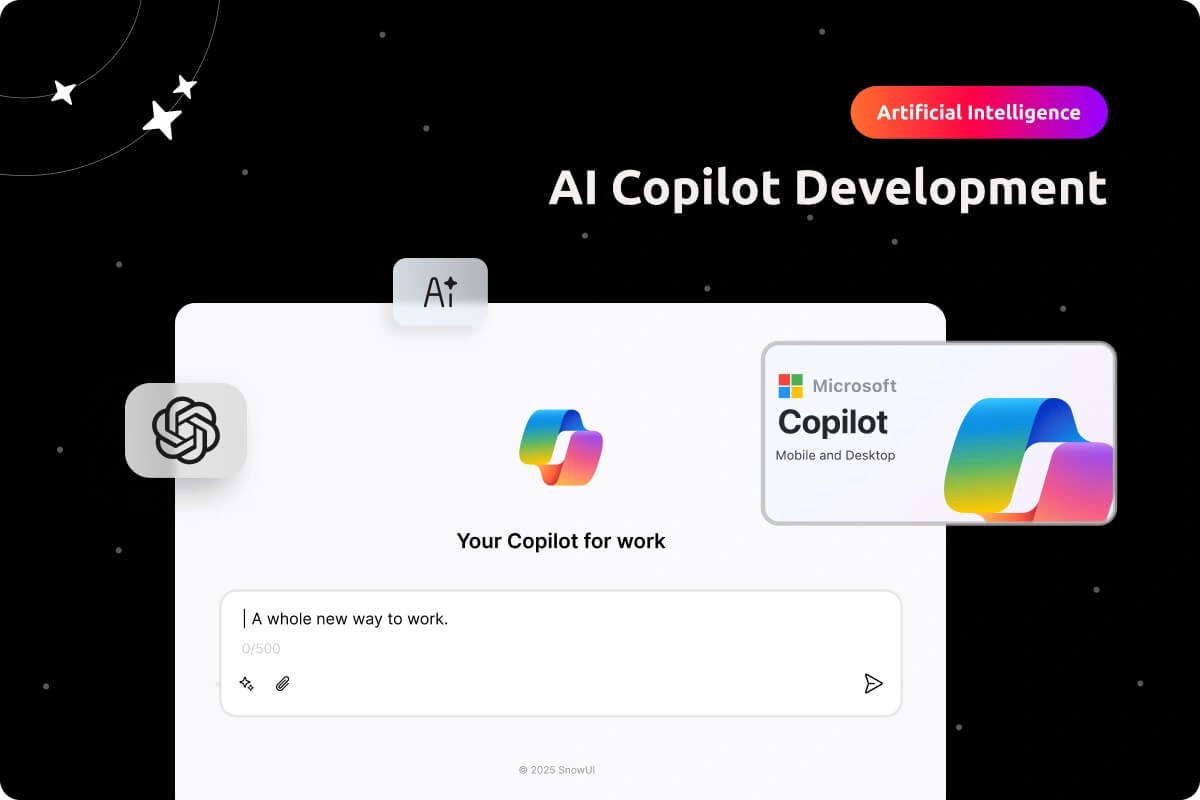
A copilot is an AI assistant embedded in a product, aware of what the user is doing, that suggests or performs actions while leaving the person in control. The defining characteristics are context and control: it already knows what is on screen, and the user decides whether to accept what it offers.
How is a copilot different from a chatbot or an agent?
A chatbot handles a conversation, usually support, usually with someone outside your company. A copilot works alongside a user inside your product, aware of their current task. An agent completes multi-step work on its own with much less supervision. Copilots sit deliberately in the middle: more context than a chatbot, less autonomy than an agent, and that middle position is why they are often the safest first AI feature to ship.
What makes copilots fail?
Rarely bad answers. Usually poor placement, so nobody finds it. Or no context, so the user has to explain what the product already knows. Or slowness, so it breaks concentration. Or too many capabilities, so it does nothing memorably well. Each of these is a product decision made before any model was chosen.
How do you measure whether a copilot is working?
Invocation rate tells you whether people find it. Acceptance rate tells you whether suggestions are useful. Edit distance on accepted output tells you how close it got. Repeat usage across weeks tells you whether it survived novelty. Accuracy alone tells you almost nothing, because a correct suggestion nobody accepts is a failed feature.
How fast does a copilot need to respond?
Fast enough not to break flow, which in practice means first output within a second or two and completion within a handful. Streaming helps a great deal because the wait becomes visible. Beyond roughly ten seconds people switch away and stop coming back, so we treat the response budget as a hard requirement and design the model and retrieval choices around it.
Should the copilot take actions or only suggest them?
Start with suggestions the user accepts. It is safer, it builds trust, and the accept and reject data is genuinely valuable for deciding what to automate later. Promote specific capabilities to direct action once measured acceptance is high and the action is reversible. Anything irreversible should keep a confirmation step indefinitely.
How do you stop it surfacing data users should not see?
The copilot runs with the user's own permissions and every retrieval is filtered by them before anything reaches the model. It is a straightforward principle that is easy to get wrong, particularly with a shared vector index where documents from across an organisation sit together. We enforce it at the retrieval layer rather than relying on the model to decline.
Can it be trained on how our best users work?
It can be grounded in their patterns, which is usually better than training. Examples of well-handled cases, internal conventions and documentation go into retrieval and prompting, so the copilot reflects your practice without a training run. Fine-tuning becomes worth considering only when a consistent format or voice cannot be held any other way.
How long does it take to build a copilot?
A focused copilot with two or three capabilities typically reaches production in eight to twelve weeks, including the instrumentation. Context assembly from your application is usually the largest engineering item and the one most often underestimated. We would rather ship a narrow copilot early and let acceptance data guide expansion than spend six months on a broad one.
How much does copilot development cost?
The build is driven by how deeply the copilot integrates with your product, since surfacing live context is most of the work. Running cost is per invocation and scales with active users rather than total users, which makes it more predictable than most AI features. Latency requirements also affect cost, because faster paths often mean routing to models chosen for speed.
Will our users actually trust it?
Trust is earned by showing sources, admitting uncertainty and declining cleanly instead of guessing. Users are notably tolerant of a copilot that says it is unsure, and notably unforgiving after one confident error in their own domain. We design the uncertainty behaviour deliberately rather than leaving it to whatever the model does by default.
Why choose Zyneto for copilot development?
We treat copilots as product work, so placement, invocation and latency get decided before model selection. We instrument acceptance from launch so you learn what people actually use. We push for fewer capabilities done well. And we have built AI assistance inside Kroolo, a real multi-tenant product with permissions and paying users, rather than only in prototypes.