Frequently Asked Questions
What is AI workflow automation?

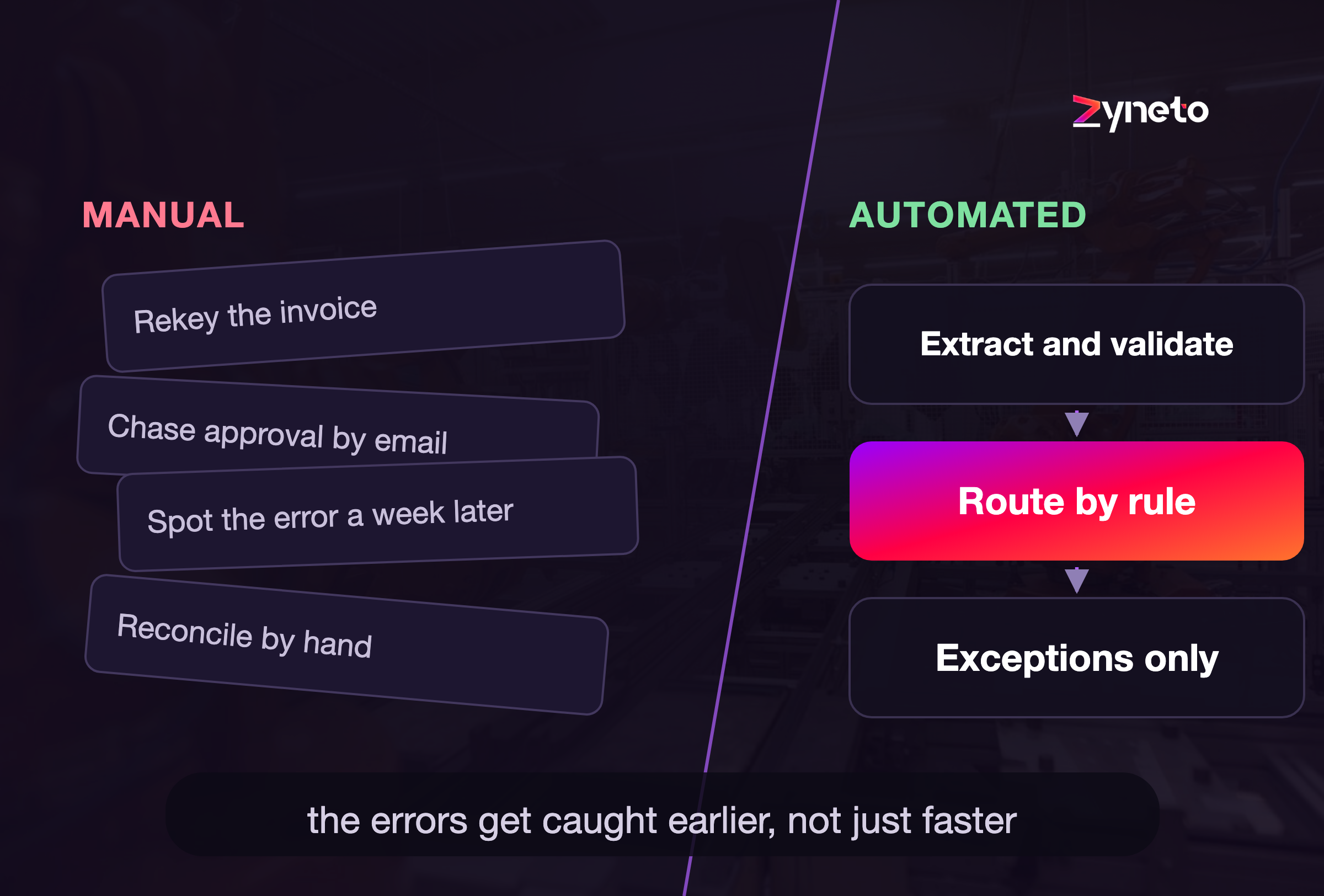
It is automating a business process from start to finish, using AI for the steps where inputs are unstructured or require judgment and conventional logic everywhere else. The distinction from traditional automation is that it can handle messy inputs such as free-text email, scanned documents and inconsistent formats, which is exactly where older rules-based tools stopped and handed back to a person.
How is this different from RPA?
Robotic process automation follows a fixed script, typically driving a user interface, and breaks when the screen or the input changes. AI-based automation reasons over the input, so it copes with variation and with cases nobody enumerated in advance. In practice the two combine: RPA is still a reasonable way to reach a legacy system with no API, sitting behind a layer that decides what to do.
Which processes are worth automating first?
High volume, high repetition, and a clear definition of a correct outcome. Processes crossing several systems are usually the strongest candidates, because most of their cost is in the handoffs rather than the work. Avoid starting with something low volume, rare or politically contested, however visible the pain, because the payback will not justify the effort of the first project.
What is a straight-through rate and why does it matter?
It is the share of items that complete with no human involvement at all. It matters because it is the figure that converts directly into recovered time, and because it is honest in a way that accuracy is not. An automation with excellent accuracy but a 40 percent straight-through rate still has someone touching four items in ten, and the team will feel very little difference.
What happens to cases the automation cannot handle?
They route to a person, with the context already gathered rather than left to be reassembled. Good exception design means the handler sees the item, the reason it was flagged, the data already extracted and the action available, on one screen. Handled badly, exceptions simply move the bottleneck from the process into a review queue nobody can clear.
How accurate does it need to be?
That depends entirely on the cost of an error and whether errors are detectable downstream. A misrouted internal request is cheap and self-correcting. An incorrect payment is neither. We set confidence thresholds per decision so uncertain cases go to review rather than proceeding, which means the practical target is rarely maximum accuracy but the right split between automated and reviewed.
Will this replace jobs on our team?
It replaces tasks rather than roles in most deployments we have delivered, and the honest answer is that it depends on your intent rather than on the technology. What consistently does happen is that the routine share of a role shrinks and the exception and judgment share grows. Teams that plan for that shift get adoption. Teams that do not tend to find the automation quietly bypassed.
How long does an automation project take?
A single well-scoped process typically runs from discovery to production in six to twelve weeks, with integration count the main driver. Discovery is a real phase and worth its time, since a week understanding the process regularly removes a month of rework. Programmes covering several processes are sequenced rather than run at once, so each one benefits from what the previous taught us.
How much does AI workflow automation cost?
Build cost tracks the number of systems involved and the complexity of the decision logic more than anything else. Running cost has two parts: model usage where AI handles a step, and hosting. We model cost per item during design and compare it with the manual cost per item, because automation that costs more per transaction than the process it replaces is a failed project even when it works flawlessly.
Can it work with our legacy systems?
Usually yes, though it affects effort. Modern APIs are straightforward. Older systems may need database-level integration, file exchange, or a UI-driven layer where nothing else is exposed. We assess integration surface during discovery precisely because it is the single largest factor in both timeline and cost, and it is where optimistic estimates usually go wrong.
How do we know it is working after launch?
Straight-through rate, exception volume grouped by cause, cycle time against your original baseline, and cost per item. Exception causes matter most, because they show what to fix next. A process that launches at 60 percent straight-through and reaches 85 within two quarters is a normal and good trajectory.
What do you need from us to get started?
Time with the people who perform the process, access to the systems it touches or a sandbox equivalent, a sample of real work including the awkward cases, and someone who can decide what the automation is allowed to do unattended. The awkward cases matter most: a clean sample produces an automation that only handles clean inputs.
Why choose Zyneto for workflow automation?
We measure your process before changing it, design the exception path first, and use AI only where it genuinely beats a rule. We build the human review interfaces rather than treating them as someone else's problem. And we will tell you when a process is not worth automating, which saves more money than most of the automations we do build.