Frequently Asked Questions
How long does an Android app take to build?
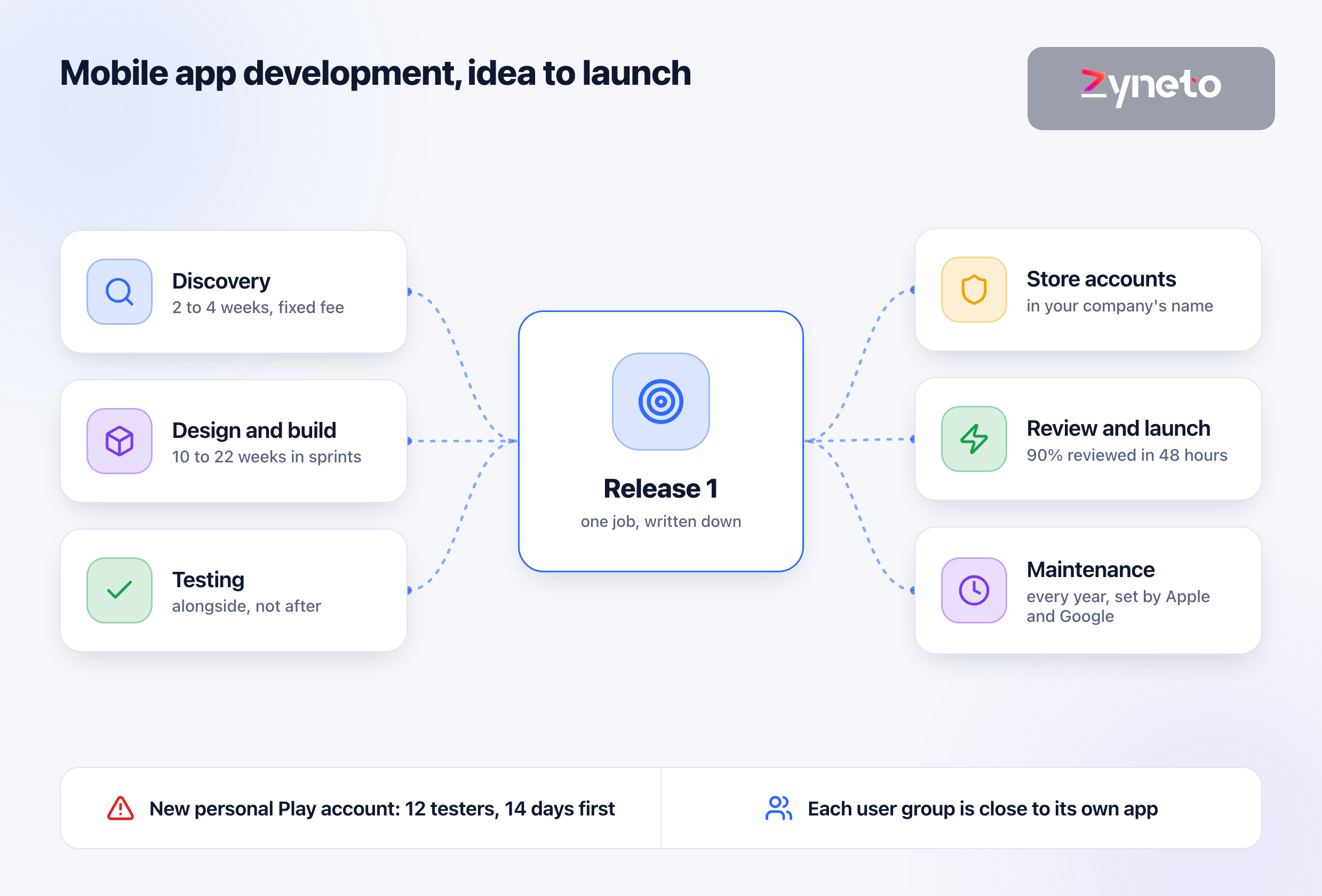
Discovery goes first, fixed in price and 2 to 4 weeks in length. After it, expect 10 to 16 weeks until most Android MVPs we build reach real users, with the cut list drawn up on day 1. A bigger first release runs longer. In the gym and studio platform we published, member app and all, the total is 1,260 hours, which one squad spreads over 14 to 22 weeks, and access hardware and payment gateway certification drive its date more than the code does. If the app publishes from a new personal Google Play account, add the 14-day closed test Google requires before production access.
How much does Android app development cost?
Zyneto bills an Android build hourly. Role and seniority set each rate between $40 and $100, and across a mixed Android team the blend is $60 to $70. On the first call we size your Android app as a band of hours, and we fix a price only once discovery is complete. What moves your Android number most is how many screens you need, the integrations (in our published examples, 80 to 200 hours per payment provider and 180 to 320 hours for recurring billing), whether you want native Kotlin alone or an iOS app too, and QA, which takes its own line at 20 to 25 percent of the build's hours.
Should I build my Android app in native Kotlin or cross-platform?
Build in native Kotlin when the app depends on hardware, background work or Android features a cross-platform layer would have to wrap, or when you only need Android. Build cross-platform, usually React Native, when iOS matters as much as Android and most screens are forms, lists and transactions. Zyneto has shipped both: native Kotlin and Java for Tvam's Android app, and React Native for both Al Amri Express apps on Android and iOS.
What about Kotlin Multiplatform?
Kotlin Multiplatform has been declared stable since November 2023. Compose Multiplatform for iOS followed in May 2025, going stable in version 1.8.0. It shares Kotlin business logic across Android and iOS while each platform can keep its own interface. It is a sound option for teams that already write Kotlin. None of the case studies on Zyneto's site uses it yet, so we present it as an option to weigh in discovery rather than as shipped proof.
Do I need an Android app if most of my customers use iPhones?
It depends on the market. In StatCounter's September 2026 mobile data, which measures page views and not devices owned, iOS held 53.59% in the US and 51.6% in Saudi Arabia, leaving Android a little under half in both. In India Android is at 93.89%, in the UAE 73.3% and in the UK 53.11%. If you sell in those markets, an iOS-only app misses a large share of your customers.
What do I need to open a Google Play developer account?
Google Play charges US$25 once to register a developer account. If you register as an organization, Google asks for a D-U-N-S number plus a website. A personal account opened after 13 November 2023 only gets production access once a closed test has kept 12 or more opted-in testers across 14 consecutive days. Zyneto opens the account in the client's company name, so the client owns the listing from day 1.
What is the Google Play 12-tester rule?
If your personal developer account dates from after 13 November 2023, Google Play will not release your app to production until a closed test has held a minimum of 12 opted-in testers for 14 days running. It adds at least 2 weeks to a first launch from a new personal account, so the testers and the test build need to be ready before the release date is set.
What can delay an Android app's release on Google Play?
The common blockers are not code. A new personal developer account needs a 14-day closed test with at least 12 testers. Since 31 August 2026, Android 16 (API 36) is the minimum target for each new app and update. Virtually every app needs an accurate Data safety form. Sign-in apps must let users delete their account in the app and via a web link. A company account needs a D-U-N-S number on file and a website. Zyneto plans each of these from the first week of an Android project.
What target API level does Google Play require in 2026?
Google Play's rule since 31 August 2026 is that new apps and app updates target Android 16, meaning API 36. If your live app targets anything under API 35, new users on recent Android devices can no longer find it. Leave an Android app untouched for long enough and even a small fix can be stuck until you raise its target API and retest its libraries.
What is the Google Play Data safety form?
The Data safety form is where an Android app declares the data it collects and shares, and Google Play requires it for virtually every app. Zyneto fills it from an inventory of every SDK in the build, because analytics, crash reporting and ad libraries collect data the app's own code never touches, and the form has to be revised whenever those libraries change.
Does my Android app need an account deletion option?
Yes, if users can create an account. Google Play requires an account deletion path inside the app and a web link for deletion as well. Apple's guideline 5.1.1(v) imposes the same in-app rule, so if your app ships on Play and the App Store, design deletion a single time, with the user's backend data handling included.
How much does Google take from in-app purchases and subscriptions?
Google Play's published fees, read on 7 October 2026, depend on the market. For the US, EEA, UK, Australia and Japan, Google charges a 10% service fee on your first US$1M of yearly revenue, plus a 5% billing fee when you use Play Billing; in the US, EEA and UK this applies from 30 June 2026. Across other markets such as India, the UAE and Saudi Arabia, you pay 15% on your first US$1M and 30% on revenue above it, while subscriptions sit at 15%.
Which Android versions and devices do you test on?
Zyneto agrees the minimum Android version and a device list during discovery, based on the client's analytics or target market, and tests against that list on every release. Android runs on many manufacturers' devices across several OS versions at once, so the list is a cost decision as much as a technical one. Google released Android 17 (API 37) on 16 June 2026, and new releases get added to the list as they ship. For your Android build, QA adds 20 to 25 percent to the hours of building.
Who owns the Google Play account, the code and the listing?
The client does. Each Zyneto client keeps its store listings, code and hosting accounts in its own name. Al Amri Express has both of its store listings and its hosting account. Tvam has its listings, its domain and its hosting. Changing supplier is then a commercial decision, not a technical one.
What does Android app maintenance involve after launch?
Android app maintenance is mostly keeping up with the platform and the store. Google put out a new Android version in June 2025 and again on 16 June 2026, when Android 17 (API 37) arrived, and on 31 August 2026 Play raised its target API requirement to API 36. On top of that come SDK updates, Data safety form revisions when libraries change, and bug fixes. Zyneto runs these on a calendar so a deadline does not block an urgent release.
Can you build the Android and iOS apps together?
Yes, in 2 ways. React Native ships both from 1 codebase, as Zyneto did for Al Amri Express on Android and iOS. Separate native apps in Kotlin and Swift give each platform its own code, as Zyneto did for Tvam. For the iPhone app you also pay US$99 a year for Apple's Developer Program, and enrolling as a company with Apple takes a legal entity, a public website hosted on your own domain and a D-U-N-S number.
Can one backend serve the Android app, the iOS app and the web?
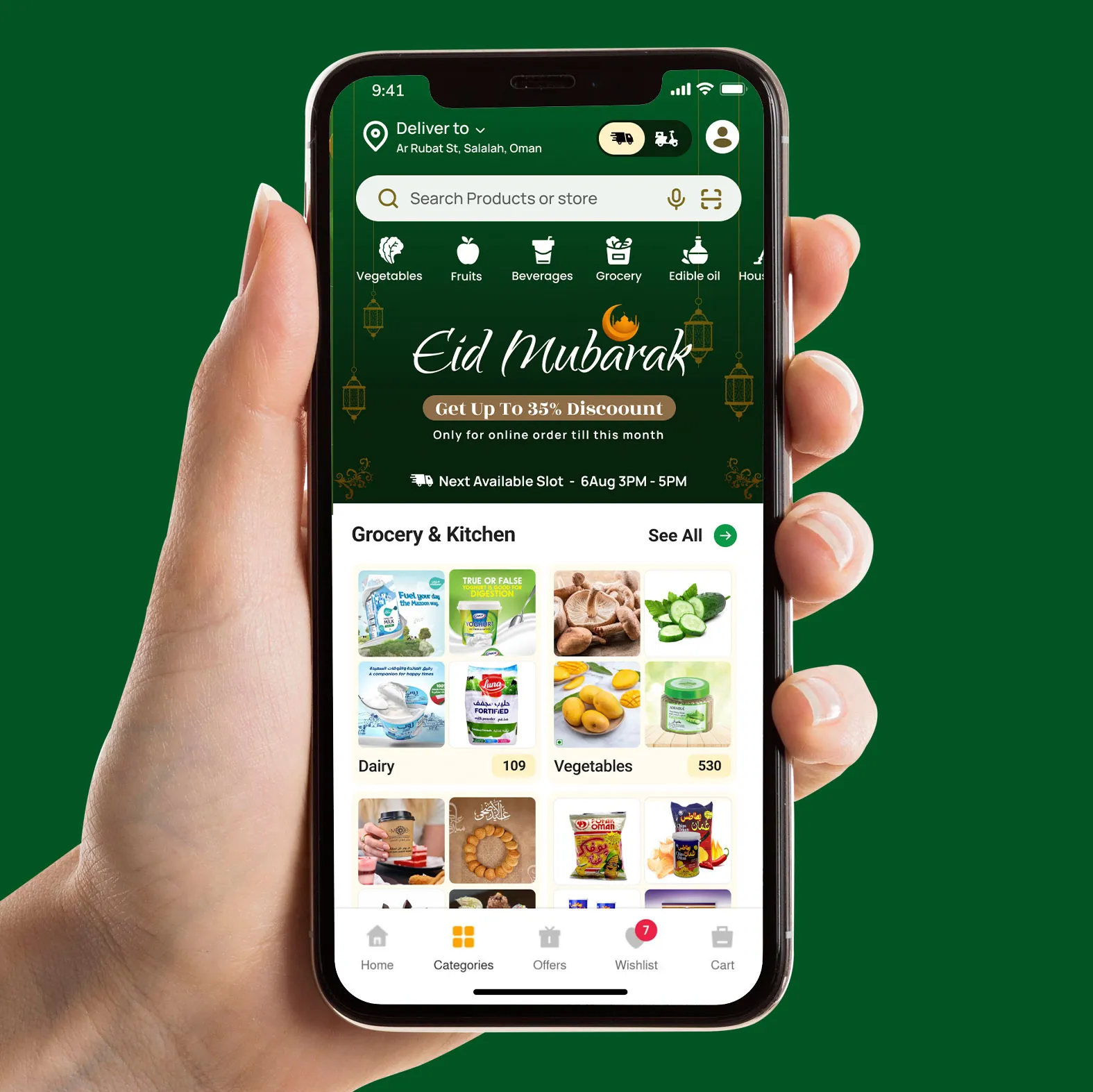
Yes, and it is often the right design. For Tvam, chart calculation runs as 1 server-side service that the web, iOS and Android apps all read, so the 3 surfaces always agree and corrections do not wait on app store review. The trade-off is that the main screen needs connectivity. For Al Amri Express, 2 apps share 1 backend built on Laravel, MySQL and Elasticsearch on AWS.
Should staff and customers use the same Android app?
Not always. In Oman, Al Amri Express's admins, packers and delivery staff use their own staff app, which Zyneto built instead of adding a role switch to the shopper app; the 2 groups have almost no screens in common and update on separate cadences. That choice costs duplicated shell code and an extra release process to run. A smaller operation can run with 1 Android app, keeping staff screens behind a role gate.
Can you take over an existing Android app?
Yes. Zyneto starts by checking the app's target API against Google Play's current rule of API 36 for updates, the libraries and SDKs it depends on, the Data safety form, account deletion, and who controls the Play Console account and signing setup. That review shows what has to change before the next update can ship, and it goes into a costed plan before any new feature work.
Why choose Zyneto for Android app development?
Zyneto has shipped Android both ways: native Kotlin and Java for Tvam, and React Native for Al Amri Express, including a separate staff operations app. Your Play account setup, closed test and policy items are planned in week 1. QA shows on the quote by itself, and it is 20 to 25 percent the size of the build in hours. We publish our $40 to $100 hourly rates, and your code and store listings remain yours.