Conversion is decided in two places, the product page and the checkout, and most builds spend their budget somewhere else. We build storefronts and apps where the product page renders fast enough to keep the sale, the checkout survives 3D Secure and a local card scheme, and the catalogue can hold the variant grid your buyer actually orders from. iOS, Android and web, at $40 to $100 per hour with the arithmetic published.

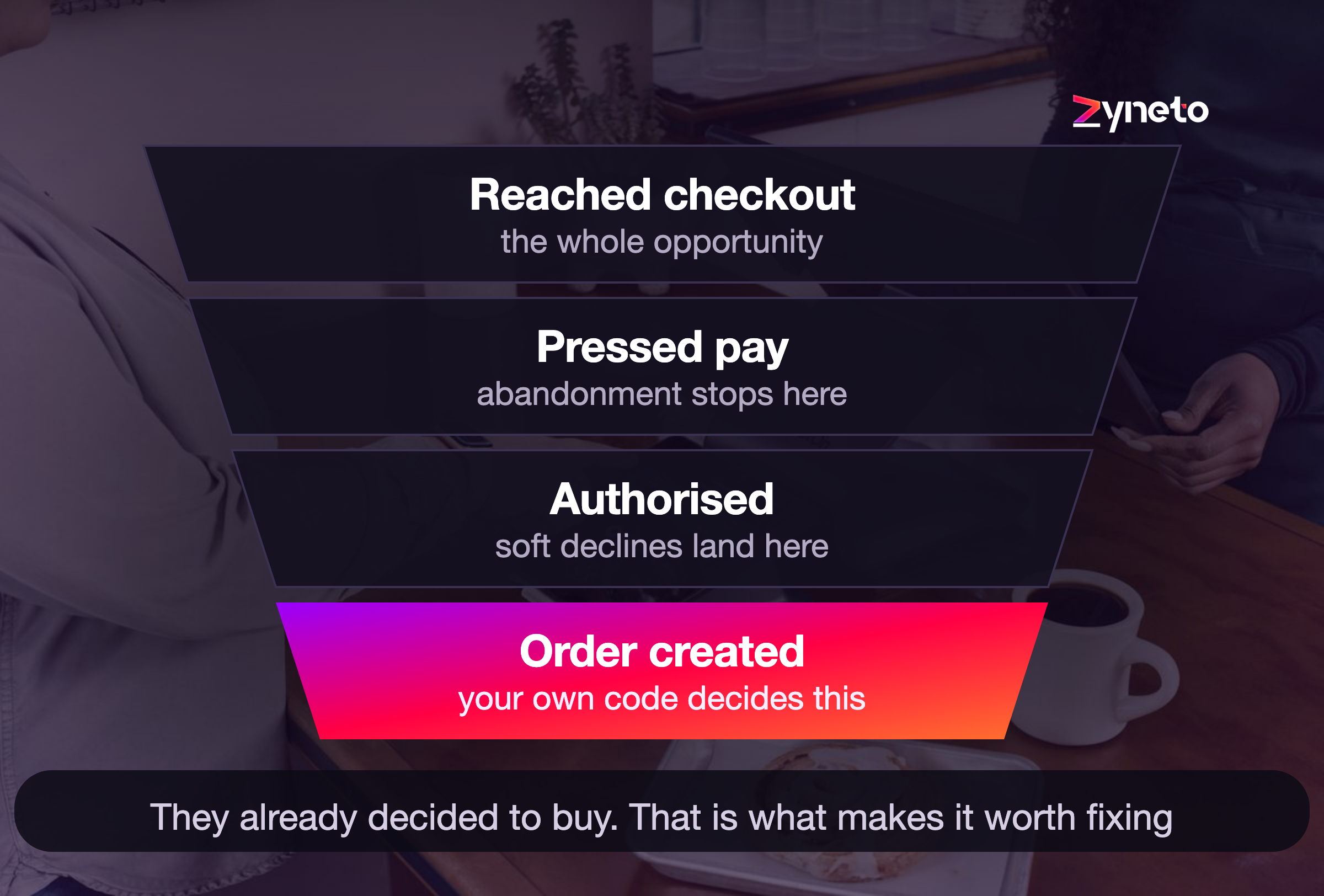
Two screens decide whether a store makes money. The product page has to load fast enough that the visitor is still there, carry the attributes a buyer filters on, and show a stock figure that is true. The checkout has to survive additional authentication, a local card scheme, a wallet, a partial capture and a tax calculation, and it has to do that without asking someone to create an account first. Everything else on a storefront is negotiable. Those two are not.
The failure we inherit most often is a store that looks finished and cannot be operated. Variants were modelled two levels deep when the product needs three. Promotions were treated as configuration until finance found the margin leak. Returns were scoped as phase two, so refunds are manual. We build the parts that decide revenue first, then the parts that decide how the store is run, and we say which is which before anyone approves a design.
Six pieces of work, each scoped by what it has to survive rather than by a feature list. If you only need one of them, that is a legitimate engagement and we will say so.
Two URLs tell us more than a discovery call. We will tell you what is costing you the sale before you commit to anything.
Most stores should buy the commerce engine and build only the edge. These are the platforms we work with, and the honest reason you would pick each one. If a template plus a plugin will do the job, that is faster and cheaper than hiring us and we will say so on the first call.
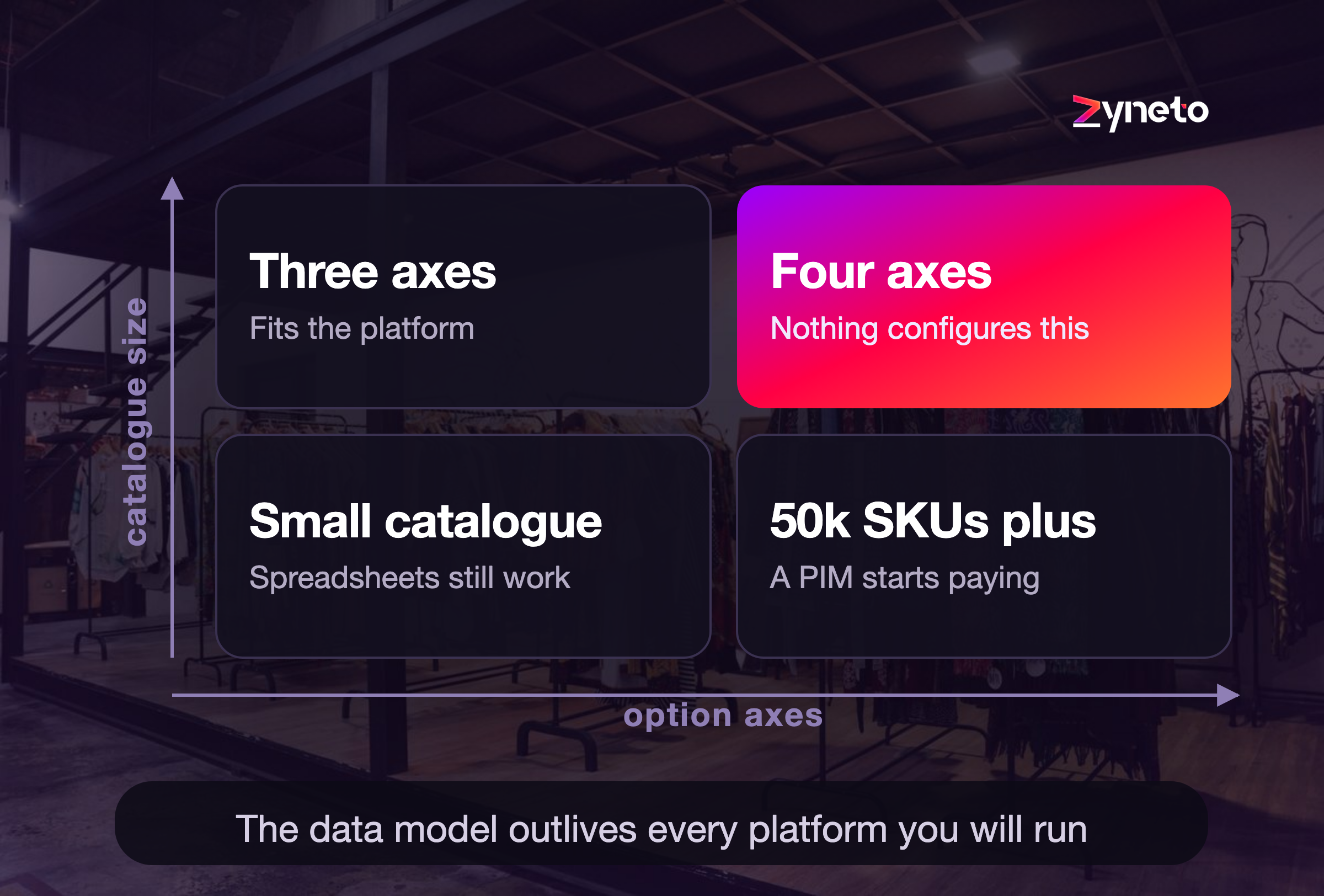
The right answer for most direct to consumer brands. The constraint to check before you commit is the three option variant ceiling, because size, colour, fit and length is four dimensions and does not fit it.

Genuinely useful where content and commerce sit together and the catalogue is modest. Costs show up later in hosting, performance work and plugin conflicts rather than in licence fees.

Strong on complex catalogues, multi store and B2B. Check your version support window before planning, and note that Adobe Commerce as a Cloud Service removes filesystem access, so module based customisations do not port across unchanged.

A reasonable middle path when you want hosted infrastructure with fewer platform limits than the entry tiers elsewhere, and are willing to work within its own API shapes.

Common in markets where a local development ecosystem matters more than the platform brand. Both are workable, and both put more of the maintenance burden on you.

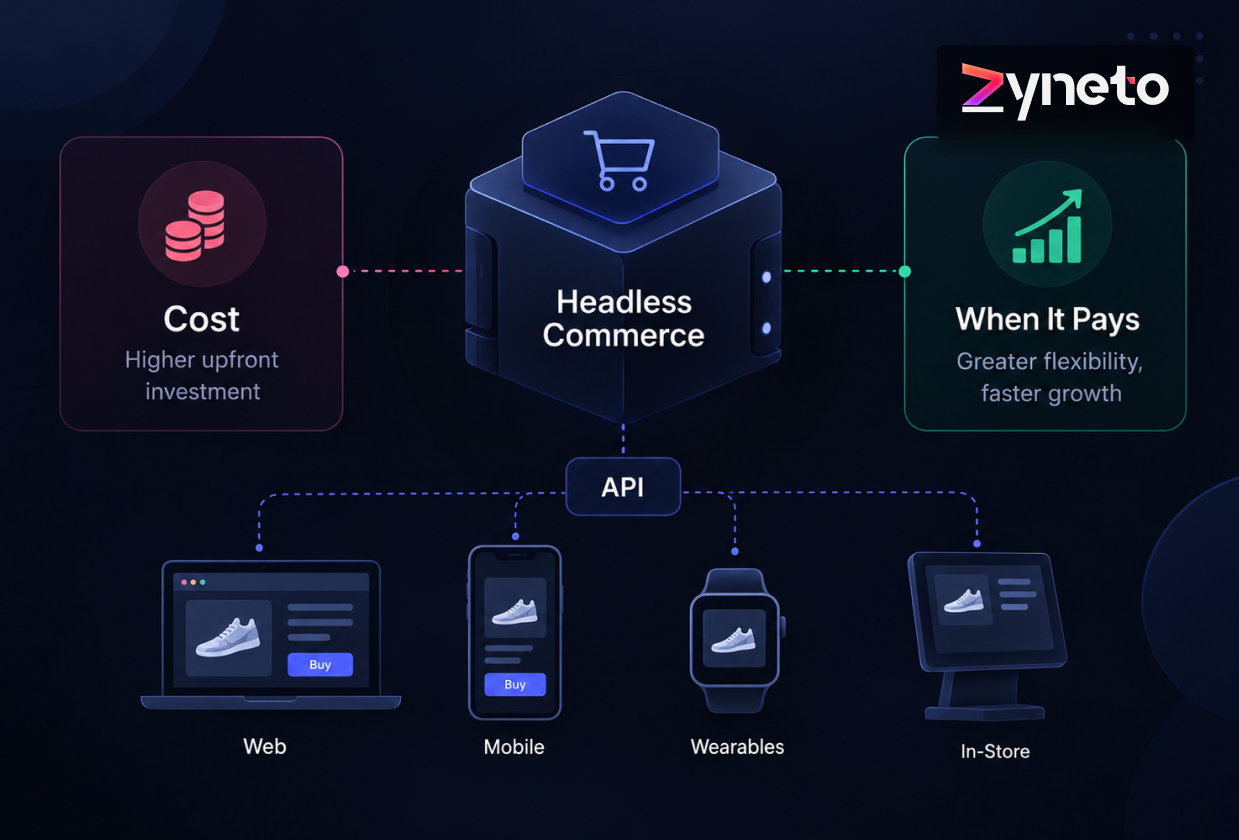
Right when you have several front ends or a genuine performance ceiling, and wrong when it is chosen for novelty. It moves work from the platform to your team, which is a staffing decision as much as a technical one.

Each of these breaks differently, so each is scoped differently. What follows is the part of each that usually gets underestimated.

The buyer facing surface, where the two screens that decide revenue live. Guest checkout is not a nice to have; forced account creation is one of the most reliable ways to lose a sale that was already won.
The operator surface. The test of an admin panel is whether a merchandiser can change price, stock and promotion without a developer, and whether finance can reconcile what the store reported against what the gateway settled.
Only needed if you run a marketplace, and the reason most marketplaces stall is that supply never scales past the sellers the founder onboarded personally. Bulk tooling is what fixes that.
Most stores we are asked to rebuild did not need rebuilding. Send us the current one and we will tell you which it is.


Five phases, each named by what it produces rather than by what we do during it. Nothing here is a status update; each phase ends with an artifact you can read and disagree with.
Step 01 of 05
Every system that owns price, stock, customer or invoice, with a named owner for each on your side, plus an audit of variant completeness, attribute coverage and image standards. Build does not start until this passes, which is occasionally unpopular and always right.
Five commitments you can hold us to, written so they are checkable rather than flattering. If any of them is not what you want from a partner, that is useful to know before a proposal rather than after.
Unlike traditional services, we use the best methods to quickly and efficiently create advanced technology solutions. Our approach ensures not only speed but also quality, guaranteeing that your project reaches its full potential.
Rates are $40 to $100 per hour by role. Front end, CMS and content operations sit near the floor. Integration architecture, payments and compliance engineering sit near the ceiling. A mixed team blends to $60 to $70, and that blend is the number worth planning against rather than either end of the band.
We do not give a fixed price before discovery, because any figure quoted before the integration inventory exists is fiction, and you would be paying a padding premium for our uncertainty. You will get an hour band on the first call. Two things we are not, and both matter here: we are not an accredited e-invoicing service provider in the UAE, Oman or Saudi Arabia, and we are not a payment institution. We integrate to licensed providers held in your name.

Every agency lists the same technologies. What follows is where each one actually pays for itself on a store, and where it is decoration.
Tell us the markets, the catalogue size and the systems that own stock. That is enough for a range on the first call.
On specifics rather than on a portfolio. Ask how they model variants when a product has four options rather than three, what their largest contentful paint budget is on a product page, how they handle a payment webhook that arrives twice, and what their redirect map is built from at replatform. Those four answers separate teams that have shipped stores from teams that have shipped websites.
Rates are $40 to $100 per hour by role, blending to $60 to $70 on a mixed team. A direct to consumer launch or a single channel B2B portal is usually 700 to 1,400 hours, which is roughly $42,000 to $98,000 at that blend. A mid market build covering web, POS, one ERP, click and collect and returns is usually 1,800 to 3,500 hours, roughly $108,000 to $245,000. Those are ranges derived from module hours, not a quote; discovery converts one of them into a fixed price.
Ten to sixteen weeks to a launchable slice for most builds, with a freeze window written into the contract. The date that matters is not the launch, it is the last safe date to launch before peak, and we plan backwards from that rather than forwards from kickoff.
It is if you sell apparel. Size, colour, fit and length is four dimensions and does not fit a three option ceiling, so you either split the product or model the grid outside the platform. Variant limits and API generation also matter: older admin API versions degrade well before the documented ceiling, so check the version your apps are on rather than the platform tier.
Assume a local acquirer whichever platform you choose, because scheme routing rather than platform choice decides your checkout shape. In the Gulf that means mada, KNET, BENEFIT and Jaywan alongside cards, plus buy now pay later. In India, UPI and eNACH matter more than cards, no merchant may store card numbers, and the RBI authentication rules effective 1 April 2026 require two factors with at least one dynamic for card not present. Once several of those coexist in one checkout, you need payment orchestration above the gateways rather than a single integration.
Only partly. Hosted fields keep the card number out of your database and keep you in SAQ A, which is a large reduction in scope. Under PCI DSS v4.0.1 the future dated requirements have been mandatory since 31 March 2025, and requirements 6.4.3 and 11.6.1 reach the payment page even for SAQ A merchants, so you still owe a script inventory and client side tamper detection.
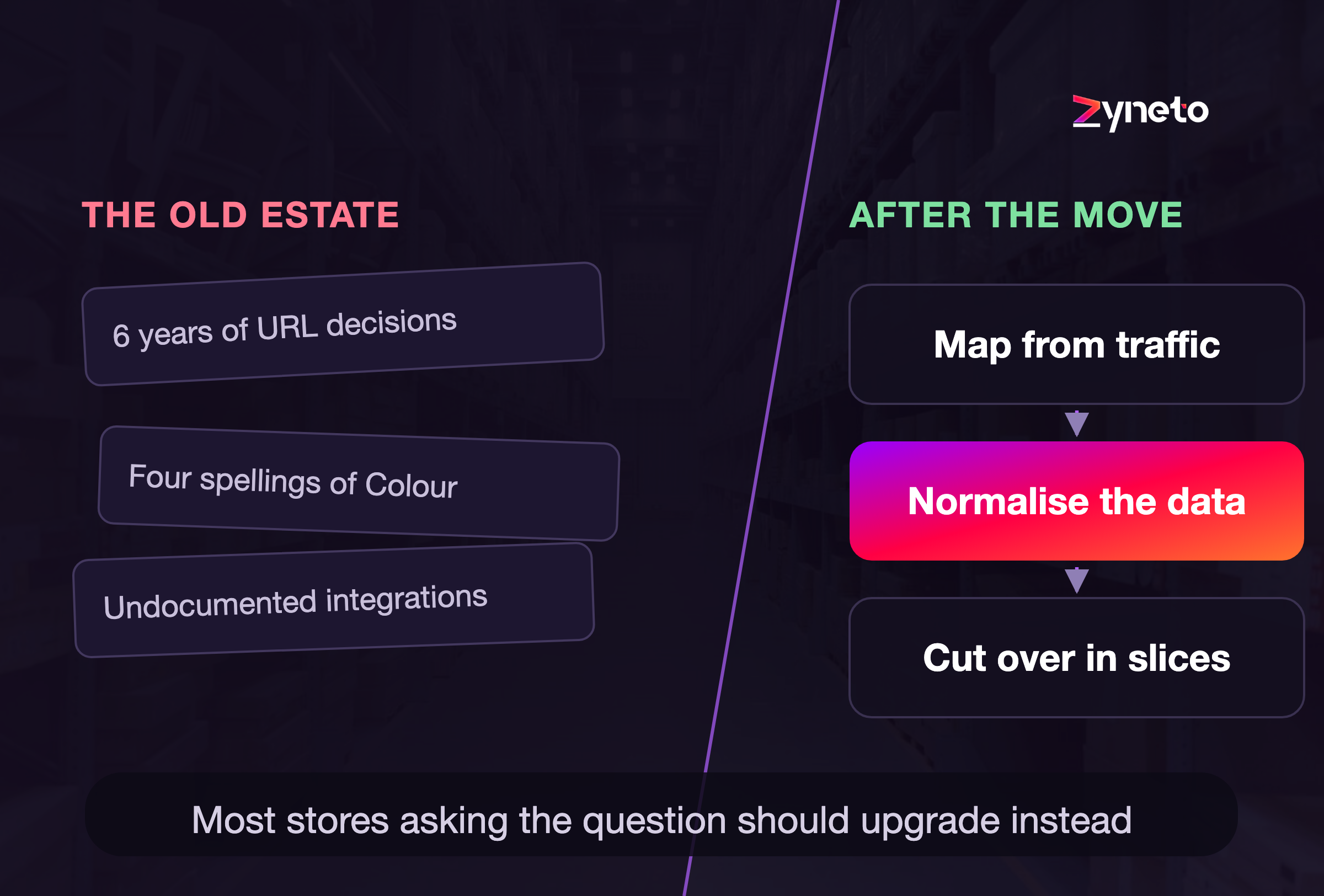
Usually, and the losses we are called in to repair share one cause: the redirect map was built from a sitemap rather than from live server logs, so the URLs that actually earned traffic were the ones missed. Build the map from logs, check canonical, schema and pagination parity before cutover, and treat Search Console monitoring as a named workstream with an owner rather than as something everybody watches.
Read your checkout against the CCPA dark patterns guidelines of 2023 before someone else does. Thirteen patterns are named, including false urgency, basket sneaking, confirm shaming and drip pricing, and the advisory of 5 June 2025 asked platforms to self audit within three months and publish a declaration.
If you sell to consumers in the EU, yes, and it applies regardless of where you are based. The European Accessibility Act has applied since 28 June 2025, with conformity presumed through EN 301 549, which incorporates WCAG 2.1 AA. For a store that reaches the whole purchase path, not just the marketing pages.
Named response targets through the freeze window and peak season, with a rota you can see. The honest limitation is that hypercare is not a discovery vehicle, and during a freeze the answer to most feature requests is January. We would rather set that expectation in the contract than negotiate it in December.
You do, from day one rather than at handover. Code sits in your repository, infrastructure is defined as code, and cloud, gateway and provider credentials are in your accounts and your name. The e-invoicing and payment relationships are contracted by you directly, because they have to be.
Often not. Most stores we are asked to rebuild have a performance problem, a data problem or a promotions problem that a replatform will carry across intact and hide for a year. Send us the current store and we will tell you which of the three it is, and whether the rebuild is actually the cheapest way to fix it.
Real feedback from the people we've proudly partnered with.
Sales Director |Cintas
United States
Zyneto Global Technologies provided excellent project management and technical expertise throughout the engagement. The team was responsive, collaborative, and adaptive, ensuring the project met our expectations and set a strong foundation for future growth.


Founder & CEO |Moneteo
We engaged Zyneto to design and develop a custom web platform for Moneteo, aimed at improving project management, data tracking, and collaboration across internal teams and external partners. Their work included full-stack web development, custom modules for workflow automation, API integration, and comprehensive testing.
CEO |E-Commerce Platform
Overall, their responsiveness and timely deliveries contributed positively to the project's success. The client achieved better data management and quality. The service provider delivered the project on time and ensured prompt responsiveness throughout the engagement. Their innovative approach was outstanding.
Practical guides and analysis on ecommerce app development company, written by the team that builds it.