Frequently Asked Questions
What is Flutter app development?

Flutter app development is building mobile, web or desktop apps with Google's Flutter framework, written in the Dart language. Rather than borrowing each platform's native buttons and lists, Flutter paints the whole interface with its own engine, so a single codebase gives you iOS and Android apps that look and behave alike. Platform features such as push notifications, app signing and background work still need native Swift and Kotlin code behind plugins.
When is Flutter the right choice for an app?
Pick Flutter if 3 conditions hold: your interface is custom and brand-led instead of mirroring each platform's defaults, it has to look identical on iOS and Android, and you have no React code worth reusing. A booking or commerce app with its own design system fits well. If your roadmap also includes an app-like web dashboard or a desktop screen, Flutter can target those from the same code.
When should you not use Flutter?
Skip Flutter if your app has to follow each OS's native look as it changes from release to release, since a Flutter app holds its design until you change it. Avoid it when your engineers already write React, since React Native reuses that skill. Think twice if your product mostly wires together third-party native SDKs: every SDK needs its own Flutter plugin, and every plugin is native code you must upgrade each quarter.
Should I choose Flutter or React Native?
Choose by interface and team, not by benchmarks. Flutter renders its own widgets, which suits a custom design that must match on both platforms. React Native uses each platform's own views and suits companies that already write React. Popularity is close: Stack Overflow's 2024 Developer Survey, the last that asked, found 9.4 percent of respondents had used Flutter and 8.4 percent React Native. The release clocks differ: Flutter's release manifest shows a stable every 91.2 days on average with fixes only for the current one, while React Native supports its latest 3 minor series at a time.
How many weeks does a Flutter app take to build?
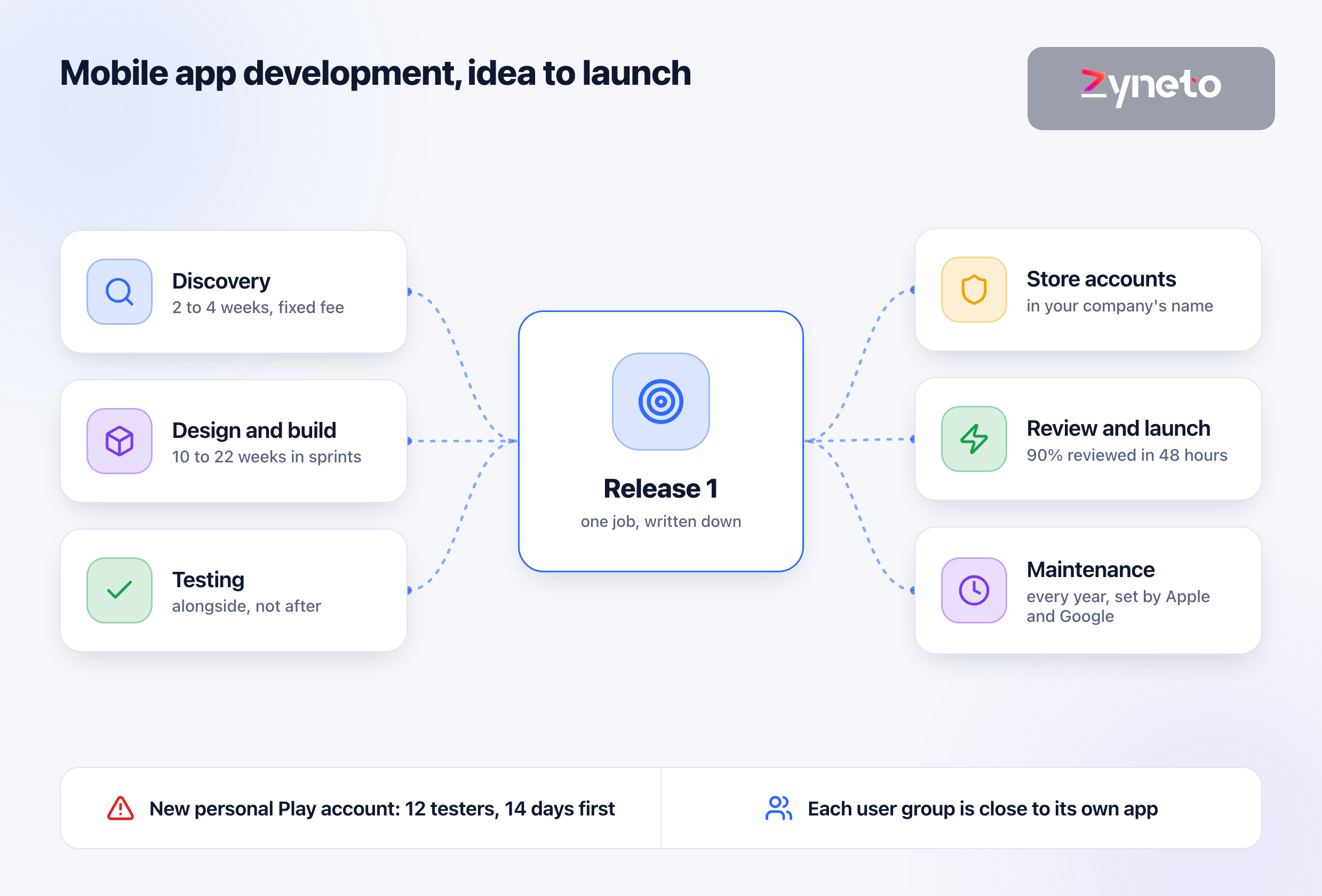
Zyneto's published figure for most builds, on any framework, is 10 to 16 weeks from kickoff until real users hold the app, and we write the cut list on day 1. Discovery comes first and takes 2 to 4 weeks. A bigger phase 1 runs longer. Zyneto's published gym and studio example, member app included, adds up to 1,260 hours, and it takes 14 to 22 weeks. App review costs you days rather than weeks: by Apple's own figures, it typically clears at least 50 percent of submissions within 24 hours and 90 percent within 48.
How much does Flutter app development cost?
Zyneto publishes its rates: each hour costs $40 to $100 by role and seniority, and blended across a mixed team that comes to $60 to $70. Cost follows hours, and hours follow scope: integrations, payments and native features move the number most. Two of Zyneto's published module figures: 160 to 280 hours for a self-service member app, and 80 to 200 hours for each payment provider. Flutter testing is billed apart from the build: for every 100 build hours, 20 to 25 more. Add the store fees: Apple charges US$99 a year, Google Play US$25 one time. You won't get a fixed price until discovery is done, but the first call gives you an hour band.
Does Flutter really mean one codebase for iOS and Android?
For the interface and business logic, mostly yes: Flutter renders the same widgets on both platforms, so screens and rules are written once in Dart. It does not mean zero platform code. Swift and Kotlin still handle push notification entitlements, app signing, background execution, Xcode and Gradle configuration, and any SDK lacking a maintained plugin, and Dart reaches that code through platform channels or Pigeon. Plan for a small native share, not none.
Will a Flutter app still need iOS and Android specialists?
Plan for at least 1 engineer comfortable in both native projects, rather than a separate team for each platform. For a team of 5, a workable shape is 4 Dart engineers building features and 1 native owner who handles the iOS and Android projects, native plugins, signing and the upgrade calendar. Direct interop is still young: Swift interop goes through an Objective-C wrapper, and the binding generator for Swift is an experimental project at version 0.2, so budget your 2026 build around platform channels and Pigeon.
How often does Flutter release new versions, and do old versions get fixes?
Flutter's official release manifest shows a new stable release every 91.2 days on average, from 3.22 in May 2024 to 3.47 in August 2026. The same manifest shows no hotfix for any line from 3.22 to 3.44 once its successor shipped, and Flutter sets no support window for older stables. Staying on code that still gets fixes means upgrading roughly once a quarter. The latest stable on 1 October 2026 was 3.47.6 with Dart 3.13.5.
What does maintaining a Flutter app involve?
Maintaining a Flutter app means upgrading to each new stable, keeping plugins current and meeting store deadlines. Expect some migration work on every upgrade: from 3.22 to 3.47, Flutter's breaking changes page logs 65 entries over 10 stables. Store deadlines are fixed: Xcode 26 builds became mandatory at Apple on 28 April 2026, and Google Play made API 36 the required target for new apps and updates on 31 August 2026. Plan to adopt every stable no more than 4 weeks after release, and never skip 2 in a row.
Are Flutter plugins a risk?
Plugins are where most of the risk sits. In a 6 October 2026 test, Zyneto installed 26 common plugins in a new Flutter 3.47.6 app and the resolver added 187 packages; 43 had Android or iOS native code, the part that breaks whenever Xcode, Gradle or the Flutter engine changes. That day, the latest flutter_local_notifications and connectivity_plus could not be installed together because of a Linux-only dependency conflict, and with open version ranges the resolver silently picked a notifications release 14 major versions old. Pin versions, commit the lockfile and review each plugin's publisher and last release date.
Can Flutter build my website as well as my app?
Flutter can build web apps, but Google's Flutter documentation recommends it for app-like single-page apps and for bringing an existing mobile app to the browser, and not for text-heavy, document-style or SEO content. A logged-in dashboard or tool can share your mobile code. A marketing site, blog or catalog that needs to rank in search should be a separate web build, for example in Next.js.
Does Flutter support the latest App Store and Google Play requirements?
Yes, on current versions. Flutter 3.38, released 12 November 2025, added full iOS 26 and Xcode 26 support and set the Android target to API 36. Since 28 April 2026, every Apple upload has needed Xcode 26 plus the iOS 26 SDK, and since 31 August 2026 Google Play has needed API 36 for new apps and updates. On Android, Flutter's supported platforms page now covers API 24 to 37; on iOS, versions 15 to 27. An app stuck on an older Flutter must be upgraded before its next store update.
Can a Flutter app be updated without going through app store review?
Not with anything Google provides. Flutter has no official over-the-air update mechanism, so every change, including a 1 line fix, goes through a store release by default. The third-party option is Shorebird, which runs on its own forked Flutter engine and can push Dart patches to Android and iOS apps. Its published plans on 6 October 2026 started free at 5,000 patch installs a month and went up to $400 a month for 1,000,000. Patches cannot change native code, add plugins or move Flutter versions, and each Flutter upgrade then depends on Shorebird supporting that version.
Who owns the code and store listings of an app Zyneto builds?
You do. Every Zyneto client keeps ownership of its code, store listings and hosting accounts. On Al Amri Express and Tvam, 2 published Zyneto case studies built in React Native and native code, the client holds its own store listings and hosting. What discovery produces, the target architecture and costed phase 1 among it, stays yours even if Zyneto never builds the app, so switching suppliers later is a commercial choice, not a migration.
Does Zyneto have a Flutter case study?
No. No Flutter case study is published on Zyneto's site. The mobile case studies there, Al Amri Express and Tvam, were built in React Native and in native Swift and Kotlin. Zyneto's Flutter advice rests on Flutter's own documentation, the official release manifest and Zyneto's dated measurements of plugins and release cadence, and you can ask for the same plugin check on your own app before deciding.
Is it hard to hire Flutter developers?
The pool is smaller than for Kotlin or JavaScript. Stack Overflow's 2026 Developer Survey found 4.9 percent of respondents used Dart, against 10.8 percent for Kotlin, 5.9 percent for Swift and 62.0 percent for JavaScript. Google reported 1.5 million monthly Flutter developers in May 2026. Engineers who know Java, Kotlin, Swift or TypeScript find Dart's syntax familiar and can cross over, but your Flutter team's native owner still has to be at home in Xcode and Gradle.
Can Zyneto take over or upgrade a Flutter app we already have?
Yes. A takeover starts with an audit: the current Flutter version, every plugin with its publisher and last release, which plugins carry native code, and whether everything resolves at its newest version. Next, your app advances 1 stable release per step; if 2 quarters of breaking changes arrive at once, a routine upgrade becomes a long bisecting job. Both platforms build in CI from the first commit, so build-system changes such as Android Gradle Plugin 9 or the Swift Package Manager default in Flutter 3.44 surface early.
Does a Flutter app perform like a native app?
Your app renders through Impeller, Flutter's own engine; on iOS it has been the sole renderer since Flutter 3.29 dropped Skia in February 2025. Android devices on API 29 or higher get Impeller by default, and those on API 28 or lower still run the legacy Skia backend. That leaves your own code, images and plugins as the parts you control, so profile on the oldest devices you intend to support.
What should we prepare before a Flutter project starts?
A description of the app and its users, designs or brand guidelines if they exist, the list of third-party services the app must connect to, such as payments, maps, analytics or login providers, and 1 person who can make product decisions. The third-party list matters most for Flutter, because each service means a plugin, and the plugin list predicts year 2 maintenance better than any framework comparison. After that, discovery runs for 2 to 4 weeks at a price fixed in advance.