Dating App Development Cost in 2026: The Safety Layer Comes First


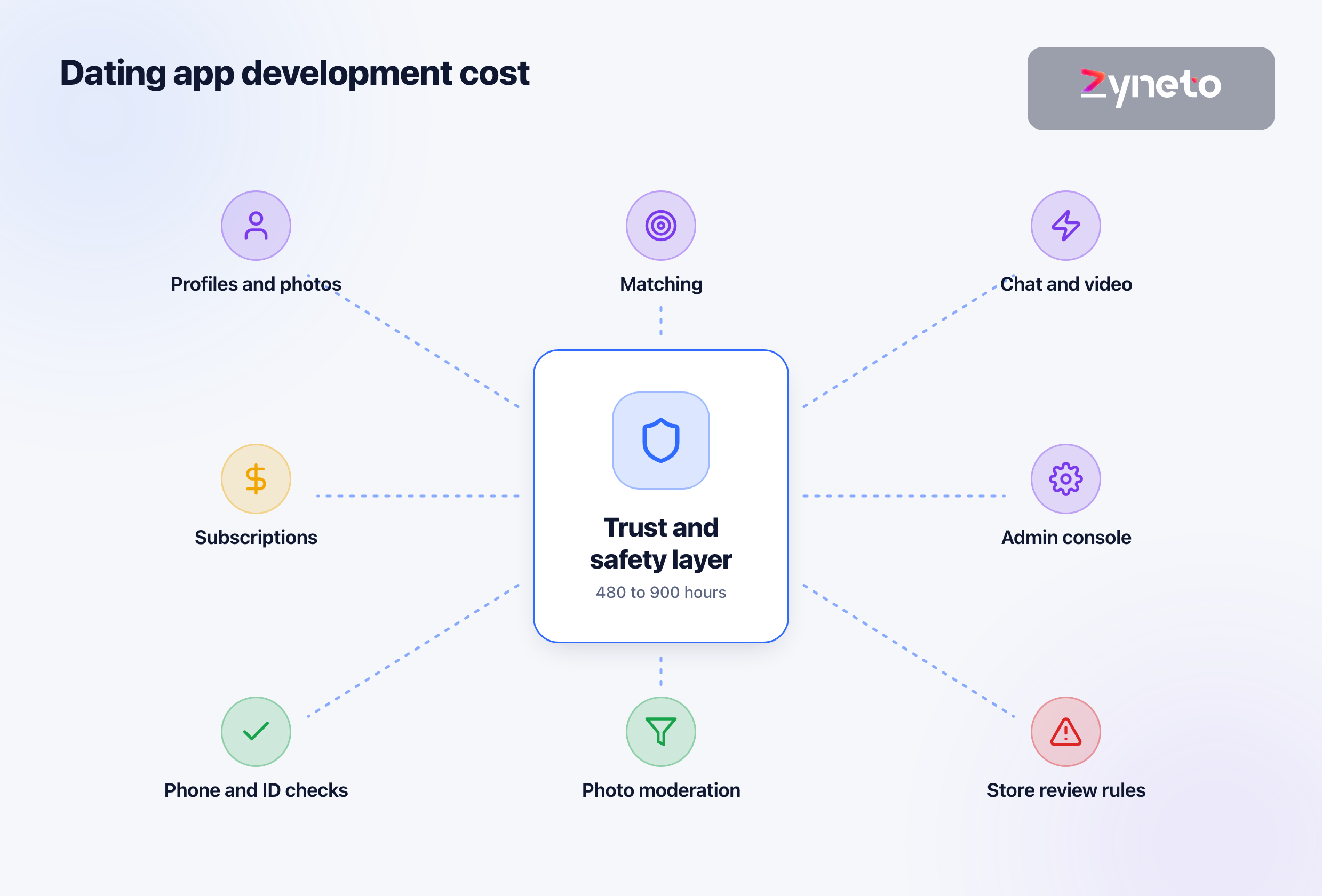
A dating app's cost comes down to 3 questions: what the safety layer costs, what the app around it costs, and what it costs to run each month once people sign up. Everything else, from the swipe animation to the colour of the match screen, hangs off those answers. Most founders start with features, and that is the wrong end: Apple and Google will not list a dating app that cannot filter content, take reports, block abusers and keep minors out, and that layer is often the largest single block of hours. The ordinary failure is not a crash. It is a finished app that gets rejected because it has a chat screen and no way to report the person on the other end of it.
On Zyneto's published estimate, the trust and safety layer alone is 480 to 900 hours. Our worked example is 680 hours, which is $27,200 at $40 an hour and $68,000 at $100, about $44,200 at a $65 blended rate, delivered in 8 to 14 weeks. Profiles, matching, chat and subscriptions come on top and are priced module by module in discovery. Running costs start the day users arrive: on list prices, verifying, moderating and connecting 10,000 new users in a month costs about $3,300 in third-party services before hosting.
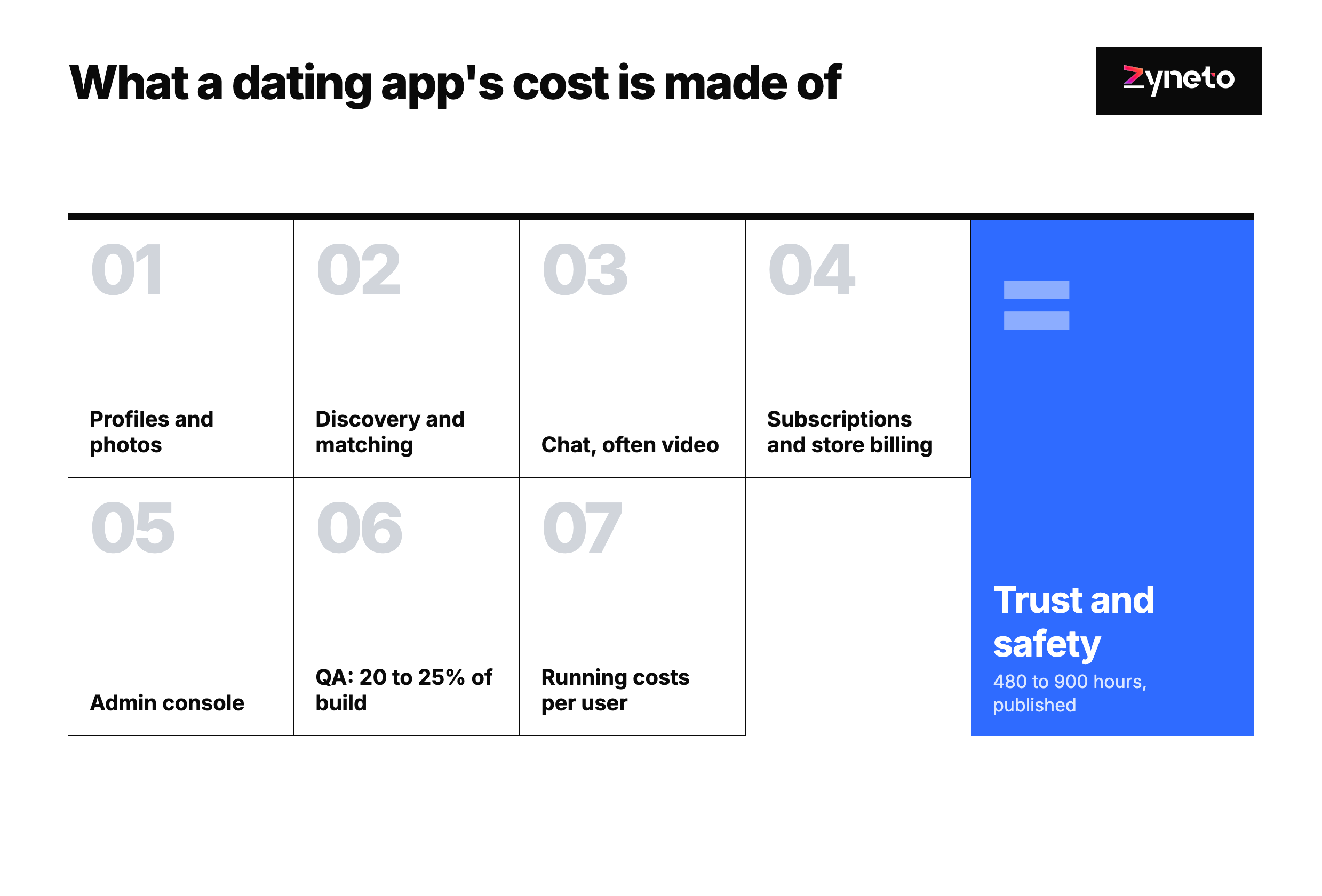
A dating app costs its hours multiplied by a rate. Discovery lists the modules, each module gets an hour range, and the ranges add up to a band. Zyneto's rates run from $40 to $100 an hour by role, blending to $60 to $70 on a mixed team, and quality assurance is priced as its own line at 20 to 25 per cent of build hours. Any quote you receive should let you do the same arithmetic.
The modules are the same in every serious dating app. Profiles and photos. Discovery and matching. Chat, and often video. Subscriptions and in-app purchases. An admin console for the people who run it. And the trust and safety layer that sits across all of them. The visible screens are the cheapest part; the rules behind them are where the hours go.
We publish hours for the safety layer, not for the rest. Our community app development page prices trust and safety in 6 modules. We have not published a dating-specific band for profiles, matching or chat, and we will not invent one here. Those depend on choices this post walks through, such as whether you match on distance alone or on behaviour, and whether video is in release 1.
Trust and safety module (Zyneto published) | Hours |
Policy and taxonomy | 60 to 120 |
Classification integration | 80 to 160 |
Queue and case management | 120 to 200 |
Enforcement and notice | 90 to 160 |
Appeals | 60 to 120 |
Audit and reporting | 70 to 140 |
Total | 480 to 900 |
The worked example lands in the middle. Policy 90, classification 120, queue 160, enforcement 120, appeals 90 and audit 100 make 680 hours. At the ends of the rate band that is $27,200 to $68,000; at a $65 blend it is about $44,200. The page states the variable plainly: how much of your policy already exists in writing, because undocumented policy has to be drawn out before it can be built.
Apple requires 4 things of any app with user content. Under App Review Guideline 1.2, an app with user-generated content or social networking must filter objectionable material before it is posted, let users report offensive content and respond in a timely way, let users block abusive users, and publish contact information. A dating profile, a photo and a chat message are all user-generated content.
Apple also draws lines on the category itself. Guideline 1.1.4 excludes "hookup" apps and apps that may facilitate prostitution or trafficking. Since July 2025 Apple's age ratings include 13+, 16+ and 18+ tiers; Apple has no dating-specific rating rule, so the rating follows your questionnaire answers, and you can choose 18+.
Google requires dating apps to keep minors out. Google Play's policy says apps whose core function is matchmaking or dating must use Play Console tools to block minors. Its Child Safety Standards policy applies to the Social and Dating categories: you publish child safety standards on a public web page, provide an in-app way to report, act on child sexual abuse material, and name a child safety contact. Its user-generated content policy adds terms users accept before posting, in-app reporting and blocking, and "robust, effective, and ongoing" moderation. "Sugar dating" is banned outright.
Requirement | Apple App Store | Google Play |
Filter content before it is posted | Required (1.2) | Moderation required, "robust, effective, and ongoing" |
Report and block users in the app | Required (1.2) | Required |
Keep minors out | Age rating, age assurance options | Block minors through Play Console (dating apps) |
Published safety information | Contact information | Child safety standards page and named contact |
Banned outright | "Hookup" apps (1.1.4) | Compensated or "sugar" dating |
The UK adds a regulator. Ofcom counts dating among the services in scope of the Online Safety Act. Its illegal content codes have applied since 17 March 2025 and its children's protection codes since 25 July 2025. In December 2025 Ofcom reported that Tinder, Grindr, Bumble and Hinge now use age checks. If you launch in the UK, age assurance is a release 1 feature, not a roadmap item.
The reason the rules exist is money. The US Federal Trade Commission reported 64,003 romance scam reports and $1.14 billion lost in 2023, with a median loss of $2,000, and said reported romance scam losses rose 22 per cent in 2025. A dating app that cannot catch a scammer is a liability, and the stores know it.
Dating is on Apple's list of saturated categories. Guideline 4.3(b) names dating alongside flashlights, wallpapers and timers as "well established" categories, and says Apple will not accept new ones unless they offer "a meaningfully different or improved experience". A Tinder clone with your logo on it is exactly what that guideline rejects.
Differentiation is therefore a cost decision, not a marketing one. The feature that makes your app different, a community it serves, a matching approach, a verification standard, has to be in release 1, because release 1 is what Apple reviews. Budget for it before you budget for polish. Our guide to how dating app algorithms work covers the matching side of that choice.
Narrow beats broad for a new app. The apps that grew in the latest quarter were not the broadest. Match Group reported Hinge's payers up 17 per cent to 2.0 million in Q2 2026 while Tinder's fell 5 per cent to 8.5 million. A clear audience is easier to review, easier to moderate and easier to explain.
Phone verification is the floor. Twilio Verify charges $0.05 per successful verification plus the SMS fee, $0.0083 per message in the US, and nothing for failed or expired attempts. That is about 6 cents a sign-up.
Identity and liveness checks cost dollars, not cents. Veriff publishes ID and selfie verification with liveness at $0.80 a check on its Essential plan ($49 monthly minimum), $1.39 on Plus and $1.89 on Premium. Persona's Help Center lists its Essential plan from $250 a month on an annual contract with 500 checks included, then $1.50 each. Onfido does not publish prices.
Photo moderation is cheap at list price. AWS Rekognition's moderation API costs $0.0010 an image for the first million images a month in US East, with 1,000 images a month free for the first 12 months. Sightengine sells 10,000 operations for $29 a month and 40,000 for $99, and Hive lists $3.00 per 1,000 requests.
Decide who gets the expensive check. Checking everyone's ID at sign-up costs the most and loses the most sign-ups. Many apps verify phones for everyone and offer an ID and selfie check for a verified badge. The badge is the product decision; the per-check price is what it costs.
The worked example below uses list prices and stated assumptions. Assume 10,000 new sign-ups in a month, each verifying a phone and uploading 6 photos, a quarter of them taking an ID check for a badge, 50,000 minutes of HD video calls, and a hosted chat service. Hosting, storage and your own team are not included.
Service (list price, read 7 October 2026) | Assumption | Monthly cost |
Phone verification, Twilio Verify ($0.05 + $0.0083 SMS) | 10,000 verifications | $583 |
Photo moderation, AWS Rekognition ($0.0010 per image) | 60,000 images | $60 |
ID and liveness, Veriff Essential ($0.80) | 2,500 checks | $2,000 |
Video calls, Agora HD ($3.99 per 1,000 minutes, 10,000 free) | 50,000 minutes | $160 |
Chat, Stream Start ($499 a month, monthly billing) | 10,000 monthly active users | $499 |
Geocoding, Google Maps ($5 per 1,000 after 10,000 free) | 10,000 lookups | $0 |
Total | about $3,300 |
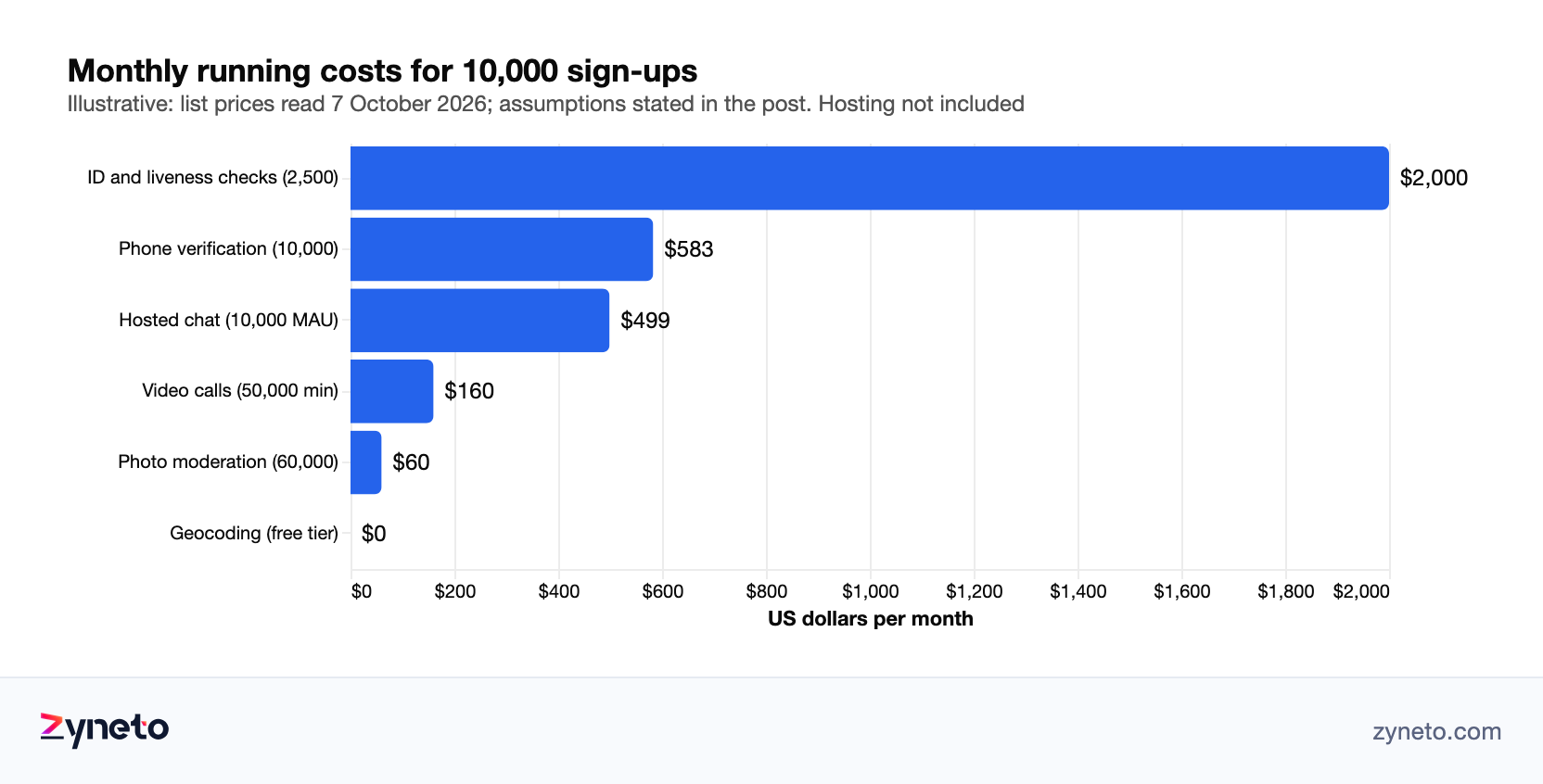
The largest line is the one you chose. ID verification is 60 per cent of the total here, and it is optional. Phone verification and moderation, the parts the stores effectively require, are under $650. That is the pattern to look for in any running-cost estimate: separate what compliance needs from what your product promise adds.
Build or buy chat at your scale, not ours. A hosted chat service at $499 a month is cheap at 10,000 users and expensive at 1 million. Building chat yourself costs hours up front and saves fees later. The crossover depends on your growth plan, which is why it belongs in discovery rather than in a default.
Dating revenue is subscription revenue. Match Group reported revenue per payer of $17.90 for Tinder and $33.11 for Hinge in Q2 2026, and Bumble reported average revenue per paying user of $21.96 for the same quarter. Bumble's paying users fell 16.4 per cent to 3.2 million. Payers are a minority of users in every one of these apps, so your model has to work on a small paying share.
The stores take a share of every subscription. Apple keeps 30 per cent of a subscription's first year and 15 per cent after a subscriber's first year, or 15 per cent from the start for developers in its Small Business Program, which covers those under $1 million in proceeds the previous year. On Google Play, in the US, UK, EEA, Australia and Japan, subscriptions carry a 10 per cent service fee plus a 5 per cent billing fee when Google Play Billing is used; in other markets, including India and the UAE, subscriptions are 15 per cent.
Price the subscription after the store's share and the running costs. If a subscriber pays $20 a month and the store keeps 15 per cent, you receive $17. Your running costs per paying user, verification, moderation, chat and video, come out of that $17, not the $20.
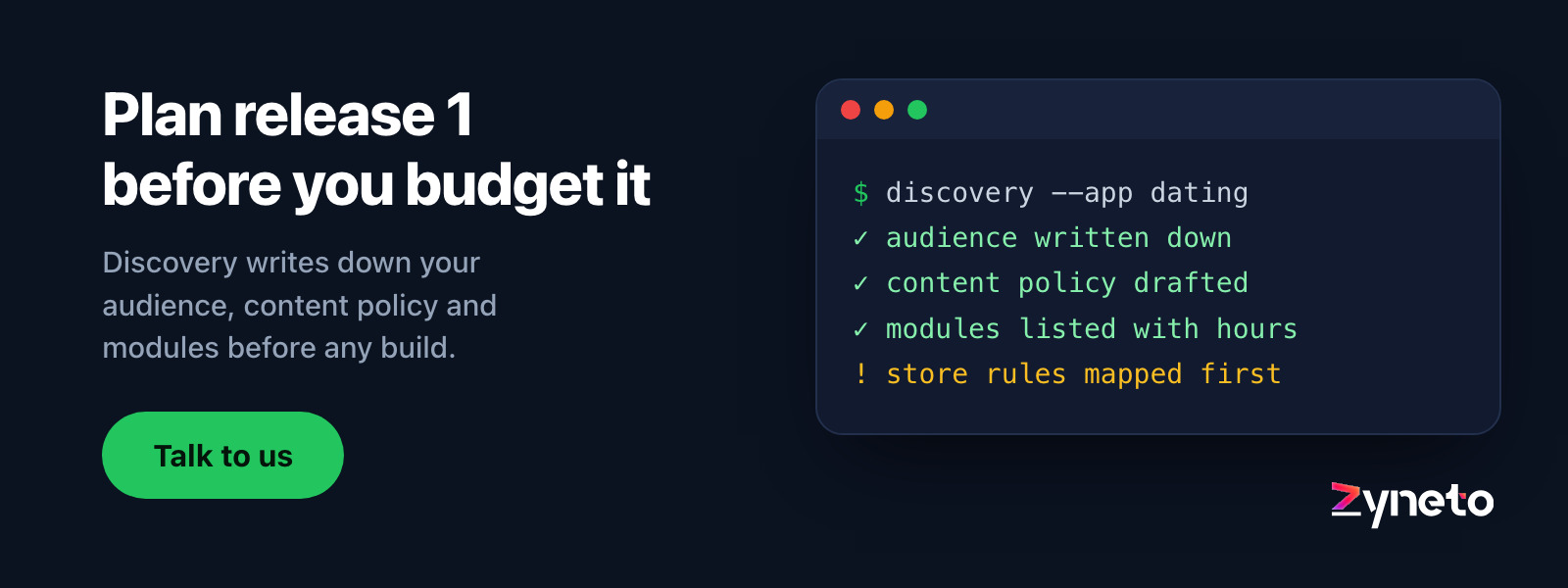
Discovery takes 2 to 4 weeks at a fixed fee. It ends with the module list, the hours and a fixed price for release 1, and the document is yours whether or not you build with us. For a dating app it also ends with your written content policy, because that is the slowest part of the safety layer.
Build time depends on the cut list. Zyneto's MVP page puts most builds at 10 to 16 weeks to something real users touch. The trust and safety layer on its own is 8 to 14 weeks on our community estimate, and it runs alongside the app rather than after it.
Store approval has its own clock. Apple says it typically reviews at least 50 per cent of submissions in under 24 hours and 90 per cent in under 48. A new personal Google Play developer account must first run a closed test with at least 12 testers for 14 consecutive days. Our mobile app development guide lists the store steps that move a launch date.
Stage | Typical length | Source |
Discovery | 2 to 4 weeks, fixed fee | Zyneto published |
Build to first real users | 10 to 16 weeks | Zyneto MVP page |
Trust and safety layer | 8 to 14 weeks, in parallel | Zyneto community estimate |
Apple review | 90% under 48 hours | Apple |
Google closed test (new personal accounts) | 14 days, 12 testers |
Cut features, never the safety basics. Reporting, blocking, content filtering and keeping minors out are what the stores review. Removing them does not save money; it delays launch until they are added back.
Defer video and behavioural matching. Video calls add a running cost and a moderation problem. Matching on behaviour needs data you do not have on day 1. Distance, preferences and a clear audience are enough for release 1; our guide on how to create a dating app covers what a first version needs.
Write your content policy before the build starts. On our estimate, the variable in the safety layer is how much of the policy already exists in writing. A founder who arrives with a written policy saves hours that would otherwise go into drawing it out of meetings.
Keep the store accounts and the code in your company's name. Open the Apple and Google developer accounts yourself and give your developers access. An app published under an agency's account is controlled by that agency.
The cheapest dating app is the one that passes review the first time. Founders who budget the safety layer first, pick an audience Apple will see as different, and price running costs per paying user rather than per download spend less overall, because they build the expensive part once. If you are choosing a team for the build, our dating app development company page sets out how we approach it.
A dating app costs its hours multiplied by a rate. On Zyneto's published estimate, the trust and safety layer that Apple and Google require is 480 to 900 hours; the worked example of 680 hours is $27,200 to $68,000 at $40 to $100 an hour, about $44,200 at a $65 blend. Profiles, matching, chat and subscriptions are priced on top, module by module, in a 2 to 4 week discovery.
Discovery takes 2 to 4 weeks. Most first releases reach real users in 10 to 16 weeks, with the trust and safety layer built in parallel over 8 to 14 weeks. Apple reviews 90 per cent of submissions in under 48 hours, and a new personal Google Play account needs a 14-day closed test with 12 testers before it can publish.
Apple's guideline 1.2 requires filtering of objectionable content, in-app reporting with timely responses, user blocking and published contact information. Google Play requires reporting, blocking, ongoing moderation and terms users accept before posting, and dating apps must block minors through Play Console and meet Google's Child Safety Standards, including a public child safety standards page and a named contact.
Yes, but not clones. Apple's guideline 4.3(b) lists dating as a well-established category and says Apple will not accept new apps in it unless they offer "a meaningfully different or improved experience". The difference, such as the audience served, the matching approach or the verification standard, needs to be in the first version Apple reviews.
Phone verification through Twilio Verify costs $0.05 per successful check plus $0.0083 per US SMS. ID and selfie checks with liveness cost $0.80 to $1.89 each on Veriff's published plans, and Persona's Essential plan starts at $250 a month with 500 checks included. Many apps verify every phone and offer the ID check as an optional verified badge.
On list prices read in October 2026, verifying, moderating and connecting 10,000 new sign-ups in a month costs about $3,300 in third-party services: $583 for phone verification, $60 for photo moderation, $2,000 for ID checks on a quarter of users, $160 for 50,000 video minutes, $499 for hosted chat and $0 for geocoding within Google's free tier. Hosting and staff are extra.
Apple keeps 30 per cent of a subscription's first year and 15 per cent after that, or 15 per cent throughout under its Small Business Program for developers below $1 million in annual proceeds. Google Play charges a 10 per cent service fee plus a 5 per cent billing fee on subscriptions in the US, UK, EEA, Australia and Japan when Play Billing is used, and 15 per cent in other markets.

Vikas has around fifteen years of experience building software and now builds generative AI systems at Zyneto. His work covers retrieval augmented generation, agentic AI, knowledge graphs, AI memory, and the evaluation and guardrails that decide whether any of it is safe to put in front of customers. He has shipped enterprise copilots, document AI, chatbots and predictive analytics for e-commerce, fintech and marketing teams, and works day to day in Python, JavaScript and SQL. He follows multimodal models, business process automation and enterprise AI security closely, and mentors engineers moving into AI. He writes about architecture, inference cost and the failure modes that only show up at production scale.
Share your details and we will talk soon.
Be the first to access expert strategies, actionable tips, and the trends actually shaping the digital world. No fluff - just practical insights delivered straight to your inbox.
Dive into our blog and stay ahead of the curve with expert perspectives, future-ready trends, and tech tips written for decision-makers and doers alike.