Rest API vs FastAPI: A Complete Guide


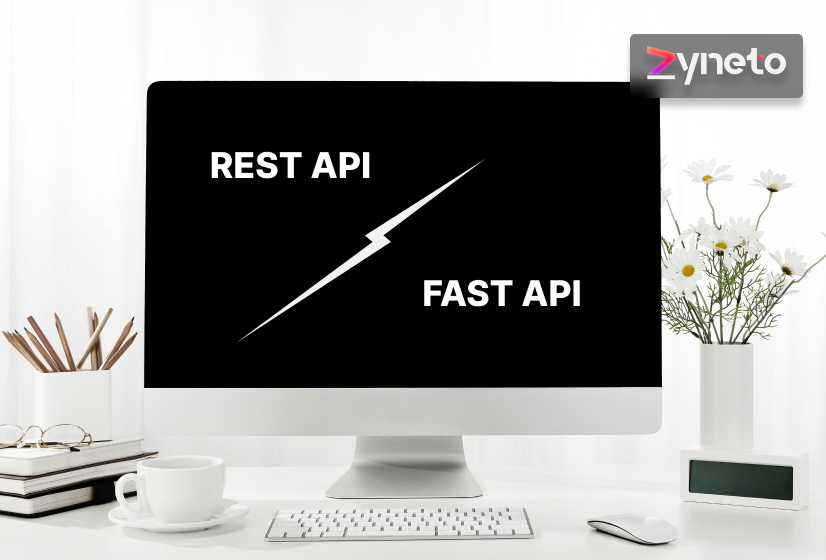
APIs are the backbone of modern digital products. From mobile apps and SaaS platforms to AI-powered tools and enterprise systems, everything communicates through APIs.
But when it comes to choosing the right backend approach, one question keeps coming up: REST API vs. FastAPI: which one should you choose?
If you’ve searched for “Is FastAPI better than REST API?” or “FastAPI vs REST performance comparison," you’re not alone.
Developers want speed and flexibility. Businesses want scalability and lower costs. Startups want rapid development. And enterprises want reliability.
A traditional REST API has been the industry standard for years, powering everything from e-commerce platforms to banking systems.
Meanwhile, FastAPI has rapidly gained popularity for building high-performance APIs with Python, especially in AI, machine learning, and real-time applications.
So what’s the real difference? Is FastAPI just another way to build a REST API, or is it a smarter, faster alternative?
In this complete guide, we’ll break down the key differences between REST API and FastAPI, compare performance, scalability, use cases, and security, and help you decide which approach is right for your project in 2026 and beyond.

When comparing FastAPI vs REST API, it’s important to first understand what a REST API actually is.
A REST API (Representational State Transfer Application Programming Interface) is an architectural style used to build web services that communicate over HTTP.
It allows different systems, like mobile apps, web apps, and servers, to exchange data in a standardized and scalable way.
Instead of being a specific framework, REST is a set of principles that guide how APIs should be structured.
For years, REST APIs have powered everything from e-commerce platforms to social media apps, making them the foundation of modern backend development.
When comparing FastAPI vs REST API, it’s important to understand that FastAPI is not a replacement for REST but a modern framework used to build RESTful APIs more efficiently.
FastAPI is a high-performance Python web framework designed for creating APIs quickly using standard Python type hints, making it a strong choice for FastAPI for Python API development in modern backend systems.
It is built on Starlette for web handling and Pydantic for data validation, making it extremely fast, reliable, and developer-friendly.
In the ongoing debate of FastAPI vs REST API, FastAPI stands out for its automatic documentation, async support, and speed, making it ideal for AI-driven, real-time, and high-performance applications.
When comparing FastAPI vs REST API, it’s important to clarify one thing: REST is an architectural style, while FastAPI is a modern Python framework used to build APIs (often RESTful ones).
The real difference between FastAPI and REST API lies in their nature; one defines principles, the other provides tools to implement them efficiently.
Below is a structured breakdown to help developers and businesses quickly understand where each approach stands.
REST API follows a resource-based architectural style built on HTTP constraints like statelessness, client-server separation, and uniform interfaces. It can be implemented using multiple frameworks such as Django, Flask, or Express.
FastAPI, on the other hand, is a high-performance framework built on ASGI and designed for asynchronous programming. It naturally supports FastAPI for microservice architecture, making it highly suitable for modern cloud-native systems.
One of the most searched topics is the FastAPI vs REST performance comparison. Traditional REST implementations are often synchronous, meaning each request is processed sequentially.
FastAPI supports asynchronous processing by default, enabling it to handle multiple requests concurrently. This results in faster response times, especially in high-traffic or real-time applications.
REST APIs require more manual configuration, validation setup, and documentation handling depending on the framework used.
FastAPI significantly reduces development time through:
This makes it extremely efficient for rapid backend builds and FastAPI for web development projects.
REST APIs are highly scalable when designed properly, especially in distributed systems.
FastAPI enhances scalability further due to:
It is particularly effective for startups and SaaS platforms expecting rapid growth.
Both REST APIs and FastAPI support robust security mechanisms such as:
FastAPI simplifies secure implementation with built-in dependency injection and automatic validation layers.
REST architectural principles are straightforward, but implementing them properly can vary depending on the framework used.
FastAPI is beginner-friendly for Python developers, but may requirean understanding of:
For developers familiar with Python, FastAPI is relatively easy to adopt.
REST has been around for decades and is supported by virtually every programming language and enterprise system. It has massive community backing.
FastAPI, although newer, has rapidly grown in popularity due to its performance and developer experience. It benefits from the broader Python ecosystem, including AI and machine learning libraries.
When discussing FastAPI vs traditional REST API, performance is often the deciding factor.
While REST defines architectural principles, performance largely depends on the framework implementing it.
FastAPI, built with asynchronous support at its core, is designed for speed and concurrency, making it highly competitive in modern backend environments:
Traditional REST implementations are usually synchronous, meaning each request waits for completion before handling the next.
This can slow down high-traffic systems. FastAPI uses asynchronous processing, allowing multiple requests to run concurrently.
This directly impacts FastAPI vs REST API scalability, especially in real-time apps and microservices.
Independent benchmarks consistently show FastAPI performing close to Node.js and Go in raw speed.
Thanks to ASGI and non-blocking I/O, it handles more requests per second compared to many traditional REST setups.
However, performance alone isn’t enough; teams must also consider FastAPI vs REST API security comparison when building production systems.
Performance becomes critical in AI inference, fintech transactions, streaming platforms, and SaaS products handling thousands of users simultaneously.
In these scenarios, the debate of FastAPI vs traditional REST API shifts toward concurrency, response time, and resource efficiency.
For modern, high-demand systems, FastAPI often delivers a measurable edge.
Many businesses consult a reliable Python development company when evaluating FastAPI vs REST API to ensure the chosen architecture aligns with long-term scalability goals.
When comparing developer experience, the discussion often extends beyond features to productivity and long-term maintainability.
While performance debates focus on speed, teams frequently evaluate FastAPI vs REST API scalability from a development workflow perspective, looking at how easy it is to build, extend, and maintain APIs as projects grow.
Traditional REST implementations can require boilerplate code, manual routing, validation logic, and configuration depending on the framework used.
FastAPI emphasizes clean, minimal code using Python type hints, reducing repetition and improving readability.
For teams choosing FastAPI for app development, the simplified syntax accelerates onboarding and reduces development friction.
With many REST frameworks, developers must manually configure Swagger or other documentation tools.
FastAPI automatically generates interactive API documentation (OpenAPI & Swagger UI) without extra setup.
This built-in feature significantly improves collaboration between frontend and backend teams while reducing documentation overhead.
Data validation in traditional REST setups often requires external libraries or custom logic.
FastAPI integrates validation directly using Pydantic models and Python type hints. This ensures cleaner code, fewer runtime errors, and predictable API behavior, making development faster and safer.
REST APIs can be tested effectively, but the setup varies across frameworks.
FastAPI’s structured typing, dependency injection, and automatic schema generation make debugging more straightforward.
The clear request-response structure simplifies unit testing and integration testing, especially for scalable modern applications.
Understanding when to use the REST API becomes crucial when building stable, long-term systems. Despite modern frameworks emerging, REST remains a dominant architectural style across industries.
Let’s explore practical use cases of REST API where it continues to deliver strong value:
One of the strongest use cases of REST API is within enterprise systems where multiple departments and services must communicate securely.
Its stateless architecture and standardized HTTP methods make it reliable for ERP platforms, banking software, and large corporate infrastructures.
Among common REST API use cases, integrating legacy systems with modern applications stands out.
REST allows older databases or enterprise tools to connect with newer web or mobile applications without complete system overhauls, ensuring smoother digital transformation.
A major REST API use case scenario is building public APIs for third-party developers.
Because REST follows universal web standards, it ensures predictable endpoints, easy documentation, and broad compatibility across platforms and programming languages.
In discussions around FastAPI vs REST API, REST often proves advantageous for globally distributed systems requiring long-term consistency.
When evaluating these two approaches, REST’s mature ecosystem and language-agnostic design make it dependable for multi-region enterprise architectures.
If you’re evaluating backend technologies and wondering when to use FastAPI, think speed, scalability, and modern Python development.
FastAPI is built for performance-driven applications that require clean architecture and rapid API delivery.
Here are the most impactful Use cases of FastAPI explained clearly:
One of the strongest use cases of FastAPI is high-performance systems.
Thanks to asynchronous support and non-blocking I/O, FastAPI handles thousands of concurrent requests efficiently.
It’s ideal for fintech platforms, SaaS dashboards, and high-traffic APIs where low latency is critical.
This is exactly when to use FastAPI, when performance directly impacts user experience and system reliability.
Among practical FastAPI use cases, serving AI and ML models stands out.
FastAPI integrates smoothly with Python-based ML libraries and supports large JSON payloads for model inference.
Whether you’re deploying recommendation engines or predictive analytics tools, this is clearly the time to use FastAPI for fast and scalable model-serving APIs, especially when building FastAPI for ML-powered web applications.
Another important area within the use cases of FastAPI is real-time apps.
With WebSocket support and async capabilities, FastAPI works well for chat platforms, live notifications, and streaming dashboards.
If instant data updates and responsiveness matter, this is definitely when to use FastAPI.
Modern distributed systems rely on lightweight APIs, making microservices one of the key FastAPI use cases.
It also accelerates MVP development for startups by reducing boilerplate and auto-generating documentation, proving again when to use FastAPI for scalable, future-ready backends.
Before choosing an architectural style for your backend, it’s important to understand the pros and cons of REST APIs in real-world scenarios.
REST (Representational State Transfer) is widely used because of its simplicity, scalability, and compatibility with HTTP standards.
However, like any technology, it has trade-offs. Evaluating the pros and cons of REST API helps teams decide whether it aligns with their performance, flexibility, and long-term scalability goals. Below is a clear comparison to help you make an informed decision.
|
Pros |
Cons |
|
Simple and easy to understand due to standard HTTP methods (GET, POST, PUT, DELETE). |
Over-fetching or under-fetching of data can occur in complex applications. |
|
Stateless architecture improves scalability and reliability. |
Multiple endpoints may be required for complex data retrieval. |
|
Works seamlessly across platforms and programming languages. |
Not ideal for real-time communication without additional technologies. |
|
Caching support improves performance for read-heavy applications. |
Versioning APIs can become challenging over time. |
|
Large ecosystem, strong community support, and mature tooling. |
Limited flexibility compared to query-based approaches like GraphQL. |
|
Easy integration with web and mobile applications. |
Handling very large payloads may affect performance. |
Understanding the pros and cons of REST API ensures you select the right approach for your system architecture.
While REST remains a dependable choice for many enterprise and web applications, analyzing the advantages & disadvantages carefully will help determine whether it fits your specific technical requirements.
Before choosing FastAPI for your backend project, it’s important to evaluate the pros and cons of FastAPI in practical development scenarios.
FastAPI has gained massive popularity for building modern, high-performance APIs with Python. It offers automatic documentation, strong data validation, and asynchronous request handling.
However, like any framework, it also comes with certain limitations depending on project complexity, team experience, and ecosystem maturity.
Understanding the pros and cons of FastAPI helps you decide whether it aligns with your technical goals, scalability needs, and long-term maintenance strategy.
|
Pros |
Cons |
|
Extremely high performance due to async support and Starlette foundation. |
Smaller ecosystem compared to older frameworks like Django. |
|
Automatic API documentation with Swagger UI and ReDoc. |
Requires understanding of async programming for advanced use. |
|
Built-in data validation using Pydantic. |
Not ideal for full-stack web apps with built-in admin panels. |
|
Faster development with less boilerplate code. |
Some third-party integrations are still evolving. |
|
Excellent for AI/ML model serving and microservices. |
Learning curve for beginners unfamiliar with type hints. |
|
Easy integration with modern frontend frameworks. |
Limited built-in authentication compared to mature frameworks. |
Analyzing the pros and cons of FastAPI ensures you make an informed architectural decision, especially when performance and rapid API development are key priorities.
When you’re choosing a backend approach, the debate around FastAPI vs REST API can feel confusing.
Are they competitors? Are they even comparable?
Here’s the simple truth. REST is an architectural style. FastAPI is a framework that can implement REST.
So when people say FastAPI vs REST API, what they’re really asking is:
“Should you use a modern Python framework like FastAPI, or stick with traditional REST implementations?”
Let’s break it down in a way that actually helps you decide.
If your business depends on high performance , think SaaS platforms, AI tools, analytics dashboards , FastAPI gives you serious advantages.
It supports asynchronous programming out of the box.
It’s fast. Very fast.
It automatically generates API documentation.
And it reduces development time.
If you want quicker launches and cleaner code, FastAPI makes your life easier.
REST works everywhere.
Every language.
Every platform.
Every enterprise system.
If your product needs to integrate with multiple third-party systems or legacy software, REST’s standardized structure makes integration predictable and stable.
That’s a big deal for enterprise environments.
If you're creating AI-powered tools, prediction engines, or automation platforms, FastAPI usually wins.
Why?
Because it’s Python-native.
And most AI frameworks are Python-based.
This makes development smoother and faster.
Both options work well in microservices.
But FastAPI’s lightweight nature makes it perfect for containerized environments like Docker and Kubernetes.
If scalability is on your roadmap, FastAPI helps you grow without friction.
When planning long-term infrastructure growth, teams also evaluate the cost to hire a FastAPI developer to ensure scalability aligns with budget expectations.
If you need:
FastAPI is a smart choice.
If you need:
REST remains reliable.
At the end of the day, the real FastAPI vs REST API decision depends on your business goals.
What are you building?
Who will use it?
How fast do you need to scale?
Answer those, and the choice becomes clear.

Choosing the right backend technology can shape the future of your product.
That’s where the right technical partner makes all the difference.
At Zyneto, the focus isn’t just on building APIs; it’s about building systems that are fast, scalable, and ready for growth. As a FastAPI development company, the team understands how performance, clean architecture, and rapid deployment directly impact your business success.
If you’re launching a SaaS platform, an AI-powered solution, or a high-traffic application, you need more than basic development. You need speed. You need flexibility. You need a backend that won’t slow you down six months from now.
FastAPI makes that possible.
With its async capabilities, automatic documentation, and high-performance execution, it offers a modern foundation for serious digital products. And when implemented correctly, it reduces technical debt while improving scalability.
Zyneto helps you:
The goal is simple.
You focus on growing your business.
Zyneto ensures your backend is powerful enough to support it.
Choosing between REST and FastAPI isn’t about picking a winner , it’s about picking what fits your vision.
If you value universal compatibility, mature ecosystems, and long-term enterprise stability, REST remains a dependable foundation.
But if speed, async performance, AI integration, and rapid development matter more to your roadmap, FastAPI clearly stands out.
The real difference in the REST API vs FastAPI discussion comes down to how modern, scalable, and performance-driven your product needs to be.
For startups, SaaS platforms, and AI-powered systems in 2026 and beyond, FastAPI often provides the edge.
Evaluate your traffic expectations, integration needs, and growth plans carefully.
Because the right backend choice today determines how confidently you scale tomorrow.
The main difference is that REST is an architectural style, while FastAPI is a modern Python framework used to build RESTful APIs. In the FastAPI vs. REST API comparison, REST defines principles, and FastAPI provides tools to implement them efficiently with high performance.
In many cases, yes. FastAPI supports asynchronous processing by default, allowing it to handle multiple requests concurrently. Traditional REST implementations are often synchronous, which can impact performance under heavy traffic.
You should choose REST when you need broad language compatibility, legacy system integration, or enterprise-grade standardization across multiple platforms.
Yes. FastAPI works well for enterprise systems, especially those requiring scalability, microservices architecture, or AI/ML integrations.
For startups prioritizing rapid development, performance, and scalability, FastAPI is often the better choice. However, the right decision depends on your technical requirements and long-term business goals.

Vikas has around fifteen years of experience building software and now builds generative AI systems at Zyneto. His work covers retrieval augmented generation, agentic AI, knowledge graphs, AI memory, and the evaluation and guardrails that decide whether any of it is safe to put in front of customers. He has shipped enterprise copilots, document AI, chatbots and predictive analytics for e-commerce, fintech and marketing teams, and works day to day in Python, JavaScript and SQL. He follows multimodal models, business process automation and enterprise AI security closely, and mentors engineers moving into AI. He writes about architecture, inference cost and the failure modes that only show up at production scale.
Share your details and we will talk soon.
Be the first to access expert strategies, actionable tips, and the trends actually shaping the digital world. No fluff - just practical insights delivered straight to your inbox.
Dive into our blog and stay ahead of the curve with expert perspectives, future-ready trends, and tech tips written for decision-makers and doers alike.