Django vs Spring Boot: All You Need to Know


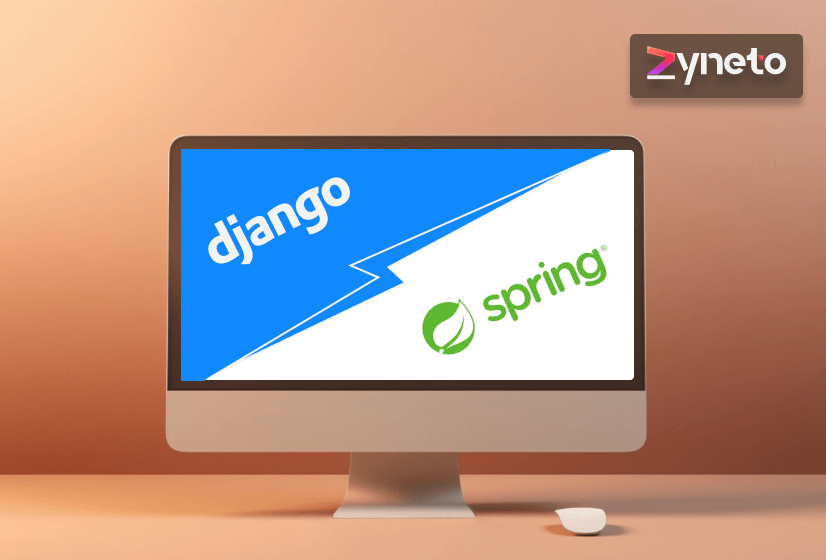
Let's be real, picking the wrong framework can cost you months of rework and thousands in development dollars.
That's exactly why the Django vs Spring Boot debate matters so much, especially if you're an investor or business owner evaluating which technology stack to back.
Both frameworks are battle-tested, production-ready, and trusted by some of the world's biggest companies.
But they're built on very different philosophies, and the "right" choice depends entirely on your project's goals, your team's skill set, and how fast you want to ship.
In this guide, you'll get a straight-talking, no-fluff comparison of Django (Python) and Spring Boot (Java).
We're talking performance, scalability, security, development speed, real-world use cases, everything you need to make a confident decision.
Let's dive in:
Django is a high-level Python web framework that was released in 2005. It was built with one core idea: help developers with web development quickly, with less code, and without reinventing the wheel every single time.
The Django team describes it as "the web framework for perfectionists with deadlines," and honestly, that sums it up perfectly.
It comes with a rich set of built-in tools, including the following:
• An ORM (Object Relational Mapper) to talk to databases without writing raw SQL
• A built-in admin dashboard, ready to use out of the box
• Authentication, form handling, and template rendering are all included
• Django REST Framework (DRF) for building powerful APIs
Companies like Instagram, Pinterest, Disqus, and National Geographic have all built on Django. It's especially a popular choice for mobile app development services in the startup world because you can go from idea to working product incredibly fast.
If your team knows Python, and increasingly, most modern development teams do, Django is an extremely natural choice.
Spring Boot is a Java-based framework that extends the Spring ecosystem, released by Pivotal (now VMware) in 2014. It was designed to remove the painful boilerplate configuration that plagued traditional Spring development.
Before Spring Boot, setting up a Java web application meant wrestling with mountains of XML configuration files. Spring Boot changed that by offering "convention over configuration", sensible defaults that you can override when needed.
Spring Boot gives you:
• Embedded server support (Tomcat, Jetty, Undertow) , no separate server setup needed
• Auto-configuration to reduce manual setup drastically
• Production-ready features like health checks and metrics out of the box
• Excellent support for microservices architectures
• Seamless integration with the broader Spring ecosystem
Netflix, Amazon, LinkedIn, and many Fortune 500 companies run Spring Boot in their backend systems. When you need enterprise-grade performance, compliance, and long-term maintainability, Spring Boot is a serious contender.
Before we go deep on each area, here's a bird's-eye view of how Python Django vs Java Spring Boot compare on the most critical dimensions:
|
Feature |
Django (Python) |
Spring Boot (Java) |
|
Primary Language |
Python |
Java |
|
Release Year |
2005 |
2014 |
|
Architecture Style |
Monolithic (MVT) |
Microservices / Monolithic |
|
Learning Curve |
Gentle, beginner-friendly |
Steeper enterprise-focused |
|
Development Speed |
Very fast |
Moderate |
|
Raw Performance |
Good |
Excellent |
|
Scalability |
Good (with effort) |
Excellent (native) |
|
Built-in Admin |
Yes, out of the box |
No, requires third-party tools |
|
Best For |
Startups, MVPs, data apps |
Enterprise, microservices, high-traffic |
|
Community Size |
Large (Python ecosystem) |
Very Large (Java ecosystem) |
|
Typing |
Dynamic (Python) |
Static (Java) |
|
Cost of Talent |
Generally lower |
Generally higher |
Now let's break down each of these dimensions in detail.
This is one of the most debated topics whenever spring boot vs django performance comes up in developer communities, and for good reason.
Here's the honest truth: Spring Boot is generally faster in raw benchmark tests.
Java is a statically typed, compiled language. That means the JVM (Java Virtual Machine) has already done a lot of optimization work before your code even runs.
Spring Boot applications can handle a very high number of requests per second with low memory overhead per request, especially with reactive programming using WebFlux.
Python, on the other hand, is dynamically typed and interpreted. Django runs synchronously by default (though async support has been improving since Django 3.1+).
In a head-to-head Django vs. Spring Boot benchmark, Spring Boot often wins, sometimes even with a small margin.
But here's what investors should actually care about: performance in isolation rarely determines business success.
If your app spends 90% of its time waiting on database queries, network calls, or third-party API responses, the raw speed difference between the frameworks becomes largely irrelevant.
Both Django and Spring Boot can handle millions of requests per day when properly architected.
The spring boot vs django performance conversation also needs to include infrastructure costs.
A well-optimized Django app running on fewer servers may be cheaper to operate than a Spring Boot app that needs beefier hardware to run the JVM.
Bottom line: If raw throughput at massive scale is a hard requirement from day one, Spring Boot wins.
If you're building a typical web application with standard traffic patterns, Django's performance is more than sufficient.
When developers talk about django vs spring boot for microservices, scalability is usually at the center of the conversation.
Spring Boot was practically built for microservices. Its deep integration with Spring Cloud, Kubernetes, Docker, and service mesh technologies makes it the natural choice if you're planning a distributed architecture from the start.
Each microservice can be independently deployed, scaled, and updated, and Spring Boot's tooling makes this relatively straightforward.
Django, on the other hand, tends to shine in monolithic architectures. It can absolutely be scaled horizontally; Instagram scaled Django to serve billions of users, but it takes deliberate architectural choices.
You'll typically need to:
• Use Celery for async task processing
• Add caching layers with Redis or Memcached
• Separate read and write databases
• Implement proper load balancing
Can Django scale to enterprise levels? Absolutely yes. But does it do it as naturally out of the box as Spring Boot? Not quite.
For startups and growing businesses, Django's scalability is more than adequate and lets you move much faster in the early stages.
For enterprise-grade systems that expect to decompose into dozens of microservices, Spring Boot gives you a head start.
Security is non-negotiable, whether you're building a mobile app, an e-commerce platform, or an internal business tool.
Both frameworks take security seriously, but they approach it differently.
Django comes with security batteries included. Out of the box, you get protection against the following:
• SQL Injection , Django's ORM automatically parameterizes queries
• Cross-Site Scripting (XSS) , Template engine escapes HTML by default
• Cross-Site Request Forgery (CSRF) , Built-in CSRF middleware enabled by default
• Clickjacking , X-Frame-Options header support included
• Session security , signed cookies, and secure session management
Django's philosophy is "secure by default." You have to actively opt out of protections, which makes it harder to accidentally leave vulnerabilities open.
Spring Security is one of the most powerful and comprehensive security frameworks in existence. It gives you:
• Extremely granular control over authentication and authorization
• OAuth2 and OpenID Connect support
• JWT (JSON Web Token) integration
• Method-level security annotations
• Built-in protection against CSRF, XSS, and injection attacks
The trade-off? Spring Security has a steep learning curve. Misconfiguration is a real risk if your team doesn't have deep Java security experience. Django's simpler defaults make it less likely that a junior developer accidentally ships a security hole.
For industries like banking, healthcare, and government, where compliance and audit trails are critical, Spring Boot's granular security controls often make it the preferred choice.
If you're an investor asking, "How fast can we get to market?" this section is for you.
Django wins on development speed. It's not even close.
When comparing prototyping time, Spring Boot vs Django shows a clear gap. Django's Python syntax is concise and readable.
The built-in admin panel means you can have a fully functional back-office interface without writing a single line of frontend code.
The ORM handles database operations elegantly. The project structure guides developers toward good patterns by default.
A typical MVP built with Django can be production-ready in weeks. The equivalent Spring Boot application often takes months, not because Spring Boot is bad, but because Java is more verbose by nature, and enterprise Java patterns add layers of abstraction that take time to implement correctly.
The learning curve follows the same pattern. Python is widely considered one of the easiest programming languages to learn. Django's documentation is exceptional. Junior developers can become productive relatively quickly.
Java, while powerful, is more verbose. Spring Boot adds a lot of magic under the hood (auto-configuration, dependency injection, AOP) that developers need to understand deeply to debug and extend. Hiring senior Spring Boot developers is also more expensive and harder than hiring Django developers.
If your priority is speed to market, Django is the clear choice. If you're building a team for the long haul and need Java expertise anyway (perhaps for other parts of your system), Spring Boot's learning curve becomes a one-time investment.
Here are some pros and cons of Django we are going to explore:
• Incredibly fast development , you can ship features quickly
• Python ecosystem , Access to world-class ML, AI, and data science libraries
• Built-in admin panel saves weeks of work
• Batteries-included philosophy has less integration overhead
• Gentler learning curve, easier to hire for and onboard
• Excellent Django REST Framework for building APIs
• Lower development costs overall
• Proven at scale , Instagram, Pinterest, and more
• Python's GIL (Global Interpreter Lock) limits true multi-threading
• Monolithic architecture can become harder to decompose at a large scale
• Async support is improving but still maturing compared to Java
• Not the natural first choice for microservices
• Dynamic typing can lead to runtime errors that static typing catches at compile time
Let’s explore the pros and cons of Spring Boot:
• Superior raw performance for CPU-intensive workloads
• Excellent for microservices architecture
• Enterprise-grade features and compliance-friendly
• Static typing catches bugs early at compile time
• Rich ecosystem for distributed systems (Spring Cloud, Kafka, etc.)
• Highly mature and battle-tested in large enterprise environments
• Excellent tooling support (IntelliJ IDEA, Spring Initializr, etc.)
• Steeper learning curve , takes longer to onboard new developers
• Java is more verbose. Development takes longer
• Heavier memory footprint due to JVM
• No built-in admin panel , you build everything yourself
• Hiring senior Spring Boot developers is more expensive
• Configuration can get complex in large projects
• You need to launch an MVP or prototype quickly and validate your idea
• Your team is Python-first, or you want to leverage AI/ML capabilities alongside your web app
• You're building a content-heavy site, a SaaS product, or an internal business tool
• Budget is a constraint, and you need to maximize developer productivity
• You need a powerful built-in admin panel without custom development
• You're building a Django REST Framework-powered API backend for a mobile or React app
• Your traffic patterns are predictable, and scale can be managed incrementally
Whichever comparison brings you here, Flask vs. Django or Spring Boot vs. Node.js vs. Django, then Django wins on speed, simplicity, and ecosystem maturity.
• E-commerce platforms
• News and media websites
• Data-driven dashboards and analytics tools
• Healthcare and education portals
• Internal enterprise tools and admin systems
• You're building enterprise-grade software for a large organization
• Microservices architecture is required from the start
• Your system needs to handle massive concurrent traffic
• The codebase will be maintained by a large team over many years
• You need fine-grained security controls and compliance features
• Your team already has strong Java expertise
• You're integrating with legacy Java systems
In the Rails vs Django vs Spring Boot comparison, Spring Boot consistently comes out on top for long-term enterprise maintainability and scalability in distributed architectures.
• Banking and financial services platforms
• Large-scale e-commerce systems with complex business logic
• Healthcare systems requiring HIPAA compliance
• Real-time trading platforms
• Enterprise resource planning (ERP) systems
Here's the straightforward answer you've been waiting for.
If you're an investor or business founder trying to bring an idea to life quickly, validate a market, or build a data-intensive web application, Django is almost certainly your better starting point.
It's faster to build with, cheaper to develop, easier to find developers for, and backed by one of the most versatile ecosystems in software (Python).
The Django vs Spring Boot comparison of 2025 shows that Django continues to grow in popularity, especially as Python's dominance in AI and data science makes it the default language for many modern tech teams.
If you're scaling an enterprise system, building a platform that will need to decompose into dozens of microservices, or you already have a Java-heavy organization, Spring Boot is worth every bit of the upfront investment.
The Spring Boot vs. Django market shows Java remaining dominant in enterprise contexts precisely because of the reliability, performance, and ecosystem maturity it provides.
One more thing worth noting: the Django vs. Spring Boot Reddit discussions and developer forums overwhelmingly show that neither framework is universally better.
The best framework is the one that matches your team's skills, your project's requirements, and your business timeline.
Choosing between Django and Spring Boot is only half the battle; executing it well is where most projects succeed or fail.
As a trusted Django development company with deep expertise in Spring Boot as well, Zyneto helps you cut through the confusion and pick the stack that actually fits your project, not just the one that's trending.
Whether you need Django's rapid development for an MVP or Spring Boot's enterprise muscle for a large-scale system, we've got the hands-on experience to back it up.
We don't just write code; we ask the right questions, architect for growth, and deliver solutions built for real-world pressure.
Ready to build something that lasts? Let's talk
The Python Django vs. Java Spring Boot debate doesn't have a single winner, and that's actually good news for you.
Django gives you speed, simplicity, and a rapid path to market. Spring Boot gives you power, scalability, and enterprise-grade robustness. Both are excellent frameworks with proven track records and large communities.
Your job is to match the right framework to the right problem, and if you've read this far, you're already equipped to do that.
Still unsure which one is right for your specific project? Don't guess. Talk to the experts.
Not in raw benchmarks. Spring Boot generally outperforms Django in throughput for CPU-intensive workloads. However, for typical I/O-bound web applications, the difference is much smaller and often irrelevant to business outcomes. The Django vs Spring Boot benchmark gap matters at a very large scale; for most apps, both perform well within acceptable limits.
Spring Boot is the stronger choice for microservices. It was built with distributed systems in mind and integrates natively with the Spring Cloud ecosystem, Kubernetes, and container-based infrastructure. Django can work in a microservices setup, but requires more effort to configure correctly.
Django is significantly easier to learn, largely because Python is more beginner-friendly than Java. A motivated developer with no prior framework experience can become productive in Django much faster. Spring Boot's complexity, especially its reliance on dependency injection, AOP, and Java conventions, takes longer to master.
Yes. Instagram (1 billion+ users), Pinterest, and Disqus are all built on Django at enterprise scale. The key is proper architectural decisions: caching, async task queues, horizontal scaling, and database optimization. Django itself is not the limitation; poor architecture is.
Both have strong, active communities. Django benefits from the booming Python ecosystem and growing adoption in AI/ML teams. Spring Boot benefits from decades of Java enterprise development. In terms of Stack Overflow questions, GitHub repositories, and third-party libraries, both are extremely well-supported.

Vikas has around fifteen years of experience building software and now builds generative AI systems at Zyneto. His work covers retrieval augmented generation, agentic AI, knowledge graphs, AI memory, and the evaluation and guardrails that decide whether any of it is safe to put in front of customers. He has shipped enterprise copilots, document AI, chatbots and predictive analytics for e-commerce, fintech and marketing teams, and works day to day in Python, JavaScript and SQL. He follows multimodal models, business process automation and enterprise AI security closely, and mentors engineers moving into AI. He writes about architecture, inference cost and the failure modes that only show up at production scale.
Share your details and we will talk soon.
Be the first to access expert strategies, actionable tips, and the trends actually shaping the digital world. No fluff - just practical insights delivered straight to your inbox.
Dive into our blog and stay ahead of the curve with expert perspectives, future-ready trends, and tech tips written for decision-makers and doers alike.