Smart Contracts vs Traditional Contracts: Everything You Need to Know


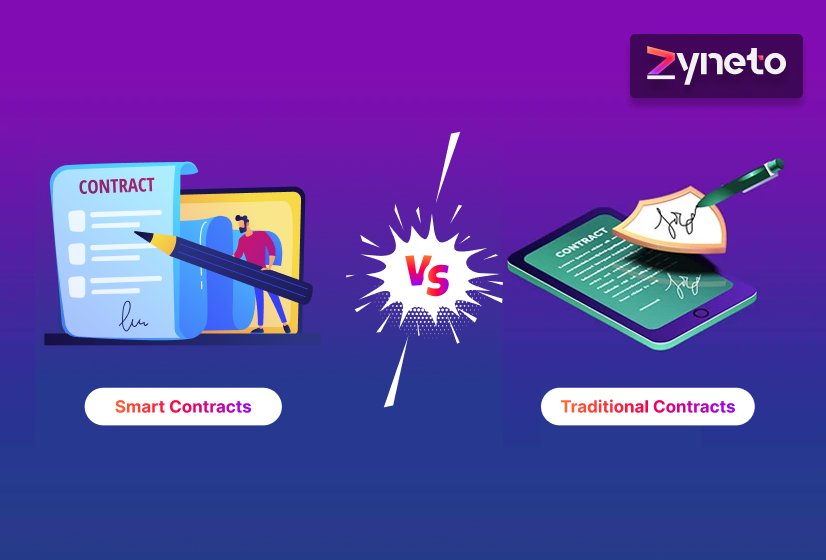
Contracts have always been the backbone of how agreements get made in business, real estate, employment, and almost every deal you can think of.
But for centuries, contracts looked the same: paper, signatures, lawyers, and a whole lot of waiting.
Then came blockchain technology, and with it smart contracts.
Now, you're probably wondering, what's the real difference between a smart contract and a traditional one? Which one is better? And does one replace the other entirely?
This guide breaks it all down for you in plain language.
Whether you're a business owner, a developer, or just someone curious about where contracts are headed, you'll walk away with a clear picture of both worlds, what they do well, where they fall short, and how they might work together in the future.
Let's get into it.

A traditional contract is a legally binding agreement between two or more parties, typically written on paper or in a digital document and signed by everyone involved.
It outlines the terms of an agreement, who does what, when, how much, and what happens if someone doesn't hold up their end.
Courts recognize and enforce these agreements, which is a big part of why they've been the standard for so long.
Here's how a typical traditional contract flows:
One party drafts the terms. The other reviews and negotiates. Both sign,either on paper or electronically. If something goes wrong, the injured party takes the matter to court or arbitration.
A lawyer is usually involved somewhere in that process, especially for high-value deals.
The whole thing is heavily dependent on human involvement at every step drafting, reviewing, signing, and enforcement all require people to take action.
You probably encounter traditional contracts more often than you realize. For ex:
A legal contract vs smart contract comparison really starts here: traditional contracts are built for human relationships, human negotiations, and human enforcement.
A smart contract is a self-executing program stored on a blockchain. Instead of relying on a middleman or a court to enforce an agreement, the code does it automatically when specific conditions are met.
For example, a smart contract can automatically release a payment once a product is delivered, transfer ownership after verification, or trigger a transaction when predefined requirements are fulfilled. This automation helps reduce delays, minimize manual work, and improve transparency in business processes.
Most blockchain development services today include smart contract creation as a core offering, covering everything from writing the code to auditing it before launch.
Smart contracts run on blockchain networks like Ethereum. The terms of the agreement are written directly into code. When the pre-set conditions are triggered, say, a payment is received or a delivery is confirmed, the contract executes itself immediately.
No waiting. No middleman. No manual processing.
Everything is recorded on the blockchain, which means it's transparent, timestamped, and nearly impossible to tamper with.
A smart contract typically has three core elements:
Smart contract use cases are growing fast. From decentralized finance (DeFi) platforms to insurance payouts to NFT transactions, they're already reshaping how value is exchanged online.
Here's a quick side-by-side to give you a clear picture before we go deeper.
|
Feature |
Traditional Contracts |
Smart Contracts |
|
Execution |
Manual |
Automatic |
|
Enforcement |
Courts / Legal system |
Code / Blockchain |
|
Speed |
Days to weeks |
Seconds to minutes |
|
Cost |
High (legal fees, admin) |
Low (mostly gas fees) |
|
Transparency |
Limited |
Full (on-chain) |
|
Flexibility |
High |
Low (once deployed) |
|
Legal Recognition |
Globally established |
Varies by jurisdiction |
|
Error Risk |
Human error possible |
Code bugs possible |
|
Intermediaries |
Yes (lawyers, notaries) |
No |
|
Accessibility |
Can be geographically limited |
Global |
This smart contract vs traditional contracts overview makes one thing clear: both have their strengths depending on what you're trying to achieve.
Before jumping on the bandwagon to create a smart contract, it’s important for you to know the difference between smart contracts and traditional contracts:
Traditional contracts depend on people to act. Someone has to initiate payment, file paperwork, or complete a task, and then another person verifies it.
Smart contracts skip all of that. The moment conditions are met, the contract runs itself. It's faster, cleaner, and removes the dependency on any single party taking action.
With a traditional contract, enforcement means going to court if something goes wrong. That's expensive, slow, and uncertain.
Smart contracts enforce themselves. There's no judge needed because the outcome is baked into the code. If condition A is met, result B happens, every time, automatically.
Traditional contracts are private documents. The parties involved see them, but no one else does unless there's a dispute.
Smart contracts live on a public blockchain. Anyone can see the terms and verify that they were executed correctly. This level of openness builds trust without requiring you to trust any single party.
Physical contracts can be lost, forged, or altered. Even digital ones can be tampered with.
Blockchain-based smart contracts are secured by cryptography and distributed across thousands of nodes. Once recorded, they're almost impossible to change without the network's consensus.
Traditional contracts involve lawyers, notaries, administrative overhead, and time. Those costs add up fast.
The smart contract implementation cost usually includes a one-time deployment fee, commonly known as a gas fee on blockchain networks like Ethereum, along with minimal ongoing maintenance expenses.
As transaction volume grows, businesses can significantly reduce operational costs through automation and fewer manual processes.
A traditional contract might take days or weeks to finalize, sign, and execute, especially across borders.
Smart contracts can execute in seconds. That speed is a game-changer in industries where timing matters, like finance and trading.
Here's where traditional contracts win. You can negotiate, amend, add clauses, and adapt them to almost any situation.
Smart contracts are rigid by design. Once deployed, changing them is difficult and sometimes impossible without creating a new contract entirely.
Traditional contracts are bound by geography. Laws differ by country, enforcement varies, and cross-border deals can get complicated fast.
Smart contracts run on decentralized networks that have no borders. Two parties on opposite sides of the world can transact with the same speed and security as two people in the same city.
Traditional contracts are vulnerable to human error vague language, missing clauses, or one party misunderstanding the terms.
Smart contracts are vulnerable to coding errors. A bug in the code can lead to unintended outcomes, and since the contract executes automatically, there's no human to catch the mistake before it happens.
The future of smart contracts depends heavily on solving this challenge making the code as airtight as the legal language in the best traditional contracts.
Before making your decision, we will suggest you take a look at the advantages of smart contracts:
The biggest win is removing the need for anyone to manually trigger execution. Payment released automatically when goods are delivered? Done. Royalties paid the moment a song is streamed? Done. Smart contracts make this seamless.
No lawyers, no notaries, no middlemen eating into your margins. The savings from cutting out intermediaries are significant, especially at scale.
What takes days with paperwork takes seconds on the blockchain. For global transactions, this speed difference is enormous.
Smart contracts are encrypted, decentralized, and immutable. That combination makes them among the most tamper-resistant ways to record and execute agreements.
Every transaction on a public blockchain is visible and verifiable. There are no accusations or misunderstandings; the code and the ledger are the record.
Now, understand first the advantages or benefits of traditional contracts and why they sustained for so long:
This is the big one. Traditional contracts are recognized in courts around the world. If someone breaks the terms, you have clear legal recourse. That's a massive advantage in high-stakes situations.
You can negotiate every detail and add riders, exceptions, and special clauses. Traditional contracts can handle nuance and complexity in a way that code currently can't.
Sometimes situations arise that no one anticipated. A traditional contract allows courts and mediators to use common sense and context to resolve disputes fairly.
Smart contracts can't do that. They execute what the code says, even if the outcome seems unfair in hindsight.
Circumstances change. With a traditional contract, you can sign an amendment and update the terms. With a smart contract, that's much harder or impossible once it's deployed.
Get to know the limitations of smart contract below:
Bad code leads to bad outcomes. There have been high-profile cases where bugs in smart contracts led to millions of dollars being lost or stolen. The code is only as good as the developer who wrote it.
Many jurisdictions don't have clear laws governing smart contracts. This creates uncertainty, especially for businesses that need legal protection.
The same feature that makes smart contracts secure also makes them problematic when you need to fix a mistake. Once deployed on the blockchain, changing the terms is a challenge.
Smart contracts can only act on data that lives on the blockchain. For anything that happens in the real world a weather event, a shipment delivery, a stock price they need oracles (external data feeds). If the oracle is wrong or compromised, the contract can execute based on bad data.
Below we are going to talk about the limitations of traditional contracts:
Everything requires human action. That creates bottlenecks, delays, and opportunities for things to fall through the cracks.
Legal fees, printing, storage, notarization, the overhead of managing traditional contracts adds up quickly, especially for businesses handling hundreds of agreements.
Waiting for signatures, approvals, and disbursements can stretch timelines to weeks. In a fast-moving business environment, that's a real disadvantage.
Vague language, missing signatures, or clerical mistakes can invalidate a contract or lead to disputes. Human involvement at every stage means human error is always possible.
In the debate of smart contracts vs. traditional contracts, let’s explore the use cases to understand better:
DeFi platforms use smart contracts to automate lending, borrowing, and trading without any bank involvement. Transactions happen 24/7, globally, in seconds.
Smart contracts can automatically release payments when goods are scanned at a checkpoint, reducing fraud and delays across complex supply chains.
Property transfers traditionally involve mountains of paperwork and weeks of processing. Smart contracts can streamline title transfers, escrow, and payment though legal frameworks are still catching up.
Parametric insurance is one of the most exciting applications. A smart contract can automatically pay out a flight delay claim the moment an airline confirms a delay no claims form needed.
Creators can encode royalty terms into smart contracts so they're paid automatically every time their work is used, streamed, or sold, without depending on platforms to honor those terms.
Smart contracts shine when:
If your use case fits one or more of these, smart contract technology is worth exploring seriously.
Stick with traditional contracts when:
For high-stakes, complex, or relationship-heavy agreements, traditional contracts remain the gold standard.
Absolutely, and this is where things get really interesting.
Many organizations are already using hybrid approaches. The core terms of an agreement are written in a traditional legal contract, while certain executable clauses like payment triggers or delivery confirmations are handled by a smart contract.
This gives you the legal protection and flexibility of a traditional contract, combined with the automation and efficiency of a smart contract.
Think of it as the best of both worlds. The legal framework protects you if something goes sideways. The code handles the routine stuff automatically.
As the legal industry catches up with blockchain technology, expect to see more of this hybrid model become standard practice.
The future isn't smart contracts replacing traditional contracts overnight. It's a gradual evolution, one where technology handles more of the routine, repetitive work while humans focus on the complex, judgment-heavy parts.
Governments are starting to recognize smart contracts legally. Some U.S. states, like Wyoming and Tennessee, have passed laws giving smart contracts legal standing. The EU is working on frameworks too.
At the same time, tools are emerging to make smart contract code more auditable and secure, reducing the risk of the bugs that have caused problems in the past.
The future of smart contracts is one of integration, not replacement. The most successful organizations will be those that know when to use which tool and how to combine them effectively.
Knowing about smart contracts is one thing; actually building and deploying them the right way is another.
That's where Zyneto comes in.
As a trusted smart contract development company, Zyneto helps businesses design, audit, and deploy smart contracts that are secure, efficient, and built for real-world use.
Whether you're looking to automate payments, streamline your supply chain, or launch a blockchain-based product, the team at Zyneto brings the technical expertise and business understanding to get it done right.
You don't have to figure it all out on your own. Zyneto makes the transition to smart contract technology straightforward, so you can focus on growing your business.
So, smart contracts vs traditional contracts, which one wins?
Neither entirely.
Smart contracts are faster, cheaper, and more transparent. They remove middlemen and automate processes that used to take days. For the right use case, they're genuinely transformative.
But traditional contracts offer something smart contracts can't yet match: legal recognition, flexibility, and the ability to handle the complex, human side of agreements.
The smartest approach isn't choosing one over the other. It's understanding both well enough to know when to use which and, increasingly, how to combine them.
As technology and regulation continue to evolve, the line between these two worlds will keep blurring. The organizations that adapt early will have a real competitive edge.
Whether you're a business owner, developer, or just someone trying to understand where contracts are headed, you're now better equipped to navigate that future.
It depends on where you are. In some jurisdictions, like certain U.S. states and parts of Europe, smart contracts are starting to receive legal recognition. In many places, though, the legal framework hasn't caught up yet. A hybrid approach, pairing a smart contract with a traditional legal agreement, is often the safest bet.
Not entirely. Lawyers bring judgment, context, and the ability to navigate disputes in ways that code simply can't. Smart contracts can reduce the need for lawyers in routine, repetitive transactions but for complex agreements, legal counsel remains essential.
They're highly resistant to tampering because of how blockchain works. However, they're only as secure as the code itself. Bugs and vulnerabilities have led to significant losses in the past. Auditing smart contract code before deployment is critical.
Finance, insurance, supply chain, real estate, and healthcare are seeing the biggest impact. Any industry where transactions are rule-based, high-volume, and benefit from transparency is a good candidate.
In most cases, no that's by design. Once a smart contract is deployed on the blockchain, it's immutable. Some contracts are built with upgrade mechanisms, but these add complexity and can introduce new vulnerabilities.

Vikas has around fifteen years of experience building software and now builds generative AI systems at Zyneto. His work covers retrieval augmented generation, agentic AI, knowledge graphs, AI memory, and the evaluation and guardrails that decide whether any of it is safe to put in front of customers. He has shipped enterprise copilots, document AI, chatbots and predictive analytics for e-commerce, fintech and marketing teams, and works day to day in Python, JavaScript and SQL. He follows multimodal models, business process automation and enterprise AI security closely, and mentors engineers moving into AI. He writes about architecture, inference cost and the failure modes that only show up at production scale.
Share your details and we will talk soon.
Be the first to access expert strategies, actionable tips, and the trends actually shaping the digital world. No fluff - just practical insights delivered straight to your inbox.
Dive into our blog and stay ahead of the curve with expert perspectives, future-ready trends, and tech tips written for decision-makers and doers alike.