AI Chatbots for Business: Types, Use Cases, and How to Build One That Works


Almost everyone has rage-typed "agent" at a chatbot that refused to fetch a human. That is the reputation AI chatbots for business carry, and honestly, a lot of it was earned. But the thing under the hood changed. Modern chatbots run on language models that understand what you meant, not just the keywords you typed, and the good ones actually solve problems. This guide covers what these tools can really do for a business now, the types worth knowing, where they pay off, and how to build one your customers do not immediately try to escape.
A chatbot holds a conversation. That part is old news. What changed is the brain behind it.
Older bots followed a script. Press 1 for billing. Type a keyword, get a canned line. That approach is genuinely old: ELIZA, written at MIT in 1966, ran on keyword matching and reflected your words back as questions, and the phone trees still irritating people 50 years later were doing the same thing with a longer script. Step off the path and the whole thing collapsed, which is how "sorry, I didn't understand that" turned into a punchline. Modern AI chatbots read intent instead. Ask the same question five different ways and it still knows what you are after. It can pull an answer from your help docs, keep track of a few messages of context, and reply in something close to plain human language.
That is the real leap. Not a slicker menu. An assistant that actually understands the question.
Three kinds turn up in business, and the differences are practical, not academic.
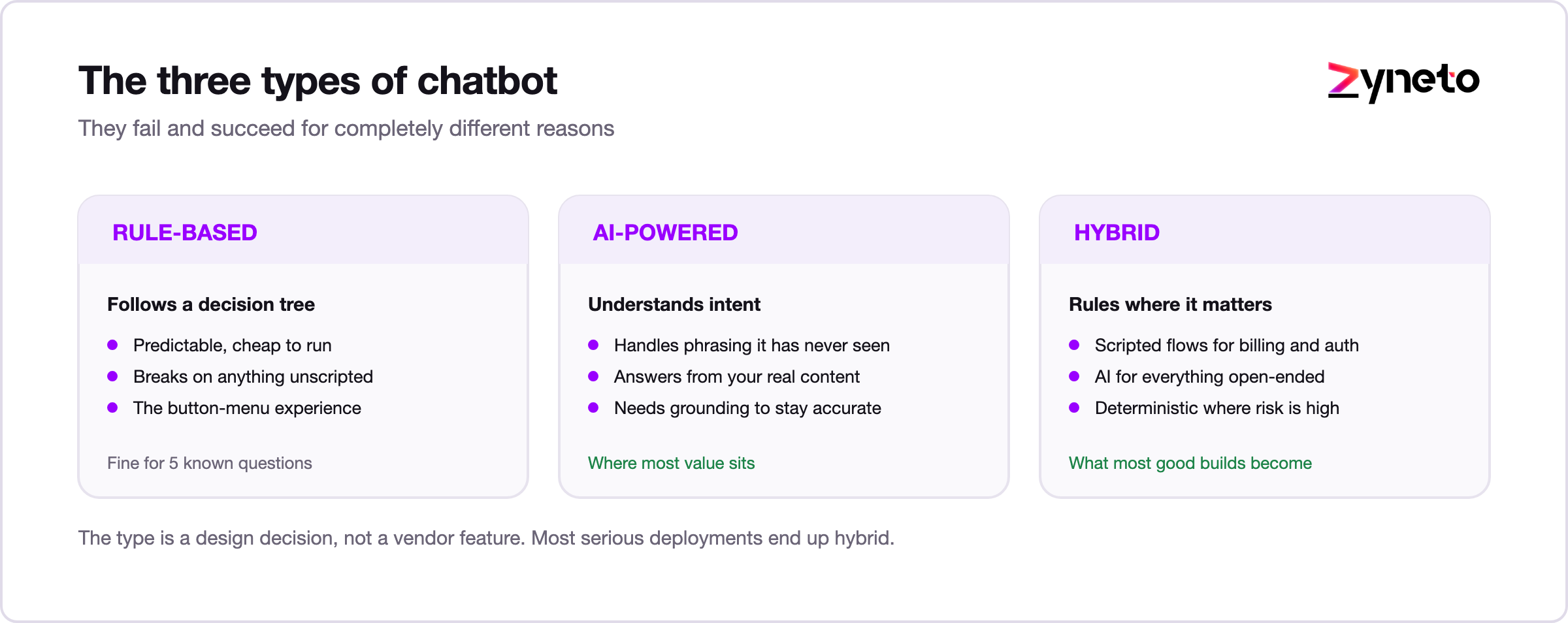
Rule-based bots follow fixed paths, usually buttons and menus. They are predictable, cheap, and fine for a short list of known questions. They also fall over the second a customer types something nobody planned for.
AI bots run on language models. They handle open questions, messy phrasing, and topics you never scripted. The catch: left ungrounded, they will invent an answer and sound certain doing it.
Hybrid bots are what most serious deployments actually are. Rules protect the flows that must not go wrong, like payments or account changes, and the AI takes everything open-ended. You get flexibility where it helps and control where it matters. If a vendor pitches you a pure rule-based bot today, keep walking. If they pitch pure AI with no guardrails, walk a little faster.
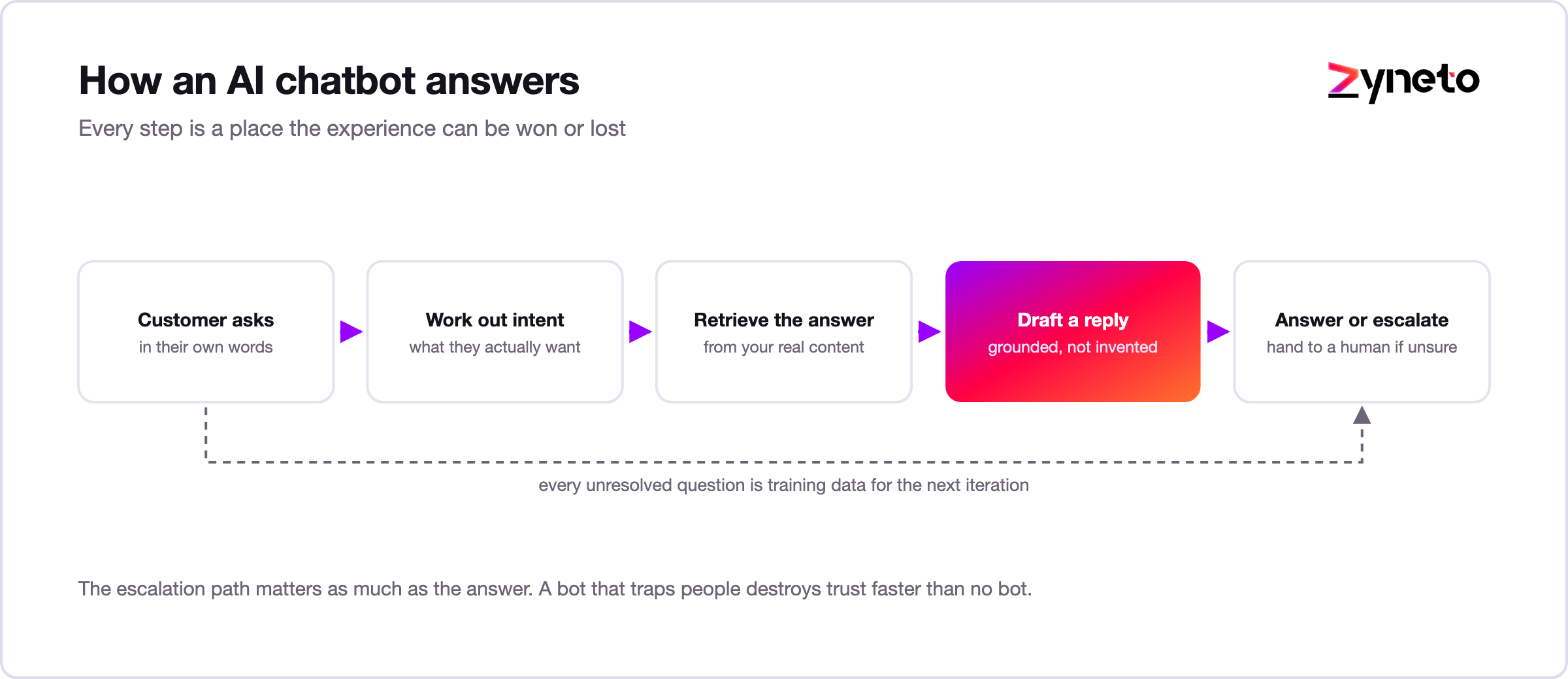
You do not need to build one to buy one well, but a rough mental model helps. Under the hood, a modern chatbot runs a short loop. First it reads the message and works out intent, what the person actually wants, using a language model rather than keyword matching. Then it fetches whatever it needs to answer, usually by retrieving the relevant passage from your help content or a record from your systems. Next it drafts a reply grounded in what it fetched, not in thin air. And finally it decides whether it is confident enough to send, or whether this one belongs with a human. The magic everyone talks about lives in that first step. The value everyone actually feels lives in the last two.
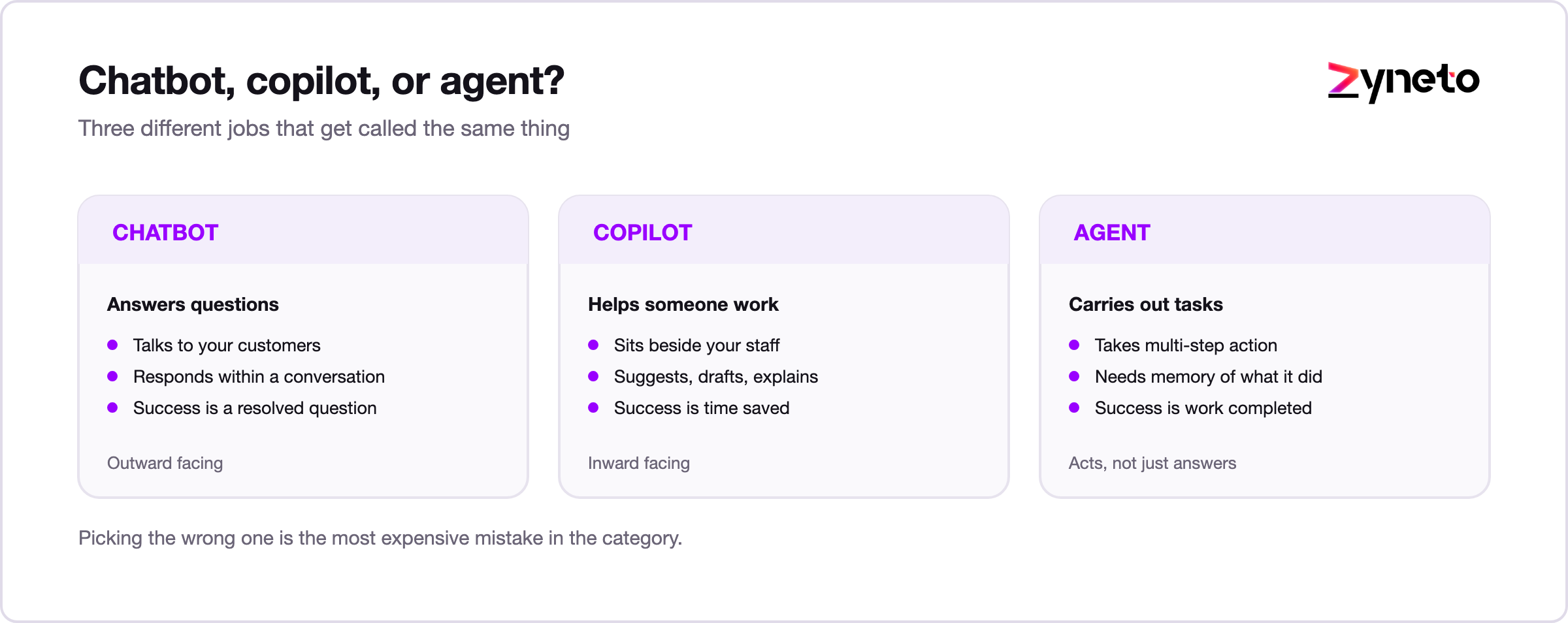
These three get muddled constantly. The short version: a chatbot talks to your customers, mostly to answer and resolve. A copilot rides inside a product and helps your employees as they work. An agent takes on a whole multi-step task and checks back in. They overlap, and a capable support chatbot can borrow agent-like tricks, but the job is different. We went deep on the other two in the guides to AI copilots for business and AI agents for business.
Here is the mistake that earned chatbots their bad name. It was a measurement mistake, not a technology one.
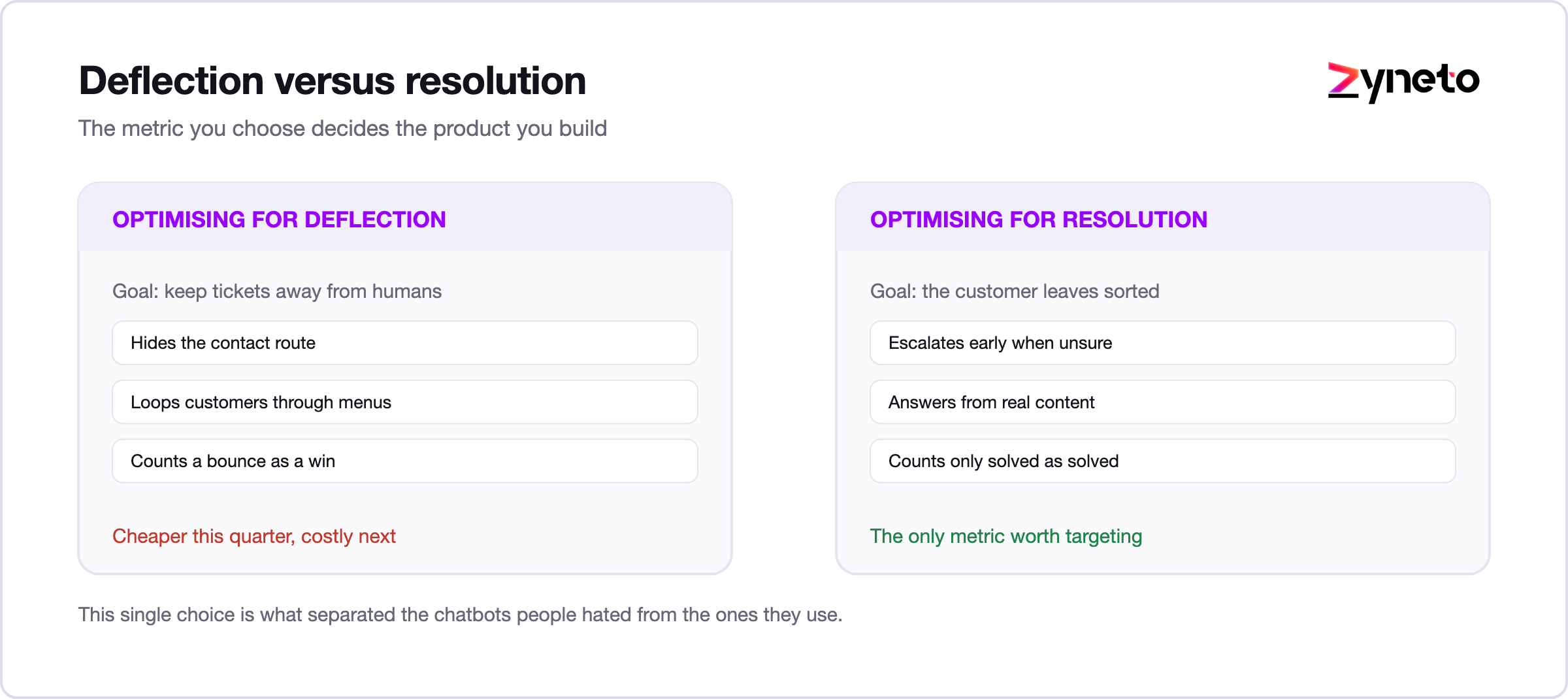
Companies measured deflection: how many people the bot kept from reaching a human. Big number, big celebration. Trouble is, a bot that blocks someone from support has "deflected" them whether it helped or not. So the dashboards glowed while customers quietly learned to type "agent" on sight.
The honest metric is resolution. Did the person leave with their problem actually handled? A chatbot built for resolution answers what it can, and when it cannot, it hands off to a human with the whole conversation attached, so nobody starts from scratch. Build for deflection and you save money this quarter and lose customers the next. Build for resolution and the savings are real, because the work actually got done.
They earn their keep wherever the same conversations repeat all day long. Four places stand out.
The obvious one, and still the biggest. The bot handles routine questions around the clock, checks an order, resets a password, explains a return policy, and hands the hard cases to a person who shows up already briefed on what was said. The win is not only cost. It is that a customer at midnight gets a real answer instead of a "we're closed" auto-reply and a day's wait.
Quieter, and often worth more than support. A bot on your site greets a visitor mid-question, answers the pre-sales things that would otherwise send them to a competitor, qualifies them with two questions that usually come down to budget and timeline, and books the meeting. Compare that to a contact form sitting there hoping someone fills it in, and the gap in captured interest is stark.
Scheduling, order status, address changes, appointment reminders, all handled in a chat window instead of a phone queue or a clunky portal. High frequency, low complexity, which is exactly the sweet spot.
The one people forget. Point a chatbot at your HR and IT knowledge and staff stop emailing around to ask how to reset a tool, where a policy lives, or how much leave they have left. It is customer support turned inward, and the same rules apply.
The pattern repeats every time. High volume, highly repetitive, and answerable from information you already own.
People pit these against each other, and it is the wrong fight. Live chat is a human on the other end. A chatbot is software. The strongest support setups run them together: the bot takes the first message and the repetitive volume, then hands off to live chat the moment a person is genuinely needed, with the whole conversation already in hand. The customer never has to know or care which one they are talking to from second to second. What they feel is a fast answer that turns into a human exactly when it should. Framed as bot versus human, you miss the point. The good experience is bot and human, stitched together so cleanly the seam does not show.
Worth walking one through, because "resolution" is easy to say and slippery to pin down.
A customer messages at 11 p.m.: "my order hasn't shipped and I need it by Friday." A scripted bot would offer a menu. A good AI chatbot reads the worry in that sentence, looks up the order, sees it is stuck, and says so plainly. It offers the one thing that helps, an expedited reship, confirms the Friday date, and does it. No menu tree. No "please rephrase." And if the fix needed a human, it would have pulled one in with the order details already loaded, so the customer never repeats themselves. That is the bar. Everything below it is the old chatbot wearing a new coat.
A chatbot is only useful where your customers already are. For most businesses that means the website, first and foremost, where a widget can catch a visitor mid-question. Plenty of audiences live on WhatsApp or Messenger instead, and with WhatsApp past 2 billion users that is simply where a lot of conversations already happen, so meeting them there beats forcing them to a web form. If you have your own app, an in-app assistant keeps support inside the product rather than bouncing people to email. Pick the one or two channels your customers actually use, and do those well, rather than spreading a thin bot across six.
The return comes from three places, and only one of them is headcount.
The first is time. Routine questions get handled without a person, so your team spends its hours on the messy cases that need judgment. The second is availability. A chatbot answers at 2 a.m. on a Sunday, which is exactly when a surprising amount of buying and frustration happens. The third is consistency. Every customer gets the same correct answer, drawn from your approved content, rather than whatever a tired agent half-remembered on a Friday.
To size it, take one high-volume conversation, count how often it happens and how long it takes today, and estimate how much a chatbot can carry while people keep the rest. Say it runs 400 times a week and takes 6 minutes each: that is 40 hours, a full-time person, spent on one repeated question. Prove one, and the next is an easy argument.
Keep the cost side honest too. A chatbot has a build cost and a running cost, because each conversation can call a model, so the numbers only work when the volume is real. On a low-traffic support line, a good help page may beat a bot outright. On a high-traffic one, the bot pays for itself quickly, and then keeps paying.
Most of the difference here is design, not the model.
Ground it in your content. A chatbot that answers from your real help docs and account data is genuinely useful. One that improvises is a liability with a smile. This is the same retrieval approach behind chatting with your documents, aimed at support.
Design the escalation first, not last. Decide exactly when the bot should give up, how it hands off, and make sure the human inherits the entire conversation. Nothing burns goodwill faster than re-explaining your problem to a person because the bot kept no notes.
Give it permission to say "I don't know." A bot that guesses to look helpful is worse than one that admits a limit and gets a human. Keep replies short, set the tone to match your brand, and let people reach a person whenever they ask, without a fight for it.
Scope it tightly at first. A bot that tries to answer everything answers most of it badly. Pick the topics it should own, be honest about the rest, and widen the scope as it earns the room. A narrow bot that nails its lane beats a broad one that fumbles all over the place.
And test it against real conversations before you turn it loose, not just the tidy path you planned for. The failures hide in the odd phrasings, the angry openings, and the questions your docs never covered. Find those in a test, not in front of a paying customer.
The safe way to launch is small and visible. Start with your top handful of questions, the ones that flood the queue, and let the bot handle only those while a person watches the transcripts. Prove it resolves them, then add the next batch. Say plainly, everywhere, that a human is one message away, because nothing sinks trust like feeling trapped in a loop. And keep a feedback habit running, since the transcripts tell you what to fix and what to add next. A chatbot is never really finished. It is a system you tend, and the ones that get better every month are the ones somebody is actually reading.
A customer-facing chatbot sees real customer data, which makes privacy a build requirement, not a footnote. It should only reach the records the current user is allowed to see, never spill one customer's details into another's chat, and handle personal data in line with rules like GDPR, in force since 25 May 2018 and carrying fines of up to 20 million euro or 4% of global annual turnover, whichever is higher. The EU AI Act adds a disclosure duty on top of that: it entered into force on 1 August 2024 and phases in over several years, and its transparency rules require that a system conversing with people makes clear they are talking to an AI rather than a colleague. Confirm which obligations are live on your launch date, because the phase-in dates have moved before. If it connects to your systems to check orders or accounts, those connections need the same access controls your staff work under. Plenty of companies also keep the whole thing inside their own cloud rather than routing customer conversations through a third party they cannot audit. A fair test of any vendor: ask how they handle this before you ask how clever the bot sounds.
Measure the outcome, not the dodge. Resolution rate is the headline: how often people leave with the problem actually solved. Pair it with customer satisfaction on chatbot conversations, and with how clean the handoffs are when it escalates. Watch the transcripts, too, especially the ones that ended badly, because that is where you learn what to fix. If the only number anyone reports is how many humans the bot blocked, you are measuring the wrong thing and the customers know it.
Chasing deflection instead of resolution. Launching with no clean route to a human. Letting an ungrounded model answer factual questions it will happily get wrong. Scripting every path and calling it AI. And the quiet killer: never reading the transcripts, so you never find out what it botches. None of these are exotic. They just get skipped to ship a week sooner.
Skip it when your volume is small, because the setup will cost more than it saves. Skip it for genuinely sensitive or complex conversations, where a person should lead from the first word. And if your help content is a mess, fix that before you automate answering from it, or the bot will serve your confusion politely and at scale. A chatbot suits high-volume, repeatable conversations grounded in solid information. Match it to that and it works. Force it anywhere else and it becomes the thing people rage-type "agent" at.
The line between a chatbot and an agent is thinning fast. The next wave does not just answer, it acts: processes the return, updates the address, reschedules the delivery, all inside the same conversation, with a human approving anything risky. That is a chatbot borrowing an agent's hands. It raises the stakes, because a bot that can do things needs tighter guardrails than a bot that can only talk. The teams that get grounding and escalation right today are the ones ready to hand their chatbot real actions tomorrow. Earn resolution first, then earn the right to act.
Modern AI chatbots are not the scripted menus everyone learned to resent. They read intent, answer from your content, and, built well, resolve real problems while handing the hard ones to a person with full context. Most business bots should be hybrid, grounded in your knowledge, designed around escalation, and judged on resolution rather than deflection. Take one high-volume conversation, build for a real outcome, and grow from there.
If you want a chatbot your customers do not try to skip, Zyneto builds AI chatbot development measured on resolution, with the grounding and escalation that make one worth deploying. Book a free consultation and we will start with the one conversation that floods your queue.
It is software that holds a conversation in natural language and, in its modern form, uses a language model to understand what a person means and answer them. Unlike old scripted bots, it handles questions it was never explicitly programmed for.
A rule-based bot follows fixed paths and buttons and breaks on anything unplanned. An AI chatbot reads intent and handles open-ended questions. Most business deployments are hybrid: rules for critical flows, AI for everything else.
Handle routine customer support around the clock, qualify and capture leads, manage bookings and order questions, and answer internal HR and IT queries, while routing the hard cases to a person.
When they are built for resolution and grounded in your content, yes. They save time on repetitive questions, answer outside business hours, and keep responses consistent. Built for raw deflection, they cost you customers.
A chatbot talks to your customers to answer and resolve. A copilot helps your employees inside a product. An agent completes a whole multi-step task on its own. They overlap, but the job differs.
No. They handle the repetitive volume and escalate anything complex or sensitive to a person, ideally with the full conversation attached. The goal is to free agents for the cases that need judgment, not to remove them.

Vikas has around fifteen years of experience building software and now builds generative AI systems at Zyneto. His work covers retrieval augmented generation, agentic AI, knowledge graphs, AI memory, and the evaluation and guardrails that decide whether any of it is safe to put in front of customers. He has shipped enterprise copilots, document AI, chatbots and predictive analytics for e-commerce, fintech and marketing teams, and works day to day in Python, JavaScript and SQL. He follows multimodal models, business process automation and enterprise AI security closely, and mentors engineers moving into AI. He writes about architecture, inference cost and the failure modes that only show up at production scale.
Share your details and we will talk soon.
Be the first to access expert strategies, actionable tips, and the trends actually shaping the digital world. No fluff - just practical insights delivered straight to your inbox.
Dive into our blog and stay ahead of the curve with expert perspectives, future-ready trends, and tech tips written for decision-makers and doers alike.