Dating App Development Challenges to Explore


So, you want to build a dating app.
Maybe you've got an idea that feels different from Tinder, Bumble, or Hinge.
Maybe you've noticed a gap in the market, a niche audience, a fresh matching approach, or a feature nobody else is offering.
That's exciting. Genuinely.
But here's the thing nobody tells you upfront: building a dating app is one of the trickiest categories in mobile app development.
It's not just about swiping cards and sending messages.
You're dealing with real people, real emotions, real safety concerns, and real trust issues.
One bad experience, a fake profile, a spam bot, a data leak, and users delete your app forever.
They don't come back. They don't give second chances.
That's why understanding the dating app development challenges before you start coding (or even before you hire a development team) is so important.
In this blog, you'll walk through the top dating app development challenges that founders and product teams face today.
You'll also see practical solutions for each one.
And by the end, you'll understand how a team like Zyneto can help you sidestep these problems entirely.
Let's get into it.
Let's break down the leading dating app challenges one by one. Some of these will feel obvious. Others might surprise you.
Either way, you need to know them before you invest time and money into your app.
This is probably the biggest headache in the dating app world right now.
You've probably experienced it yourself as a user: you match with someone, start chatting, and then realize it's not even a real person.
Fake profiles hurt trust.
And trust is literally the entire product when it comes to dating apps.
If people don't trust that they're talking to real humans, your app has no reason to exist.
Bots are also getting smarter.
They're no longer just broken English and stolen stock photos.
Some bots now use AI-generated images and even AI-generated conversations that sound eerily human.
You need multi-layered verification.
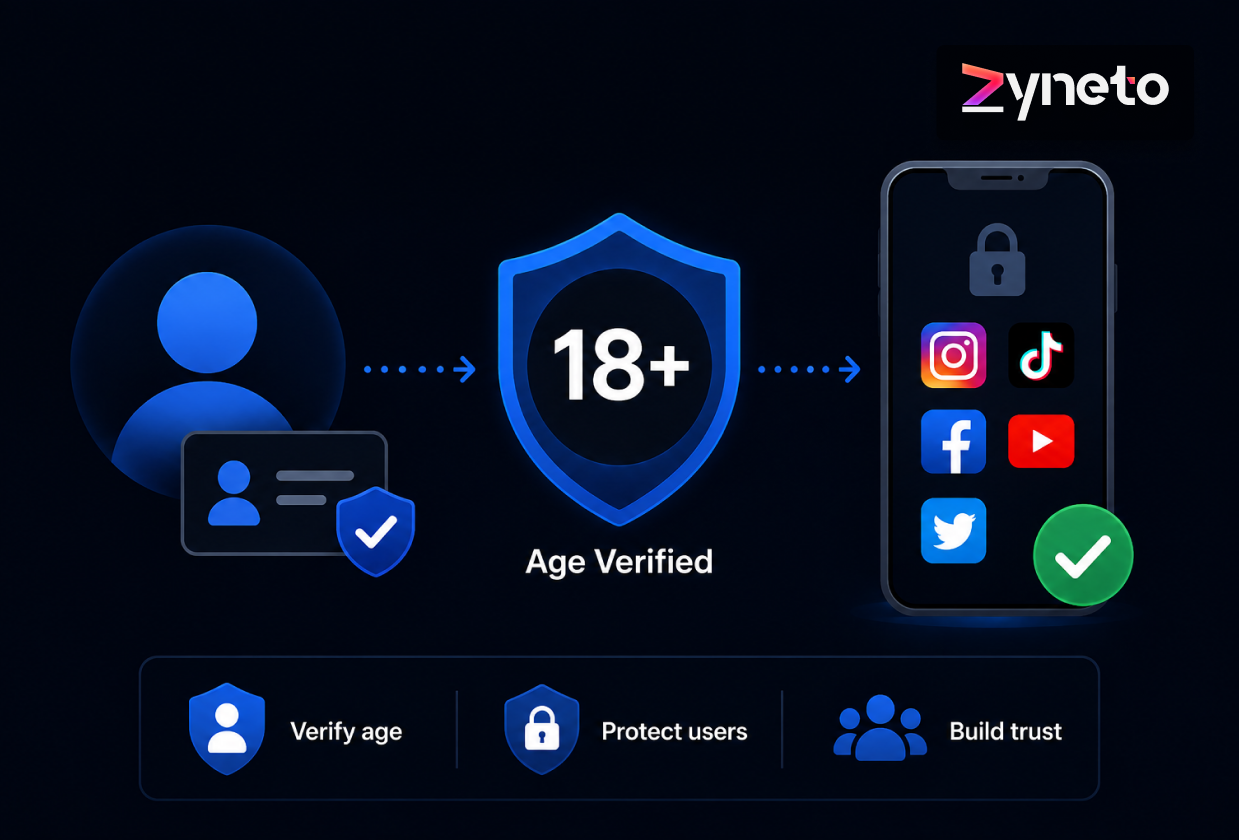
This means combining email verification, phone number verification, and photo verification (where users take a live selfie that gets matched against their profile pictures using facial recognition).
Some apps go a step further and use government ID verification for extra safety, though this level of verification can also add to your overall dating app development cost.
You should also invest in AI-based behavior analysis.
This tracks patterns like unusually fast messaging, repetitive scripted responses, or accounts that message hundreds of people in a short window.
These patterns often reveal bots before human moderators even need to step in.
This one deserves its own spotlight because it's becoming a massive top dating app development challenge.
Spam in dating apps doesn't always look like the obvious "click this link" message anymore.
It's evolved.
Now you'll see spam disguised as flattering compliments, fake "premium" upgrade prompts, or accounts pushing users toward external platforms like OnlyFans, crypto scams, or shady websites.
This kind of design spam is sneaky because it mimics genuine interaction.
It's built to look real enough that your moderation systems miss it and real enough that users engage with it before realizing something's off.
If you don't address this early, your app's reputation takes a hit fast.
Review sections fill up with complaints. Trust drops. Downloads slow down.
When you create a dating app, you need smart content moderation baked into your app's architecture from day one, not bolted on later as an afterthought.
This includes:
You also want a strong reporting system.
Make it dead simple for users to flag a suspicious profile or message in one or two taps.
Then make sure your moderation team (or automated system) actually reviews those reports quickly.
Nothing frustrates a user more than reporting spam and seeing it still active a week later.
Think about how much personal information a dating app collects.
Location. Photos. Preferences. Private messages. Sometimes even sexual orientation or relationship history.
This is incredibly sensitive data.
If it gets breached, the consequences aren't just financial; they're deeply personal for your users.
There have been high-profile data leaks in the dating app industry, and the fallout was brutal for user trust and brand reputation.
Security can't be an afterthought. It has to be part of your app's foundation.
You'll want to implement the following:
If you're not a security expert yourself, this is exactly where working with an experienced development partner pays off.
Here's a challenge that's less about safety and more about actual product value. Your dating app matching algorithm is the heart of your app.
If it doesn't work well, users get frustrated fast.
Too many irrelevant matches, and people feel like the app doesn't understand them.
Too few matches, and people feel like there's nobody around worth talking to.
Balancing this is genuinely hard.
You're working with subjective human preferences, changing behavior patterns, and incomplete data (since most users won't fill out every single field in their profile).
Modern dating apps are leaning heavily into AI and machine learning to solve this.
Instead of relying purely on stated preferences (age range, location, interests), smart algorithms also factor in behavioral data: who a user actually swipes right on, who they message first, how long conversations last, and so on.
This creates a more accurate picture of what someone actually wants, versus what they think they want.
You'll also want to build in feedback loops. Let users indicate when a match felt like a good fit or a poor one. Over time, this data trains your algorithm to get sharper and more personalized.
Dating apps have a strange paradox built into their business model.
If your app works really well, users find a partner and leave. That's actually success , but it also means constant user churn.
You're always fighting to bring in new users just to maintain your existing user base.
On top of that, dating apps naturally have a lot of passive users who download the app, browse for a bit, get discouraged, and go inactive without deleting it.
You need engagement features that go beyond basic swiping.
Think about:
The goal is to make your app feel alive and worth checking, even for users who aren't actively looking for someone right now.
Dating apps need to make money. That's not controversial. But how you monetize matters a lot.
If you gate too many core features behind a paywall, users feel cheated and leave. If your free tier is too generous, you struggle to convert anyone to paid plans.
This balance is one of the most underrated challenges in dating app development.
Successful dating apps usually blend multiple monetization strategies rather than relying on just one.
This might include:
The key is making sure your free experience is still genuinely useful.
Users should get real value before you ask them to pay for more.
Most dating apps rely heavily on location data to suggest nearby matches.
Sounds simple, right?
It's not.
GPS accuracy varies by device. Users travel. Some people fake their location for privacy or curiosity reasons.
And you also have to think carefully about how much location precision to expose, showing an exact address is a serious safety risk, while showing a vague "5 miles away" radius keeps things safer.
Use approximate location zones instead of pinpoint accuracy in the visible profile. Combine GPS with IP-based location verification to catch obvious location spoofing.
And always give users control over how visible their location is, including the option to hide it entirely.
Your users are going to access your app from iOS, Android, and possibly a web version too.
Keeping the experience consistent , same dating app features, same performance, same look and feel , across all these platforms is genuinely challenging.
Different operating systems handle notifications, permissions, and background processes differently.
If your app feels clunky on Android but smooth on iOS (or vice versa), you'll lose users on whichever platform feels worse.
Many teams now use cross-platform frameworks like React Native or Flutter to maintain consistency while still allowing for platform-specific optimizations where needed.
Rigorous testing across devices and OS versions before every release is non-negotiable here.
Once two users match, the entire experience shifts to messaging.
And this is where a lot of dating apps quietly fall apart on the backend.
Real-time chat sounds simple from a user's perspective , you type, you hit send, the other person sees it instantly.
But under all that, you're dealing with WebSocket connections, message queues, delivery confirmations, typing indicators, read receipts, and offline message syncing, all of which need to work flawlessly across spotty mobile networks.
Add push notifications into the mix, and things get even trickier.
You need notifications to arrive instantly when someone gets a new match or message, but not so frequently that users mute your app entirely out of annoyance.
Get the balance wrong, and you either lose users to lag and dropped messages, or you lose them to notification fatigue.
Use a dedicated real-time messaging infrastructure (like WebSockets, Firebase Realtime Database, or a purpose-built service such as Stream or Sendbird) instead of trying to force real-time behavior out of standard REST APIs.
Implement message queuing so texts sent while a user is offline are delivered the moment they reconnect, instead of getting lost.
Build smart notification logic that batches or prioritizes alerts so users get meaningful updates (a new match, a reply) without being bombarded every few minutes.
And always load-test your chat system before launch, since messaging is usually the single most-used feature in any dating app, and it's the one users have zero tolerance for when it breaks.
Let's say your app takes off. Great problem to have, right?
Except now you've got thousands (or millions) of concurrent users, real-time messaging, photo uploads, video calls, and location queries all happening simultaneously.
If your backend wasn't built to scale, your app starts lagging, crashing, or dropping messages right when you need it to perform at its best.
Plan your architecture for scale from the very beginning, even if you're launching small.
Use cloud infrastructure that can scale horizontally (adding more servers as demand grows) rather than systems that hit a hard ceiling.
Implement efficient database indexing, caching layers, and content delivery networks (CDNs) for media-heavy content like photos and videos.

You have a dating app idea and are ready to turn it into reality.
This is exactly where Zyneto comes in.
You don't have to figure all of this out alone.
Zyneto provides end-to-end dating app development services that help you overcome technical, security, and scalability challenges with confidence.
From AI-powered matchmaking and real-time messaging to user verification, privacy controls, and secure payment integration, our experts build every feature with performance and user trust in mind.
We also focus on creating intuitive user experiences, seamless third-party integrations, and scalable architectures that grow with your business.
Whether you're building a niche dating platform or the next mainstream app, Zyneto delivers reliable, future-ready solutions that set your product up for long-term success.
Building a dating app is exciting, but it's also genuinely complex.
You're not just building software; you're building a space where people put themselves out there, hoping to connect with someone real.
That responsibility means you have to take things like fake profiles, spam, privacy, and user safety seriously from the very beginning.
The leading dating app challenges we covered here, from bots and spam to monetization and scalability, aren't things you can patch later.
They need to be part of your planning from day one. The good news? You don't have to navigate all of this by yourself.
With the right development partner, like Zyneto, you can build an app that's not only functional but genuinely trustworthy and enjoyable for your users.
So if you're serious about launching a dating app that actually stands out and lasts, now's the time to start planning with these challenges in mind.
Your future users are counting on it, even if they don't know it yet.
The top dating app development challenge areas right now include fake profiles and bots, dating app design spam, data privacy and security, building an accurate matching algorithm, and keeping real-time chat fast and reliable. Most of these need to be planned for from the very start, not fixed after launch.
Costs vary a lot depending on features, platforms (iOS, Android, or both), and complexity of your matching algorithm. A basic MVP can cost significantly less than a full-featured app with AI moderation, video chat, and advanced matching. It's best to get a custom estimate based on your specific feature list.
Most apps use a mix of email and phone verification, live selfie checks matched against profile photos, AI-based behavior analysis to catch bot-like activity, and automated spam detection that scans messages and links for known scam patterns. Combining several of these layers works far better than relying on just one.
A simple MVP can typically be built in a few months, while a full-featured app with AI matching, real-time chat, and robust moderation systems usually takes longer. Timelines depend heavily on how many features you want at launch versus what you plan to add later.
Zyneto builds dating apps with security, anti-spam moderation, and scalability baked in from day one, instead of treating them as afterthoughts. That means you get a partner who already understands the leading dating app challenges, rather than a team that's learning them for the first time on your project.
Sudhanshi has several years of experience in digital marketing and now works on growth at Zyneto. Her work covers SEO, content strategy, organic lead generation, social media and paid campaigns across Google, LinkedIn, Instagram and Facebook. She has run B2B technology and SaaS campaigns for international audiences, helping brands get found in search and stay found, and works day to day in Google Analytics, Search Console, Ahrefs, SEMrush, Screaming Frog and Canva. She follows AI driven marketing, changing search behaviour, content automation and social growth closely, and turns audience and search data into plans a team can actually run. She writes about SEO, content strategy and the tactics that still earn traffic as search keeps shifting.
Share your details and we will talk soon.
Be the first to access expert strategies, actionable tips, and the trends actually shaping the digital world. No fluff - just practical insights delivered straight to your inbox.
Dive into our blog and stay ahead of the curve with expert perspectives, future-ready trends, and tech tips written for decision-makers and doers alike.