
Typical integration set
01ERP or accounting, e-invoicing service provider, payment gateway, mapping, WhatsApp and SMS, carrier APIs, and EDI wherever a modern trade retailer is involved.
Scheme and claim engines, offline van sales apps, warehouse pick and pack flows, retailer portals, and the ERP and e-invoicing integration underneath. Built for distributors in Oman and the wider Gulf.




















The six things buyers ask before they book a call, answered before you scroll. Supply chain software development and warehouse management system development are the usual entry points, and the scheme engine is what tends to follow. The tiles cover: Typical integration set, Phase one timeline, Rate band, Phase one range, Stack we actually use and Our commitment.
Typical integration set
01ERP or accounting, e-invoicing service provider, payment gateway, mapping, WhatsApp and SMS, carrier APIs, and EDI wherever a modern trade retailer is involved.
Phase one timeline
02Three to five months, based on a team of five delivering around 600 useful hours a month.
Rate band
03$40 to $100 per hour by role. QA and junior implementation near the floor, solution architecture and integration engineering near the ceiling. Mixed teams blend to $60 to $70.
Phase one range
04$101,000 to $179,000 at a $65 blend, before a stated 15 to 20 percent contingency. The arithmetic is further down the page.
Stack we actually use
05Next.js, TypeScript, Node, React Native, Laravel, MySQL, Elasticsearch, AWS.
Our commitment
06No fixed quote before discovery. Anyone who quotes firm on a first call has either padded it heavily or plans to reprice you at change request time.
Audience
Six kinds of operation, and the one system each is usually missing. Not a fit: if what you need is a packaged WMS configured and rolled out, a specialist integrator will do that faster and cheaper than we will, and we will tell you so on the first call.
Hundreds of SKUs, suppliers spread across twenty or more countries, and no outlet level view of what actually sold through.
Salalah, Sohar, Al Mazunah or Duqm. Multiple clients in one building, and activity billing rebuilt by hand after month end.
Counter sales and delivered sales fighting over one stock pool, with credit exposure nobody enforces at the moment of order entry.
Dairy, meat, frozen and produce, most of it imported, and every claim dispute needs excursion evidence that lives on paper.
Dark stores, rider fleets, and cash on delivery that takes two days to reconcile against what the riders actually banked.
Filing on Bayan, re-keying the same document into three places, and no reliable view of profit per shipment file.
Each of these is a different business wearing the same word. What breaks is different, so what we build is different. The operations covered here are: FMCG distribution, 3PL and fulfilment, Cold chain and perishables, Wholesale and cash and carry, Van sales and direct store delivery and Last mile and quick commerce.
01 · Your operation
What breaks
Slab, QPS, combo, free goods, display and retro schemes get computed in spreadsheets. Claims against the principal sit for sixty to ninety days, and by then nobody can prove the number.
What we build
A configurable scheme engine that applies at order entry rather than after invoicing. Automatic claim generation, reconciliation against principal credit notes, credit limit blocking at capture, and a secondary sales upload that runs whether or not somebody remembers.
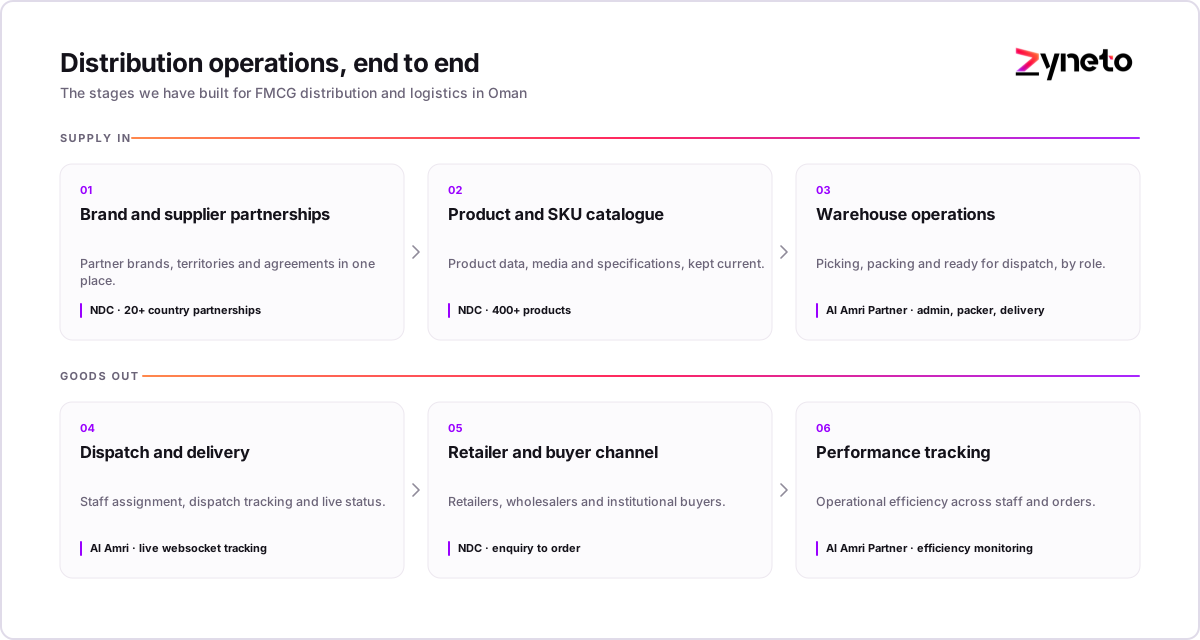
The stages an order moves through, and the build behind each one. Nothing on this map is a capability we have not shipped. The stages run: Partnerships, Catalogue, Warehouse, Dispatch, Retailer channel and Performance. Each one is a place a system either holds the fact or loses it.
A distribution build is mostly an integration project wearing a product costume. Here is the estate we expect to meet. The estates we expect to meet are: Warehouse management, Transport, split three ways, ERP for distributors and The rest of the estate.
Enterprise: Manhattan Active Warehouse Management, Blue Yonder WMS, Infios (Korber Supply Chain Software, rebranded March 2025), SAP EWM, Oracle WMS Cloud, Infor CloudSuite WMS. Mid market: Softeon, Deposco, Tecsys, Generix, Logiwa, Extensiv, Mantis.
Buyers conflate these and they are not the same data model. Shipper TMS: Oracle OTM, Blue Yonder TMS, Manhattan Active TM, SAP TM, e2open, Alpega. Carrier and broker operational TMS: McLeod LoadMaster and PowerBroker, Trimble TMW.Suite. Real time visibility: project44, FourKites, Shippeo, Descartes MacroPoint, which are aggregation layers over carrier and telematics feeds, not execution systems.
SAP S/4HANA, Oracle Fusion and Dynamics 365 Finance and Operations at enterprise level. NetSuite, Dynamics 365 Business Central, SAP Business One and Odoo across the cloud mid market. Focus Softnet is a genuine Dubai headquartered regional player, and TallyPrime is pervasive at SME trading company level. Treat that as partner density we have observed, not as measured market share.
POS and retail: LS Central on Business Central, Oracle Retail Xstore, Retail Pro. Telematics: Samsara, Geotab, Motive, Webfleet, noting that fleets in Saudi Arabia must stream to the national WASL platform under TGA rules. Regional carriers: Aramex, SMSA, Naqel, iMile, with EasyPost, Shippo, nShift or Descartes for multi carrier abstraction. Middleware: Boomi, MuleSoft, Workato, Celigo, Azure Logic Apps.
Who owns stock truth, and exactly when the goods receipt posts. Get this wrong and the two systems argue forever.
Dock and yard slotting against the load tender, so the pick wave and the truck arrival are the same plan.
Getting secondary sales back to the principal without asking a distributor to key it twice.
Gap free invoice numbering per device when the van has no signal, which is a tax requirement before it is an engineering one.
Bring us the part that still runs on spreadsheets and phone calls. That is usually where a first release pays for itself.
If you sell into modern trade, this is where projects are won or quietly lost. Almost nobody writes this section honestly, so here it is.
| X12 | EDIFACT | What it does |
|---|---|---|
| 850 / 860 / 855 | ORDERS / ORDCHG / ORDRSP | Purchase order, change, acknowledgement |
| 856 | DESADV | Advance ship notice, carrying the SSCC hierarchy |
| 810 / 820 | INVOIC / REMADV | Invoice and remittance |
| 846 / 852 | INVRPT / SLSRPT | Inventory position and point of sale sell through |
| 940 / 945 | n/a | Warehouse shipping order and shipping advice, for 3PL |
| 943 / 944 / 947 | n/a | Stock transfer ship, receipt and adjustment |
| 204 / 214 / 210 | IFTMIN / IFTSTA | Load tender, shipment status, freight invoice |
| 894 / 895 | n/a | Direct store delivery, delivery and return |
| 997 | CONTRL | Functional acknowledgement |
One planning note that catches people out: every retailer runs its own certification cycle, typically four to twelve weeks, and it runs on their calendar rather than yours.
Five standards carry the questionnaires a distributor and its retail customers will send you, so they get a row each. Everything after them is jurisdiction, which decides the build but only where you actually trade, so it sits in one row and the FAQ goes deeper. We hold none of these ourselves. We build the traceability and the controls that let you pass the audit.
The information security standard, 93 Annex A controls in 4 themes. The transition from the 2013 version closed 31 October 2025, so a 2013 certificate is now void. Increasingly asked for by the retail groups and principals you are supplying, not just by your own board.
HACCP, ISO 22000:2018, and the GFSI recognised FSSC 22000 or BRCGS. These are the ones your retail customers audit you against, and they matter to software because the traceability records the audit asks for are a design input at the start rather than a report bolted on at the end.
Incoterms 2020, including the DAT to DPU rename, with CIP requiring Institute Cargo Clauses (A) while CIF stays at (C). Store HS 2022 codes versioned, so a historical shipment keeps the code that was valid at the time rather than being silently reclassified by a later update.
Applies on the basis of your EU and UK data subjects rather than your incorporation, and it reaches driver and rep data as much as customer data. Article 30 records, Article 33 breach notice inside 72 hours, data subject requests inside a month, and a documented position on transfers out.
SOC 2 covers security and availability and turns up from principals and larger retail groups. SOC 1 covers controls feeding your customers' financial reporting, which is the one that appears once you are running settlement, scheme claims or consignment stock that lands on someone else's books.
Oman: VAT at 5 percent since 16 April 2021 with mandatory registration at OMR 38,500 and Arabic or bilingual invoices; Fawtara e-invoicing on Peppol PINT OM, Phase 1 August 2026 through Phase 4 for B2G in August 2028; Bayan single window, where 12 digit GCC tariff codes have been required since January 2025 and 8 digit declarations are auto rejected; PDPL under Royal Decree 6/2022, binding since the transition closed 5 February 2026; and In-Country Value scoring, which affects tender evaluation for government linked and energy buyers, with JSRS registration needed to bid for PDO, OQ and Oxy work. Saudi Arabia and the UAE if you sell across borders: ZATCA Fatoora Phase 2 in waves, and Peppol PINT AE through an accredited provider. GCC-wide: GSO 9:2022 labelling with mandatory Arabic printed on the original pack, and conformity through SABER, ECAS, MoIAT or DGSM.
Three builds in this sector. We would rather describe real work than show a wall of logos.
Oman
An FMCG distribution platform covering product catalogue, brand partnerships, media delivery and buyer enquiry, for an operation running 400 plus products, 300 plus employees and partnerships across more than 20 countries.
Oman
Grocery and daily essentials delivery across iOS and Android, with search and filtering, one tap reordering, and live order tracking over websockets.
Oman
The internal operations app behind the storefront. Order processing, picking, packing and ready for dispatch stages, with access separated by role across admin, packer and delivery staff.
Ten failure modes we have either hit or inherited. Naming them is more useful than a list of reasons to choose us. The first three below are: Integration is scoped as a few APIs, Master data treated as a data load and Offline bolted on late.
It is routinely 30 to 50 percent of total effort, and the failure mode is point to point wiring with no idempotency, no retry design and no reconciliation report, so failed messages go unnoticed until the stock figure is wrong. Budget integration as a third of the project and ship the reconciliation report as a deliverable.
Wrong UOM conversions and case packs, missing weights and dimensions, unmapped barcodes, duplicate outlet records. Cleansing needs to be a funded workstream with a named owner and a quality threshold that gates go live.
Offline first is an architecture, not a feature flag. It needs conflict resolution, gap free invoice numbering per device, delta sync and an agreed stale data window.
A picker paid on rate will scan at the end of the aisle and share logins if the handheld adds keystrokes. Design to the scan sequence, and make productivity an explicit acceptance criterion.
It is a customer project with a four to twelve week test cycle that runs on the retailer's calendar. Plan it as a dependency, not a task.
Walk the floor instead. WhatsApp orders, driver held stock and informal credit approvals never appear in a meeting room, and all three turn up on day one of go live.
No wall to wall count, no transaction freeze, no rollback, and it gets scheduled near peak. Count wall to wall, freeze transactions, write the rollback before you need it, and move the date away from peak.
Every rate change or new scheme then becomes a change request. Configuration is more work up front and cheaper by month four.
Allocation, wave release and route optimization behave politely on 5,000 rows and fall over on five million. Test with three years of history before user acceptance, not after.
Baseline lines per hour, OTIF, claim cycle time, cost per order and fill rate before the project starts. Otherwise nobody can say whether it worked.
The honest answer is usually the third one, and sometimes the answer is that you should not hire us for this part. The components judged here are: Packaged enterprise WMS, Packaged TMS, ERP, Scheme and claim engine, Offline field and van sales app, E-invoicing transmission and Retailer portal and the integration fabric.
| Component | Our recommendation | Our honest verdict |
|---|---|---|
| Packaged enterprise WMS | Buy | Genuinely best at wave planning, labour standards, slotting and task interleaving. Do not commission a custom WMS to compete with Blue Yonder or Manhattan on their own ground. |
| Packaged TMS | Buy the core, build the edge | Genuinely best at multi leg planning, rating and carrier settlement. Buy it if you are running that complexity. If your operation is single country on an owned fleet, build only the dispatch layer. |
| ERP | Buy the core, build the edge | Genuinely best at ledger, tax, procurement and financial close. Where NetSuite, Business Central or Odoo already covers around 70 percent of the requirement, extend it rather than rebuild it. |
| Scheme and claim engine | Build | This is where custom earns its money. The regional trade terms are not modelled by the packaged market, because the products that exist were built for a different market's trade structure. |
| Offline field and van sales app | Build | Journey plans, settlement and on vehicle invoicing. Either route works, and either way the offline behaviour is the hard part and worth designing deliberately rather than retrofitting. |
| E-invoicing transmission | Buy | Only an accredited Service Provider may transmit to Fawtara. We integrate to one and build the document mapping. We do not transmit, and neither should your development partner claim to. |
| Retailer portal and the integration fabric | Build | Nobody sells the glue between your specific estate. This is the layer that ties together the systems that are not going to be replaced, and it is the one nobody else can supply off the shelf. |
Transparency
Every competitor publishes a total with no hours behind it. Here is the rate, the hours, and the multiplication, so you can argue with any line of it. What moves the number: Each integration, Offline capability, Multi warehouse over single site, Real time tracking, Multi currency and multi language, Each distinct user role and Catalogue size.
Phase one range
$101k to $179k
At a $65 blended rate
Typical timeline
3 to 5 months
Five people, ~600 hrs/month
Useful hours
1,550 to 2,760
Before 15 to 20% contingency
| Driver | Hours |
|---|---|
| Each integrationDocumented API at the low end, reverse engineered CSV drop at the high end | 60 to 160 hours |
| Offline capabilityApplied to that app's hours, not to the project | adds 40 to 60 percent |
| Multi warehouse over single siteAllocation and transfer logic, not just a dropdown | 120 to 250 hours |
| Real time trackingSockets, presence, and the reconnect path | 120 to 240 hours |
| Multi currency and multi languageArabic and right to left rendering included | 100 to 220 hours |
| Each distinct user roleIts own screens, permissions and audit trail | 40 to 90 hours |
| Catalogue sizeIrrelevant until search relevance and query performance start to matter | 80 to 200 hours |
| Module | Hours |
|---|---|
| Platform foundations | 300 to 500 |
| Product catalogue | 180 to 320 |
| Order management | 320 to 560 |
| Warehouse basics | 400 to 700 |
| Dispatch and route | 300 to 560 |
| Offline partner or driver app | 400 to 700 |
| Retailer portal, reporting and the first integration | 440 to 880 |
Engagement
Four models for logistics software development, each with the downside stated. The models are: Fixed scope phase one, Discovery led rollout, Dedicated squad, monthly and Engineers into your team. Pick by how settled the scope actually is, not by preference.
Upside
Budget certainty and light management overhead. You know the number before you start, and the delivery risk on the signed scope sits with us rather than with you.
Downside
You pay a risk premium inside the number, and every change becomes a negotiation. Suits a bounded phase with a signed specification, not a platform.
Upside
Billed on time and materials, so you pay for work done, see the logged hours, and can redirect scope mid flight as the floor tells you something new.
Downside
You carry the overrun risk and you have to actually read the reports. Best fit where warehouse reality will reshape the requirements, which it usually does.
Upside
The same people accumulate your domain knowledge and the team flexes in size.
Downside
It needs a real product owner on your side. Without one it drifts.
Upside
Cheapest per head, and it slots into a team you already run without changing how that team works.
Downside
Only sensible when you already have an engineering lead supplying architecture and accountability.
Delivery
Five phases, each named by what it produces. A generic waterfall diagram would tell you nothing. The phases are: Integration inventory, Label and scan specification, Volume tested build, Cutover runbook and Adoption pack. Each is named by the artifact it hands you, so you can ask to see one.
Phase 01
A floor walk of the distribution centre and two days out with reps, because the as-is documented from a meeting room misses driver held stock and WhatsApp orders. Output is an integration inventory with a named owner per system, and a data quality baseline.
Phase 02
SSCC and GS1-128 label specification, a scan sequence storyboard for the handheld, the scheme matrix, and a permission matrix by role.
Phase 03
A volume test with three years of history and peak day concurrency before user acceptance sign off, not after it.
Phase 04
Wall to wall count, transaction freeze, rollback plan, and site by site waves with a stabilisation window. Never near peak, and in this region never during the inventory build ahead of Ramadan.
Phase 05
A superuser network, a short dual running period, productivity as an explicit acceptance criterion, and a named owner for the operating metric.
Non-functional
The things that decide whether this works in year three, which rarely appear on a landing page. The groups are: Connectivity, Data integrity, Security controls, Certifications, stated honestly, Exit and portability and Interfaces for the actual workforce. Copy any line straight into your own requirements document.
Radio dead zones in racked aisles and cold stores are normal. Delta sync, an agreed stale data window, and conflict resolution on reconnect are requirements, not refinements.
Idempotency keys, retry with backoff, a dead letter queue, and a daily reconciliation report between ERP and warehouse stock positions. That last control is the one most projects skip and most operations need.
Role based access control, segregation of duties on inventory adjustments, an immutable audit log of who changed what and when, seal number, container number and driver identity captured at despatch, encryption in transit and at rest, configurable hosting region, and retention and deletion controls.
ISO/IEC 27001:2022 and SOC 2 Type I or Type II are what your procurement team and your customs audits will ask about. We build to support those controls. We do not claim certifications Zyneto does not hold, and you should ask any vendor who implies otherwise to show the certificate.
Code in your repository, infrastructure as code, credentials in your accounts, and a documented export of master data and transaction history. Changing supplier should be a commercial decision rather than a technical hostage situation, and the time to establish that is before you sign.
Warehouse and delivery teams across the Gulf are largely expatriate and multilingual. Icon led flows, and bilingual Arabic and English with proper right to left rendering, are functional requirements rather than preferences.
Yes, and the effort varies more than people expect. A documented REST API sits near 60 hours. A nightly CSV drop that has to be reverse engineered, reconciled and monitored sits nearer 160. We scope each integration separately rather than quoting one number for all of them.
Odoo Inventory handles locations and stock moves well, and the gap is everything that makes a picker efficient rather than merely correct. If you are running a few thousand SKUs from one site it is often the right answer. At 40,000 SKUs across multiple sites with productivity targets, it is not, and stretching it there is a failure mode we have been called in to fix.
It is the advance ship notice, and it carries the SSCC hierarchy that tells the retailer what is on each pallet before the truck arrives. If the SSCC on the label does not match the one in the message, the receiving scan fails, the goods get handled manually, and the cost comes back to you as a chargeback under the vendor agreement.
FIFO ships the oldest received stock. FEFO ships the earliest expiring stock, which is not always the same thing. Modern trade accounts often contract a minimum remaining shelf life, so an account may reject anything under 75 percent life while a wholesaler accepts 50. Your allocation logic has to know the rule per customer, or you will ship stock that is legally fine and contractually rejected.
It has to, and that shapes the architecture rather than a setting. Offline first means local storage, delta sync, conflict resolution on reconnect, and gap free invoice numbering per device so the tax sequence survives. Retrofitting this later is close to a rewrite of that app.
Oman is moving to a Peppol based e-invoicing model, XML UBL 2.1 per PINT OM alongside a PDF/A-3, phasing from large taxpayers in August 2026 through to all remaining VAT registered businesses by August 2027 and B2G in 2028. Practically, invoicing stops being something your system prints and becomes something it transmits and gets acknowledged. Confirm the current phase dates before you plan around them.
The most common cause since January 2025 is tariff code length. Bayan requires 12 digit GCC Integrated Customs Tariff codes, and 8 digit declarations are auto rejected. If your product master still carries 8 digit codes, that is a data problem rather than a filing problem.
Yes. Oman requires invoices in Arabic or bilingual form, with an Arabic version producible on request, and consumer packs carry mandatory Arabic labelling. Right to left is a layout and data concern from the first sprint, not a translation pass at the end.
Roughly 1,550 to 2,760 hours, which at a $65 blended rate is about $101,000 to $179,000 before a 15 to 20 percent contingency. With a team of five at around 600 useful hours a month, that is three to five months. The module by module breakdown is on this page so you can check the arithmetic against your own scope.
Ask this of every vendor you speak to, and get the answer in the contract rather than in an email. Our position is that the client should hold the hosting account and the repository, so that changing supplier is a commercial decision rather than a technical hostage situation. Confirm the specifics with us in writing before you sign.
No quote without discovery. Here is the actual sequence.
From someone who has read what you sent, not a scheduling link.
Systems that must stay, roles, sites, whether the field works offline, and which e-invoicing regime applies.
The same format as the table on this page, applied to your scope.
Credited against phase one if you proceed.
Tell us what your operation runs on today, and we will tell you what is worth rebuilding and what is not.
Real feedback from the people we've proudly partnered with.

Sales Director |Cintas
United States

Zyneto Global Technologies provided excellent project management and technical expertise throughout the engagement. The team was responsive, collaborative, and adaptive, ensuring the project met our expectations and set a strong foundation for future growth.

Founder & CEO |Moneteo

We engaged Zyneto to design and develop a custom web platform for Moneteo, aimed at improving project management, data tracking, and collaboration across internal teams and external partners. Their work included full-stack web development, custom modules for workflow automation, API integration, and comprehensive testing.

CEO |E-Commerce Platform

Overall, their responsiveness and timely deliveries contributed positively to the project's success. The client achieved better data management and quality. The service provider delivered the project on time and ensured prompt responsiveness throughout the engagement. Their innovative approach was outstanding.
Explore further
Where automation meets decisions
Counter and van sales at the point of order
Vehicle, cold chain and warehouse telemetry
Demand and replenishment forecasting
The stores and pipelines behind the reporting
Getting data out of systems that will not share
Where the stock lands and who promises it
Fleet, parts and the aftersales tail
Every sector we build for, in one place
Automation, analytics and data work that applies directly to distribution operations.