Smart Meter Data Management In India: The Bill Has To Survive The Missing Read


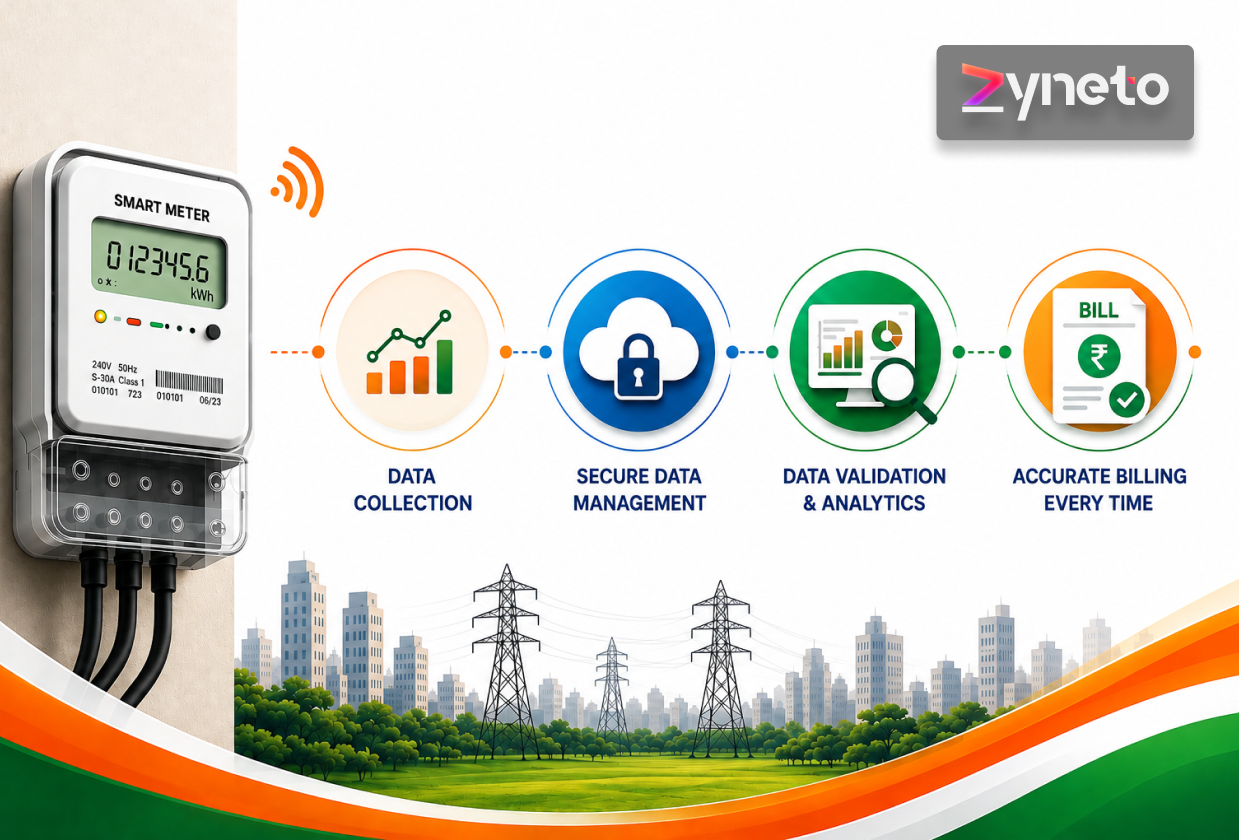
A consumer receives a bill for a month in which their meter reported nothing for nine days. The meter was fine. An RF mesh gateway lost backhaul, the reads queued, and some of them never came back at all.
The bill still had to go out, on time, and it had to be defensible if the consumer walked into an office and asked how the number was reached. Smart meter data management in India is mostly the engineering of that situation, not the engineering of a working day. Reading a meter that is online and responding is close to trivial. Producing a billable, auditable determinant from an estate where a small percentage of meters are unreachable at any moment is the entire job.
Two systems, and confusing them is the most common scoping error in this sector.
The head end system talks to meters. It holds the communication stack, manages the security associations, polls for register reads, load profile blocks and instantaneous values, and receives events pushed from the meter such as tamper alerts and outage notifications. Its job is acquisition, and its measure of success is how much of the estate it can reach and how quickly.
The meter data management system takes what the head end collected and turns it into something a billing engine can use. It validates, it fills gaps, it stores intervals for years, it produces billing determinants, and it keeps a record of every value it changed and why. Its measure of success is whether the number it publishes can be defended.
The boundary matters commercially because contracts are usually written against it. An AMISP is measured on data availability, which is a head end metric, and on billing accuracy, which is an MDM one. A project that treats the two as one system ends up with no clear owner for the reads that were acquired late and therefore missed a billing window.
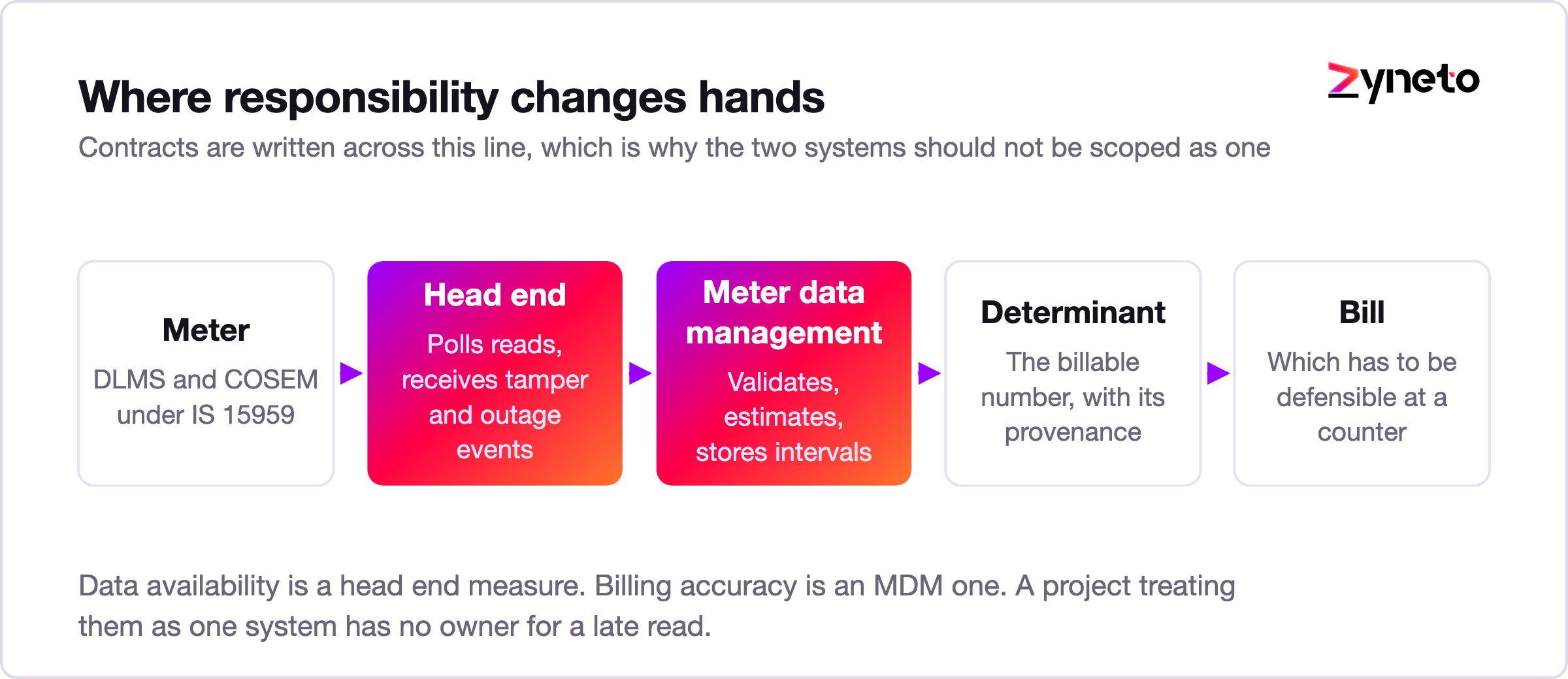
India has adopted DLMS and COSEM under IS 15959, with Part 2 acting as the companion specification for smart meters covering data exchange for reading, tariff and load control. Under that specification a compliant meter supports two communication profiles, HDLC and TCP/IP, which is a genuinely useful constraint for anyone building against it.
The head end therefore needs a DLMS and COSEM client stack capable of holding a very large number of secure application associations at once, since every meter is an individually authenticated endpoint rather than a row in a table.
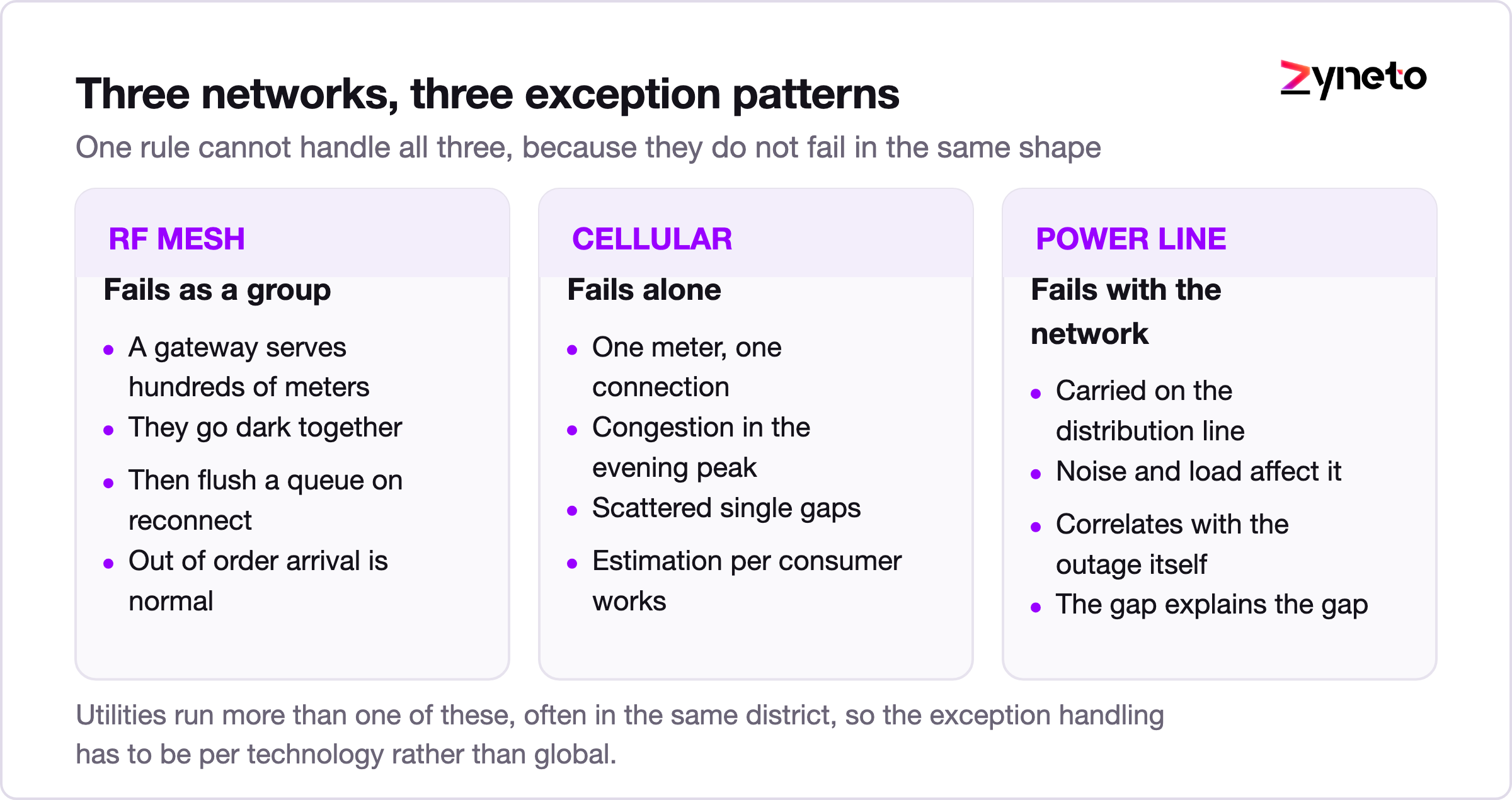
None of that makes the estate uniform. Indian deployments run over power line communication, RF mesh and 4G cellular, frequently within the same utility and sometimes within the same district. Each carries different latency, different failure behaviour and a different definition of what a temporary outage looks like. A gateway serving several hundred meters over RF mesh fails as a group. A cellular meter fails alone. Those two produce completely different exception patterns downstream and they cannot be handled by one rule.
Compliance assessments of Indian meters against IEC 62056 and IS 15959 have identified gaps in communication profiles, security mechanisms and interface class implementation compared with international practice. The practical reading of that for a software team is straightforward. Certification tells you a meter passed a test. It does not tell you how a specific vendor's firmware behaves during a partial network failure, and that is what the data path has to absorb.
Volume is worth doing the arithmetic on before choosing a storage design, because it decides the answer. At a 15 minute interval a single meter produces 96 reads a day. One million meters produce 96 million rows a day, which is roughly 35 billion rows a year for one quantity, before load profile blocks, events and register reads are counted. A utility measuring both import and export doubles it.
That volume rules some options out immediately. It also means anything that requires a manual step per meter, or a per meter row in a configuration table maintained by hand, will not survive the first year of a rollout.
Design for this from the first day, because it is the normal condition rather than the exception.
Interval data is a time series with a strict identity: this meter, this interval, this quantity. The mistake that causes the most rework is treating arrival order as meaningful. A read for eleven in the morning may arrive after a read for three in the afternoon, hours later, once a gateway reconnects and flushes its queue. Any store that assumes append order equals chronological order will produce a load profile that is silently wrong.
Three properties save a great deal of pain later.
Writes must be idempotent by meter and interval, because the same read will be delivered more than once and a duplicate must not become a second unit of energy. Every value needs a status alongside it recording whether it was measured, estimated or edited, since a number without provenance cannot be audited. And the store has to accept a value that arrives after a bill has already been produced, which means the design has to answer what happens to the bill, not only what happens to the row.
That last point is where most packaged assumptions break. A late read for a billed period is not a data problem. It is an adjustment, and it needs a defined path through to the next bill with a visible reason code.
When a read is missing, the MDM performs validation, estimation and editing, usually shortened to VEE, before the data reaches billing.
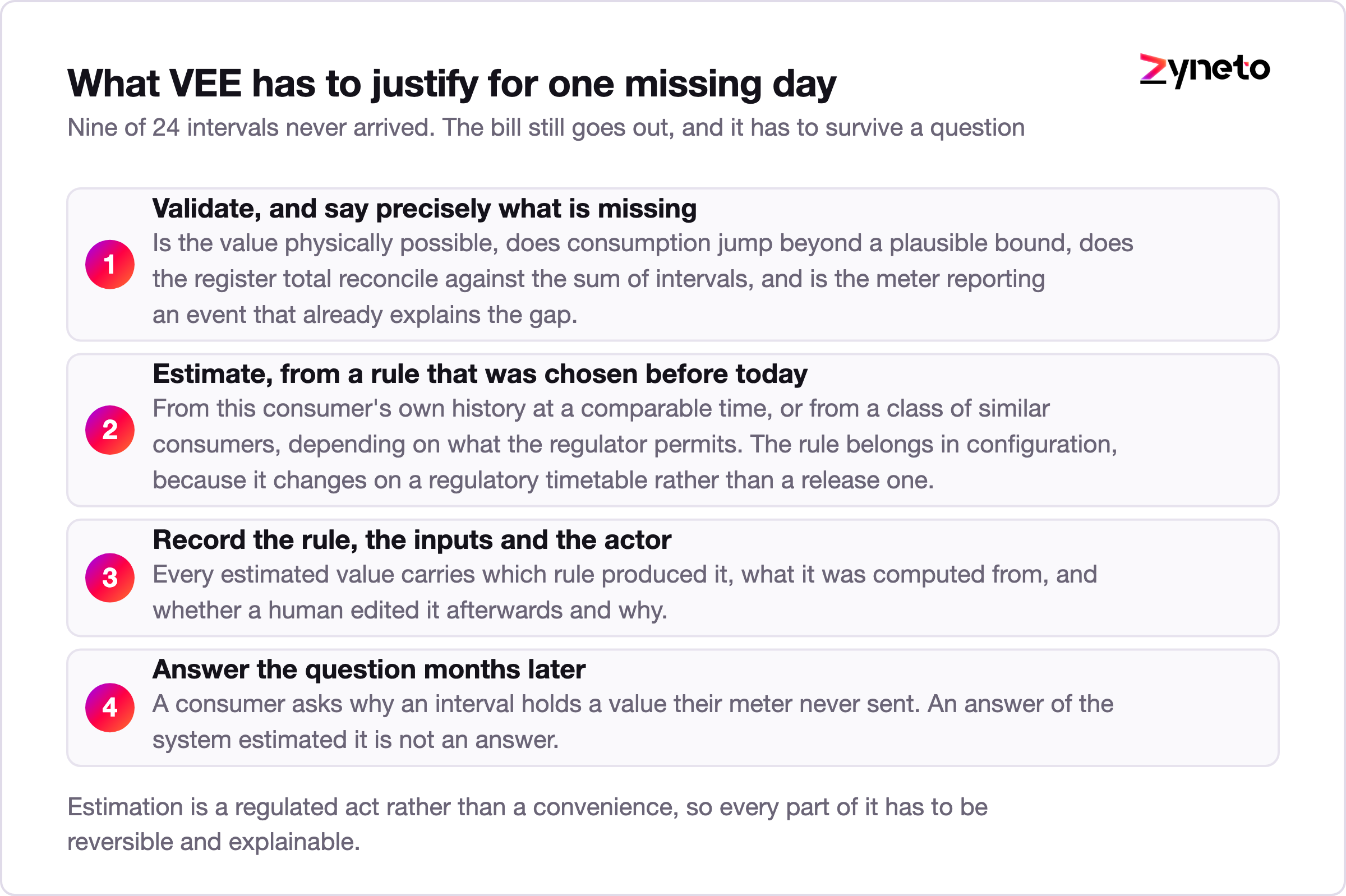
Validation is a set of checks: is the value physically possible, does consumption jump beyond a plausible bound, does the register total reconcile against the sum of intervals, is the meter reporting an event that explains the anomaly. Estimation fills the gap, typically from the same consumer's history at a comparable time, or from a class of similar consumers, depending on what the regulator permits. Editing is a human correcting a value with a recorded reason.
The engineering consequence is that every one of those actions needs to be reversible and explainable months later. A consumer dispute, a regulatory audit or an internal reconciliation will ask why a specific interval on a specific day holds a value the meter never sent. An answer of "the system estimated it" is not sufficient. The answer has to name the rule, the inputs and the person or process that applied it.
One validation check earns its place ahead of the others. A smart meter reports both a cumulative register value and a series of intervals, and the sum of the intervals across a period should reconcile against the movement in the register. When those two disagree the cause is almost always informative: a missed interval, a clock drift, a firmware rollover, or a tamper event that reset something. Utilities that run this reconciliation daily catch problems while the field team can still act. Utilities that run it at the billing cycle discover them 30 days late, on the day the bill was due.
Two design choices follow. Estimation rules belong in configuration rather than in code, because they change on a regulatory timetable rather than a release timetable. And the exception queue is a product surface in its own right, not an admin screen, because it is where field visits get raised and where operational cost is decided. A queue that cannot be prioritised by billing impact produces field teams driving to the wrong meters.

This one is procurement rather than engineering, and it is decisive.
Smart metering in India is driven largely by the Revamped Distribution Sector Scheme, and from 1 January 2025 a full local content requirement applies to key software components, including the meter data management system and the head end system. A scheme-funded rollout cannot simply install an imported platform and call it done.
For utilities that has narrowed the field of acceptable answers. For Indian engineering firms it has widened the opportunity considerably, and it has raised the value of being able to demonstrate the data path rather than describe it. Anyone bidding into this work should expect provenance of the software to be a question asked early and answered with evidence.
It also changes a build against buy calculation that used to be simple. When an imported platform was permissible, the packaged option carried years of accumulated handling for exactly the failure modes described above, and building was hard to justify. With that option constrained for scheme-funded work, the comparison is now between an Indian packaged product and an Indian build, which is a much closer contest and one that turns on how unusual the utility's estate and tariff structure actually are.
The practical advice is to treat the requirement as an architectural input rather than a paperwork exercise. Where a component will need to be demonstrably local, decide that before the integration boundaries are drawn, because retrofitting a replacement into the middle of a working data path costs considerably more than designing the seam in at the start.
Under the advanced metering infrastructure service provider model a DISCOM signs a long-term service agreement, typically eight to ten years, and the provider carries the whole lifecycle: procuring devices, installing them, deploying the communications network, operating the head end and managing meter data.
That structure changes the software requirements in ways a feature list will not capture.
The provider is usually paid against measured outcomes, which means data availability percentages and billing accuracy are contractual numbers rather than aspirations. Anything that affects them has to be measurable in the system from day one, which makes instrumentation a first release requirement instead of a later addition. An eight to ten year term also means the system will outlive several meter firmware versions and at least one communications technology decision, so the acquisition layer has to be replaceable without disturbing the interval store beneath it.
Two contractual numbers deserve specific attention during scoping, because they are usually written before anyone has asked what they cost to achieve.
Data availability is normally expressed as a percentage of expected reads successfully acquired within a defined window. The gap between 97 and 99.5 per cent is not a small increase in effort. The last two per cent are the meters in basements, behind metal, at the edge of a mesh, or served by a cell that is congested in the evening, and reaching them is a field and network problem that software can only partially compensate for. Agreeing that number without understanding the estate is how providers end up paying penalties on physics.
Billing accuracy is the other, and it is where estimation quality becomes money rather than principle. A rule that estimates conservatively generates disputes from consumers. One that estimates generously generates revenue loss the DISCOM will eventually notice. The rule set is a commercial position expressed as configuration, which is another reason it does not belong in code.
Published figures for the national rollout run into several crore meters installed, which is a useful reminder that per-meter costs matter and that anything requiring a manual step per meter does not survive contact with the volume.
Here is the rate, the hours and the multiplication.
The rate band for this work is $40 to $100 per hour by role. Reporting and extracts sit near the floor. The interval store and the settlement timeline sit near the ceiling. A mixed team blends to about $65.
The scope below is the path from head end to billing determinant. It excludes tariff and rating, and it excludes prepaid and disconnection, both of which are separate modules.
|
Module |
Hours |
|
Discovery, meter population and comms audit |
70 |
|
Read acquisition from the head end |
200 |
|
Validation, estimation and editing rules |
210 |
|
Interval store with status and provenance |
190 |
|
Billing determinant export |
140 |
|
Exception and field work queue |
120 |
|
Audit trail and regulatory reporting |
130 |
|
Total |
1,060 |
One thousand and sixty hours runs $42,400 at $40, $106,000 at $100, and $68,900 at the $65 blend.
Two things move that number more than anything else. The number of distinct meter vendors and firmware versions in the estate, because each one is a behaviour to accommodate rather than a configuration entry. And whether the billing system accepts an adjustment cleanly, because if it does not, the adjustment path has to be built on the metering side and that is a project rather than a line item.
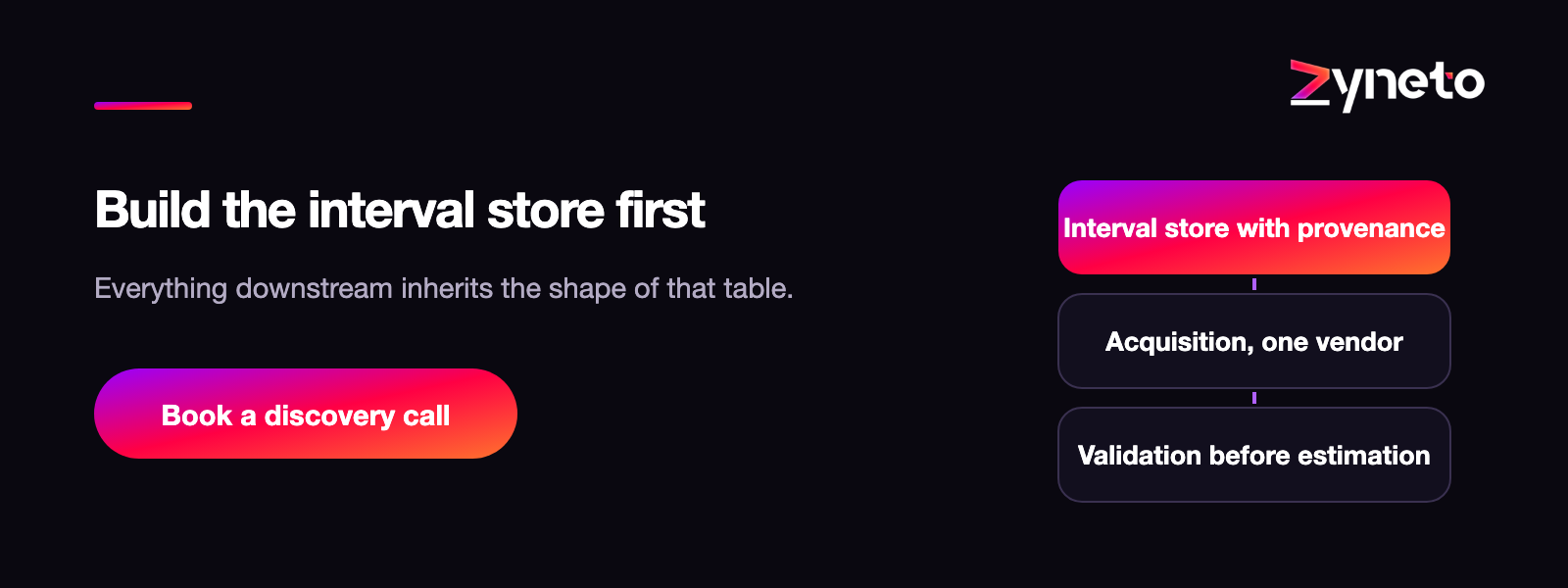
Build the interval store first, with status and provenance on every value, because everything downstream depends on the shape of that table and it is the hardest thing to change later.
Take acquisition second, against a single meter vendor and a single communications technology, and prove the idempotency and late arrival behaviour with deliberately delayed and duplicated reads rather than with a clean feed. A test that only uses well-behaved data proves nothing about this domain.
Add validation before estimation. Knowing precisely which reads are missing, and why, is worth more in the first release than filling them, and it produces the exception queue that operations will actually use.
Then estimation, in configuration, with the applied rule recorded against every estimated value. Then the billing determinant export, and only then the second meter vendor, which is where the assumptions built into the first one become visible.
A slice of this shape reaches a defensible billable output in about 14 to 20 weeks with a small team. Adding the second meter vendor typically costs 25 to 40 per cent of the acquisition module again, and the third costs far less than the second, because by then the abstraction is real rather than assumed.
Two questions separate a real scope from a demonstration. What happens to a bill that has already been issued when a read for that period arrives next week. And when a consumer asks why a specific interval holds a value their meter never sent, what does the system show. A vendor without a clear answer to both has shown you the working day and not the job.
The head end system talks to meters, holding the communication stack and collecting reads, load profile and events. The meter data management system takes what was collected and turns it into a defensible billing determinant, through validation, estimation and editing. Acquisition against interpretation, and contracts are usually written across that boundary.
Validation, estimation and editing. Validation checks whether a value is plausible and reconciles registers against interval sums. Estimation fills gaps from the consumer's own history or a comparable class. Editing is a human correction with a recorded reason. Every one has to be explainable months later in an audit.
DLMS and COSEM, adopted under IS 15959, with Part 2 as the companion specification covering data exchange for meter reading, tariff and load control. A compliant meter supports two communication profiles, HDLC and TCP/IP.
From 1 January 2025 a full local content requirement applies to key software components under the scheme, including the MDM and the head end system. Software provenance is a question to answer with evidence early in a bid rather than late.
The head end to billing determinant path is about 1,060 hours, which is $42,400 at $40 per hour, $106,000 at $100, and $68,900 at a $65 blend. That excludes tariff and rating and excludes prepaid. Meter vendor and firmware diversity moves it more than meter count does.
Because arrival order is not chronological order. A gateway that reconnects flushes a queue, so a morning read can land after an afternoon one. Writes have to be idempotent by meter and interval, and a read arriving after a bill has been issued needs a defined adjustment path rather than an exception.
Typically eight to ten years, covering device procurement, installation, the communications network, head end operation and meter data management. The term is long enough that the system will outlive several firmware versions, so the acquisition layer needs to be replaceable without disturbing the interval store.

Vikas has around fifteen years of experience building software and now builds generative AI systems at Zyneto. His work covers retrieval augmented generation, agentic AI, knowledge graphs, AI memory, and the evaluation and guardrails that decide whether any of it is safe to put in front of customers. He has shipped enterprise copilots, document AI, chatbots and predictive analytics for e-commerce, fintech and marketing teams, and works day to day in Python, JavaScript and SQL. He follows multimodal models, business process automation and enterprise AI security closely, and mentors engineers moving into AI. He writes about architecture, inference cost and the failure modes that only show up at production scale.
Share your details and we will talk soon.
Be the first to access expert strategies, actionable tips, and the trends actually shaping the digital world. No fluff - just practical insights delivered straight to your inbox.
Dive into our blog and stay ahead of the curve with expert perspectives, future-ready trends, and tech tips written for decision-makers and doers alike.