
Typical integration set
01An existing HIS or EHR over HL7 v2, a lab or imaging feed, an insurer channel such as Dhamani or NPHIES, an identity provider, and a payment rail. Plus the portal your billing team currently re-keys into by hand.
The systems a provider actually runs on: patient master and MRN merge, scheduling against provider and room rules, clinical documentation, HL7 and FHIR interfaces, and the eligibility and claims path that decides whether the work gets paid. Access control, audit and retention are first-sprint requirements here rather than a hardening pass later.




















The commercial facts in one block, so you never have to hunt for them. Clinical software development and telemedicine app development share one constraint: the patient index has to be right before anything else can be. Those tiles are: Typical integration set, Phase one timeline, Rate band, Phase one range, with the arithmetic, Stack we actually use and Our commitment.
Typical integration set
01An existing HIS or EHR over HL7 v2, a lab or imaging feed, an insurer channel such as Dhamani or NPHIES, an identity provider, and a payment rail. Plus the portal your billing team currently re-keys into by hand.
Phase one timeline
023 to 5 months for a clinic or polyclinic operations scope. Certification is calendar rather than hours: NPHIES conformance, HIE sign-off and ABDM M1 to M3 consume weeks nobody bills and everybody waits for.
Rate band
03$40 to $100 per hour by role. Portal and reporting work near the floor, interface engineering, claims logic and validation near the ceiling. Mixed teams blend to around $65.
Phase one range, with the arithmetic
04Discovery 90 plus identity 240 plus patient master 160 plus scheduling 290 plus documentation 350 plus interfaces 120 plus eligibility 210 plus compliance 180 equals 1,640 hours. That runs $65,600 at $40 and $164,000 at $100, about $106,600 at a $65 blend. Full span 1,160 to 2,270.
Stack we actually use
05Postgres for the clinical record, because audit and retention are relational problems. An interface engine in front of every HL7 feed rather than parsing in application code. Your existing identity provider, with break-glass access modelled explicitly.
Our commitment
06No quote before discovery. We are not a notified body, a QMS auditor or your regulatory consultant, and we will tell you when a scope crosses into medical device territory rather than discovering it at certification.
Audience
Six organisations and the system each is usually missing. Not a fit: if you need a consumer wellness app, that is a product build rather than a clinical system, and the constraints on this page will only slow you down.
Eligibility, pre-authorisation and remittance still move by portal re-keying, so a claim's status lives in someone's memory between screens. We start by mapping which of those steps can be a machine call rather than a person.
NABIDH, Malaffi or Riayati is a condition of operating rather than a roadmap item, each with its own regulator and pre-production test. We start with the conformance path rather than the feature list.
Orders get re-keyed on arrival and no result feed goes back to the ordering clinician, so the loop closes by phone. We start with an ORM in, ORU out interface and the accessioning identity that makes it safe.
Duplicate MRNs accumulate quietly and merge is treated as an admin task rather than a clinical safety event. We start with deterministic matching, a review queue and a merge that is reversible.
Clinical decision support crosses into regulated territory sooner than most teams expect, and finding out at certification is expensive. We start by determining regulated scope in discovery, in writing.
Everyone can see everything because roles were never modelled against the care relationship, and break-glass does not exist. We start with the access model, because retrofitting it touches every screen.
Healthcare is one word for six operations with different failure modes. What breaks is different, so what we build is different. This page covers: Hospitals and polyclinics, Clinics and practices, Diagnostics and imaging, Digital health and SaMD, Life sciences and trials and Home care and field visits.
01 · Your operation
What breaks
Departments run their own workflows, the insurer channel is a portal, and the patient index carries years of duplicates nobody dares merge.
What we build
One patient master with a safe merge path, department-scoped workflow above it, and eligibility and claims as machine calls rather than re-keying.
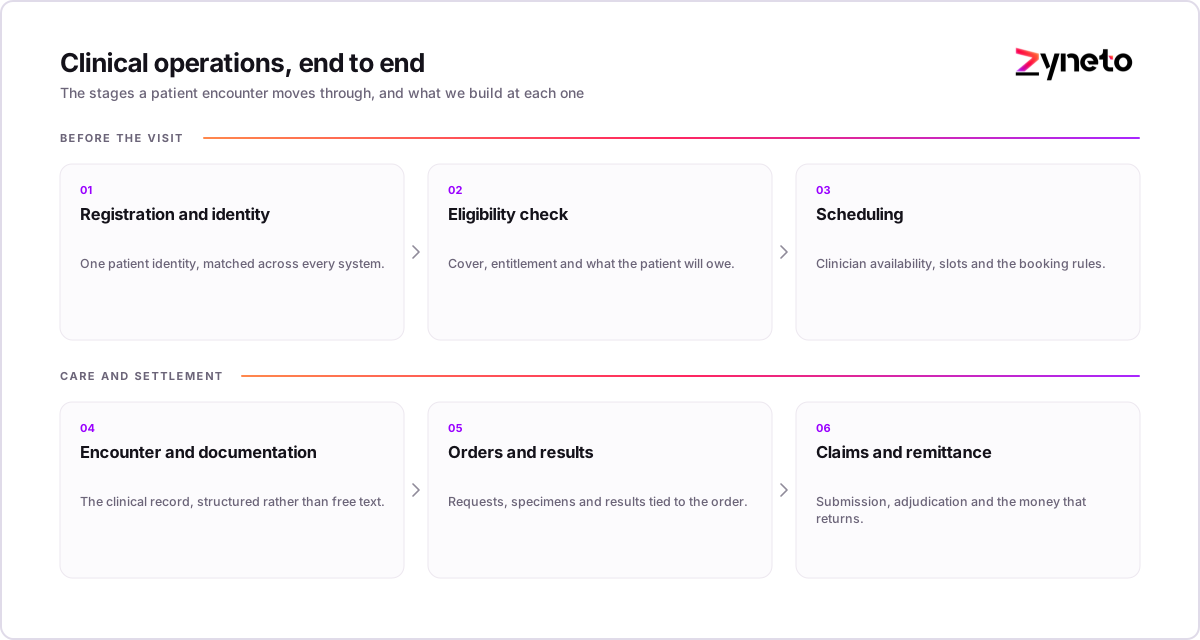
The stages a patient encounter moves through, and what we build at each one. In sequence, the stages are: Registration and identity, Eligibility check, Scheduling, Encounter and documentation, Orders and results and Claims and remittance. Each one is a place a system either holds the fact or loses it.
Healthcare integration is an identity problem wearing a messaging protocol. Here is the estate we expect to meet, and the modelling decision that determines whether any of it is safe. Grouped as: HL7 v2, which still carries the traffic, FHIR, which did not replace it and Identity and codes.
ADT for admissions and demographics, ORM for orders, ORU for results, SIU for scheduling, DFT for charges. Pipe-delimited, decades old, and the format most of your estate speaks today. Put an interface engine in front of it rather than parsing segments in application code.
FHIR R4 is the API layer for new integration and the mandated format for channels such as NPHIES with its Saudi profiles. It sits alongside HL7 v2 rather than removing it, so plan for both and for a mapping layer between them that somebody owns.
MRN is local, national identifiers are jurisdictional, and neither is globally unique. Codes are not interchangeable: SNOMED CT for clinical findings, LOINC for observations and lab, ICD for diagnosis and billing, and a local drug code such as the Dubai Drug Code where the regulator mandates it.
Deterministic matching on strong identifiers is safe and misses duplicates. Probabilistic matching finds them and occasionally proposes a wrong merge. Use deterministic for automatic action and probabilistic only to populate a human review queue, never to merge unattended.
Linking two identities to one patient is reversible. Merging records destroys provenance. Prefer link, keep the source identities intact, and treat merge as a clinical safety event with an approver and an undo path.
A role says what a clinician can do. The care relationship says which patients they may do it to. Systems with only roles let every doctor read every chart, which passes a demo and fails an audit. Model both, and add break-glass with a review obligation attached.
An application log helps engineers. An audit log is evidence: who accessed which record, when, and under what justification, immutable and retained to a schedule. They are different systems with different retention and different access, and conflating them is the most common finding in a healthcare access review.
Whichever step moves by portal today, eligibility, pre-authorisation or remittance, tells us where the billing cycle is losing days. We will tell you whether it can be a machine call and what that would take in hours.
Regulation is the least promotional reason to start a project and currently the most pressing one. Each row is dated and says what the software has to do as a result. Verify current status before contracting; several of these dates have already moved once.
Royal Decree 6/2022 came into force on 13 February 2023, a year after publication, with Executive Regulations under Ministerial Decision 34/2024 and the transition period since expired. Health data is sensitive personal data and processing it requires an MTCIT permit. Build purpose-scoped written consent with withdrawal, 45-day data subject responses, 72-hour breach notification and a named DPO. Cross-border transfer needs express consent plus an adequacy assessment, so default to in-country hosting and gate every offshore analytics call, support tool and model prompt explicitly, because each one is a transfer.
The unified mandatory health insurance scheme, in force from January 2023 and regulated by the Financial Services Authority. Its e-platform is the mandated channel for eligibility linked to Civil ID, pre-authorisation, e-claims, remittance reconciliation and denial handling. Portal re-keying is precisely the thing being replaced, and the value of the integration is measured in days of billing cycle rather than in screens.
Circular 161/2025 issued 6 July 2025 under Ministerial Decree 113/2020, with the e-portal live from 11 August 2025. Since 1 July 2026, Class C and Class D devices including IVDs cannot clear customs without MOH registration, and the quality management requirement is ISO 13485:2016. Software that qualifies as a medical device is in scope, which surprises product teams who did not think the rule applied to them.
NPHIES is governed by the Council of Health Insurance and mandatory for licensed facilities, on FHIR R4 with Saudi profiles, using CHI-issued digital signature certificates that must be renewed annually. Conformance testing against every profile precedes production connectivity. Saudi PDPL sits under SDAIA with the grace period long ended and a Data Transfer Regulation in force, so govern cross-border flows explicitly and expect NCA controls in vendor questionnaires.
NABIDH in Dubai, Malaffi in Abu Dhabi and Riayati federally are licensing conditions rather than roadmap items, each with its own regulator and pre-production test. Federal Decree-Law 45/2021 is the general data protection law and processing UAE health data outside the UAE without approval is restricted, which is an architectural constraint rather than a policy paragraph. E-prescription and claims run through DHPO and eClaimLink using the Dubai Drug Code, and mandatory health insurance extended across all seven emirates from 1 January 2025.
India's DPDP Rules were notified on 14 November 2025, with Consent Manager registration from November 2026 and full obligations by 13 May 2027, so consent artefacts and withdrawal have to be first-class objects. ABDM certification runs M1 to M3 and is the practical requirement for PM-JAY empanelment. For Europe, health data is special category under GDPR Article 9 with 72-hour breach notice, and EU MDR Rule 11 pushes most clinical decision support to Class IIa or higher and therefore to a notified body. HIPAA brings business associate agreements, minimum necessary and audit logging.
One platform described properly, and one client statement. We would rather write up a single build in depth than show a wall of logos. The statement below is from Doron Harel, CCO of Mego Afek AC Ltd. in Israel, published on GoodFirms: “Zyneto worked closely with our team to develop a custom web platform and software automation solutions for our medical device business. Their team was highly professional, responsive, and proactive, ensuring all deliverables were completed on time. The solutions improved operational efficiency and enhanced the user experience.”
India
A practice management platform for clinics and independent practitioners: appointment scheduling with automated reminders, telemedicine consultations, electronic health records and secure patient messaging. Around the clinical core sits the practice's digital presence, its website, business profile, reputation and analytics. The constraint that shaped the build is the one this whole page is about: patient records set the bar for access control, audit and retention from the first sprint rather than in a later hardening pass.
Ten failure modes with the counter-practice attached. Naming them is more useful than a list of reasons to pick us. It starts with: Merge treated as an admin action, Probabilistic matching allowed to act and Roles without the care relationship.
Two records for one patient get combined by whoever noticed, with no approver and no undo. Make merge reversible, require an approver, and keep the source identities rather than destroying them.
A fuzzy match merges two different people and the error surfaces clinically rather than in a report. Probabilistic matching populates a review queue; only deterministic matching acts unattended.
Every clinician can read every chart because access was modelled on job title alone. Model the relationship as well, and add break-glass with a review obligation rather than an open door.
The evidence a regulator wants is mixed with debug output, with the wrong retention and the wrong access. They are different systems; separate them before the first access review.
Segment handling spreads through the codebase and every new feed becomes a regression risk. Put an interface engine at the boundary so a feed change is one mapping, not a release.
Clinical decision support crosses into device territory and the validation package was never planned. Determine regulated scope in discovery, in writing, and price the validation openly.
An offshore analytics call or a model prompt moves health data out of the country without anyone calling it a transfer. Gate each one explicitly and make region pinning real rather than nominal.
The integration stops at claims and eligibility stays manual, so the billing cycle keeps the delay it always had. Automate the check first; it is the step that touches every encounter.
A field visit app assumes connectivity and loses documentation at the point of care. Offline-first with explicit conflict resolution, decided before the first screen is designed.
Conformance testing and enrolment consume weeks nobody billed and everybody waits for, so the launch slips without anyone having been slow. Put certification on the calendar as its own dependency.
The honest answer is usually the third one. Worth stating plainly: we are not a notified body, we are not accredited to certify a quality management system, and we are not your regulatory consultant. Those judgements stay outside this table.
| Component | Our recommendation | Our honest verdict |
|---|---|---|
| The core HIS or EHR | Buy | Clinical documentation, order management and the certification surface are solved, heavily regulated and expensive to own. Building your own means carrying conformance and validation permanently for no differentiation. |
| The integration and identity layer | Build | Your patient index, your access model and your mapping between systems are where your organisation differs and where packaged products fit worst. This is also the layer that decides whether anything else can be trusted. |
| Claims and eligibility | Buy the core, build the edge | Buy the channel connectivity, which is commodity work with real certification overhead. Build the denial worklist and the rules that reflect how your organisation actually chases money, because no vendor knows that. |
Transparency
Every competitor publishes a total with no hours behind it. Here is the rate, the hours and the multiplication, so you can argue with any line. The scope priced here is a clinic or polyclinic operations phase one. The drivers are: Whether the scope is regulated, HIPAA in scope, Number of HL7 feeds and Duplicate rate in the patient index.
Phase one range
$65,600 to $164,000
The 1,640 hour worked example at the ends of the rate band, about $106,600 at a $65 blend.
Typical timeline
3 to 5 months
Plus certification weeks that nobody bills. Those change the launch date rather than the price.
Useful hours
1,160 to 2,270
Every module at its minimum, through to every module at its maximum. Multipliers quoted separately.
| Driver | Hours |
|---|---|
| Whether the scope is regulatedGxP or medical device scope adds that up front and 15 to 30% on every subsequent release, permanently. This is the largest single multiplier on the page and it is decided in discovery. | Adds 25 to 40% |
| HIPAA in scopeApplied across the board rather than to one module, because business associate agreements, minimum necessary and audit logging touch everything. | Adds 10 to 15% |
| Number of HL7 feedsIncluding mapping and certification. The second feed is where the interface engine pays for itself; the fifth is comparatively cheap. | 80 to 160 each |
| Duplicate rate in the patient indexA legacy index with years of duplicates needs a review queue, an approver flow and a reversible merge, none of which a clean index needs. | Drives the merge work |
| Insurer channelsDhamani, NPHIES and the UAE channels each have their own conformance path. Connectivity is the small part; passing their test is the calendar. | 150 to 300 each |
| Offline requirementTo the affected app only. Conflict resolution on sync is the cost, not the local database. | Adds around 30% |
| Validation package where regulatedIQ, OQ, PQ and a traceability matrix, produced alongside the build. Reconstructing it afterwards costs more and convinces nobody. | 150 to 400 |
| Certification calendarNPHIES conformance, HIE sign-off, ABDM M1 to M3 and eRx enrolment consume weeks that nobody bills. They change when you launch, not what you pay. | Schedule, not hours |
| Module | Hours |
|---|---|
| Discovery and regulated-scope determination | 60 to 120 |
| Identity, access model and audit log | 180 to 320 |
| Patient master with MRN merge | 120 to 220 |
| Scheduling with provider and room rules | 200 to 400 |
| Clinical documentation and charge capture | 250 to 500 |
| HL7 v2 interfaces, first two feeds | 80 to 160 |
| Eligibility and prior authorisation | 150 to 300 |
| Compliance layer, retention and legal hold | 120 to 250 |
Engagement
Four models for healthcare software development, each with the downside stated in the same breath. Those four are: Discovery and scope determination, Phase one build, Build and carry through certification and Ongoing engineering. Pick by how settled the scope actually is, not by preference.
Upside
Three to four weeks producing a PHI data-flow map, an interface inventory and a written determination of whether any of it is regulated. On this vertical that last document is the one that prevents a very expensive surprise.
Downside
You pay for a document, and it sometimes reports that your product is a medical device. That is worth knowing early and it is never welcome news.
Upside
The eight modules above against a written scope, ending with an access model, a patient index and an eligibility path that works.
Downside
It is an operations foundation, not a full clinical suite. Claims, lab and trial systems are later phases and saying otherwise would be a worse trade for you than saying so now.
Upside
We stay through conformance testing and sign-off, which is when interface assumptions actually get tested by someone else.
Downside
It ties our team to a regulator's calendar rather than your backlog, and that calendar is not ours to accelerate.
Upside
A standing allocation, which suits a provider adding sites, channels or feeds steadily.
Downside
It works when there is a genuine backlog and quietly wastes money when there is not. We will tell you when there is not.
Delivery
Five phases, each named by the artifact it produces rather than by a stage in a generic waterfall. Those phases are: Data-flow map, Access model, Patient index, Interfaces and Revenue path. Each is named by the artifact it hands you, so you can ask to see one.
Phase 01
Every place PHI enters, rests and leaves, written down with the interface inventory and a determination of what is regulated. This artifact decides the size and the risk of everything after it.
Phase 02
Roles, care relationships, break-glass and the audit log as a separate system with its own retention. Agreed before any screen is built, because retrofitting it touches all of them.
Phase 03
Deterministic matching, a human review queue for probabilistic candidates, and a merge that is reversible with an approver.
Phase 04
An interface engine at the boundary with the first feeds mapped and certified, so a later feed is a mapping rather than a release.
Phase 05
Eligibility and prior authorisation as machine calls, with the denial worklist reflecting how your team actually chases money.
Non-functional
Copy this and run it against us, or against anyone else quoting for healthcare software development. The groups are identity and safety, then access and evidence, then residency and transfer. Each line is a question with a right answer rather than a preference, so a vendor either meets it or tells you plainly why not.
Deterministic matching for unattended action and probabilistic only into a review queue. Merge reversible, with an approver and preserved source identities. A written answer on what happens to documentation attributed to a record that is later merged.
Access modelled on the care relationship as well as the role, with break-glass carrying a review obligation. An audit log separate from application logging, immutable, retained to a schedule and queryable by patient and by user.
Region pinning that is real rather than nominal, with every offshore analytics call, support tool and model prompt enumerated and gated, because each is a cross-border transfer. Retention and legal hold that survive a deletion request.
Usually not. The core clinical system is heavily certified and expensive to own, and what most providers actually lack is the layer around it: a trustworthy patient index, an access model that survives an audit, and machine calls to the insurer instead of portal re-keying. We integrate over HL7 and FHIR rather than replacing what already passes inspection.
Hours times $40 to $100 per hour by role. The module table gives the range for each of the eight modules and the worked example shows 1,640 hours coming to about $106,600 at a $65 blend. The regulated and HIPAA multipliers are stated separately rather than folded in, because they apply across the board and would otherwise hide inside every line.
You do. The code is yours on delivery, patient data lives in your infrastructure rather than ours, and the interfaces are yours to keep running or hand to another supplier. We do not retain a copy of clinical data, and there is no arrangement under which it becomes training material for anything.
Possibly, and it is the question worth answering first. Clinical decision support crosses into regulated territory sooner than most teams expect, and EU MDR Rule 11 pushes much of it to Class IIa or higher and therefore to a notified body. We determine regulated scope during discovery and put it in writing. We are not a notified body and cannot certify you; we can make sure you are not surprised.
Yes, and the honest part is that connectivity is the small half. Each channel has a conformance path that has to be passed before production, NPHIES on FHIR R4 with Saudi profiles and certificates renewed annually. Budget those weeks as calendar rather than as hours, because nobody bills them and everybody waits for them.
Deterministic matching acts automatically, probabilistic matching only proposes into a human review queue, and merge is reversible with an approver. A wrong merge that cannot be undone is the worst outcome in this domain, so the design starts from that rather than from throughput.
In Oman, cross-border transfer of sensitive data needs express consent plus an adequacy assessment, so in-country hosting is the sane default. The UAE restricts processing health data outside the country without approval. The practical consequence is that every offshore analytics call, support tool and model prompt is a transfer and has to be gated explicitly.
We have iCareHeal, described in full above, and a client statement from a medical device business. That is what we have and we would rather say so than pad the page. Everything else here is protocol, regulation and failure modes, which you can verify independently of us.
We can produce IQ, OQ, PQ and a traceability matrix alongside the build, which is far cheaper and more convincing than reconstructing them afterwards. Approval of that package belongs to your quality function and your auditor, not to us.
It never leaves your infrastructure, so nothing has to be handed back. We document the interfaces and the mappings as part of delivery specifically so another supplier can pick them up without us, which is the test of whether documentation was real.
Four steps with a shape attached to each, so booking a call is a known quantity.
Bring your HIS name, your insurer channels, and one thing your billing team currently re-keys. Those three size the project faster than an hour of description.
We establish whether anything you are planning is regulated as a medical device, in writing. It is a short conversation that occasionally changes the entire plan.
The modules, the hour ranges and the arithmetic, with the regulated and HIPAA multipliers shown separately. If the answer is that your HIS vendor should do this, the document says that.
With the scope in hand you choose whether we build it, your team does, or your incumbent extends. The document is useful in all three cases and it is yours either way.
Almost every question on this page resolves to where PHI goes and who may see it. We will map that, tell you whether any of your scope is regulated, and give you the hours either way.
Real feedback from the people we've proudly partnered with.

Sales Director |Cintas
United States

Zyneto Global Technologies provided excellent project management and technical expertise throughout the engagement. The team was responsive, collaborative, and adaptive, ensuring the project met our expectations and set a strong foundation for future growth.

Founder & CEO |Moneteo

We engaged Zyneto to design and develop a custom web platform for Moneteo, aimed at improving project management, data tracking, and collaboration across internal teams and external partners. Their work included full-stack web development, custom modules for workflow automation, API integration, and comprehensive testing.

CEO |E-Commerce Platform

Overall, their responsiveness and timely deliveries contributed positively to the project's success. The client achieved better data management and quality. The service provider delivered the project on time and ensured prompt responsiveness throughout the engagement. Their innovative approach was outstanding.
Explore further
Patient index, audit log and retention
Clinician, front desk and patient surfaces
Offline-first field and visit apps
Clinical documents, retention and legal hold
Triage and denial worklist assistance
Retrieval over policy and protocol libraries
Claims, adjudication and the payer side
Records scoped to a session, and consent
Every sector we build for, in one place
Document, retrieval and assistant work that applies directly to clinical and administrative systems.