Travel software development for operators and distributors

The systems behind the sell: inventory and availability that stay true across every channel, rate rules a revenue manager can actually change, a booking record that survives a schedule change, and the refund path that decides whether a cancellation costs you a customer. If what you want is a restaurant ordering app for a hotel outlet, the restaurant app page is the one you want.

  • IATA NDC and ONE Order
  • GDS and channel manager
  • Package Travel Directive
  • $40 to $100 per hour
See the short version

Get Your Free Consultation & We'll Reach Out Promptly!

By submitting this form, I authorize Zyneto to collect and process my personal data in accordance with theZyneto Privacy Policy.

We respond to all inquiries within 1 hour.

Trusted by
Global Industry Leaders

Al Amri Express
Cheer Sagar
MRO Supply
BankSathi
DoraDori
Kroolo
StyleBank
Hire Right
Cintas
Up in the Air
Famepilot
Swedishness
Corrib Coil
iCare Heal
TWAM
NDC: National Distribution Company Oman
Moneteo
Algora
Numerology
G4Girl

The short version

The commercial facts in one block, so you never have to hunt for them. Booking engine development and hotel management software development meet at inventory, the one record that must never disagree with itself. Those tiles are: Typical integration set, Phase one timeline, Rate band, Phase one range, with the arithmetic, Stack we actually use and Our commitment.

Typical integration set

01

A supplier or GDS connection, a channel manager pushing to OTAs, a payment gateway that can hold and release, and whatever the reservations team currently reconciles in. Plus the rate spreadsheet somebody maintains by hand.

Phase one timeline

02

3 to 5 months. The pacing constraint is supplier certification rather than engineering: every channel has its own test environment and sign-off, and those weeks are nobody's to accelerate.

Rate band

03

$40 to $100 per hour by role. Reporting and admin near the floor, availability modelling and refund logic near the ceiling. Mixed teams blend to around $65.

Phase one range, with the arithmetic

04

Discovery 90 plus inventory 240 plus rates 210 plus booking record 270 plus supplier links 250 plus payments 190 plus refunds 200 plus reconciliation 130 equals 1,580 hours. That runs $63,200 at $40 and $158,000 at $100, about $102,700 at a $65 blend. Full span 1,170 to 2,280.

Stack we actually use

05

Postgres for inventory and orders, because availability is a concurrency problem before it is a product one. A queue in front of every channel, since they retry and they duplicate. Your existing payment provider, with authorisation and capture separated.

Our commitment

06

No quote before discovery. We will also tell you when a channel manager you already pay for covers most of what you are asking us to build, which on this vertical happens more often than not.

Audience

Who this is for

Six operator shapes and the number each one cannot currently produce. Not a fit: if you want a consumer ordering app for a hotel restaurant, that is the restaurant app page, linked at the foot of this one. The shapes it fits are: You oversold on two channels at once and Rate changes take a developer.

01

You oversold on two channels at once

Availability lives in three places and none of them is authoritative, so the same room or seat sells twice on a busy weekend. We start by making one inventory the source of truth and every channel a projection of it.

02

Rate changes take a developer

Seasonal rates, minimum stays and promotions are hardcoded, so revenue management files tickets instead of changing prices. We start by moving rate rules into data a non-engineer can edit safely.

03

A schedule change breaks the booking

The supplier moves a flight or a sailing and your record no longer matches theirs, so reconciliation becomes manual archaeology. We start with a booking record that can absorb a change without losing its history.

04

Refunds are a support queue

Cancellation policy lives in prose, agents interpret it differently, and the same case gets two answers. We start by encoding the policy so the system computes the entitlement and a human approves an exception.

05

You are moving to NDC

A carrier or supplier is pushing you off legacy distribution and the answer to whether you support Offers and Orders is currently no. We start by scoping what actually changes, which is the order record rather than the search screen.

06

You sell packages in the EU

Combining flight, hotel and transfer makes you an organiser with insolvency protection and refund duties, and the rules were tightened in 2026. We start by mapping which of your combinations are legally packages.

Find your operation

Travel is one word for six businesses. What breaks is different in each, so what we build is different. This page covers: Hotels and groups, Tour operators, Online travel agencies, Airlines and air distribution, Ground transport and transfers and Activities and attractions.

01 · Your operation

Hotels and groups

What breaks

Channel parity, overbooking and a rate plan matrix that grew organically until nobody can explain a price. Group and corporate rates sit outside the system entirely.

What we build

One availability model with channel projections, rate plans as editable data, and controlled overbooking rather than accidental overselling.

Where booking systems earn their keep

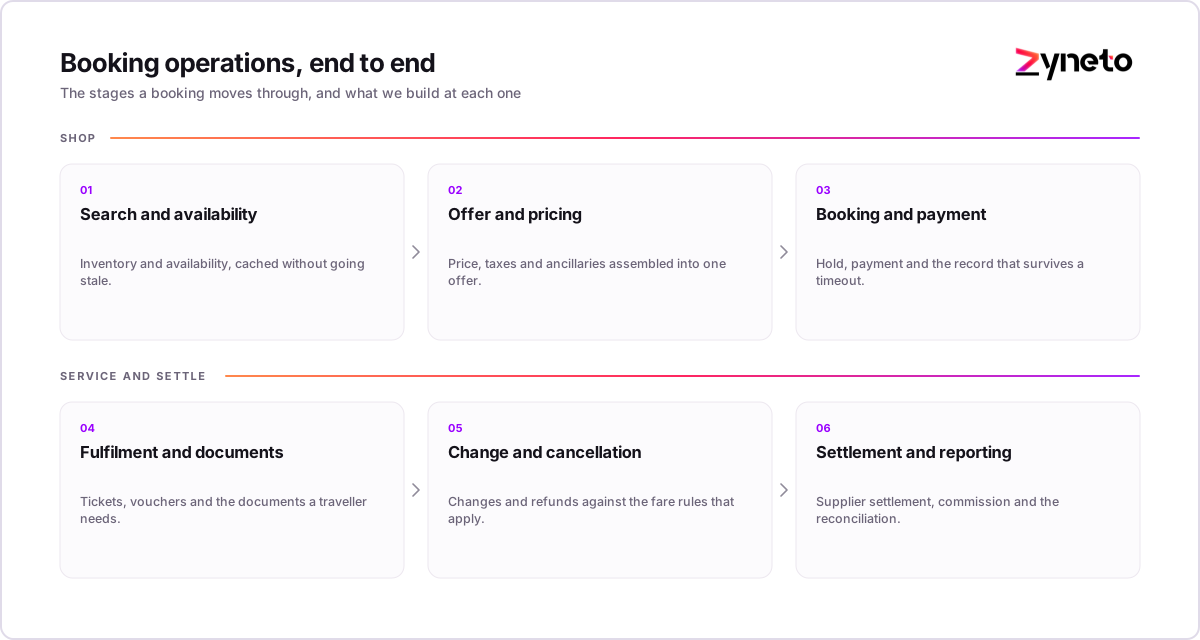
The stages a booking moves through, and what we build at each one. In sequence, the stages are: Search and availability, Offer and pricing, Booking and payment, Fulfilment and documents, Change and cancellation and Settlement and reporting. Each one is a place a system either holds the fact or loses it.

01Search and availability02Offer and pricing03Booking and payment04Fulfilment and documents05Change and cancellation06Settlement and reporting
Two band travel map covering availability, pricing and booking, then documents, changes and settlement.

How a booking actually works, and why it lives in several records

Travel distribution is an inventory problem with a settlement problem attached. Here is the estate we expect to meet and the modelling decision that determines whether any of it reconciles. Grouped as: Legacy distribution, NDC and Orders and Channel managers and OTAs.

Legacy distribution

The GDS layer, Amadeus, Sabre and Travelport, still carries a great deal of traffic. Its shape assumes a passenger name record, a separately issued e-ticket and electronic miscellaneous documents for anything else, which is why an ancillary reconciles on a different path from the fare.

NDC and Orders

IATA's New Distribution Capability, not to be confused with a distribution company, is an XML standard for exchanging Offers and Orders directly rather than through legacy messaging. ONE Order consolidates the PNR, the e-ticket and the EMDs into a single Order record. IATA's Distribution Advisory Council holds an aspirational goal of 100% Offers and Orders by 2030, with the explicit caveat that this means the capability exists by then, not that the industry has moved. Most carriers are expected to transition around 2028 to 2029.

Channel managers and OTAs

The layer that pushes availability and rates outward and pulls bookings back. Each channel has its own retry behaviour, its own idea of what a cancellation means, and its own certification before you may connect to production.

Hold versus booking

A hold reserves capacity without a contract and must expire on its own. Systems that only understand confirmed bookings either oversell while a customer is entering card details, or leak inventory when they abandon the cart. Model the hold explicitly with a timeout the business chooses.

Rate plan versus price

A rate plan is the rule, a price is what that rule produced for a specific stay on a specific day through a specific channel. Store both. Keeping only the price makes a dispute unanswerable; keeping only the rule makes a historic invoice unreproducible.

Cancellation policy versus refund entitlement

The policy is what was agreed at booking. The entitlement is what this cancellation, at this moment, actually earns back. Compute the second from the first and store it on the booking, so an agent approves an exception rather than performing an interpretation.

Supplier reference versus your booking id

Every supplier issues their own reference and some reissue it after a schedule change. Key your record on your own identifier and hold theirs as an attribute with history, or a supplier-side change quietly orphans your booking.

Tell us where availability lives today

Name every system that holds a copy of what you can sell right now. If the answer is more than one, that list is the reason you oversold, and it tells us more than a requirements document would.

Which rules apply to you

Consumer protection, card handling and data residency land on different teams and all three end up in the same booking flow. Each row is dated. Verify current status before contracting, because one of these changed in 2026. Covered here: EU Package Travel Directive, revised 2026, IATA distribution and settlement, PCI DSS v4.0.1 and Data protection across your markets.

EU Package Travel Directive, revised 2026

The Council adopted the revision on 30 March 2026 and it became Directive (EU) 2026/1024 of 29 April 2026, with 28 months for member states to transpose, so national law lands around September 2028 and applies from 2029. The build consequences are concrete: vouchers may still be offered but acceptance must be voluntary and the traveller must be expressly told they can refuse and take a monetary refund instead, and where a supplier cancels or fails to deliver, they must refund the organiser within seven days. Combining a flight with a hotel or a transfer generally makes you an organiser, which brings insolvency protection with it.

IATA distribution and settlement

Selling air on behalf of carriers brings accreditation and settlement obligations, and the messaging standard is moving. NDC exchanges Offers and Orders directly, and ONE Order collapses the PNR, e-ticket and EMD into one record. Plan for both worlds at once rather than a cutover: the aspiration is capability by 2030 and most carriers land around 2028 to 2029, so a system that can only speak one of the two will be wrong for several years in either direction.

PCI DSS v4.0.1

All 51 future-dated requirements became mandatory on 31 March 2025, and multi-factor authentication now applies to all access to the cardholder data environment rather than only administrative accounts. Travel makes this harder than most retail because bookings are authorised early and captured late, sometimes weeks later, and because agents handle card details by phone. Keep card data out of your systems entirely and the assessment shrinks dramatically.

Data protection across your markets

Oman's PDPL came into force on 13 February 2023 and treats cross-border transfer as needing express consent plus an adequacy assessment. India's DPDP Rules were notified on 14 November 2025 with full obligations by 13 May 2027. Passenger data is unusually mobile in this sector, moving between operator, supplier, channel and destination, so enumerate every hop and treat each as a transfer rather than as plumbing.

Passenger and guest rights

Air passenger compensation and assistance regimes, hotel guest registration requirements and local tourism levies all vary by jurisdiction and change without much notice. The architectural answer is the same in each case: keep the rule in a jurisdiction-scoped policy layer with its own adapter, so a new market is a configuration rather than a change to how bookings work.

The architectural consequence

Consumer protection, card scope and passenger rights all move on their own timetable and none of them should be threaded through the booking path. Keep each behind its own adapter and store the version of the policy that applied at the moment of sale, because a refund dispute two years later is judged against the terms in force then, not the terms in force now.

What goes wrong

Ten failure modes with the counter-practice attached. Naming them is more useful than a list of reasons to pick us. It starts with: Availability cached as a copy of inventory, No hold semantics and Rate rules hardcoded. Each is written plainly enough that you can check whether yours is already happening.

01

Availability cached as a copy of inventory

The cache goes stale under load and the same unit sells twice on exactly the day it matters. Derive availability from inventory with holds applied, and choose the cache window against your real look-to-book ratio.

02

No hold semantics

Capacity is either committed or free, so a customer entering card details is either blocking stock indefinitely or racing another buyer. Model the hold with an explicit timeout owned by the business.

03

Rate rules hardcoded

Revenue management raises a ticket to change a price, so prices change late or not at all. Rate plans belong in data with a safe editor, not in a deployment.

04

Only the final price stored

A dispute arrives and nobody can reconstruct why that customer paid that amount through that channel. Store the offer and the rule alongside the price.

05

Cancellation policy left in prose

Two agents read the same terms and give two answers, and the difference is refunded from margin. Encode the entitlement and let a human approve exceptions rather than interpret rules.

06

Booking keyed on the supplier reference

The supplier reissues it after a schedule change and your record is orphaned. Key on your own identifier and keep theirs as an attribute with history.

07

Channel messages trusted on arrival

Channels retry and duplicate, so one cancellation arrives three times and the third one refunds a booking that no longer exists. Make every handler idempotent on the channel's own reference.

08

Authorisation and capture treated as one step

Travel authorises early and captures late, and a system that captures immediately either breaks the commercial model or fails when the authorisation expires. Separate them from the first design.

09

Package status not determined

A flight plus a hotel is sold without anyone establishing that this makes you an organiser with insolvency and refund duties. Determine package status in discovery, per combination, in writing.

10

Certification time left out of the plan

Every supplier and channel has a test environment and a sign-off, and those weeks are nobody's to accelerate. Put each certification on the plan as its own dependency rather than as part of the integration task.

Build, buy, or buy the core and build the edge

The honest answer is usually the third one, and on this vertical the honest answer is more often than elsewhere that you should buy. We are not an IATA accreditation body and we are not your consumer law adviser, so those judgements sit outside this table.

ComponentOur recommendationOur honest verdict
Channel management and distribution plumbingBuyConnecting to dozens of OTAs and keeping each certification current is a commodity with a permanent maintenance cost. Building it yourself means owning every channel's retry quirks forever for no differentiation.
Inventory, rates and the booking recordBuildThis is where your commercial model lives, and it is the part every packaged system models for the average operator rather than for you. It is also the layer that decides whether anything else can be trusted.
Payments and refund executionBuy the core, build the edgeBuy the gateway and the card handling, which carry real compliance overhead. Build the entitlement calculation, because the policy is yours and no provider can compute it for you.

Transparency

What travel software development costs, with the arithmetic shown

Every competitor publishes a total with no hours behind it. Here is the rate, the hours and the multiplication, so you can argue with any line. The scope priced here is a direct-sell operator with channel distribution. The drivers are: How many supplier or channel connections, Complexity of the rate model, Look-to-book ratio, Whether you sell packages and Payment timing.

Phase one range

$63,200 to $158,000

The 1,580 hour worked example at the ends of the rate band, about $102,700 at a $65 blend.

Typical timeline

3 to 5 months

Plus supplier certification weeks that nobody bills and nobody can accelerate.

Useful hours

1,170 to 2,280

Every module at its minimum, through to every module at its maximum.

What moves the number, ranked
DriverHours
How many supplier or channel connectionsThe second is expensive because it forces the abstraction. The fifth is cheap because the abstraction exists. Certification is separate and is calendar rather than hours.80 to 200 each
Complexity of the rate modelSeasonal rates, minimum stays, occupancy pricing, promotions and corporate agreements compound. A single flat rate per unit is a different project from a real revenue model.High impact
Look-to-book ratioA high ratio makes caching a commercial necessity and a correctness risk at the same time, which is where the availability engineering goes.Drives the cache work
Whether you sell packagesComponent-level supplier terms, combined liability and insolvency protection are not a feature on top of single-item selling; they change the booking model.Adds real scope
Payment timingDeposits, balance dates, authorisation held for weeks and partial refunds. Straight capture at booking is far simpler and far less common in travel.140 to 280
Number of jurisdictionsThe first consumer-protection regime is a build, each additional one is an adapter, provided the policy layer was kept out of the booking path.Medium
Migration of live bookingsYou cannot pause selling to migrate. Forward bookings have to move without losing their terms, which is a reconciliation exercise as much as a data one.Rarely small
Supplier certification calendarEach channel's test environment and sign-off consumes weeks that nobody bills. They change your launch date rather than your price.Schedule, not hours
Hours by module
ModuleHours
Discovery and channel inventory60 to 120
Inventory and availability model180 to 340
Rate plans and pricing rules160 to 300
Booking and order record200 to 380
Supplier and channel integration180 to 360
Payments, deposits and capture140 to 280
Changes, cancellations and refunds150 to 300
Reconciliation and reporting100 to 200

Phase one, added up

  • Discovery 90 plus inventory 240 plus rate plans 210 plus booking record 270 plus supplier integration 250 plus payments 190 plus refunds 200 plus reconciliation 130 equals 1,580 hours. Every one of the eight sits inside its own published range above, so you can move any line and see what it does to the total.
  • At $40 per hour that is $63,200. At $100 per hour it is $158,000. At a $65 blended rate, about $102,700. The full span across the eight modules is 1,170 hours at every minimum to 2,280 at every maximum.
  • Deliberately outside that number: loyalty, dynamic packaging, a native mobile app, and any NDC or GDS accreditation fee. Each is its own decision, and the accreditation belongs to a body rather than to us.

Engagement

Engagement models

Four models for travel software development, each with the downside stated in the same breath. Those four are: Distribution and rate audit, Phase one build, Build and carry through certification and Ongoing engineering. Pick by how settled the scope actually is, not by preference.

Distribution and rate audit

Upside

Two to three weeks establishing where availability actually lives, how many channels contradict it, and whether your rate model can be expressed as data. It frequently removes scope.

Downside

You pay for a document, and on this vertical it quite often concludes that a channel manager you already licence covers most of the ask. That is a good outcome and a small invoice for us.

Phase one build

Upside

The eight modules above against a written scope, ending with one authoritative inventory, editable rates and a refund path that computes rather than interprets.

Downside

It is a selling foundation, not a full travel platform. Loyalty, dynamic packaging and mobile are later phases and saying otherwise would be a worse trade for you than saying so now.

Build and carry through certification

Upside

We stay through supplier and channel sign-off, which is when integration assumptions get tested by somebody who is not us.

Downside

It ties our team to other people's test calendars, and those are not ours to speed up however much either of us would like.

Ongoing engineering

Upside

A standing allocation, which suits an operator adding channels, markets or product types steadily.

Downside

It works when there is a genuine backlog and quietly wastes money when there is not. We will tell you when there is not.

Delivery

How we deliver travel software development

Five phases, each named by the artifact it produces rather than by a stage in a generic waterfall. Those phases are: Distribution map, Inventory model, Rate engine, Order and servicing and Channel certification. Each is named by the artifact it hands you, so you can ask to see one.

  1. Phase 01

    Distribution map

    Every channel, what it can accept, what it sends back, and where availability is authoritative today. This artifact decides the shape of everything after it and usually surprises the operator.

  2. Phase 02

    Inventory model

    Inventory, availability and offers separated on paper, with hold semantics and their timeouts agreed before anything is built against them.

  3. Phase 03

    Rate engine

    Rate plans as editable data with a safe editor, and both the rule and the resulting price stored against every booking.

  4. Phase 04

    Order and servicing

    A booking record that absorbs a supplier schedule change without losing history, with the refund entitlement computed from the policy in force at sale.

  5. Phase 05

    Channel certification

    Each connection taken through its own test environment and sign-off, tracked as its own dependency rather than folded into an integration ticket.

Non-functional

The technical buyer's checklist

Copy this and run it against us, or against anyone else quoting for travel software development. Three groups cover: Correctness under concurrency, Idempotency and reconciliation and Evidence at the moment of sale. Copy any line straight into your own requirements document.

Correctness under concurrency

One authoritative inventory with availability derived from it, holds that expire on their own, and a documented answer on what happens when two customers reach the last unit at the same moment. Overbooking allowed only where the business chose it.

Idempotency and reconciliation

Every channel handler idempotent on the channel's own reference, because duplicates are certain rather than possible. A daily reconciliation that names discrepancies rather than absorbing them, with an owner for the exception queue.

Evidence at the moment of sale

The offer, the rate rule and the cancellation policy version all stored against the booking, because a dispute two years later is judged against the terms in force then. Card data never resident in your systems, with authorisation and capture separated.

Frequently Asked Questions

Do we need to replace our channel manager?

Usually not, and on this vertical we say that more often than on any other. Connecting to dozens of OTAs and keeping each certification current is commodity work with a permanent maintenance cost. What operators actually lack is an authoritative inventory and a rate model they can edit. We would rather integrate with the channel manager you already pay for.

What does it cost, and how do you price it?

Hours times $40 to $100 per hour by role. The module table gives the range for each of the eight modules and the worked example shows 1,580 hours coming to about $102,700 at a $65 blend. Loyalty, dynamic packaging, mobile and any accreditation fee are excluded and named as excluded. We do not quote before discovery.

Who owns the code, the booking data and the integrations?

You do. The code is yours on delivery, booking and customer data live in your infrastructure rather than ours, and the channel integrations are yours to keep running or hand to another supplier. We do not retain a copy of your booking data.

What is NDC, and do we need it now?

New Distribution Capability is IATA's XML standard for exchanging Offers and Orders directly rather than through legacy messaging, and ONE Order collapses the passenger name record, the e-ticket and the miscellaneous documents into a single Order. IATA's aspiration is that the capability exists industry-wide by 2030, with most carriers moving around 2028 to 2029. The practical answer is to build a record that is order-shaped now and keep speaking legacy alongside it, because both will be live for years.

Does the new Package Travel Directive affect us?

If you combine a flight with a hotel or a transfer for EU travellers, very likely. The revision became Directive (EU) 2026/1024 on 29 April 2026 with 28 months to transpose, so national law lands around September 2028. The concrete build items are that a voucher can never be forced, the traveller must be told they may take cash instead, and a supplier who cancels must refund the organiser within seven days.

How do you stop us overselling?

By making one inventory authoritative and deriving availability from it with holds applied, rather than letting each channel keep its own copy. Most overselling we inherit comes from a stale cache that nobody chose deliberately, rather than from a race condition.

Can you handle deposits and balance payments?

Yes, and it is the reason payment work is heavier here than in retail. Travel authorises early and captures late, sometimes weeks later, so authorisation and capture have to be separate from the first design and expiry has to be handled rather than discovered.

You have no travel client. Why should we trust the page?

We do not have one, and we would rather say so than stretch an unrelated project to fit. Everything on this page is distribution mechanics, regulation and failure modes, all of which you can verify independently of us. Judge it on whether it describes your problem accurately, and ask us hard questions on the call.

Can you migrate our live forward bookings?

Yes, and it is rarely small. You cannot pause selling to migrate, so forward bookings have to move with their terms intact while new ones keep arriving. We treat it as a reconciliation exercise with a rollback plan rather than a data load.

How long does supplier certification take?

Longer than the integration, frequently. Each channel and supplier has its own test environment and sign-off, and the calendar belongs to them. We put each one on the plan as its own dependency so a slip is visible early rather than discovered at launch.

What happens next

Four steps with a shape attached to each, so booking a call is a known quantity.

  1. A 30 minute technical call

    Bring your channel list, your rate plan structure, and the last time you oversold. Those three size the project faster than an hour of description.

  2. The availability question

    We establish where availability is authoritative today and how many systems hold a copy. The answer usually explains every symptom you called about.

  3. A written scope within a week

    The modules, the hour ranges and the arithmetic, with certification weeks shown as calendar rather than cost. If your existing channel manager covers most of it, the document says that.

  4. You decide

    With the scope in hand you choose whether we build it, your team does, or your incumbent extends. The document is useful in all three cases and it is yours either way.

Start with inventory, not the search screen

Almost every question on this page resolves to whether one system is authoritative about what you can sell. We will establish that, tell you which regulations bind you, and give you the hours either way.

Our Success Stories

Real feedback from the people we've proudly partnered with.

Brooklyn Foster profile

Brooklyn Foster

Sales Director |Cintas

United States

GoodFirms
"

Zyneto Global Technologies provided excellent project management and technical expertise throughout the engagement. The team was responsive, collaborative, and adaptive, ensuring the project met our expectations and set a strong foundation for future growth.

"
Verified Review
Rating: 5 out of 5
Krystian Chlebek profile

Krystian Chlebek

Founder & CEO |Moneteo

TechBehemoths
"

We engaged Zyneto to design and develop a custom web platform for Moneteo, aimed at improving project management, data tracking, and collaboration across internal teams and external partners. Their work included full-stack web development, custom modules for workflow automation, API integration, and comprehensive testing.

"
Verified Review
Rating: 5 out of 5
Kevin Scott profile

Kevin Scott

CEO |E-Commerce Platform

Clutch
"

Overall, their responsiveness and timely deliveries contributed positively to the project's success. The client achieved better data management and quality. The service provider delivered the project on time and ensured prompt responsiveness throughout the engagement. Their innovative approach was outstanding.

"
Verified Review
Rating: 5 out of 5

Explore further

Go deeper

Build the system

Adjacent capabilities

Other sectors

Related Insights

Forecasting, automation and assistant work that applies directly to booking and distribution systems.

WhatsApp
Email
Book a Meeting