Frequently Asked Questions
What does a phase one cost, how many hours, and how long does it take?

The worked example is 1,180 hours, which is $47,200 to $118,000 across our $40 to $100 rate band and about $76,700 at a $65 blend, landing in 14 to 22 weeks with a squad. The module ranges sum to 1,040 to 1,860 hours, so a smaller or larger phase one is a question of which modules are in it. We do not quote a fixed number before a discovery that produces the integration inventory.
Who owns the code, the data and the accounts?
You do, all three, from the first commit. Repositories, cloud accounts, domains and third party service accounts are in your name or transferred to it at handover. What transfers alongside them is the engagement decision record and the rate card and billing rules, which is the part that makes the code readable by whoever comes after us.
Why is the revenue schedule separate from billing?
Because under IFRS 15 and ASC 606 a services contract satisfied over time is recognised as progress is made, and progress is measured by an input method such as costs incurred or labour hours, or an output method such as milestones. A retainer billed evenly against work delivered unevenly recognises unevenly, and the difference is work in progress or deferred income. If your system treats the invoice as the revenue event, finance rebuilds that difference by hand every month, which is usually the real reason a close takes two weeks.
Can you make our work in progress figure defensible?
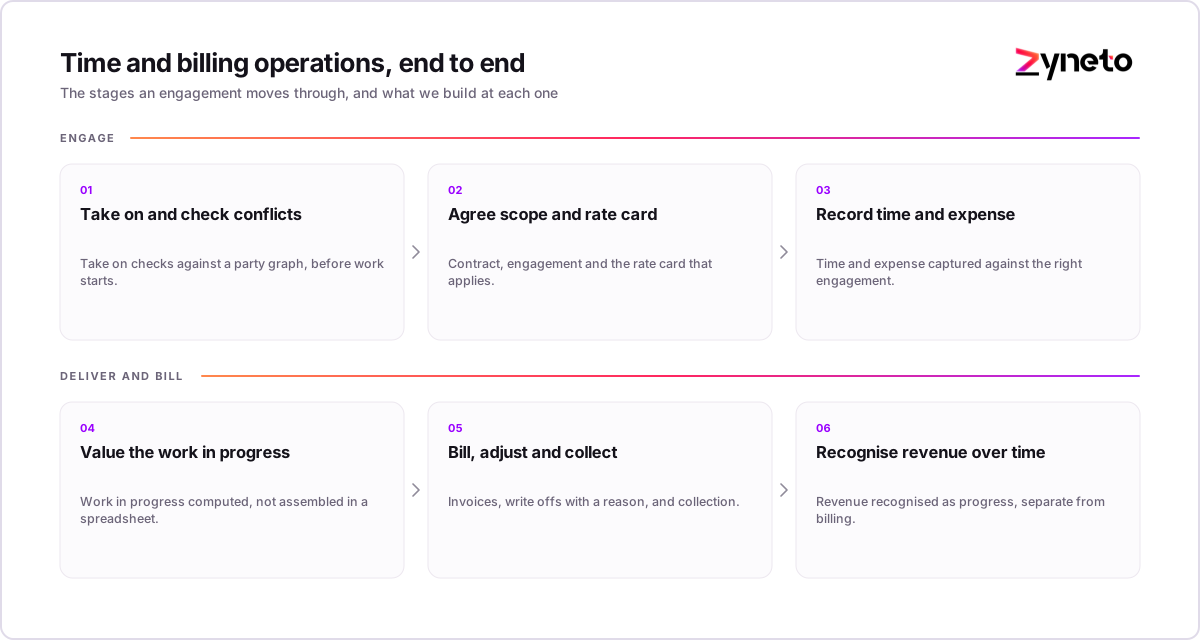
That is usually the actual brief, whatever the request says on the first call. It means computing the valuation from the engagement, the rate card as it stood at the date, and a write off policy that is written down and applied consistently, rather than assembling it in a spreadsheet. The test is whether last quarter's figure can be reproduced today without anyone remembering how it was prepared.
You have no professional services clients on this page. Why should we take you seriously?
Because we would rather say that than describe a software client as a practice and hope nobody checks. What is on this page instead is the modelling, the standard and the arithmetic, all of which you can verify without trusting us. The code, decision records and specifications are yours from the first commit, which is the part that holds whether or not we turn out to be a fit.
Can you work with our existing Kantata, Clio or Deltek installation?
Yes, and that is the more common shape of this work. The first question is how many commercial levels your specific product models, because a platform that only understands a project cannot hold a cap that was negotiated across several engagements, and everything built beside it becomes a workaround. We would much rather establish that in discovery than in build.
How do you handle a rate change agreed with retroactive effect?
As a re-rate rather than an update. Because the timesheet holds the grade and the rate card is dated reference data, applying a new card from a past date regenerates the value of the affected entries and records what moved and why. Anything already billed becomes an adjustment with a traceable cause rather than a credit note nobody can explain, which is also the only version an auditor will accept.
Do you cover client money for regulated practices?
We build to the requirement and we do not hold the money. The requirement in practice is a per matter position that can be produced for any past date and that cannot be netted against office balances, which is a modelling problem before it is a banking one. The specific accounts rules depend on whichever regulator licenses your practice, so confirm those with them before the ledger is designed rather than after.
What does India e-invoicing mean for a firm that bills late?
It turns a cash flow habit into a tax problem. Electronic invoicing is mandatory for business to business supplies and exports above ₹5 crore of aggregate turnover, in force since 1 August 2023, and since 1 April 2025 taxpayers at ₹10 crore or above must upload an invoice to the Invoice Registration Portal within 30 days of issue. The practical build consequence is putting that clock inside the billing workflow, where the person holding the invoice can see it, rather than in a finance report they never open.
How do you prove a migration worked?
By replaying it. A full past year of time and billing is regenerated per engagement under the new model and compared entry by entry against what the old system produced. Matching the work in progress total is not the test, because it says nothing about which entries or which rates produced it, and a compensating pair of errors always agrees at the total.
Can you enforce conflicts and independence rules?
We build the enforcement; the rules are yours. In practice that means holding restrictions as data rather than as a policy document, checking them at take on against a party graph that includes parties who are not clients, enforcing them again at assignment, and re-checking when parties change on a live matter. What we will not do is decide which engagements you may accept, which is a professional judgement and not a software one.