

















Automotive software development for dealers, fleets and aftersales

The systems behind the vehicle rather than the listing: dealer and inventory management, workshop scheduling, parts catalogues that survive supersession, telematics ingest, and warranty claims that reconcile. If what you want is a marketplace or listings product, the classified app page is the one you want.

  • UNECE R155 and R156 aware
  • EU Data Act, Sept 2025
  • VIN as the spine
  • $40 to $100 per hour
See the short version

Get Your Free Consultation & We'll Reach Out Promptly!

By submitting this form, I authorize Zyneto to collect and process my personal data in accordance with theZyneto Privacy Policy.

We respond to all inquiries within 1 hour.

Trusted by
Global Industry Leaders

Al Amri Express
Cheer Sagar
MRO Supply
BankSathi
DoraDori
Kroolo
StyleBank
Hire Right
Cintas
Up in the Air
Famepilot
Swedishness
Corrib Coil
iCare Heal
TWAM
NDC: National Distribution Company Oman
Moneteo
Algora
Numerology
G4Girl

The short version

The commercial facts in one block, so you never have to hunt for them. Most of it arrives as dealer management system development or fleet management software development, and the two rarely stay separate for long. The tiles cover: Typical integration set, Phase one timeline, Rate band, Phase one range, with the arithmetic, Stack we actually use and Our commitment.

Typical integration set

01

A dealer management system, an OEM parts feed, a telematics provider, a payment provider, and whatever the workshop currently books appointments in. Plus the warranty portal, which is almost always a separate login nobody has automated.

Phase one timeline

02

12 to 18 weeks. The long pole is rarely the integration. It is agreeing that the vehicle, the asset and the customer are three different objects, and unpicking the systems that currently treat them as one.

Rate band

03

$40 to $100 per hour by role. Catalogue and reporting work near the floor, telematics ingest and warranty reconciliation near the ceiling. Mixed teams blend to around $65.

Phase one range, with the arithmetic

04

Dealer 100 plus workshop 160 plus parts 130 plus telematics 170 plus warranty 100 plus fiscal 90 equals 750 hours. That runs $30,000 at $40 and $75,000 at $100, about $48,750 at a $65 blend. The full span across the six modules is 510 to 980 hours.

Stack we actually use

05

Whatever your DMS exposes, which is the binding constraint. Python or Node for ingest, Postgres for the vehicle and service history because the queries are relational and long-lived, and a queue in front of telematics because the feed does not stop when your database does.

Our commitment

06

No quote before discovery. We will also tell you when the answer is a DMS module you already pay for rather than a build, which happens more often on this vertical than on any other we work in.

Audience

Who this is for

Six operator shapes and the question each one currently cannot answer. Not a fit: if you want a vehicle marketplace or listings product built, that is the classified app page, linked at the foot of this one. This page is written for: Your DMS cannot see the workshop, Parts supersession broke the catalogue and Telematics data goes nowhere useful.

01

Your DMS cannot see the workshop

Sales and service run on systems that share a customer record and nothing else, so nobody can tell you what a vehicle has actually cost across its life. We start by making the VIN the spine rather than the customer account.

02

Parts supersession broke the catalogue

An OEM replaced a part number and your catalogue now has orphaned stock, failed lookups and quotes that cannot be fulfilled. We start with a supersession chain that keeps history rather than overwriting it.

03

Telematics data goes nowhere useful

The fleet feed arrives and lands in a dashboard nobody opens, unjoined to service records. We start by joining telemetry to the service history on the VIN, which is where predictive maintenance actually becomes possible.

04

Warranty claims are a manual month

Someone re-keys claims into an OEM portal and rejections come back weeks later with no pattern anybody tracks. We start by capturing claim-grade data at the point of repair instead of reconstructing it afterwards.

05

You are opening connected services

The moment a service reads or writes vehicle data two-way, the EU Data Act is in scope and so is R155. We start by mapping which of your planned features actually cross that line, which is usually fewer than feared.

06

Multi-site and nobody agrees on stock

Each branch runs its own view of vehicles and parts, and transfers are phone calls. We start with one stock model across sites, because every reporting question downstream depends on it.

Find your operation

Automotive is one word for six businesses. What breaks is different in each, so what we build is different. The operations covered here are: Franchised dealer group, Independent workshop network, Fleet and leasing operators, Parts distribution, Mobility and rental and EV charging and energy.

01 · Your operation

Franchised dealer group

What breaks

OEM systems, your DMS and your own reporting disagree, and the OEM's numbers are the ones that decide your margin. Sales and aftersales are effectively separate companies sharing a car park.

What we build

One vehicle record spanning sale, finance, service and parts, reconciled against the OEM feed rather than maintained alongside it.

Where dealer and fleet systems earn their keep

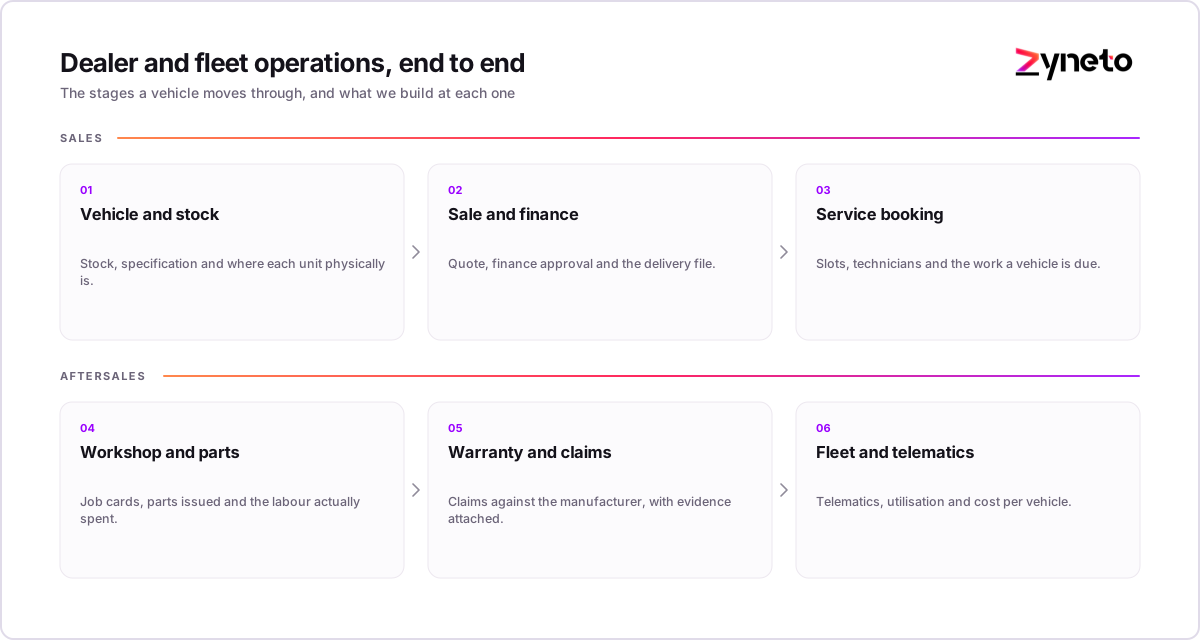
The stages a vehicle moves through, and what we build at each one. The stages run: Vehicle and stock, Sale and finance, Service booking, Workshop and parts, Warranty and claims and Fleet and telematics. Each one is a place a system either holds the fact or loses it.

01Vehicle and stock02Sale and finance03Service booking04Workshop and parts05Warranty and claims06Fleet and telematics
Two band automotive map covering stock, sale and service booking, then workshop, warranty and fleet telematics.

Systems we connect to, and how vehicle identity actually works

An automotive build is an identity problem before it is an integration problem. Here is the estate we expect to meet, and the modelling decision that determines whether any of it joins up. The estates we expect to meet are: Dealer management systems, OEM feeds and portals and Telematics and connected services.

Dealer management systems

The system of record for the transaction, and the constraint on the whole project. Its API surface ranges from a documented interface to a nightly export, and the answer decides the shape of everything after it. Establish it in week one.

OEM feeds and portals

Parts catalogues, warranty submission, technical data and recall notices, usually delivered through separate portals with separate credentials. Rarely designed for machine access, frequently the source of the numbers that decide your margin.

Telematics and connected services

A continuous feed keyed to the vehicle rather than to the customer. Volume is high and value is low per message, so the design question is what you keep, at what resolution, and for how long.

VIN versus registration

A registration is a label a jurisdiction attaches to a vehicle and it changes with a plate transfer, an export or a re-registration. The VIN does not. Keying anything durable to the registration is how service history detaches from the car it belongs to.

Part number versus supersession chain

A part number is a point in time, not an identity. Storing only the current number means yesterday's quote no longer resolves and superseded stock becomes invisible. Store the chain and every historical lookup keeps working.

Telemetry versus service history

Telematics knows how the vehicle is used. The workshop knows what was done to it. Predictive maintenance is the join between them, and in most estates that join has never been made because the two live under different keys.

Reading data versus two-way services

Reading data off a vehicle and operating a service that writes back are different regulatory positions. The second brings the EU Data Act's related-services scope and the R155 management system into play, and it is worth knowing which side of that line a feature sits on before it is built.

Send us one question you cannot answer about a vehicle

Pick a car that has been through two owners and ask what it has cost across its life, or which parts on it are superseded. Whether your systems can answer tells us where the identity model broke, usually within an afternoon.

Which rules apply to you

Type approval, data access, card handling and fiscal reporting land on four different teams and end up in the same system. This is the map with the dates that matter. We hold none of these approvals; we build the systems and the records that let you satisfy them.

UNECE R155 and R156

R155 governs the Cyber Security Management System and R156 the Software Update Management System. Since July 2024 both apply to all new vehicles regardless of when the type approval was obtained, across the 64 UNECE contracting parties including the whole EU, Japan, South Korea and Australia, as a precondition of type approval. For a dealer or fleet operator these bind the manufacturer rather than you directly, but they determine what an OEM will let your systems touch and how software updates reach vehicles you service.

EU Data Act

In effect since 12 September 2025, with Commission guidance on vehicle data adopted the same day. It covers connected products including vehicles, and related services involving bidirectional data exchange such as predictive maintenance, remote control and dynamic route optimisation. Traditional aftermarket services stay out of scope unless they involve digital two-way data use. Manufacturers must be transparent about what data exists, provide raw and pre-processed data, give it free to the vehicle user, and charge data recipients such as workshops and parts distributors only fair, reasonable and non-discriminatory fees.

Owner permission is the gate

The Data Act is user-mediated rather than automatic. A workshop or distributor gets access because the vehicle owner granted it, which makes consent capture and revocation a product surface rather than a contract clause. Systems that assume access is a commercial arrangement between businesses will find the permission is missing at the point it matters.

PCI DSS v4.0.1

All 51 future-dated requirements became mandatory on 31 March 2025, and multi-factor authentication is now required for all access to the cardholder data environment rather than only administrative accounts. Deposits, service payments and parts counter sales all touch this. The practical move is shrinking the environment so card data never reaches your own systems.

India, GST e-invoicing

Mandatory where aggregate annual turnover exceeds Rs 5 crore, effective 1 August 2023, with a 30 day Invoice Registration Portal window above Rs 10 crore. The scope is B2B, which for this sector means fleet contracts, trade parts sales and inter-branch transfers rather than the retail service invoice.

The architectural consequence

Type approval, data access and fiscal output all change on their own timetable and none of them should be threaded through the vehicle record. Keep each behind its own adapter. It costs more in week three and it is why a new market or a new OEM requirement becomes an adapter rather than a migration.

What goes wrong

Ten failure modes with the counter-practice attached. Naming them is more useful than a list of reasons to pick us. The first three below are: The customer is the primary key, Registration used as the durable identifier and Parts catalogue stores only the current number.

01

The customer is the primary key

Service history hangs off the account, so it vanishes when the car is sold and cannot answer anything about the vehicle itself. Make the VIN the spine and attach relationships to it, not the reverse.

02

Registration used as the durable identifier

A plate transfer or a re-registration silently splits one vehicle into two records. Key on the VIN and treat the registration as an attribute with a history.

03

Parts catalogue stores only the current number

Supersession overwrites the old number and every historical quote, job and stock line stops resolving. Store the chain, not the endpoint.

04

Telematics kept at full resolution forever

Storage grows without bound and nobody deletes anything because nobody agreed what it was for. Decide the retention and the resolution per signal before the first feed is connected.

05

Warranty data reconstructed after the fact

Claims are assembled from a job card written for a technician, not for an OEM assessor, and rejections arrive weeks later. Capture claim-grade fields at the point of repair.

06

Asset and vehicle modelled as one object

A lease cannot be transferred, a vehicle cannot change contract, and whole-life cost cannot be computed across either. Separate the financial position from the physical car.

07

Two-way services shipped without checking scope

A remote feature is built and only then does anyone ask whether the Data Act's related-services definition applies. Establish which side of that line a feature sits on during design.

08

Consent treated as a contract clause

Third-party data access is arranged commercially and the owner permission the Data Act requires was never captured. Build consent capture and revocation as a product surface.

09

Each branch keeps its own stock view

Transfers happen by phone and group-level reporting is a reconciliation exercise every month. One stock model across sites, with location as an attribute.

10

Buying a build that the DMS already ships

A module you already pay for gets rebuilt because nobody read the licence. We check what your DMS already does before scoping anything, and we will tell you when the answer is a configuration change.

Build, buy, or buy the core and build the edge

The honest answer is usually the third one. Worth stating plainly: we are not a DMS vendor and we are not accredited to certify anyone against R155 or PCI DSS, so type approval and card scope stay with your OEM and your assessor in every row below.

ComponentOur recommendationOur honest verdict
The dealer management systemBuyTransaction processing, OEM integration and compliance reporting are a solved and heavily regulated problem. There is no version where writing your own is the cheaper answer for a dealer or a workshop group.
The vehicle and service data modelBuildThis is the part every packaged product models for its own convenience rather than yours, and it is the part that makes whole-life cost, predictive maintenance and group reporting answerable. It is also the cheapest thing to get right early and the most expensive to retrofit.
Telematics ingest and analyticsBuy the core, build the edgeBuy the device estate and the raw feed, which are commodities. Build the join to your service history, because no telematics vendor knows what your workshop did and that join is where the value sits.

Transparency

What automotive software development costs, with the arithmetic shown

Every competitor publishes a total with no hours behind it. Here is the rate, the hours and the multiplication, so you can argue with any line of it. What moves the number: What your DMS can actually expose, Whether the VIN is already the spine, OEM feeds in scope, Telematics volume and retention and Single site or group.

Phase one range

$30,000 to $75,000

The 750 hour worked example at the ends of the rate band, about $48,750 at a $65 blend.

Typical timeline

12 to 18 weeks

The long pole is separating the vehicle, the asset and the customer, not the integration work.

Useful hours

510 to 980

Every module at its minimum, through to every module at its maximum.

What moves the number, ranked
DriverHours
What your DMS can actually exposeA documented API and a nightly export are the same requirement and a different project. Establish this first; every other number here depends on it.Highest impact
Whether the VIN is already the spineIf history hangs off the customer account, this is a data migration with a business-rules problem attached, not a schema change.High
OEM feeds in scopeEach OEM is a separate portal, format and credential. The first is a build, the third is cheaper, and none of them are self-service.High
Telematics volume and retentionIngest is straightforward. Deciding resolution and retention per signal is the part that gets deferred and then costs storage forever.Medium
Single site or groupA group adds one stock model across locations, inter-branch transfers and consolidated reporting, none of which a single site needs.Medium
Connected or two-way servicesRead-only telemetry is comparatively simple. Anything writing back to a vehicle brings consent capture and a regulatory scoping exercise with it.Low to medium
Hours by module
ModuleHours
Dealer and inventory model80 to 160
Service scheduling and workshop100 to 190
Parts catalogue and supersession90 to 170
Telematics ingest and join110 to 200
Warranty and claims70 to 140
Fiscal and compliance output60 to 120

Phase one, added up

  • Dealer and inventory 100 plus service and workshop 160 plus parts catalogue 130 plus telematics 170 plus warranty 100 plus fiscal output 90 equals 750 hours. Every one of the six sits inside its own published range above, so you can move any line and see what it does to the total.
  • At $40 per hour that is $30,000. At $100 per hour it is $75,000. At a $65 blended rate, about $48,750. The full span across the six modules is 510 hours at every minimum to 980 at every maximum.
  • Deliberately not in that number: the DMS licence, telematics hardware, and any type approval or PCI assessment fee. The first two are yours to buy and the third belongs to an accredited body, not to us.

Engagement

Engagement models

Four models for automotive software development, each with the downside stated in the same breath. The models are: DMS capability read, Phase one build, Rollout across sites and Ongoing engineering. Pick by how settled the scope actually is, not by preference.

DMS capability read

Upside

Two weeks establishing exactly what your dealer management system can expose and what it already does, ending in a written plan. It regularly removes work from the scope rather than adding it.

Downside

You pay for a document, and the answer is sometimes that a module you already licence covers most of it. That is a good outcome and a small invoice for us.

Phase one build

Upside

The six modules above against a written scope, ending with the VIN as the spine and reporting that spans sales, service and parts.

Downside

It is a foundation, not a platform. Finance attach, CRM and marketing automation are later phases and saying otherwise would be a worse trade for you than saying so now.

Rollout across sites

Upside

We stay through the first branches going live, which is when per-site data divergence actually surfaces.

Downside

More expensive per hour of output than a clean handover, and it only pays if your operations people are in the room.

Ongoing engineering

Upside

A standing allocation against a roadmap, which suits a group adding OEM feeds and sites steadily.

Downside

It works when there is a genuine backlog and quietly wastes money when there is not. We will tell you when there is not.

Delivery

How we deliver automotive software development

Five phases, each named by the artifact it produces rather than by a stage in a generic waterfall. The phases are: Capability read, Identity model, Catalogue and supersession, Workshop and warranty and Joined reporting. Each is named by the artifact it hands you, so you can ask to see one.

  1. Phase 01

    Capability read

    A written statement of what the DMS, the OEM feeds and the telematics provider can each expose and accept, produced by calling the interfaces rather than by reading a brochure. This artifact decides everything after it.

  2. Phase 02

    Identity model

    Vehicle, asset and customer separated on paper, with the VIN as the spine and registration demoted to an attribute with history. Agreed before anything is built against it.

  3. Phase 03

    Catalogue and supersession

    A parts catalogue that stores the chain rather than the endpoint, so obsolete numbers still resolve and still explain themselves.

  4. Phase 04

    Workshop and warranty

    Scheduling, job capture and claim-grade fields recorded at the point of repair instead of reconstructed for a portal weeks later.

  5. Phase 05

    Joined reporting

    Telemetry joined to service history on the VIN, with fiscal output behind its own adapter, so whole-life cost is a query.

Non-functional

The technical buyer's checklist

Copy this and run it against us, or against anyone else quoting for automotive software development. The groups are: Identity and history, Consent and data access and Feed resilience and retention. Copy any line straight into your own requirements document.

Identity and history

VIN as the durable key, registration held as an attribute with history. Service history that survives an ownership change. A documented answer on what happens to a record when a vehicle is exported or written off.

Consent and data access

Owner permission captured and revocable as a product surface rather than a contract clause, because the EU Data Act makes third-party access user-mediated. An audit trail of who accessed which vehicle's data and under whose permission.

Feed resilience and retention

Telematics queued so the feed does not stop when your database does, and idempotent on the provider's message id. Retention and resolution decided per signal and written down, not deferred until the storage bill arrives.

Frequently Asked Questions

Do we need to replace our DMS?

Usually not, and on this vertical more than any other the honest answer is often that a module you already licence covers a good part of what you want. We read the DMS capability first and check the licence before scoping a build. Replacement is a multi-site retraining project with revenue risk attached; integration is cheaper and reversible.

What does it cost, and how do you price it?

Hours times $40 to $100 per hour by role. The module table gives the range for each of the six modules and the worked example shows 750 hours coming to about $48,750 at a $65 blend. The DMS licence, telematics hardware and any assessment fee are excluded and named as excluded. We do not quote before discovery.

Who owns the code, the vehicle data and the integrations?

You do. The code is yours on delivery, the vehicle and service data lives in your infrastructure rather than ours, and the integrations are yours to keep running or hand to another supplier. We do not retain a copy of your customer or telematics data.

Does the EU Data Act apply to us?

It has been in effect since 12 September 2025 and it covers connected products including vehicles, plus related services involving two-way data exchange such as predictive maintenance or remote control. Traditional aftermarket work stays out of scope unless it involves digital two-way data use. The practical test is whether a feature writes back to the vehicle or merely reads a record you already hold.

Are R155 and R156 our problem or the manufacturer's?

Directly, they bind the manufacturer as a precondition of type approval, and they have applied to all new vehicles since July 2024 across the 64 UNECE contracting parties. Indirectly they are very much your problem, because they determine what an OEM will permit your systems to touch and how software updates reach the vehicles you service.

Why do you keep insisting on the VIN?

Because it is the only identifier that outlives everything else attached to the car. Registrations change with plate transfers and exports, customers sell the vehicle, contracts end. Key the history to the VIN and it survives all of that; key it to the account and it disappears at the first sale.

Can you work with our existing telematics provider?

Generally yes, and we would rather. The value is not in the feed, which is a commodity, but in joining it to your service history on the VIN. That join is the thing no telematics vendor can do for you because they do not know what your workshop did.

How do you handle parts supersession?

By storing the chain rather than the endpoint. A part number is a point in time, not an identity, so overwriting it breaks every historical quote, job and stock line that referenced the old one. Keeping the chain means an obsolete lookup still resolves and can explain why.

Can you help with warranty claim approval rates?

We can change what data reaches the claim, not how an OEM assesses it. Most rejections we see trace to a job card written for a technician rather than for an assessor. Capturing claim-grade fields at the point of repair is the part that is in your control.

We are a fleet operator, not a dealer. Is this still relevant?

Yes, and the modelling matters more for you, because the asset, the contract and the vehicle genuinely are three different things in a leasing business. Most systems collapse them and then cannot answer what a vehicle cost across two contracts.

What happens next

Four steps with a shape attached to each, so booking a call is a known quantity.

  1. A 30 minute technical call

    Bring the name of your DMS, your OEM list, and one question about a vehicle you currently cannot answer. Those three things tell us more than an hour of description.

  2. The capability and licence read

    We find out what your DMS can expose and what it already does, because on this vertical the second question removes scope surprisingly often.

  3. A written scope within a week

    The modules, the hour ranges and the arithmetic, not a headline price. If the honest answer is a configuration change, the document will say that.

  4. You decide

    With the scope in hand you choose whether we build it, your team does, or your DMS vendor does. The document is useful in all three cases and it is yours either way.

Start with the VIN, not the dashboard

Almost every question on this page resolves to whether the vehicle is your spine or an attribute of a customer record. We will read your DMS capability, tell you which it is, and give you the hours either way.

Our Success Stories

Real feedback from the people we've proudly partnered with.

Brooklyn Foster profile

Brooklyn Foster

Sales Director |Cintas

United States

GoodFirms
"

Zyneto Global Technologies provided excellent project management and technical expertise throughout the engagement. The team was responsive, collaborative, and adaptive, ensuring the project met our expectations and set a strong foundation for future growth.

"
Verified Review
Rating: 5 out of 5
Krystian Chlebek profile

Krystian Chlebek

Founder & CEO |Moneteo

TechBehemoths
"

We engaged Zyneto to design and develop a custom web platform for Moneteo, aimed at improving project management, data tracking, and collaboration across internal teams and external partners. Their work included full-stack web development, custom modules for workflow automation, API integration, and comprehensive testing.

"
Verified Review
Rating: 5 out of 5
Kevin Scott profile

Kevin Scott

CEO |E-Commerce Platform

Clutch
"

Overall, their responsiveness and timely deliveries contributed positively to the project's success. The client achieved better data management and quality. The service provider delivered the project on time and ensured prompt responsiveness throughout the engagement. Their innovative approach was outstanding.

"
Verified Review
Rating: 5 out of 5

Explore further

Go deeper

Build the system

Adjacent capabilities

Other sectors

Related Insights

Analytics, automation and document work that applies directly to dealer and fleet operations.

WhatsApp
Email
Book a Meeting