Frequently Asked Questions
What does a phase one cost, how many hours, and how long does it take?

The worked example is 1,260 hours, which is $50,400 to $126,000 across our $40 to $100 rate band and about $81,900 at a $65 blend, landing in 14 to 22 weeks with a squad. The module ranges sum to 1,060 to 1,860 hours, so a smaller or larger phase one is a question of which modules are in it. We do not quote a fixed number before a discovery that produces the integration inventory.
Who owns the code, the data and the accounts?
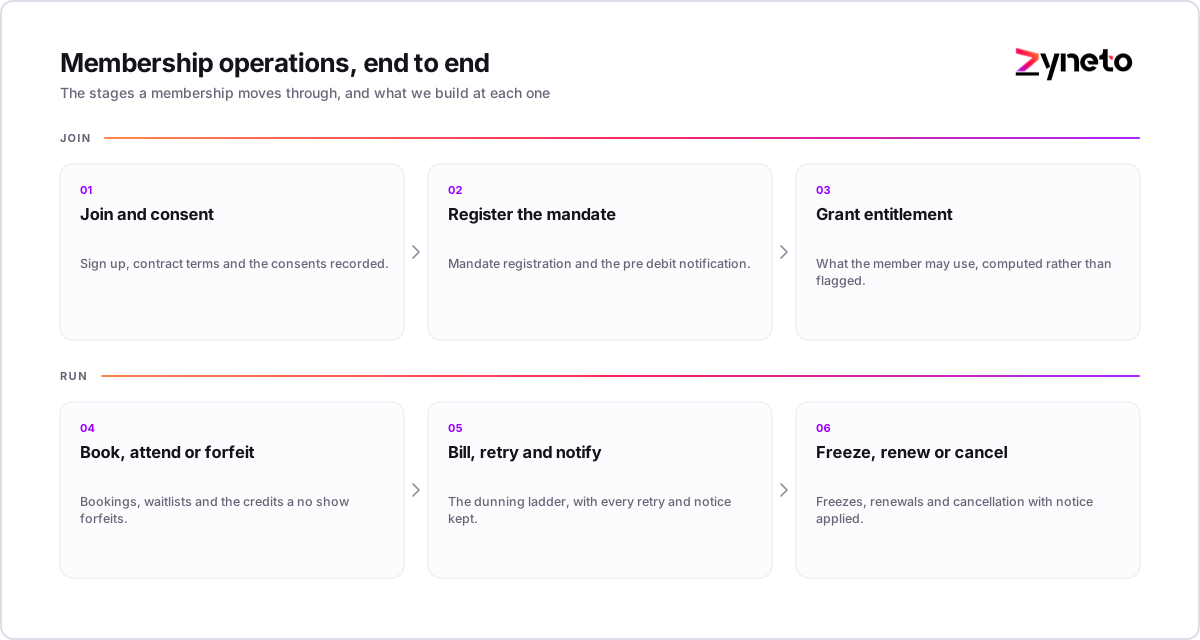
You do, all three, from the first commit. Repositories, cloud accounts, domains and third party service accounts are in your name or transferred to it at handover. What transfers alongside them is the entitlement decision record and the billing and dunning ladder, which is the part that makes the code readable by whoever comes after us.
Why does modelling entitlement matter more than the app?
Because the door, the billing engine, the refund conversation and the churn report all ask the same question and most estates answer it in four places. Once entitlement is computed in one service from the contract and its dated events, those four stop disagreeing. The app is the easy part and it is the part that gets rebuilt every few years anyway.
Does HIPAA apply to our gym app?
Almost certainly not, and that is the reason to read the next sentence rather than to relax. The FTC's Health Breach Notification Rule covers health records held by entities that are not HIPAA covered, and its 2024 amendments, effective 29 July 2024, explicitly bring direct-to-consumer wellness technology inside it. A breach there includes an unauthorised disclosure even when it was voluntary, so an analytics or advertising software development kit passing health data out of your app is a reportable event rather than a growth decision.
We built for the FTC click to cancel rule. Was that wasted?
The rule itself was vacated in full by the Eighth Circuit on 8 July 2025, six days before it was due to take effect. The work is not wasted, because the Restore Online Shoppers' Confidence Act, section 5 of the FTC Act and state auto-renewal statutes all still apply, the Commission began a fresh rulemaking on 30 January 2026, and the United Kingdom regime arriving in spring 2027 asks for much the same evidence. Keep the cancellation path and the notice ledger; they were always the defensible parts.
You have no fitness clients on this page. Why should we take you seriously?
Because we would rather say that than borrow a client from another sector and call it fitness experience. What is on this page instead is the modelling, the statute and the arithmetic, all of which you can check without trusting us. The code, decision records and specifications are yours from the first commit, which is the part that holds whether or not we turn out to be a fit.
Can you work with our existing Mindbody or ABC Fitness installation?
Yes, and that is the more common shape of this work. The first question is whether the platform will let the access decision be delegated, because if it insists on computing entitlement itself then anything you build beside it becomes a second opinion rather than the answer. We would much rather establish that in discovery than in build.
How do you stop expired cards looking like churn?
By keeping the dunning ladder as its own event sequence rather than as a status change. Each retry, notification and grace day is recorded, entitlement reads from that sequence, and the churn report distinguishes a member who decided to leave from one whose card expired. In most estates we see, switching on network tokens and an account updater alongside that is the cheapest retention work available.
How do freezes and minimum terms get handled?
As first class dated events rather than as manual adjustments. A freeze changes billing, entitlement, the contract end date and the retention denominator at the same time, and handling it by hand reliably gets one of the four wrong. Minimum term, notice period and exit conditions become fields the cancellation flow evaluates, so the system can answer whether a member may leave today instead of leaving it to whoever picks up the phone.
What does migrating off our current platform involve?
It depends on the variety of your contract shapes rather than on how many members you have. The proof is an entitlement replay: a full past year regenerated per member under the new model and compared position by position against what the old system actually did. A matching member count is not the test, because it says nothing about freezes, credits, minimum terms or contract dates.
Can you integrate wearables and health apps?
Yes, through the platform software development kits rather than by talking to devices. Health Connect is the Android path now that the Google Fit APIs are deprecated and closed to new developer signups, with HealthKit on iOS and vendor APIs for Fitbit, Garmin and Whoop. The design work is consent and normalisation rather than transport, because the same metric arrives with different definitions from each source and a chart that silently mixes them is worse than no chart.