Frequently Asked Questions
What does a phase one cost, how many hours, and how long does it take?

The worked example is 1,460 hours, which is $58,400 to $146,000 across our $40 to $100 rate band and about $94,900 at a $65 blend, landing in 18 to 26 weeks with a squad. The module ranges sum to 1,120 to 1,980 hours, so a smaller or larger phase one is a question of which modules are in it. We do not quote a fixed number before a discovery that produces the integration inventory.
Who owns the code, the data and the accounts?
You do, all three, from the first commit. Repositories, cloud accounts, domains and third party service accounts are in your name or transferred to it at handover. What transfers alongside them is the meter data decision record and the estimation rule book, which is the part that makes the code readable by whoever comes after us.
Why does provenance on a read matter so much?
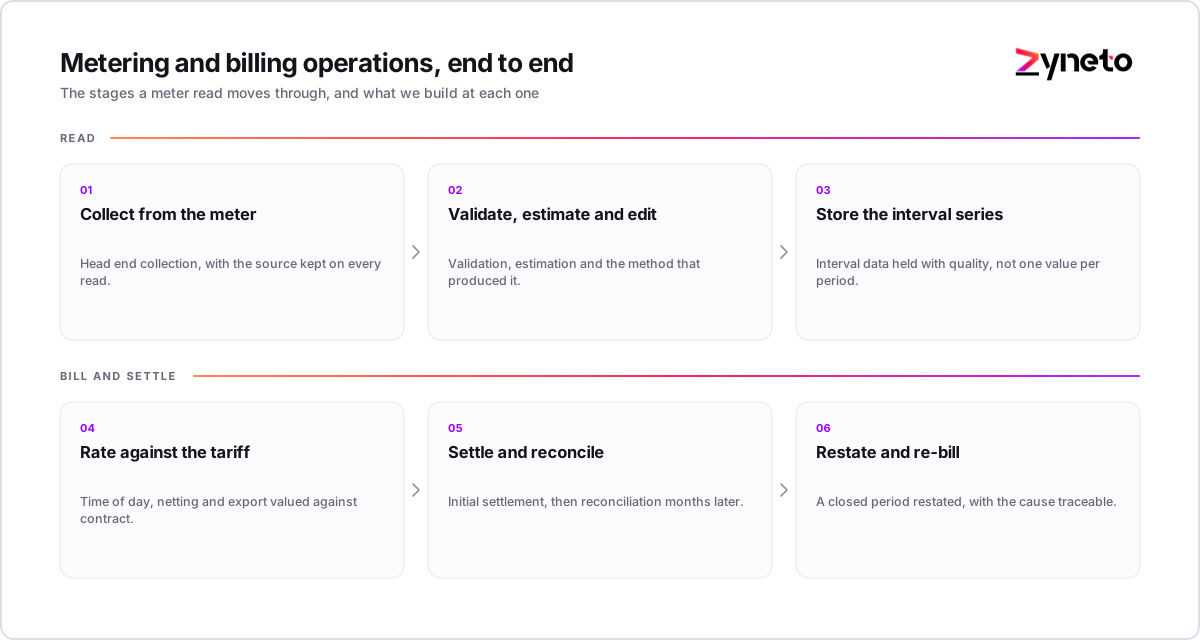
Because a bill is a restatement rather than a fact. Initial settlement often runs on estimates, reconciliation replaces them with actuals months later, and the customer or regulator asking why March changed needs an answer that names the reads involved. A system that overwrites a value in place has destroyed the only evidence that would have answered them.
What is the actual difference between a head-end, meter data management and billing?
The head-end talks to meters and knows nothing about tariffs. Meter data management holds the validated series and does not rate it. Billing rates and invoices and generally cannot hold interval history at rollout volume. They are three products, and buying one does not give you the other two, which is the single most common reason a metering programme discovers a gap with no time left to close it.
How does the half hourly settlement change in Great Britain affect a build starting now?
It is a live constraint rather than a future one. Market-wide Half Hourly Settlement is due to go live by May 2027, changes have been landing in stages since September 2025 and continue to July 2027, and the migration phase started in October 2025 across an 18 month window with most meter points moving between May 2026 and May 2027. Anything being built for a supplier now has to be testable against the new arrangements inside that window rather than after it.
You have no utility clients on this page. Why should we take you seriously?
Because we would rather say that than borrow a client from another sector and call it utility experience. What is on this page instead is the modelling, the standards and the arithmetic, all of which you can check without trusting us. The code, decision records and specifications are yours from the first commit, which is the part that holds whether or not we turn out to be a fit.
Can you work with our existing Itron or Oracle Utilities installation?
Yes, and that is the more common shape of this work. The first question is what your specific version actually exposes and actually stores, because vendor documentation describes the current release and you may not be on it. We would much rather establish that in discovery than in build.
How do you handle prepaid metering and disconnection?
As a reviewable decision rather than a threshold job, because the consequence is physical. The balance calculation, the payment timeline and any hold conditions are attached to the decision and logged, so a disputed disconnection can be explained rather than argued. In practice the most common cause we find is a payment posting later than the balance check, which is a sequencing problem rather than a credit one.
What is OBIS and why does it keep coming up?
It is the object identification system in the DLMS/COSEM Blue Book, and it is how a meter says what a given value actually is: which register, which tariff rate, which direction, which period. It matters because a data model that flattens everything into a value column has thrown away the only thing distinguishing an import register from an export one, and that distinction is the difference between a credit and a charge.
How do you test something as large as a year of interval data?
By replaying it. A full past year is regenerated interval by interval under the new model and compared period by period against what the old system produced, with both clock change days tested deliberately because those are the two days a naive implementation gets wrong. Matching monthly totals is not the test, since settlement is done on the series and a compensating pair of errors always agrees at the total.
Do you cover water and gas as well as electricity?
Yes, and the modelling differences are worth naming early. Both are measured in physical units and billed after a conversion whose factors change over time, so those factors need their own dated history or a correction becomes a manual adjustment. Read frequency is also much lower, which makes estimation the normal case rather than the exception and means a long estimated run has to be visible as a risk rather than passing as an ordinary bill.