
Typical integration set
01An LMS over LTI 1.3, a rostering feed on OneRoster, an identity provider on SAML or OIDC, a payment gateway on local rails, and whatever the incumbent SIS will export. Plus the spreadsheet the registrar actually trusts.
The systems an institution actually runs on: admissions and counsellor workflow, fees, attendance, timetabling, gradebooks that survive a curriculum change, and the LTI and rostering standards a procurement team will hold you to. Session-scoped data is the thing that makes education software different, and it is the thing most platforms get wrong in year one.

















The commercial facts in one block, so you never have to hunt for them. In practice that means edtech app development and learning management system development, joined to whatever student record already holds the truth. They are: Typical integration set, Phase one timeline, Rate band, Phase one range, with the arithmetic, Stack we actually use and Our commitment.
Typical integration set
01An LMS over LTI 1.3, a rostering feed on OneRoster, an identity provider on SAML or OIDC, a payment gateway on local rails, and whatever the incumbent SIS will export. Plus the spreadsheet the registrar actually trusts.
Phase one timeline
023 to 5 months for a K-12 operations platform. The pacing constraint is the academic calendar rather than engineering: nothing lands mid-term, and a fees or gradebook cutover has exactly one safe window a year.
Rate band
03$40 to $100 per hour by role. Admin screens and reporting near the floor, timetable constraint solving and assessment integrity near the ceiling. Mixed teams blend to around $65.
Phase one range, with the arithmetic
04Discovery 90 plus tenancy 130 plus records 170 plus admissions 190 plus fees 220 plus attendance 180 plus grades 230 plus migration 110 equals 1,320 hours. That runs $52,800 at $40 and $132,000 at $100, about $85,800 at a $65 blend. Full span 910 to 1,820.
Stack we actually use
05Postgres for the student record, because every query is relational and every row is versioned by academic year and term. Python or Node for services. Your existing identity provider. We do not replace an LMS that works; we integrate with it over LTI.
Our commitment
06No quote before discovery, and no firm price on a first call. A number quoted before anyone has seen your role list and your term structure has either been padded heavily or will be repriced at change-request time.
Audience
Six institution shapes and the record each one cannot currently produce on demand. Not a fit: if you want a consumer learning app built from scratch, that is a product build rather than an institutional system. Written for: Your SIS breaks on a curriculum change, Admissions runs on spreadsheets, An RFP demanded LTI Advantage and Fees reconciliation takes a week.
Change a subject structure and last year's results stop rendering correctly, because the data was never scoped to an academic session. We start by versioning every record by year and term, which is the single decision that makes history stay true.
Enquiries arrive across five channels, counsellors track them privately, and nobody can say which source produced admitted students. We start with a counsellor CRM whose stages match how your team actually works.
Procurement specified LTI Advantage Complete and the answer to whether you support it is currently no. We start by scoping Core plus Deep Linking, NRPS and AGS, and by being honest that certification is an annual membership cost on someone else's calendar.
Instalments, concessions, late fees and part payments live in three systems and none of them agree at month end. We start with one fee ledger that models the concession rather than adjusting the invoice after the fact.
A public institution asked for WCAG conformance and a VPAT, and nobody has tested with a screen reader. We start with an audit against the level actually required, which for US public entities is WCAG 2.1 AA rather than 2.2.
The DPDP Rules make everyone under 18 a child, requiring verifiable parental consent with no behavioural tracking. We start by mapping which of your flows need guardian consent and building the consent ledger that proves it.
Education is one word for six institutions with different failure modes. What breaks is different, so what we build is different. Each operation below breaks differently, and they are: K-12 schools and groups, Higher education, Online and distance, Test prep and assessment, Corporate training and L&D and Marketplaces and discovery.
01 · Your operation
What breaks
Parents are a first-class user nobody scoped, attendance is a daily legal record rather than a report, and a school group needs tenant-level overrides on almost every policy.
What we build
One tenancy model with per-school overrides, a parent app that is a real surface rather than a portal link, and attendance captured as an auditable daily record.
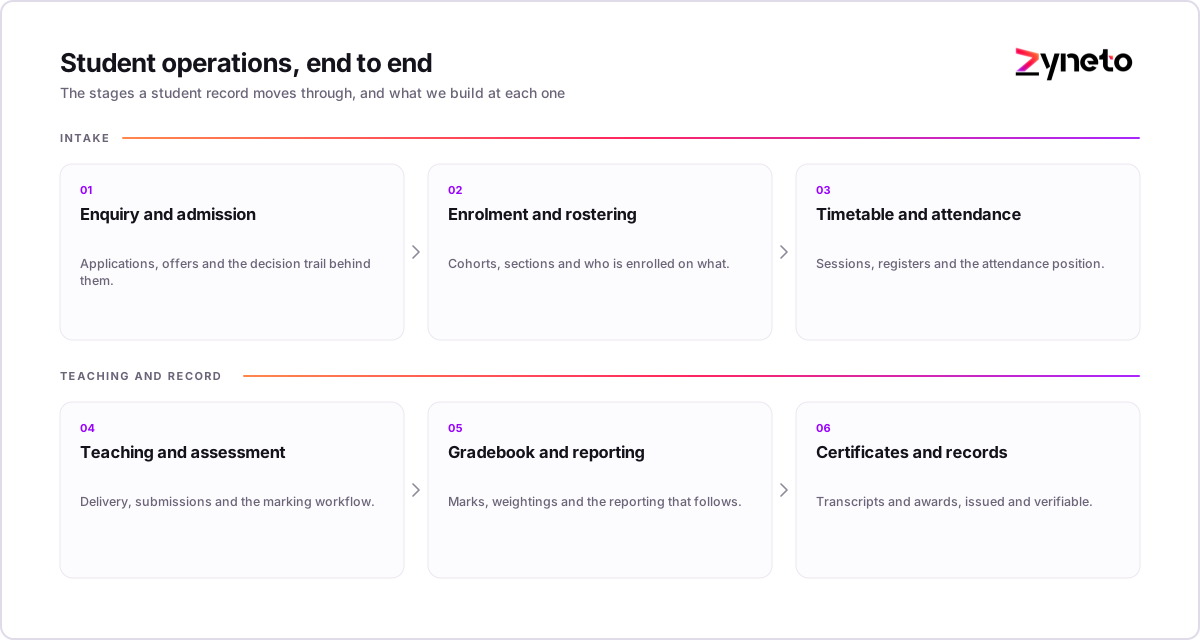
The stages a student record moves through, and what we build at each one. The arc is: Enquiry and admission, Enrolment and rostering, Timetable and attendance, Teaching and assessment, Gradebook and reporting and Certificates and records. Each one is a place a system either holds the fact or loses it.
This layer is imposed rather than chosen. RFPs specify LTI Advantage Complete the way a retailer specifies an ASN, and the vendor does not get a vote. It is also where the estimate that said it integrates with a few APIs goes wrong.
LTI 1.3 Core is an OIDC third-party-initiated login followed by an RS256-signed JWT validated against a rotating JWKS endpoint. LTI Advantage Complete adds Deep Linking 2.0 for content selection, NRPS 2.0 for rosters and AGS 2.0 for grade passback. Certification requires paid 1EdTech membership and recurs annually.
SCORM 1.2 and SCORM 2004 4th Edition are two incompatible data models and a package built for one will behave differently on the other. xAPI statements go to an LRS and are immutable: a wrong statement is corrected by voiding it, never by editing. cmi5 is the xAPI profile that defines the launch.
OneRoster 1.2 REST with OAuth 2.0 client credentials is the target; 1.1 is sunset for new certification and its OAuth 1.0a body-hash signing is a legacy landmine. SAML 2.0 federated login through InCommon or eduGAIN needs auto-refreshing metadata, or every login in the federation breaks on certificate rotation.
One platform can carry several deployments, so these are not interchangeable and a tool keyed only on client_id will cross tenants. Every multi-tenant LTI bug we have inherited lives in that confusion.
Safari ITP and Chrome both block third-party cookies, which breaks an iframe launch outright. Set SameSite=None with Secure and implement either the Storage Access API or the 1EdTech platform-storage postMessage pattern before you meet a Safari user, not after.
Nonce and state must be validated on the server. A client-side check is not a check, and this is the one people skip because the launch appears to work without it.
Registering a single key across institutions reintroduces exactly the shared-secret failure LTI 1.3 exists to remove. Register per tenant even when it is more work at onboarding.
Whichever spreadsheet gets rebuilt every term tells us more about your data model than a requirements document does. We will tell you what it would take for the system to produce it, and whether that is an integration or a rebuild.
Dated obligations a procurement team can check. Several of these have already moved once, so confirm current status before you contract against them. We hold none of these certifications; we build the records that let you satisfy them. The items are: India, DPDP Act 2023 and DPDP Rules 2025 and India, academic identity and payments.
Rules were notified on 14 November 2025 and phase in: the Data Protection Board immediately, Consent Manager registration from November 2026, and full obligations by 13 May 2027. Everyone under 18 is a child, which requires verifiable parental consent with no behavioural tracking and no targeted advertising to children. For an Indian edtech product this is the largest single build item on this page: age assurance, guardian consent capture and an auditable consent ledger.
APAAR ID, the Academic Bank of Credits and NAD all ride on DigiLocker, and higher education institutions have been directed to upload credit data to the ABC portal. NEP 2020 multiple entry and exit means credit accumulation belongs inside the student record rather than in a spreadsheet. On payments, RBI card tokenisation has been mandatory since October 2022 so never store card numbers, and e-mandate pre-debit notification applies to recurring fees.
Oman's PDPL came from Royal Decree 6/2022 and is now fully enforceable, regulated by MTCIT, with data subject rights inside 45 days, breach notification inside 72 hours and a named DPO. Children's and biometric data need a permit before processing. Saudi's PDPL sits under SDAIA with implementing regulations in force, expecting a DPIA for high-risk processing and a transfer risk assessment before data leaves the Kingdom. In-Kingdom hosting for student records is a routine buyer requirement rather than an exception.
FERPA governs the education record, including the school-official exception, annual notification and 45-day record access. The amended COPPA Rule broadens what counts as personal information and requires separate parental consent for third-party disclosure, a written retention policy and prescriptive security. Confirm the exact compliance dates against the Federal Register before planning against them.
The DOJ's ADA Title II rule sets WCAG 2.1 AA, not 2.2, for public schools and universities. An interim final rule on 20 April 2026 extended compliance to 26 April 2027 for populations of 50,000 or more and 26 April 2028 for smaller entities, with the technical standard unchanged. In Europe EN 301 549 maps to WCAG 2.1 AA and the European Accessibility Act has applied since 28 June 2025, reaching private e-learning sold to EU consumers. In India the RPwD Act 2016, GIGW 3.0 and IS 17802 apply. Section 508 procurement expects a VPAT.
Education AI is high risk under Annex III, covering admission decisions, evaluation of learning outcomes, level determination and monitoring for prohibited behaviour during tests. Prohibitions and AI literacy duties have applied since 2 February 2025, including the ban on emotion inference in education, which rules out stress-detection proctoring. Transparency duties mean disclosing AI involvement to the student.
One build, described properly. We would rather write up a single platform in depth than show a wall of logos.
India
A college discovery platform backed by Times Internet and part of the CollegeDekho Group. It consolidates what a student otherwise assembles from a dozen tabs: courses, fee structures, placement records, entrance exam details and cutoffs, in a catalogue that has to stay searchable while it changes constantly. On top sits the decision layer, student-generated reviews and campus infrastructure insight rather than brochure copy, plus real-time exam alerts so a deadline does not pass quietly. The institution side is the other half: recruitment and analytics that tell a university where its admitted students actually came from. The platform's published reach is over 40 million students a year across more than 200 universities, which is the client's figure for the size of the system rather than an outcome we claim.
Ten failure modes with the counter-practice attached. Naming them is more useful than a list of reasons to pick us. The opening three are: Data is not scoped to an academic session, Parents were never modelled as users and LTI scoped as 1.1 and sold as Advantage.
Change a curriculum and last year's records stop making sense, because nothing was versioned by year and term. Version from the first migration; retrofitting it means reinterpreting every historical result.
They arrive as an afterthought with their own permissions, their own notifications and their own app, halfway through the build. Put every role on the list in discovery, including the ones who never attend the meetings.
The trust model is different, so a version bump does not deliver it and procurement will test the difference. Scope 1.3 with per-tenant keys from the first commit.
A browser clock and a non-resumable attempt survive a demo and fail on the first high-stakes exam day. Server-authoritative timing and resumable attempts, always.
The build cost is quoted and the recurring bandwidth bill arrives in year two, larger than the maintenance line. Model egress at the volumes you actually expect before choosing a delivery approach.
Reconciliation then cannot explain why two students paid different amounts for the same programme. Model the concession as its own object against the fee, so the ledger stays explicable.
It is architectural, and retrofitting keyboard order and focus management across a finished product costs more than building it right. Audit against the level actually required, early.
Departments route around software that does not fit, and shadow spreadsheets return. Allow scoped configuration, and be clear about where configuration stops and forking begins.
Fees and gradebook migrations have one safe window a year and it is not November. Plan the cutover against the academic calendar before the engineering plan exists.
Under the DPDP Rules a guardian consent you cannot reproduce on demand is the same as no consent. Keep an auditable consent ledger, versioned like everything else.
The honest answer is usually the third one. Worth stating plainly: we are not an LMS vendor and we are not an accreditation body, so the platform choice and the academic approval stay with you in every row below. The calls are: The LMS itself, The student record and institutional workflow and Assessment and proctoring.
| Component | Our recommendation | Our honest verdict |
|---|---|---|
| The LMS itself | Buy | Course delivery, content runtime and the standards surface are solved and heavily certified. Building your own means owning SCORM, xAPI and LTI conformance permanently, for no differentiation. |
| The student record and institutional workflow | Build | This is where your institution differs from every other, and it is the part no packaged product models correctly once departments have their own rules. It is also the cheapest thing to get right early and the most expensive to retrofit. |
| Assessment and proctoring | Buy the core, build the edge | Buy the proctoring service and the delivery runtime, which are commodities with real compliance overhead. Build the item bank, exposure control and the integrity rules, because those encode your academic policy. |
Transparency
Every competitor publishes a total with no hours behind it. Here is the rate, the hours and the multiplication, so you can argue with any line of it. The scope priced here is a K-12 operations platform. Priced against: How many distinct user roles, Session-scoped data, Each integration, Report card and certificate templates and Data migration from the incumbent.
Phase one range
$52,800 to $132,000
The 1,320 hour worked example at the ends of the rate band, about $85,800 at a $65 blend.
Typical timeline
3 to 5 months
Paced by the academic calendar as much as by engineering. One safe cutover window a year.
Useful hours
910 to 1,820
Every module at its minimum, through to every module at its maximum. QA and PM quoted separately.
| Driver | Hours |
|---|---|
| How many distinct user rolesStudent, parent, teacher, head of department, registrar, exam controller, finance, counsellor, admin. Each carries its own screens, permissions and audit trail, multiplied by tenant-level overrides. | 40 to 90 each |
| Session-scoped dataApplied across every affected module. Each record versioned by academic year and term, with history that stays accurate after a curriculum change. | Adds 15 to 25% |
| Each integrationA documented REST API at the low end; a nightly batch that has to be reverse engineered and reconciled at the high end. | 60 to 160 each |
| Report card and certificate templatesBeyond the base gradebook, because every institution wants its own layout and will not accept a generic one. | 60 to 140 |
| Data migration from the incumbentIt usually arrives as inconsistent spreadsheets with no stable identifier, so identity resolution comes before loading anything. | Rarely small |
| Assessment integrityServer-authoritative timing, resumable attempts and exposure control. Expensive to do properly and unmistakable when it was not. | Invisible in a demo |
| Accessibility level requiredWCAG 2.1 AA is the level US public entities are held to. Building to it costs far less than retrofitting to it. | 60 to 140 |
| The academic calendarIt does not change the total, it changes when the total can be delivered. One safe cutover window a year is a real constraint on the plan. | Schedule, not hours |
| Module | Hours |
|---|---|
| Discovery | 60 to 120 |
| Multi-tenancy, SSO and permissions | 90 to 180 |
| Student and staff master data | 120 to 220 |
| Admissions and counsellor CRM | 140 to 260 |
| Fees, concessions and instalments | 160 to 300 |
| Attendance and timetabling | 120 to 260 |
| Gradebook and report cards | 160 to 320 |
| Data migration | 60 to 160 |
Engagement
Four models for education software development, each with the downside stated in the same breath. In order of how settled the scope is, they are: Discovery and role map, Phase one build, Build and hand over at cutover and Ongoing engineering.
Upside
Three to four weeks producing the full role list, the term structure and a scoped build with hours attached. On this vertical it regularly halves the surprise later, because the role list is always longer than anyone says.
Downside
You pay for a document, and it frequently reports a larger scope than you hoped. That is the point of it, and it is not comfortable.
Upside
The eight modules above against a written scope, delivered to a cutover window agreed with your academic calendar.
Downside
It is an operations platform, not a full institutional suite. Assessment, video and mobile are later phases and pretending otherwise would be a worse trade for you than saying so now.
Upside
We stay through the one window that matters, which is when migration defects actually surface.
Downside
More expensive per hour of output than a clean handover, and it ties a chunk of our team to your calendar rather than your backlog.
Upside
A standing allocation across terms, which suits an institution adding departments or campuses steadily.
Downside
It works when there is a genuine backlog and quietly wastes money when there is not. We will tell you when there is not.
Delivery
Five phases, each named by the artifact it produces rather than by a stage in a generic waterfall. In order, they are: Role and term map, Session-scoped model, Admissions and fees, Teaching records and Cutover pack. Each is named by the artifact it hands you, so you can ask to see one.
Phase 01
Every user role written down with its permissions and audit needs, alongside the term structure and the academic calendar. This artifact decides the size of everything after it and is the one most projects skip.
Phase 02
The student record versioned by academic year and term, agreed on paper before anything is built against it. Retrofitting this is a rewrite rather than a migration.
Phase 03
Counsellor workflow and the fee ledger with concessions modelled as objects, because these two carry the money and the disputes.
Phase 04
Attendance, timetabling and the gradebook, with report card templates that an institution can change without an engineer.
Phase 05
Migration, reconciliation reports and a rollback plan, executed inside the one safe window the calendar allows.
Non-functional
Copy this and run it against us, or against anyone else quoting for education software development. They are grouped as: The record and its history, Standards and tenancy and Consent, access and evidence. Copy any line straight into your own requirements document.
Every record scoped to an academic session, with history that stays correct after a curriculum change. A written answer on what happens to a student's record when they leave, return, or transfer between campuses in the same group.
LTI 1.3 with keys registered per tenant, not one shared key. OneRoster 1.2 rather than 1.1. Documented handling of client_id against deployment_id, and an iframe launch that works in Safari with third-party cookies blocked.
Guardian consent captured, versioned and reproducible on demand rather than implied by a checkbox. WCAG 2.1 AA verified with a screen reader rather than an automated scan alone, and a VPAT or ACR if you sell into US public procurement.
Almost never, and we will say so. Course delivery and the standards runtime are solved problems with heavy certification behind them. What institutions actually lack is the record system around the LMS: admissions, fees, attendance and a gradebook that survives a curriculum change. We integrate over LTI rather than replacing what works.
Hours times $40 to $100 per hour by role. The module table gives the range for each of the eight modules and the worked example shows 1,320 hours coming to about $85,800 at a $65 blend. QA at 20 to 30% and project management at 10 to 15% are quoted separately rather than hidden inside the module figures, and contingency is stated at 15 to 20% rather than padded in.
You do. The code is yours on delivery, student records live in your infrastructure rather than ours, and the integrations are yours to keep running or hand to another supplier. We do not retain a copy of student data, and there is no arrangement under which it becomes training material.
Because it is the difference between education software and everything else. A student's marks, fees, class and even their name belong to a specific year and term. Store them flat and the first curriculum change makes history unreadable, with no way back short of reinterpreting every record you have issued.
We can build to the specification and prepare the submission. Certification itself runs through 1EdTech, requires paid membership and recurs annually, so it is a standing cost on their calendar rather than a one-off task on ours. We scope 1.3 with per-tenant keys from the start, because an LTI 1.1 tool is not upgraded by changing a version string.
Substantially, because everyone under 18 is a child under the Rules, which means verifiable parental consent, no behavioural tracking and no targeted advertising to them. Rules were notified 14 November 2025 and phase through to full obligations by 13 May 2027. The build items are age assurance, guardian consent capture and a consent ledger you can reproduce on demand.
For US public schools and universities the DOJ Title II rule sets WCAG 2.1 AA, not 2.2, and an interim final rule on 20 April 2026 moved compliance to 26 April 2027 or 26 April 2028 depending on population. In Europe EN 301 549 maps to the same level. Build to it rather than retrofitting; the retrofit costs more than the build.
Yes, and the honest part is that migration is rarely small. It usually arrives as inconsistent spreadsheets with no stable identifier, so identity resolution comes before any loading. We also plan the cutover against your academic calendar, because fees and gradebook have one safe window a year.
We integrate it rather than building it, and we would steer you away from emotion or stress detection entirely. The EU AI Act prohibits emotion inference in education, which rules that category out for anyone selling into Europe regardless of how it demos.
Fair question, and we would rather answer it than pad the page. GetMyUni is the one education platform we have built and it is described in full above. Everything else on this page is standards work, regulation and failure modes, which are checkable independently of us. If you want references beyond that, ask and we will tell you honestly what we can and cannot offer.
Four steps with a shape attached to each, so booking a call is a known quantity.
Bring your role list, your term structure, and the one report your registrar currently builds by hand. Those three things size the project faster than an hour of description.
We look at whether your current system can still render last year's results correctly after a curriculum change. The answer tells us whether this is an integration or a rebuild.
The modules, the hour ranges and the arithmetic, with QA, project management and contingency shown separately rather than folded in. If the honest answer is that your LMS already covers most of it, the document says that.
With the scope in hand you choose whether we build it, your team does, or your incumbent extends. The document is useful in all three cases and it is yours either way.
Almost every question on this page resolves to whether your records are scoped to an academic session. We will check that, tell you which regulations actually bind you, and give you the hours either way.
Real feedback from the people we've proudly partnered with.

Sales Director |Cintas
United States

Zyneto Global Technologies provided excellent project management and technical expertise throughout the engagement. The team was responsive, collaborative, and adaptive, ensuring the project met our expectations and set a strong foundation for future growth.

Founder & CEO |Moneteo

We engaged Zyneto to design and develop a custom web platform for Moneteo, aimed at improving project management, data tracking, and collaboration across internal teams and external partners. Their work included full-stack web development, custom modules for workflow automation, API integration, and comprehensive testing.

CEO |E-Commerce Platform

Overall, their responsiveness and timely deliveries contributed positively to the project's success. The client achieved better data management and quality. The service provider delivered the project on time and ensured prompt responsiveness throughout the engagement. Their innovative approach was outstanding.
Explore further
Where the session-scoped student record lives
Registrar, counsellor and parent surfaces
Parent and student apps
Transcripts, certificates and records
Enquiry triage and counsellor assistance
Accessibility built in rather than retrofitted
Moderation and identity for student cohorts
Many institutions on one multi-tenant platform
Every sector we build for, in one place
Automation, document and assistant work that applies directly to institutional systems.