Frequently Asked Questions
What does a phase one cost, how many hours, and how long does it take?

The worked example is 1,380 hours, which is $55,200 to $138,000 across our $40 to $100 rate band and about $89,700 at a $65 blend, landing in 16 to 24 weeks with a squad. The module ranges sum to 1,140 to 1,980 hours, so a smaller or larger phase one is a question of which modules are in it. We do not quote a fixed number before a discovery that produces the integration inventory.
Who owns the code, the data and the accounts?
You do, all three, from the first commit. Repositories, cloud accounts, domains and third party service accounts are in your name or transferred to it at handover. What transfers alongside them is the tenancy decision record and the charge model specification, which is the part that makes the code readable by whoever comes after us.
Why is versioning the tenancy such a big deal?
Because arrears, possession and service charge disputes are all arguments about a past period. A system holding one current row per tenancy can tell you what is payable today and cannot defend a figure from eighteen months ago. Building it in costs more in the first month and less in every month after, and retrofitting it means reconstructing history out of signed agreements.
What changed on 1 May 2026, and what does it mean for our system?
The Renters' Rights Act 2025 commenced in England. Existing assured and assured shorthold tenancies converted automatically to assured periodic tenancies, fixed terms ended for them, and section 21 was abolished. In software terms the tenancy end date stopped being a reliable anchor for renewals, reviews, notices and reporting, and what replaces it is a notice mechanism with grounds that have to be evidenced. If your schema treats that end date as the spine of the tenancy lifecycle, that is the work.
Can you work with our existing Yardi or MRI installation?
Yes, and that is the more common shape of this work. The first question is which extension points your specific version supports, because vendor documentation describes the current release and you may not be on it. We would much rather find that out in discovery than in build.
You have no property clients on this page. Why should we take you seriously?
Because we would rather say that than borrow a client from another sector and call it property experience. What is on this page instead is the modelling, the statute and the arithmetic, all of which you can check without trusting us. The code, decision records and specifications are yours from the first commit, which is the part that holds whether or not we turn out to be a fit.
Can you build our client accounting?
We integrate to it rather than replacing it. Client money is a regulated ledger with audit expectations attached, and the sensible build is an established accounting core with the allocation, apportionment and reporting logic on top of it. We do not hold client money, and we do not want the platform to be the thing that decides whether your audit passes.
How do you handle a rent review agreed months after it took effect?
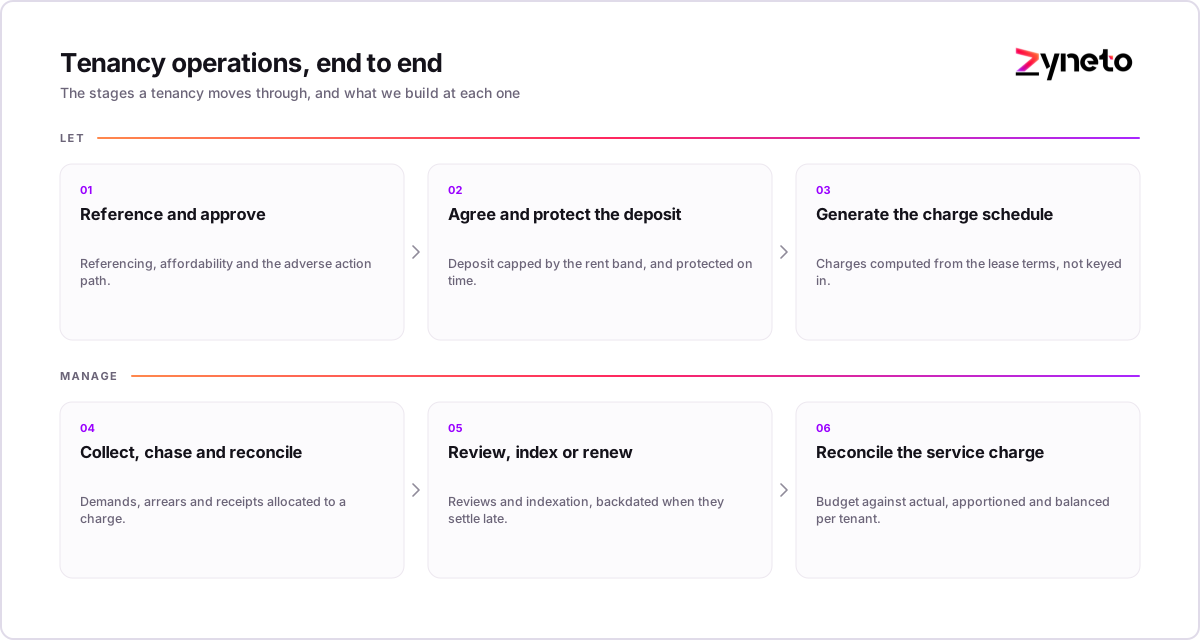
As a computed backdated adjustment rather than a manual correction. The review is a scheduled event on the lease, and when it settles the engine regenerates the charges for every affected period and posts the difference. The arrears position for those months is then right, and there is a working behind it that the tenant can be shown.
Do you build property portals and listing apps?
Not on this page. Listings and marketplace work is a different product with a different reader, and it lives on our classified app development page. This page is the operator's side: tenancy, charges, client money, service charge and building operations. Where portal distribution is needed we integrate an existing feed rather than building one.
How long does migrating our live tenancies take, and how do you prove it worked?
It depends on the variety of your lease terms rather than on how many tenancies you have, which is why a small commercial portfolio often costs more than a large residential one. The proof is a charge replay: a full past year regenerated per tenancy under the new model and compared charge by charge against what was actually billed. Matching totals is not the test, because a compensating pair of errors will always agree at the total.
Do you cover India RERA and Dubai escrow projects?
Yes, and the escrow mechanics are the part to scope carefully. Under section 4(2)(l)(D) of RERA, 70 percent of what is realised from allottees goes into a separate scheduled bank account usable only for construction and land cost, and Dubai's Law No. 8 of 2007 uses a per project escrow account with five percent retained by the escrow agent until a year after the units are registered to purchasers. In software that means receipting which separates drawable from non drawable money as it arrives, and demands keyed to certified milestones rather than to dates. We build to those rules; we are not the accredited party that transmits your filings.