Frequently Asked Questions
Why do you insist on separating the work from the recording?

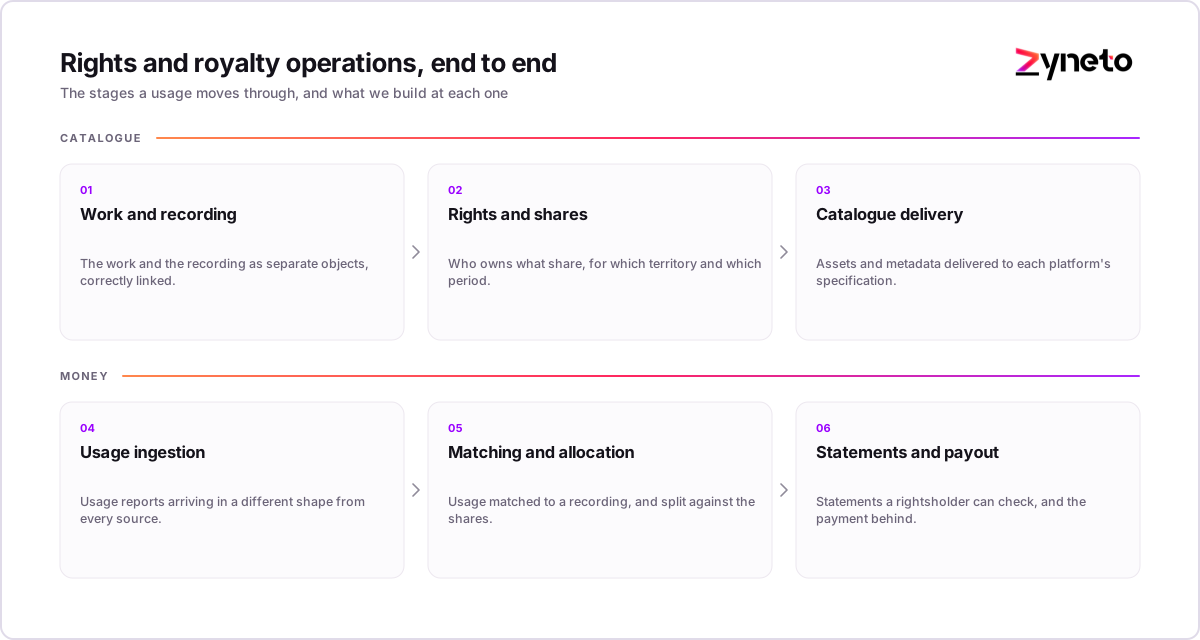
Because they pay different people. A work is the composition, identified by ISWC, and it pays publishers and writers. A recording is a performance of that work, identified by ISRC, and it pays the label and performers. One work can have a hundred recordings. A system that stores one row per track can pay a label correctly and cannot pay a publisher at all, and the fix later is a migration of every statement already issued.
Our shares sum to 99.9 in a lot of rows. Is that actually a problem?
Yes, and the problem is when you find out. A split that does not sum passes every screen because nothing checks it, then fails at statement time against money you have already received, which turns an arithmetic fix into a commercial conversation. Validate on entry, per right and per territory, and reject the record rather than the run.
Platforms send us reports in different shapes. Can that be normalised?
Yes, and it is most of the ingest work. DSR is the DDEX standard for usage and revenue coming back and the larger platforms support it, but expect bespoke CSVs from smaller ones and expect even DSR files to carry local quirks. Land everything in one internal shape, make the import idempotent so a redelivered file does not double count, and surface unmatched rows rather than dropping them.
We are about to buy a catalogue. What should we check first?
Identifier quality, before price. How much of it carries a valid ISRC, how much is duplicated, and how much of last year's reported usage can actually be matched back to a release. A catalogue that cannot be matched cannot be earned from on the model you bought it on, and that gap is discovered in the first statement run rather than in the data room.
Where does the exchange rate come from?
From a source and a date that you name in the specification, and it is finance's decision rather than ours. Platforms report in the currency they sold in and rights holders bank in another, so without a stated rate source and a stated date, two runs of the same period produce different numbers and neither is wrong. Store the rate against each calculation line.
Do we have to handle black box revenue?
You have to be able to report it. Revenue that cannot be matched to a claim sits unallocated, and the only defensible position is a standing figure with its age rather than a number somebody produces when asked. Put a state machine behind claims so a dispute has a status, and age every open conflict so the oldest one is visible.
What does the IT Rules 2021 self-classification actually require of the product?
It is a product requirement rather than a policy one. An OTT publisher self-classifies into U, U/A 7+, U/A 13+, U/A 16+ and A, implements parental locks for U/A 13+ and above and reliable age verification for A, and displays the rating with a content descriptor at the start of every programme. All three are things the player and the catalogue have to support, alongside the three tier grievance mechanism.
We use AI to dub and restore. Does the EU AI Act reach us?
If you have EU users, yes. Article 50 transparency duties apply from 2 August 2026, and machine-readable marking of AI-generated content for existing systems is required by 2 December 2026. Treat the marking as asset metadata carried with the file rather than as a disclaimer on a page, because it has to survive delivery.
Can you build the streaming app as well?
That is a different job and we have a separate page for it, linked at the foot of this one. This page is the rights, royalty and content operations layer behind a service. The two are usually built by different teams on different timelines, and conflating them is how the back office ends up as a phase two that never starts.
Is Zyneto a collecting society, or can you pay our rights holders?
No to both, and we will not imply otherwise. Registration runs through a society and remittance runs through a licensed payments institution, both contracted in your name. What we build is the queue, the acknowledgement tracking, the unmatched report and the ledger that reconciles what was reported against what was paid.
What does a phase one cost, how many hours is that, and how long does it take?
The worked example on this page is 1,480 hours, which is $59,200 to $148,000 at the ends of the rate band and about $96,200 at a $65 blend. Real scopes land between 1,200 and 2,100 hours. Calendar is 14 to 22 weeks to a first royalty run somebody is willing to send, which is deliberately a different milestone from a screen that renders. We give you a band on the first call and a fixed price only after discovery.
Who owns the code, the data and the accounts?
You do, from day one rather than at handover. Code sits in your repository, infrastructure is defined as code, and hosting, CDN and provider credentials are in your accounts and your name. The society and payment relationships are contracted by you directly because they have to be. If you take the system in house, nothing about the architecture is designed to make that expensive.