Media Asset Management Cost: You Are Not Storing Files


Ask a vendor for a media asset management cost and you will get storage, transcoding throughput and a per seat licence. Those numbers are real and they are the least interesting part of the budget, because storage is a commodity and transcoding has been solved by several companies who will rent it to you cheaply.
The money and the risk sit somewhere else. They sit in whether your system knows that the German subtitle file, the Latin American artwork, the 4K master, the broadcast conform and the airline edit are all the same title, and which of them is licensed in Spain in November.
Most systems do not know that. They know about files.
Here is the modelling error that produces most of the pain.
A file arrives. It gets stored with a name, some tags, maybe a folder. A second file arrives, a Spanish dub of the same programme. It gets stored with a different name, different tags, a different folder. Now a person is the only thing connecting them.
That works at 200 titles. At 4,000 titles with an average of nine associated assets each, it produces the situation every content operations team recognises: the artwork on the platform belongs to a version of the title that is no longer live, and nobody can say when that drifted.
The correct model has three layers rather than one.
The work. The creative thing itself, which exists independently of any file. A film, an episode, a track.
The version. A specific rendering of that work. The theatrical cut, the broadcast conform at a given duration, the airline edit, the remaster. Versions have their own durations, their own compliance status and their own rights.
The asset. An actual file belonging to a version. A video essence, a subtitle, an artwork, an audio stem, an audio description track.
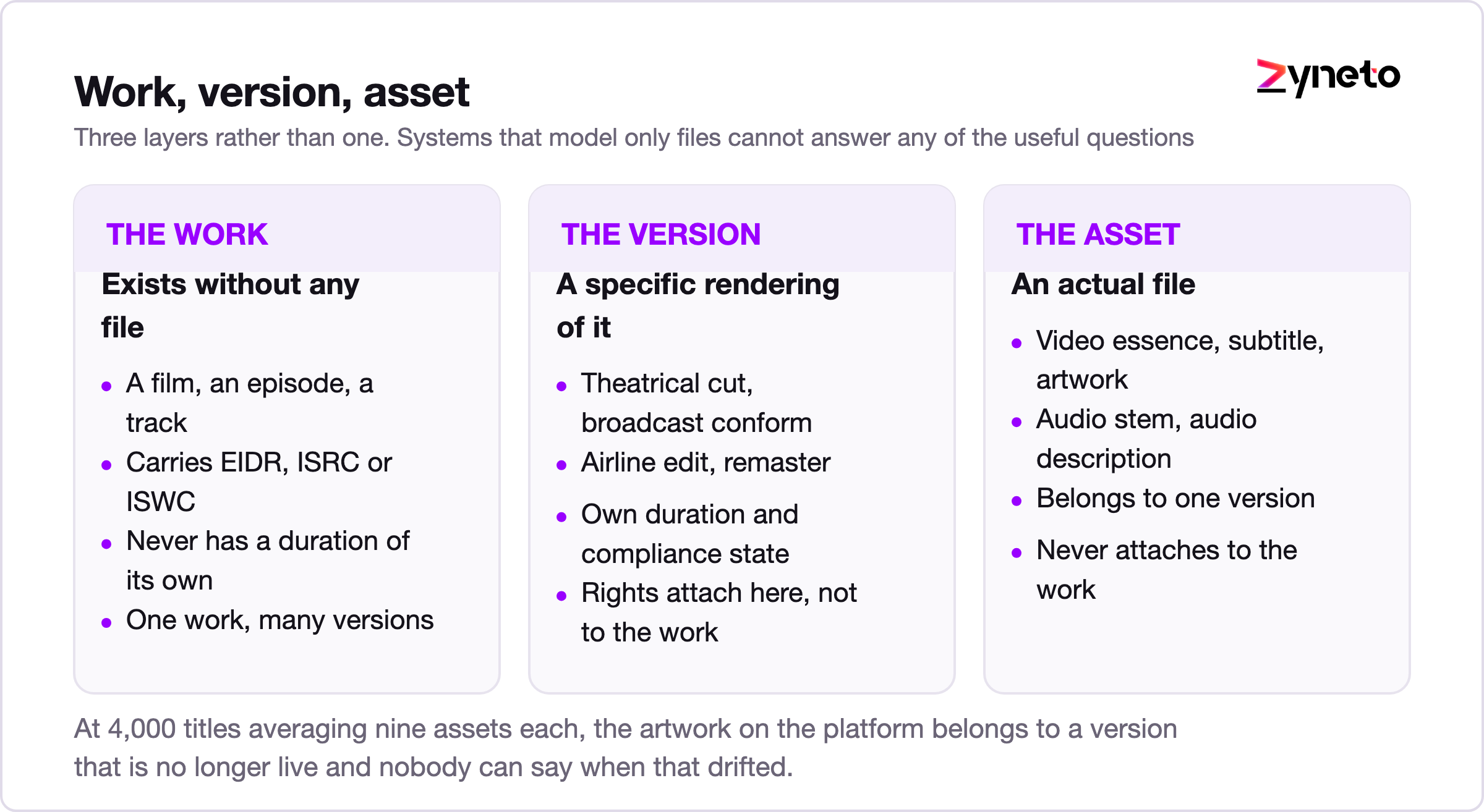
Once those three exist, the questions that were impossible become ordinary. Which versions of this title do we hold. Which of them have German subtitles. Which have audio description. Which artwork belongs to the version currently live in Spain.
Sixty to 130 hours builds that model properly. It is the single highest return work in the entire project and it is invisible in a licence comparison.
The media supply chain has standard identifiers precisely because titles pass between organisations that name things differently.
EIDR for audiovisual works and their versions. ISRC for sound recordings. ISWC for musical works. ISAN where it is in use in your corner of the industry.
Adopting them is not glamorous and it is not expensive, roughly 50 to 110 hours including backfill of an existing catalogue. What it buys is that a title arriving from a distributor, going out to three platforms and coming back in a usage report can be matched without a human doing it.
The alternative is what most catalogues actually run on: title string matching. Which fails on punctuation, on subtitles being appended, on year suffixes, on localised titles, and on the difference between a colon and a dash. We have seen a royalty reconciliation break because one platform reported a title with a trailing space.
One caution worth stating. Adopting identifiers is only useful if they are captured at ingest and treated as required. An identifier field that is optional gets filled for 60 per cent of the catalogue, which is worse than not having it, because now people trust matches that only work most of the time.
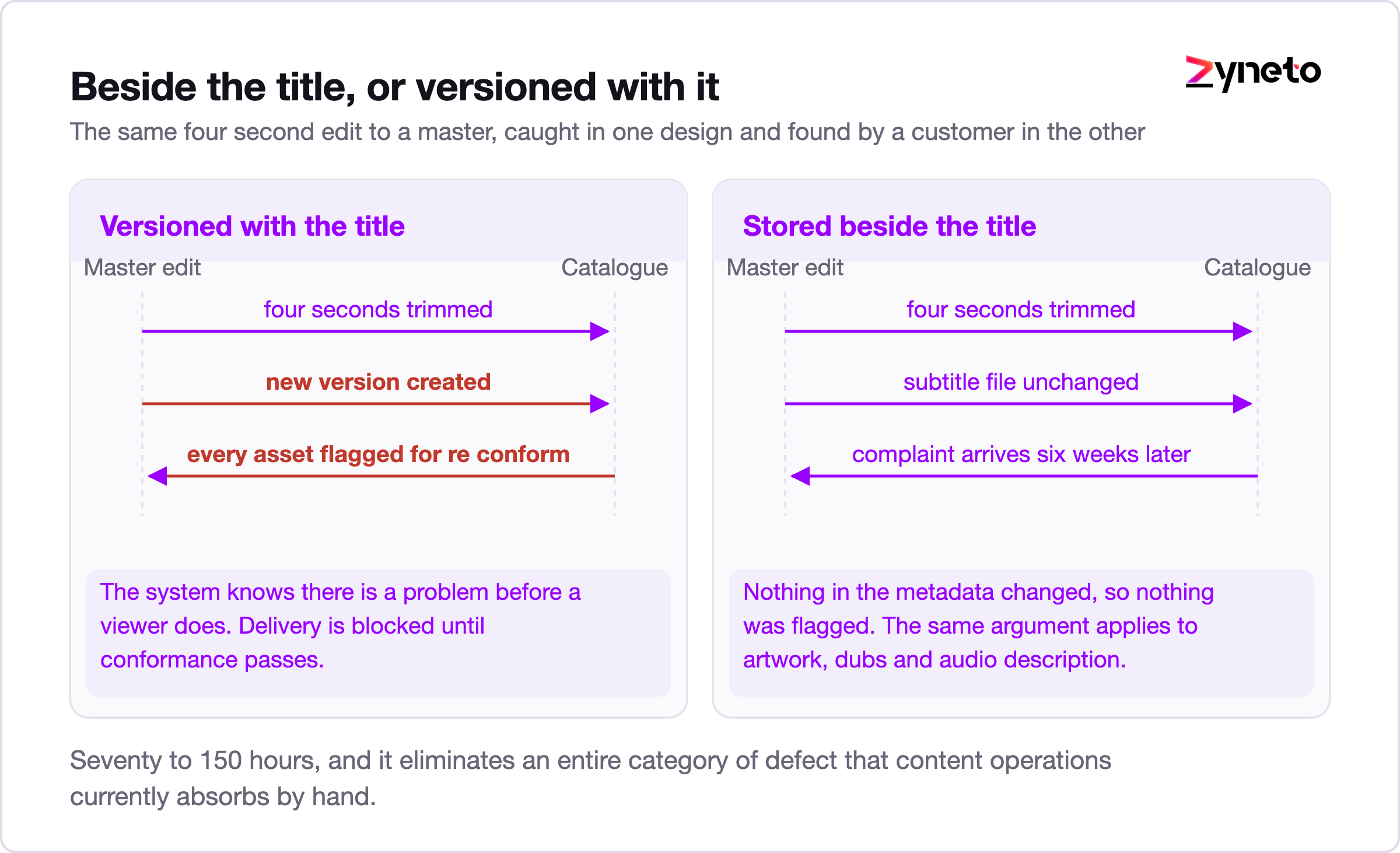
This is the sentence from the industry page that this section exists to expand: localisation, artwork and subtitle assets should be versioned with the title rather than beside it.
The difference is concrete. If subtitles are stored beside the title, then editing the master, trimming four seconds from a scene, produces a subtitle file that is now four seconds out of sync and nothing in the system knows. The subtitle file is unchanged, the title is unchanged as far as the metadata is concerned, and the error surfaces as a customer complaint six weeks later.
If subtitles are versioned with the title, changing the master creates a new version, and every associated asset either carries forward with an explicit conformance check or is flagged as requiring re conform. The system knows there is a problem before a viewer does.
The same argument applies to artwork, to audio description, and to any dubbed audio. Seventy to 150 hours, and it eliminates an entire category of defect that content operations currently absorbs by hand.
The media page names this failure directly: territory and window rights held as contract prose, so availability is decided by a person reading a PDF.
That is not a rights problem. It is a catalogue problem, because the availability answer needs the title model underneath it to be right before the rights layer can mean anything.
What a working system does is answer a question of the form: is this version of this title licensed on this platform in this territory on this date, and do we hold the assets required to deliver it there. That last clause is the part people forget. A title can be perfectly licensed for Spain and undeliverable because the Spanish subtitle asset failed conformance and nobody flagged it.
Fifty to 110 hours for the availability lookup, assuming the rights structure exists. If rights are still prose in PDFs, that is a separate and larger project, and the media page prices it.
Both of these are metadata decisions with dates attached, and both are commonly filed as legal work when they are actually build work.
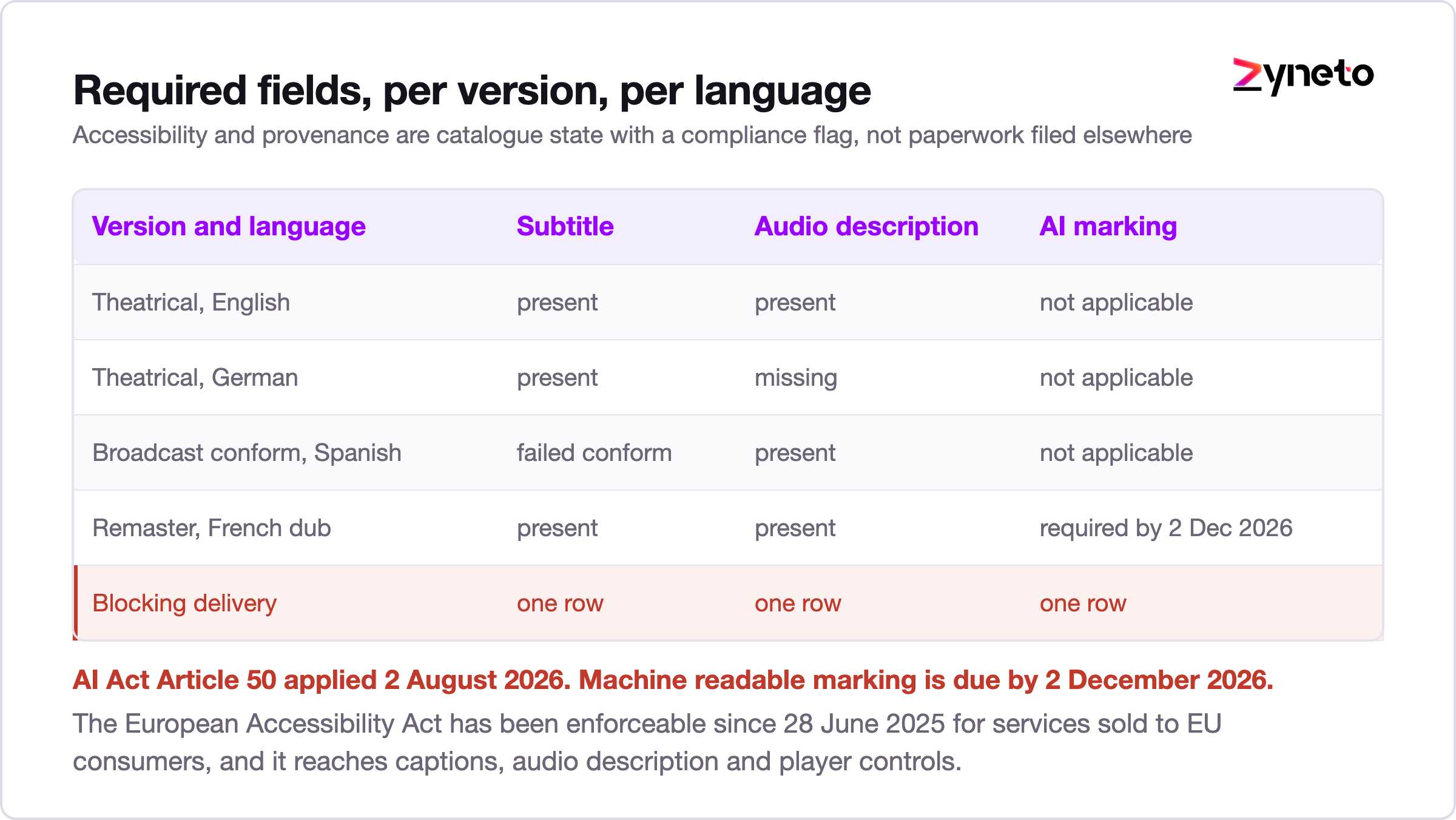
The European Accessibility Act, enforceable since 28 June 2025 for services sold to EU consumers. For a media business this reaches captions, audio description and player controls. The practical consequence for the catalogue is that caption and audio description assets stop being optional extras and become required fields with a compliance state, per version, per language. A title without them is not a title with a missing file. It is a title you may not be permitted to sell in that market.
EU AI Act Article 50. Transparency duties applied from 2 August 2026, and machine readable marking of AI generated content for existing systems is required by 2 December 2026. If any part of your pipeline generates, dubs, translates or restores using a model, that marking is a build task. It belongs in asset metadata, attached to the specific asset that was generated, and it has to survive delivery to a platform rather than living in a disclaimer on a web page.
At publication that second date is roughly ten weeks away. It is a schema change, a backfill decision for assets already produced, and a change to every delivery package. Forty to 90 hours covers both obligations together if the version model already exists, and considerably more if it does not, which is another reason to build the model first.
Every catalogue defect enters through ingest, and every organisation faces the same choice about how strict to be at that door.
Accept everything and fix it later, and the catalogue fills with packages that are technically present and operationally unusable. A subtitle with the wrong frame rate. An artwork at the wrong aspect ratio. A duration that disagrees with the version it claims to belong to by eleven seconds. Each one is small. Together they become the reason nobody trusts the system.
Reject strictly and you get a different problem, which is a distributor whose package fails and who has no idea why, so they email your operations team and the strictness has simply moved the work rather than removed it.
The version that works sits between the two and depends on one thing: the rejection has to carry a reason a non engineer can act on. Not a validation code. A sentence saying this subtitle is 25 frames per second and the version it targets is 23.976, re conform and resubmit. Suppliers fix those within a day. They ignore error codes for weeks.
Three checks earn their place at ingest and most others do not.
Sixty to 130 hours, and it is the module that determines how much manual work content operations does forever. Build it early, because retrofitting strictness onto a catalogue already full of loose data means a cleanup project first.
The rate is $40 to $100 per hour by role. Front end and reporting sit near the floor, the title model and conformance logic near the ceiling, and mixed teams blend to $60 to $70.
|
Module |
Hours |
What it covers |
|
Work, version and asset model |
60 to 130 |
Three layers, relationships, durations, compliance state per version |
|
Identifier resolution and backfill |
50 to 110 |
EIDR, ISRC, ISWC capture at ingest, backfill of the existing catalogue |
|
Localisation and asset versioning |
70 to 150 |
Subtitles, artwork, dubs and audio description versioned with the title |
|
Ingest and supply chain conformance |
60 to 130 |
Package validation, duration and frame rate checks, rejection with a reason |
|
Rights aware availability lookup |
50 to 110 |
Licensed on this platform, in this territory, on this date, with assets present |
|
Accessibility and AI provenance fields |
40 to 90 |
Caption and audio description as required state, machine readable marking |
Worked example. Model 95 plus identifiers 80 plus localisation 110 plus ingest 95 plus availability 80 plus compliance 65 equals 525 hours. That is $21,000 at $40, $52,500 at $100, and about $34,125 at a $65 blend.
The full span across the six modules runs 330 hours at every minimum to 720 at every maximum.
Deliberately excluded: storage, transcoding compute, any platform licence, and content delivery bandwidth. All four are commodities with public pricing and none of them belong inside an engineering estimate.
Most of these builds are replacements rather than greenfield, and the migration is where the schedule usually slips.
The instinct is to move everything, then fix it. That produces a new system carrying every defect of the old one, and the team loses the one moment when a cleanup is politically possible.
A better order, from having done it more than once.
The cleanup is the opportunity, and it closes. Once the new system is live and busy, nobody funds a data quality project again for years.
The honest recommendation, which costs us work and is still the right answer.
Three tests tell you whether a vendor product can carry your model rather than fight it.
Ask those three in the demo. Vendors who can do all three will show you in ten minutes. Vendors who cannot will talk about roadmap.
Weeks 1 to 3. Work, version and asset model, agreed with content operations rather than designed for them. They already know what breaks, and the model has to match how they actually talk about titles.
Weeks 3 to 5. Identifiers, captured as required at ingest from day one, with backfill running behind.
Weeks 5 to 8. Ingest and conformance, so bad packages are rejected with a readable reason instead of being accepted and discovered later.
Weeks 8 to 12. Localisation and asset versioning, which is where the drift defects stop.
Weeks 12 to 14. Accessibility and provenance fields. Earlier if December 2026 is close when you start, because that date does not move.
Weeks 14 to 16. Availability lookup on top.
Sixteen weeks, roughly 525 hours, and a catalogue that can answer a question by week eight rather than a folder structure with better search.
One closing observation from doing this several times. The team that hurts most from a bad catalogue is content operations, and they are almost never in the room when the system is chosen. Put them there. They will tell you in twenty minutes which of the three vendor tests above matters most for your catalogue, and they will be right.
About 330 to 720 hours at $40 to $100 per hour by role for the catalogue and metadata layer. A typical build lands near 525 hours, roughly $34,125 at a $65 blended rate. Storage, transcoding, platform licences and bandwidth sit outside that figure.
A title is a work, which exists independently of any file. A version is a specific rendering of it, such as a theatrical cut or a broadcast conform. An asset is an actual file belonging to a version, such as a subtitle or an artwork. Systems that model only files cannot answer which artwork belongs to the version currently live in a given territory.
Because titles pass between organisations that name things differently, and string matching on titles fails on punctuation, appended subtitles, year suffixes and localised names. Identifiers cost about 50 to 110 hours including backfill and remove an entire class of reconciliation failure.
Because editing a master, even by four seconds, silently desynchronises every subtitle stored beside it. Versioned with the title, the same edit creates a new version and flags every associated asset for re conform, so the problem is caught before a viewer finds it.
Enforceable since 28 June 2025 for services sold to EU consumers, it reaches captions, audio description and player controls. In catalogue terms those assets become required fields with a compliance state per version and per language rather than optional extras.
EU AI Act Article 50 transparency duties applied from 2 August 2026, with machine readable marking of AI generated content required for existing systems by 2 December 2026. If you generate, dub, translate or restore with a model, that marking belongs in the asset metadata and has to survive delivery, not sit in a disclaimer.
Buy storage, transcoding and the player. Own the model. Test any vendor on three things: can it express a version separately from a file, can it hold an external identifier as a required indexed field, and can it relate a subtitle to the specific version it was conformed against.

Vikas has around fifteen years of experience building software and now builds generative AI systems at Zyneto. His work covers retrieval augmented generation, agentic AI, knowledge graphs, AI memory, and the evaluation and guardrails that decide whether any of it is safe to put in front of customers. He has shipped enterprise copilots, document AI, chatbots and predictive analytics for e-commerce, fintech and marketing teams, and works day to day in Python, JavaScript and SQL. He follows multimodal models, business process automation and enterprise AI security closely, and mentors engineers moving into AI. He writes about architecture, inference cost and the failure modes that only show up at production scale.
Share your details and we will talk soon.
Be the first to access expert strategies, actionable tips, and the trends actually shaping the digital world. No fluff - just practical insights delivered straight to your inbox.
Dive into our blog and stay ahead of the curve with expert perspectives, future-ready trends, and tech tips written for decision-makers and doers alike.