AI Document Management: What Changes, and What Does Not


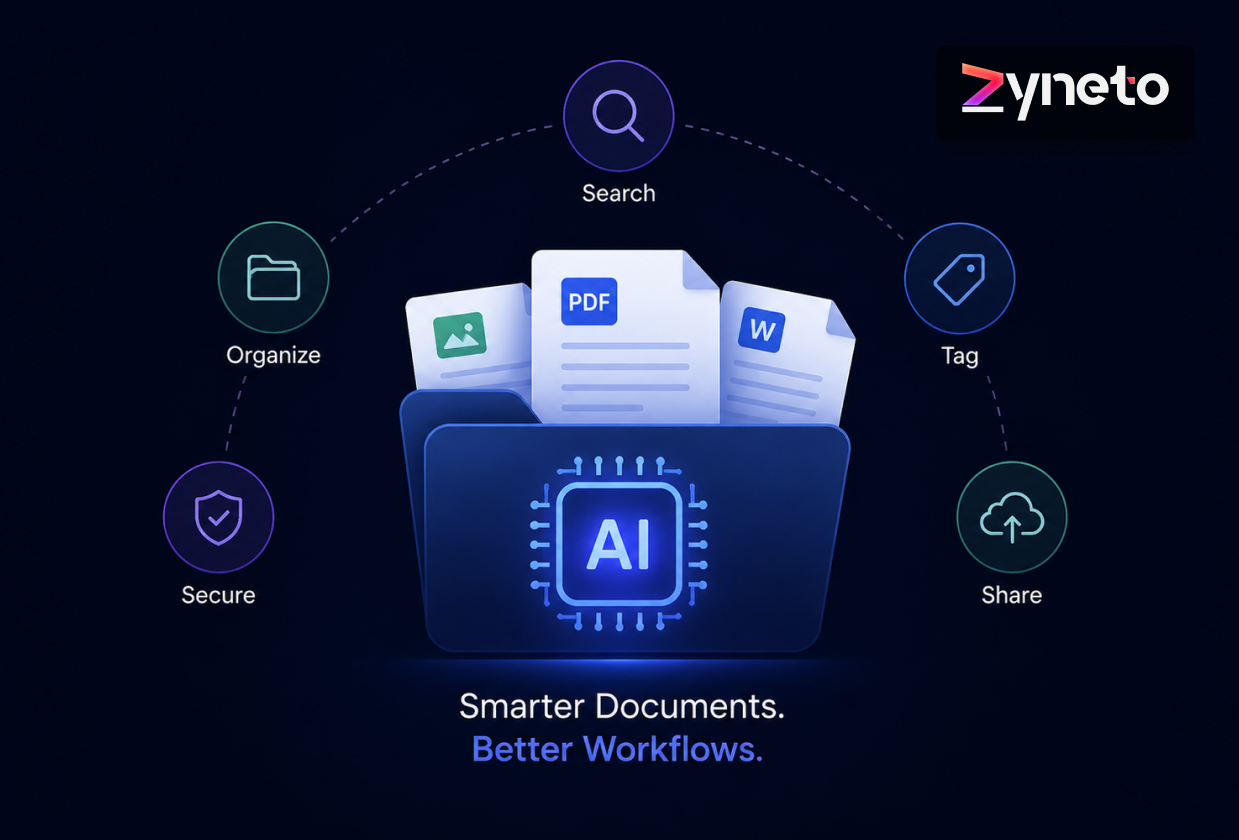
AI document management means using models to handle the parts of the document lifecycle that people currently do by hand: working out what a file is, pulling the values out of it, sending it to the right place, and applying the right retention rule. The storage layer barely changes. The work around it does.
That distinction gets lost in most product demos, so it is worth being blunt about it early. You are not replacing your document store. You are replacing the human judgement that decides what goes into it and what happens next.
Most organisations arrive at this problem the same way. A shared drive grows for eleven years. Folders multiply. Naming conventions get proposed, adopted by about a third of the company, then quietly abandoned. By the time anyone measures it, nobody can reliably answer two questions: what do we have, and are we allowed to still have it.
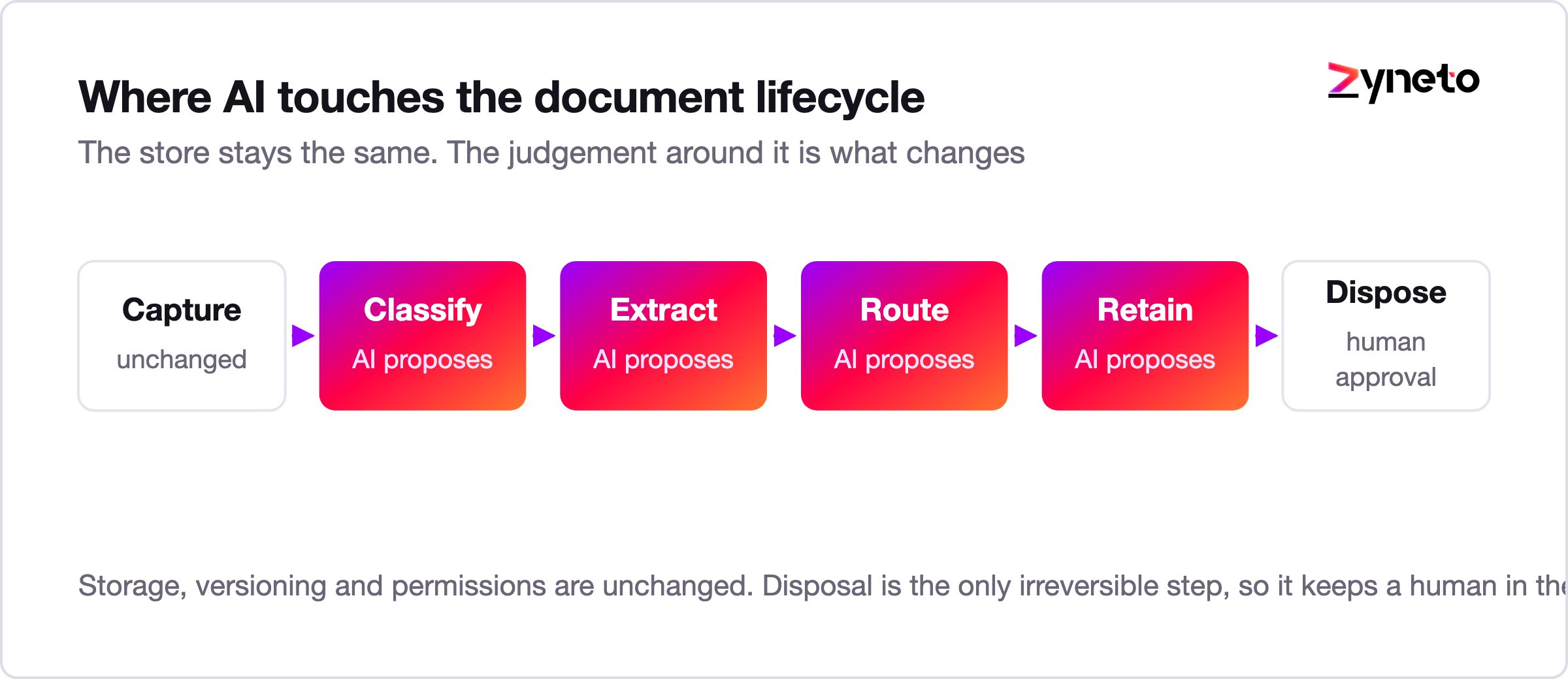
Strip away the marketing and there are four capabilities. They are usually sold as one product and they succeed or fail independently, which is why buying them as a bundle causes trouble.
policy, certificate.
reference numbers.
whose approval it now needs.
restriction, and keeping a record of all three.
A traditional document management system does all four as well, with rules and folders and someone in operations who knows where things go. The change is that the rules no longer have to be written in advance for every case, and the person no longer has to look at every file.
Note what is not on that list. Answering questions about your documents is a different capability, built on retrieval rather than classification. If that is what you actually want, our guide to chat with your documents covers it properly. The two get sold together and they solve different problems.
Your existing system probably does storage, versioning, permissions and search perfectly well. Those are solved problems and nobody needs AI for them.
Here is the honest comparison.
|
|
Traditional DMS |
With AI layer |
|
Filing a new document |
Person chooses the folder |
Model proposes, person confirms exceptions |
|
New document type appears |
Someone writes a rule |
Usually handled, sometimes needs examples |
|
Finding a document |
Keyword search on filename and metadata |
Search on content and meaning |
|
Applying retention |
Manual, or by folder location |
Proposed from document type and content |
|
Misfiling rate |
Whatever your people manage |
Measurable, and that is the real change |
|
Cost |
Licence plus staff time |
Licence plus inference plus review time |
That fifth row is the one worth pausing on. Misfiling in a manual system is invisible. Nobody logs it. With a model doing the filing, you get a measured accuracy number, and it is often the first time anyone has known what the rate was. Occasionally that number is worse than people assumed, and the honest response is relief that it is finally visible.
A document arrives by email, upload or scan. The model reads it and decides what it is, ideally with the sub-type as well: not just "contract" but "supplier contract, renewal, standard terms".
The design decision that matters here is the taxonomy. Teams tend to arrive with a list of forty document types inherited from a folder structure nobody has audited since 2019. Half are duplicates, several never occur. Cut it down before you train anything. A clean taxonomy of twelve types will outperform a messy one of forty, every time.
Once the type is known, the values follow: parties, dates, amounts, renewal terms. Extraction is where the measurable savings usually sit, because it replaces keying rather than judgement.
Routing is the piece that quietly delivers the most value and is easiest to implement. A contract with a renewal date inside ninety days goes to the commercial team. An invoice above a threshold goes for second approval. None of this is clever. It is just impossible to do consistently when a human has to open every file first.
A caution on extraction that costs teams months. Decide early whether an extracted value is authoritative or advisory. If the renewal date pulled from a contract becomes the date your business acts on, you have made the model a system of record, and it now needs the accuracy, audit trail and correction workflow that implies. If it stays advisory, a person still checks before anything happens. Both are defensible. Drifting from one to the other without noticing is not, and it happens quietly the first time someone builds a report on top of the extracted fields.
Classification changes who can find what, and that is a security question dressed as a filing question.
Consider a document that was effectively hidden by being badly filed. Nobody could find it, so nobody read it. Once classification tags it correctly and search starts working, it is discoverable by everyone with access to that folder or that class. The permissions were always wrong. Obscurity was doing the work.
This surfaces most often with HR files, board material, salary data and legal correspondence that ended up in a general store years ago. Run a permissions review as part of the classification project, not after it. Better still, use the first classification pass as an audit: it will tell you where sensitive material actually sits, which is usually not where the policy says it does.
This is the part regulated organisations came for, and the part demos skip.
Retention schedules are usually defined properly on paper and applied poorly in practice, because applying them requires knowing what every document is. That was the missing piece. Classification supplies it, so the schedule can finally run.
Two cautions worth stating plainly. Automated disposal is the highest-risk action in the entire system, because it is the only irreversible one. Every serious deployment routes deletion through human approval, at least initially. And legal hold must override everything, without exception. The principles in the ICO's guidance on the data protection principles are a reasonable starting point for retention thinking, and NARA's records management guidance is worth reading if you are in scope for formal records obligations. ISO 15489-1:2016 is the international standard for records management and the vocabulary most auditors will already recognise.
Good on distinct types, weaker on close ones, and that pattern is predictable enough to plan around.
A model separating invoices from CVs will be close to faultless. The same model separating a master services agreement from a statement of work under it will not, because the documents share structure, vocabulary and often a header. The mistakes cluster exactly where the categories genuinely overlap.
So measure per class, never in aggregate. An overall accuracy of 94% sounds excellent and can hide a contract sub-type running at 61%. That single number is what a review threshold should be set from.
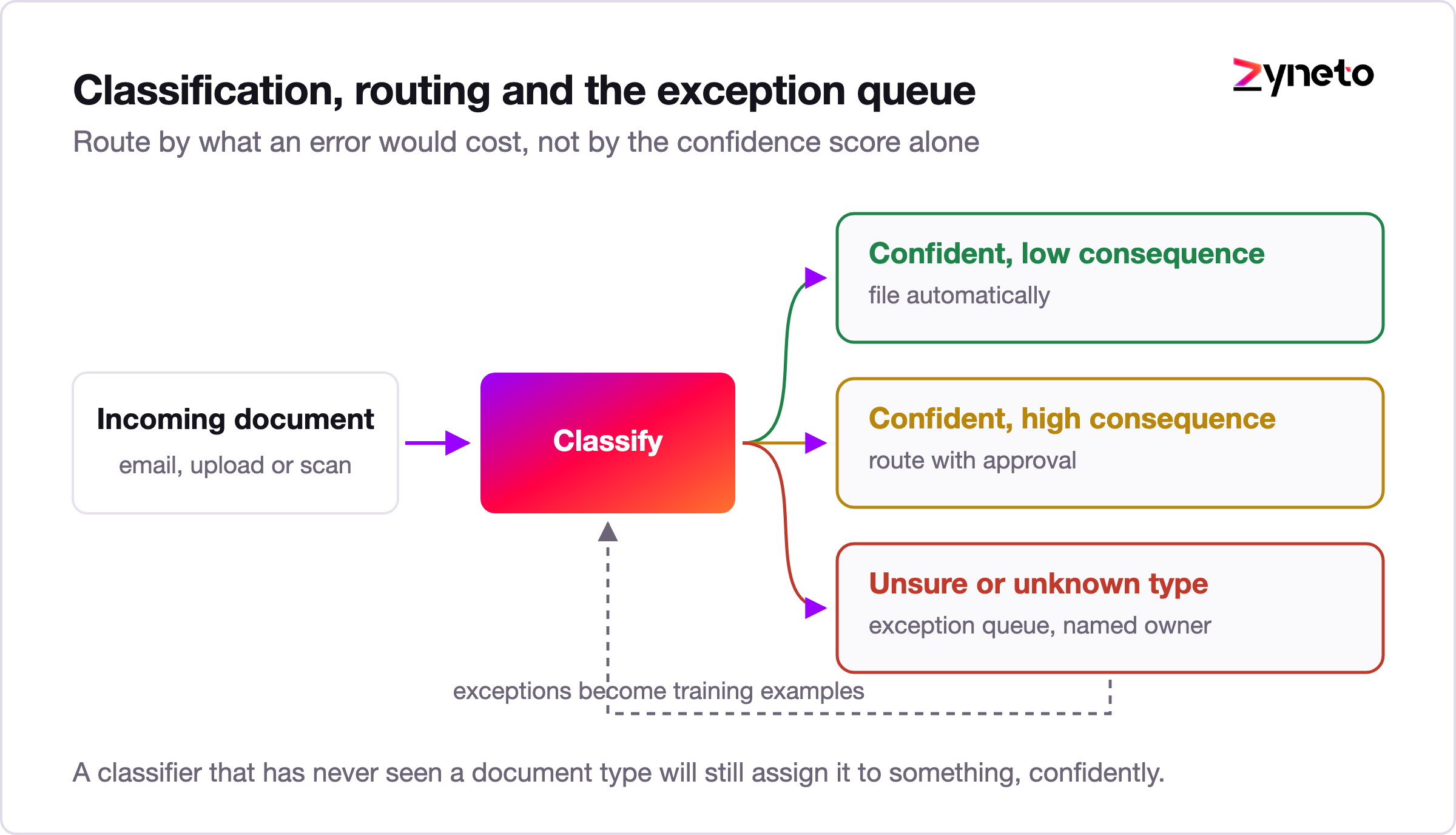
Then decide what a mistake costs, class by class. A misfiled marketing PDF is an inconvenience. A misfiled contract that consequently gets the wrong retention rule and is deleted three years early is a different category of problem. Route by consequence, not by confidence alone.
One practical warning. A classifier that has never seen a document type will still assign it to something, confidently. It has no way to say "this is new". Sample your incoming stream for genuinely unfamiliar documents, especially in the first months, or new types will be quietly absorbed into whichever existing class looks closest.
The threshold question comes up in every project and gets answered by instinct far too often. Here is a more defensible way to arrive at it.
Take a class. Estimate what one wrong filing costs, honestly, including the chance nobody notices for a year. Estimate what a review costs, which is usually a minute or two of somebody's time. Then the comparison is arithmetic rather than instinct: if a review takes 2 minutes and unpicking a wrong filing takes 4 hours, reviewing pays for itself as long as it catches more than 1 error in every 120 documents you check. Then set the threshold so that expected error cost sits below what you are willing to carry.
For a marketing asset that comparison collapses immediately: review almost nothing. For a document type that drives a retention decision, it points the other way, and you may end up reviewing a large share for the first few months until the measured accuracy justifies loosening it.
Review the thresholds on a schedule rather than setting them once. Accuracy changes as the source material changes, and a threshold that was right in month one is not automatically right in month nine.

Worth stating clearly, because the gap between expectation and outcome is where these projects lose their sponsor.
It does not fix a bad taxonomy. If your categories overlap, the model will be inconsistent in the same places your people are. It surfaces the ambiguity rather than resolving it, which is useful, but it is not what was promised.
It does not fix missing documents. Classification tells you what you have. It says nothing about what should exist and does not.
It does not fix access control. Permissions remain a policy problem. A model that can read everything will happily surface a document to someone who should not see it, unless permissions are enforced at retrieval.
It does not eliminate review. Volume of review drops substantially. The need for it does not go away, and any business case built on removing it entirely will be wrong.
It does not settle who owns a document. Ownership is organisational. A model can tell you a file is a supplier contract and can tell you which supplier. It cannot tell you whether procurement or legal is accountable for renewing it, and if that has never been agreed, automating the routing simply delivers the argument faster and to more people at once.
One more, less obvious than the rest. It does not make your existing search bad data good. Classification adds a layer of correct metadata on top of whatever is already there. The old metadata stays, still wrong, still indexed, and search results will reflect both until somebody decides which one wins. Decide early. That decision is a five-minute conversation before launch and a genuinely tedious cleanup afterwards.
This is the section every competing article omits, and it is usually the largest line in the project.
Nobody starts clean. There is a shared drive with 400,000 files in it, a SharePoint site nobody trusts, and an archive on a NAS that predates two of the current directors. Classifying that backlog is a genuine project of its own, and running it through a model at full cost per document is rarely the right answer.
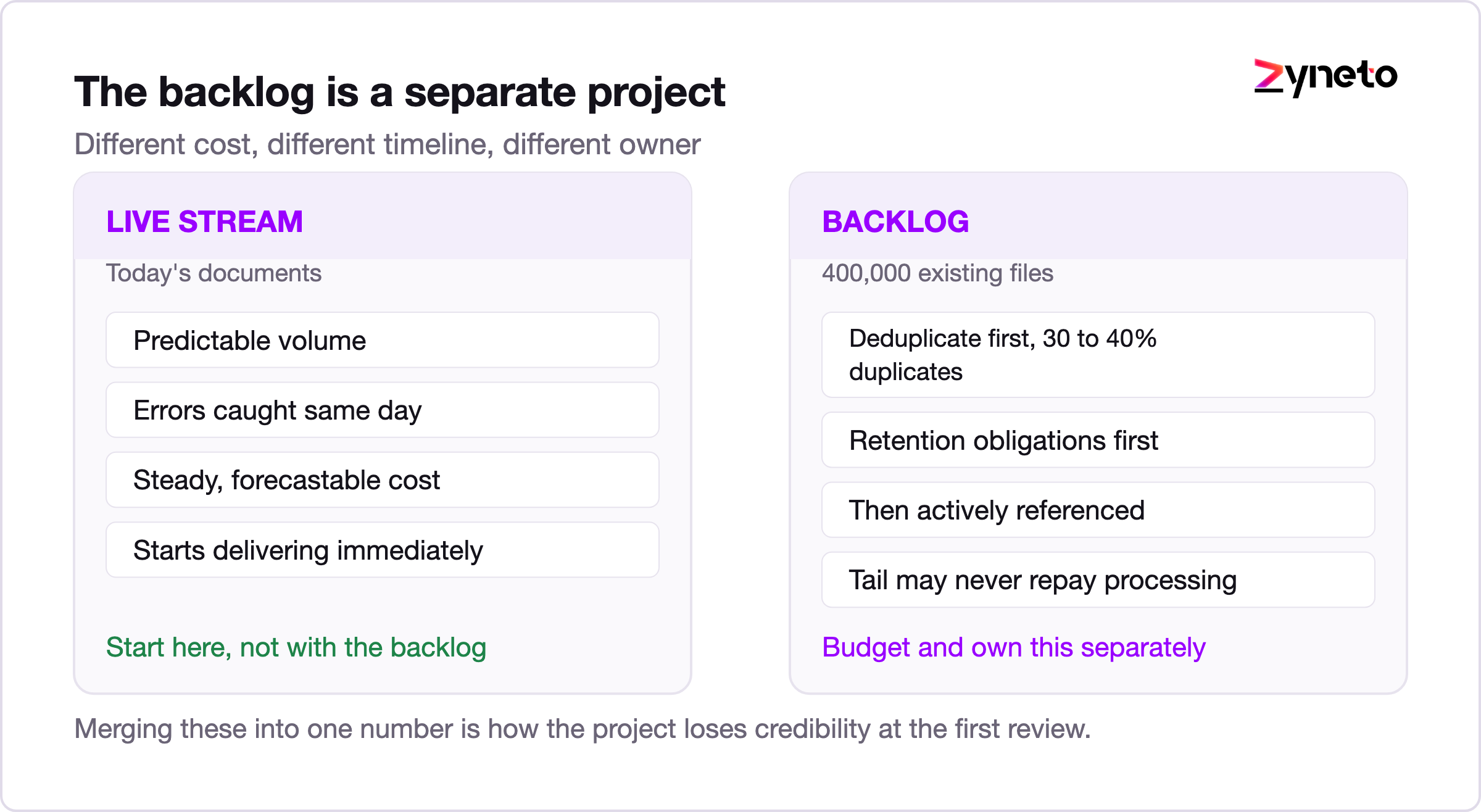
A sequence that works:
today's documents where volume is predictable and errors are cheap to catch.
obligations first, then anything actively referenced, then the rest.
years and which is under no obligation may not repay processing at all.
to forty percent duplicates, and paying to classify the same document eleven times is avoidable.
Budget for the backlog separately from the ongoing system. They have different costs, different timelines and different owners, and merging them into one number is how these projects lose credibility at the first review.
Duplicates, first. Not exact copies, which are easy to spot by hash, but the near-duplicates: the same contract saved four times with a signature added somewhere along the way, or an invoice stored once by the person who received it and again by the person who paid it. These need a similarity check rather than a hash: the usual approach is to shingle the text and compare sketches with something like MinHash, which finds the documents that are 90% the same rather than only the ones that are 100% identical, and the decision of which copy is authoritative is a business decision, not a technical one. Somebody has to make it.
Second, files that will not open. Every large store has them. Corrupt archives, formats from software nobody licences any more, password-protected files whose owner left in 2019. Expect a percentage and decide in advance whether they get flagged, quarantined or simply logged. They will not classify themselves.
Third, the mixed container. A single PDF holding a scanned batch of eleven unrelated documents, because someone fed a stack into a scanner in 2021. The model will classify the whole thing as whatever the first page looks like. Splitting these is its own step, and if your backlog came from scanning operations, there will be more than you think.
Fourth, and most awkward, documents that are evidence in something ongoing. Litigation, an audit, an HR case. These must not move, must not be reclassified, and must not be touched by any automated retention action. Get the legal hold list before the migration starts. Not during.
None of this is exotic. It is just invisible from a project plan written by somebody who has not opened the shared drive.
Three sources of value, in the order they usually appear.
Time saved on filing and keying. The easiest to quantify. Take documents per month, multiply by minutes spent per document, and be realistic that review still costs something.
Risk reduction. Harder to put a number on, more likely to fund the project in a regulated environment. The credible version is not "we will avoid a fine". It is "we can currently demonstrate retention compliance for a fraction of our store, and afterwards we can demonstrate it for most of it".
Cycle time. Often the largest and most frequently forgotten. If a contract sits in a queue for four days because nobody has looked at it, and routing reduces that to four hours, the value is in the business process, not the document team. That is also the number a sponsor outside operations will care about.
Set the baseline before you start. Current misfiling rate, current time to file, current proportion of the store with a known retention rule. Almost nobody measures these in advance, and without them the improvement is unprovable no matter how real it is.
Measuring the current misfiling rate is easier than it sounds and worth the half-day. Pull a random sample of two hundred documents filed in the last quarter. Have someone competent check whether each is in the right place with the right metadata. Whatever number comes back is your baseline, and it is usually more interesting than anyone expected.
Three situations where the honest advice is to wait.
If your document volume is low, a few hundred a month, the review and monitoring work will cost more than the filing it replaces. A person is genuinely the better system at that scale.
If your taxonomy is actively contested, meaning two departments disagree about what counts as a contract, sort that out first. A model cannot arbitrate a definitional dispute, and deploying one into the middle of it converts a management disagreement into a technical failure.
And if you have no owner for exceptions, do not start. Every deployment generates a queue of documents the model was unsure about. A queue with no named owner grows until someone declares the project a failure, which is not really what happened.

AI document management changes the judgement around your document store, not the store itself. Classification, extraction, routing and retention are four capabilities that get bundled and succeed separately.
Fix the taxonomy first, because the model will not fix it for you. Measure accuracy per class, not overall, since the aggregate hides exactly the sub-types that matter. Route by the consequence of an error rather than by confidence alone, and keep a human between the system and any irreversible deletion. Plan the backlog as its own project with its own budget.
And keep the two things separate in your own head: this is about getting documents filed, governed and moving. Asking questions of them is a different system.
Sitting on a document store nobody fully trusts? Zyneto builds AI document management systems with the classification thresholds, exception routing and retention controls that make them safe to run in a regulated environment. Book a free consultation and we will look at your taxonomy first.
It is the use of models to handle the judgement parts of the document lifecycle: identifying what a document is, extracting values from it, routing it to the right place, and applying the correct retention rule. Storage, versioning and permissions stay much as they are. The change is that filing decisions no longer require a person to open every file.
A traditional system needs a rule or a person for every filing decision, so new document types require new rules and misfiling is invisible. An AI layer proposes the classification, handles types it has not been explicitly configured for, and produces a measurable accuracy rate. That measurement is often the biggest practical difference, because it is usually the first time anyone knows the real error rate.
Very good at separating clearly different types, noticeably weaker at close relatives such as a master agreement and a statement of work under it. Measure accuracy per class rather than overall, because an aggregate of 94% can conceal a sub-type running near 60%. Set review thresholds from the per-class numbers.
It can propose them, and that is the part that was previously missing, since applying a retention schedule requires knowing what each document is. Automated deletion is a different matter. It is the only irreversible action in the system, so route it through human approval, at least initially, and make sure legal hold overrides everything.
They solve different problems. Document management is about capture, classification, routing and governance, in other words getting files filed and moving correctly. Chatting with documents is retrieval based, answering questions with sources attached. The two are frequently sold together but neither delivers what the other does.
Longer and more expensively than most plans allow, which is why it should be budgeted separately from the live system. Deduplicate first, since large stores are often thirty to forty percent duplicates. Then classify in priority order: anything under a retention obligation, then actively referenced material, then the remainder. Some of the tail may never repay the cost of processing.
Indirectly and substantially. Better classification means better metadata, and better metadata makes conventional search work far more reliably. If you want natural-language questions answered from document content, that needs a retrieval system rather than a classification one.

Vikas has around fifteen years of experience building software and now builds generative AI systems at Zyneto. His work covers retrieval augmented generation, agentic AI, knowledge graphs, AI memory, and the evaluation and guardrails that decide whether any of it is safe to put in front of customers. He has shipped enterprise copilots, document AI, chatbots and predictive analytics for e-commerce, fintech and marketing teams, and works day to day in Python, JavaScript and SQL. He follows multimodal models, business process automation and enterprise AI security closely, and mentors engineers moving into AI. He writes about architecture, inference cost and the failure modes that only show up at production scale.
Share your details and we will talk soon.
Be the first to access expert strategies, actionable tips, and the trends actually shaping the digital world. No fluff - just practical insights delivered straight to your inbox.
Dive into our blog and stay ahead of the curve with expert perspectives, future-ready trends, and tech tips written for decision-makers and doers alike.