AI PaaS for Enterprises: Benefits, Use Cases, Implementation, and Future


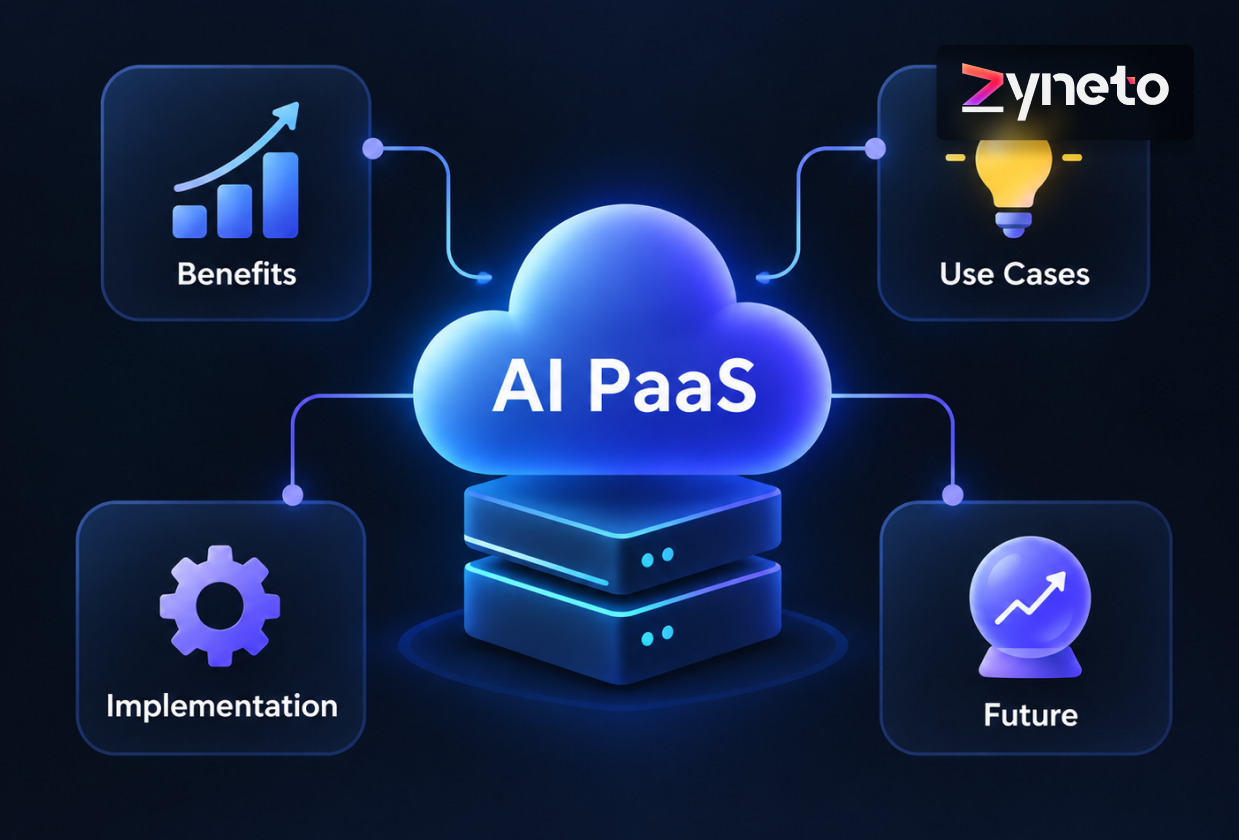
AI adoption in enterprises has moved well beyond experimentation.
Your teams may already be exploring predictive analytics, intelligent automation, generative AI, recommendation engines, or AI assistants. But moving these ideas from a proof of concept to a reliable enterprise system is where things become complicated.
You need computing infrastructure. You need access to models and development frameworks. Your data has to be prepared and connected. Models need to be deployed, monitored, secured, and updated. And everything has to work with the systems your business already uses.
This is where AI PaaS can make a meaningful difference.
Instead of assembling every part of your AI infrastructure independently, AI Platform as a Service gives your teams a managed environment for developing, deploying, integrating, and managing AI applications.
For enterprises, that can mean getting AI initiatives into production faster without building an entire AI technology stack from scratch.
In this guide, we'll look at how AI PaaS for enterprises works, what it can help you achieve, where it fits into your technology strategy, and what you should consider before implementing it.
AI Platform as a Service, commonly called AI PaaS, is a cloud-based environment that provides the infrastructure, tools, models, APIs, and development capabilities businesses need to build and operate AI applications.
Think of it as a ready-to-use foundation for enterprise AI development.
Instead of your developers setting up separate computing environments, machine learning frameworks, model repositories, deployment pipelines, monitoring systems, and integrations, an enterprise AI PaaS brings many of these capabilities together.
Your team can focus more on the business problem you are trying to solve and less on maintaining the underlying infrastructure.
An enterprise AI platform can support everything from traditional machine learning and predictive models to generative AI, natural language processing, computer vision, intelligent automation, and AI-powered applications.
This makes AI PaaS particularly useful when you want to move beyond isolated AI experiments and create repeatable AI capabilities across your organization.
An AI PaaS sits between your business applications, enterprise data, AI models, and cloud infrastructure.
Your data can come from sources such as CRM platforms, ERP systems, databases, cloud storage, customer applications, IoT devices, or internal business tools.
The platform provides the environment needed to prepare that data, train or customize models, test them, deploy them, and connect their outputs with your applications and workflows.
Suppose you want to predict which customers are most likely to churn.
Instead of building an entire machine learning environment internally, your team can use an AI platform for business to connect customer data, train a prediction model, deploy it, and integrate the results into your CRM.
The same foundation can later support other use cases without requiring you to rebuild everything from zero.
The biggest difference comes down to how much control you need and how much infrastructure you want to manage.
With AI SaaS, you typically consume a finished AI-powered application. You use the functionality provided by the vendor but have limited control over how the underlying AI works.
AI PaaS gives you a development platform. You can create or customize AI solutions for your own processes while the provider handles much of the infrastructure underneath.
With on-premises AI, you control almost everything, including servers, models, data environments, deployment, security configurations, and maintenance. That flexibility can be valuable in highly specialized situations, but it also demands considerably more resources.
For many organizations, AI platform as a service for enterprises offers a practical middle ground: enough flexibility to build custom AI capabilities without taking responsibility for every layer of the infrastructure.
Not every AI platform provides the same capabilities.
However, a strong enterprise platform usually combines several technical layers that help you take an AI project from data to production.
AI workloads can require significant computing power, particularly when you are training models or running generative AI applications at scale.
AI PaaS provides access to cloud-based CPU and GPU resources without requiring you to purchase and maintain the physical infrastructure yourself.
Resources can also scale according to workload.
This becomes valuable when your AI usage changes significantly between development, testing, and production.
You don't always need to build a model from scratch.
Many AI PaaS solutions provide access to pre-trained models for language processing, image recognition, document analysis, forecasting, speech processing, and generative AI.
AutoML capabilities can further automate parts of model selection, training, and optimization.
Your technical teams can therefore spend more time adapting AI to your business requirements rather than recreating capabilities that already exist.
Your AI is only as useful as the data feeding it.
Enterprise platforms can help collect, transform, organize, and move data between your source systems and AI models.
This matters because enterprise information rarely exists in one clean database.
It might be distributed across your ERP, CRM, customer applications, analytics systems, cloud storage, and legacy software.
Well-designed data pipelines give your AI systems consistent access to the information they need.
AI becomes valuable when it works inside the tools people already use.
APIs and integration capabilities allow your models to communicate with websites, mobile apps, internal software, customer service systems, business intelligence tools, and other enterprise applications.
For example, a forecasting model can push predictions directly into your inventory system rather than requiring someone to manually download and interpret a report.
That connection between AI and actual workflows is often what turns a promising model into something your business can use every day.
Deploying a model is not the end of the process.
Its performance can change as customer behavior, market conditions, and business data change.
MLOps capabilities help your teams version models, automate deployment, track performance, retrain models, manage experiments, and identify model drift.
For organizations running dozens or potentially hundreds of models, these capabilities become essential for maintaining consistency.
Enterprise AI introduces questions that go beyond model accuracy.
Who can access sensitive data? Which models are allowed to use it? How are AI decisions recorded? Can outputs be audited? Are regulatory requirements being followed?
Enterprise AI platform solutions should provide access controls, encryption, monitoring, audit trails, governance capabilities, and policies that help you manage AI responsibly.
The more deeply AI becomes integrated into your operations, the more important this governance layer becomes.
AI PaaS makes the most sense when your business has moved beyond simply experimenting with AI and needs a reliable way to put it into everyday operations.
You should consider AI PaaS solutions for enterprises when:
The decision should ultimately depend on whether the platform reduces complexity while giving you enough control to meet your business, technical, and security requirements.
The value of AI PaaS solutions for enterprises isn't simply that they give you access to AI technology.
Their bigger advantage is reducing the operational friction between having an AI idea and turning it into something useful.
Building your own AI infrastructure can consume months before your team even begins solving the intended business problem.
With AI PaaS, many foundational capabilities already exist.
Your developers and data teams can experiment, build prototypes, test models, and move successful projects toward production much faster.
Running AI internally may require specialized hardware, cloud architecture, engineering resources, maintenance, security, and monitoring systems.
AI PaaS shifts much of this responsibility to the platform provider.
You still need to manage usage carefully, but you avoid many of the upfront infrastructure investments associated with building an AI environment independently.
A successful AI application can quickly outgrow the infrastructure used during its pilot stage.
Cloud-based enterprise AI PaaS solutions allow computing resources to expand as demand increases.
You can start with one department or use case and scale the underlying environment as adoption grows.
An AI model that sits outside your operational systems rarely delivers its full value.
Modern platforms provide APIs, connectors, and integration capabilities that make it easier to connect AI with your existing technology ecosystem.
That could mean adding recommendations to your eCommerce platform, predictions to your ERP, or an AI assistant to an internal knowledge system.
The AI landscape changes quickly.
New foundation models, machine learning frameworks, development tools, and infrastructure capabilities appear constantly.
Using an established AI platform gives your teams access to many of these capabilities without requiring them to build and maintain every technology internally.
Enterprise AI often involves data scientists, software developers, IT teams, domain experts, security teams, and business stakeholders.
A shared platform gives these teams a more consistent environment in which to build, test, deploy, and monitor solutions.
It also lowers the cost of experimentation.
Instead of treating every AI idea as a major infrastructure project, you can validate promising use cases first and invest further once they demonstrate business value.
One reason enterprises are exploring AI PaaS is that the same technology foundation can support very different business problems.
You don't need a separate infrastructure strategy for every AI initiative. This flexibility becomes especially useful across diverse AI use cases, including:
You can use generative AI to build assistants that answer questions, summarize documents, retrieve company knowledge, and support customers.
With generative AI development, you can customize these capabilities around your workflows and data.
AI PaaS provides the models and infrastructure needed to build, integrate, and scale them across your business.
Predictive models can help you anticipate what is likely to happen rather than reacting after it happens.
Depending on your business, this might involve predicting customer churn, demand, equipment failures, credit risk, sales performance, or inventory requirements.
With predictive analytics development services, you can build these models around your business data, while AI PaaS provides the infrastructure to train, deploy, monitor, and continuously improve them.
Traditional automation works well when every step follows predictable rules.
AI allows you to automate processes involving less structured information.
For example, AI can classify documents, extract information from invoices, interpret customer messages, route support requests, or identify anomalies before triggering an automated workflow.
Retailers, media companies, financial platforms, marketplaces, and digital products can use AI to personalize experiences based on customer behavior.
An enterprise AI platform can process behavioral data and run recommendation models that determine which products, content, offers, or actions are most relevant to each user.
AI for fraud detection can continuously analyze transactions, behavioral patterns, and historical information to identify activity that appears unusual.
Banks and financial institutions can use this for transaction monitoring and credit risk, while insurers can apply similar techniques to claims analysis.
But the possibilities extend across industries.
Telecom companies can use AI PaaS solutions for network optimization, churn prediction, customer support, and anomaly detection.
The specific application changes from industry to industry, but the underlying idea remains consistent: build a reusable AI foundation instead of creating an entirely separate technology stack for every use case.
Successful AI platform implementation shouldn't begin with choosing the most impressive AI model.
It should begin with a business problem worth solving. Let’s find out how to implement AI Pass:
Start by identifying where AI could create a measurable improvement.
Maybe customer support costs are rising. Perhaps your forecasting process is unreliable. Your teams could be manually reviewing thousands of documents, or customers might be leaving before you can identify why.
Define the problem, the desired outcome, and how you will measure success.
That keeps the project focused on business value instead of AI experimentation for its own sake.
Next, determine whether you have the data required to solve the problem.
Where is it stored? Is it accurate? Can your teams access it? Does sensitive information require additional controls? Which existing systems will need to communicate with your AI platform?
Answering these questions early can prevent expensive integration problems later.
Evaluate platforms according to your actual requirements rather than the longest feature list.
Consider the AI models and frameworks supported, infrastructure scalability, integration options, security, governance, MLOps capabilities, pricing, and compatibility with your existing cloud environment.
Your long-term enterprise AI implementation strategy should influence this decision as much as your first use case.
Don't roll AI across your entire organization from day one.
Start small and create an AI app around one clearly defined use case.
Use the proof of concept to test your data, model performance, integrations, and user experience.
If it delivers measurable value, you can refine the solution and scale it with greater confidence.
Once the concept works, connect it to the systems where employees or customers will actually use it.
That could involve your CRM, ERP, mobile application, website, data warehouse, or internal software.
Pay close attention to workflow design here.
A highly accurate model can still fail to create value if using its output makes people's jobs harder.
After deployment, track both technical and business performance.
Is the model maintaining its accuracy? Are people actually using the solution? Is it reducing costs, improving conversions, speeding up decisions, or achieving whatever outcome you initially defined?
Use those results to refine the system before expanding it to more users, departments, or use cases.
AI PaaS removes some of the complexity of enterprise AI, but it doesn't remove every challenge.
Knowing where problems usually appear can help you design around them.
Moving sensitive business or customer data through AI systems requires careful controls.
You need to understand where your data is processed, how it is stored, who can access it, and whether platform policies meet your regulatory requirements.
Security requirements should therefore be part of platform selection, not something added after development.
Building too deeply around proprietary models, APIs, and platform-specific tools can make future migration difficult.
Where portability matters, consider modular architectures, open standards, containerization, and abstraction layers that reduce your dependence on a single provider.
Your newest AI platform may still need to communicate with software built years ago.
Older systems might lack modern APIs or use inconsistent data structures.
Instead of forcing direct connections everywhere, middleware and carefully designed API layers can create a more manageable bridge between legacy infrastructure and AI services.
As AI starts influencing customer experiences or business decisions, you need clear rules around how it is used.
Define ownership, access policies, model approval processes, monitoring requirements, and human oversight before scaling.
For high-impact applications, explainability and auditability may be just as important as model performance.
Cloud AI can reduce upfront infrastructure costs, but uncontrolled consumption can become expensive.
Your AI development cost can vary based on model usage, GPU requirements, storage, data transfers, integrations, and the scale of your workloads.
Monitor usage from the beginning and optimize models and infrastructure according to the value each workload creates.
Technology alone won't make your enterprise AI PaaS successful.
Your teams need to understand how AI fits into their workflows and when its outputs should or shouldn't be trusted.
Combining technical training with thoughtful change management can improve adoption and reduce resistance when AI moves into everyday operations.
There isn't one AI platform that is automatically right for every enterprise.
The better question is: which platform fits what you are trying to build?
Start with AI capabilities.
Does the platform support the machine learning, generative AI, natural language processing, computer vision, or other capabilities your use cases require?
Then consider scalability. The infrastructure that works for a pilot with 500 users may not work when the same application serves 500,000.
Integration should be another priority.
Look at how easily the platform connects with your current databases, cloud environment, applications, APIs, and enterprise software.
Security and compliance requirements should reflect your industry and the sensitivity of your data.
You should also examine MLOps capabilities, monitoring, customization options, governance tools, model portability, and technical support.
Finally, look beyond the advertised subscription price.
The total cost of ownership can include computing, model inference, storage, data transfer, integrations, development, monitoring, and ongoing optimization.
The right AI PaaS solutions for enterprises should fit both your immediate project and the wider AI ecosystem you expect to build over the next several years.
Getting an AI system into production is an important milestone, but it doesn't automatically mean the project is successful.
You need to know whether your Enterprise AI PaaS investment is improving the business outcome that justified it in the first place. That means measuring more than model accuracy or system uptime.
The right metrics will depend on your use case, but these areas can give you a practical starting point:
Compare how long it takes your team to develop, test, and deploy AI applications before and after adopting AI PaaS. Shorter development cycles can show whether the platform is actually removing infrastructure and deployment bottlenecks.
Look at how AI changes the process it was introduced to improve. You might measure hours of manual work eliminated, processing time reduced, support tickets resolved automatically, or the number of repetitive tasks handled without human intervention.
Track the complete cost of running your AI workloads, including computing, storage, model usage, integrations, maintenance, and development resources.
Lower infrastructure requirements are valuable, but you should compare those savings against ongoing platform and usage costs to understand the actual financial impact.
This is where your metrics should connect directly to the original use case.
For a recommendation system, you might track conversions or average order value. For predictive maintenance, measure downtime. For customer service AI, look at resolution time, cost per interaction, and customer satisfaction.
A capable AI platform for business creates limited value if employees don't use the applications built on it.
Monitor adoption rates, active users, workflow usage, and feedback to understand whether AI is becoming part of day-to-day operations.
As usage grows, monitor response times, availability, model accuracy, drift, and infrastructure consumption.
Your AI PaaS solutions should continue delivering reliable performance as you add users, data, models, and new business use cases.
Ultimately, ROI should connect technical performance with measurable business improvement. Define these success metrics before your AI platform implementation begins so you have a clear baseline for evaluating what AI is actually delivering.
AI PaaS removes some of the complexity of enterprise AI, but it doesn't remove every challenge.
Knowing where problems usually appear can help you design around them.
Moving sensitive business or customer data through AI systems requires careful controls.
You need to understand where your data is processed, how it is stored, who can access it, and whether platform policies meet your regulatory requirements.
Security requirements should therefore be part of platform selection, not something added after development.
Building too deeply around proprietary models, APIs, and platform-specific tools can make future migration difficult.
Where portability matters, consider modular architectures, open standards, containerization, and abstraction layers that reduce your dependence on a single provider.
Your newest AI platform may still need to communicate with software built years ago.
Older systems might lack modern APIs or use inconsistent data structures.
Instead of forcing direct connections everywhere, middleware and carefully designed API layers can create a more manageable bridge between legacy infrastructure and AI services.
As AI starts influencing customer experiences or business decisions, you need clear rules around how it is used.
Define ownership, access policies, model approval processes, monitoring requirements, and human oversight before scaling.
For high-impact applications, explainability and auditability may be just as important as model performance.
Cloud AI can reduce upfront infrastructure costs, but uncontrolled consumption can become expensive.
Your AI development cost can vary based on model usage, GPU requirements, storage, data transfers, integrations, and the scale of your workloads.
Monitor usage from the beginning and optimize models and infrastructure according to the value each workload creates.
Technology alone won't make your enterprise AI PaaS successful.
Your teams need to understand how AI fits into their workflows and when its outputs should or shouldn't be trusted.
Combining technical training with thoughtful change management can improve adoption and reduce resistance when AI moves into everyday operations.
There isn't one AI platform that is automatically right for every enterprise.
The better question is: which platform fits what you are trying to build?
Start with AI capabilities.
Does the platform support the machine learning, generative AI, natural language processing, computer vision, or other capabilities your use cases require?
Then consider scalability. The infrastructure that works for a pilot with 500 users may not work when the same application serves 500,000.
Integration should be another priority.
Look at how easily the platform connects with your current databases, cloud environment, applications, APIs, and enterprise software.
Security and compliance requirements should reflect your industry and the sensitivity of your data.
You should also examine MLOps capabilities, monitoring, customization options, governance tools, model portability, and technical support.
Finally, look beyond the advertised subscription price.
The total cost of ownership can include computing, model inference, storage, data transfer, integrations, development, monitoring, and ongoing optimization.
The right AI PaaS solutions for enterprises should fit both your immediate project and the wider AI ecosystem you expect to build over the next several years.
Getting an AI system into production is an important milestone, but it doesn't automatically mean the project is successful.
You need to know whether your Enterprise AI PaaS investment is improving the business outcome that justified it in the first place. That means measuring more than model accuracy or system uptime.
The right metrics will depend on your use case, but these areas can give you a practical starting point:
Compare how long it takes your team to develop, test, and deploy AI applications before and after adopting AI PaaS. Shorter development cycles can show whether the platform is actually removing infrastructure and deployment bottlenecks.
Look at how AI changes the process it was introduced to improve. You might measure hours of manual work eliminated, processing time reduced, support tickets resolved automatically, or the number of repetitive tasks handled without human intervention.
Track the complete cost of running your AI workloads, including computing, storage, model usage, integrations, maintenance, and development resources.
Lower infrastructure requirements are valuable, but you should compare those savings against ongoing platform and usage costs to understand the actual financial impact.
This is where your metrics should connect directly to the original use case.
For a recommendation system, you might track conversions or average order value. For predictive maintenance, measure downtime. For customer service AI, look at resolution time, cost per interaction, and customer satisfaction.
A capable AI platform for business creates limited value if employees don't use the applications built on it.
Monitor adoption rates, active users, workflow usage, and feedback to understand whether AI is becoming part of day-to-day operations.
As usage grows, monitor response times, availability, model accuracy, drift, and infrastructure consumption.
Your AI PaaS solutions should continue delivering reliable performance as you add users, data, models, and new business use cases.
Ultimately, ROI should connect technical performance with measurable business improvement. Define these success metrics before your AI platform implementation begins so you have a clear baseline for evaluating what AI is actually delivering.
AI PaaS is evolving from a development environment into a broader foundation for building, deploying, and managing enterprise AI.
As emerging AI trends reshape how businesses use data, applications, and automation, Enterprise AI PaaS platforms will become more autonomous, accessible, and industry-focused.
Here are some of the key developments shaping that future:
AI platforms will increasingly support models that work across text, images, audio, video, and structured data.
This will help you build applications that understand and respond to different types of business information within a single workflow.
AI agents will move beyond generating responses to planning and completing multi-step tasks.
Future AI PaaS environments will provide the infrastructure you need to build, connect, monitor, and govern agents that interact with enterprise systems and tools.
More AI PaaS solutions will be designed around specific industries rather than offering only general-purpose capabilities.
Healthcare, finance, retail, manufacturing, and other sectors will benefit from platforms built around their workflows, data requirements, and regulatory environments.
AI development will become accessible to more than just technical teams.
Low-code and no-code capabilities will allow business users and domain experts to create AI-powered workflows while developers maintain control over complex integrations and infrastructure.
As AI influences more business decisions, governance will become a core platform capability. Enterprises will need stronger controls for model monitoring, data privacy, explainability, security, regulatory compliance, and human oversight.
Ultimately, the future of AI Platform as a Service will be about making advanced AI easier to operationalize across your business not simply giving you access to more models.
Choosing an AI platform is only one part of the journey.
The bigger challenge is turning its capabilities into a system that solves a real problem inside your business.
Zyneto helps businesses plan and execute enterprise AI implementation around their actual workflows, data, infrastructure, and growth objectives.
Our AI development services can support you from initial use-case discovery and architecture planning through model development, AI integrations, application development, deployment, and ongoing optimization.
If an existing AI PaaS provides the right foundation, we can help you customize and integrate it rather than rebuilding capabilities unnecessarily.
And when your requirements demand more control, we can design custom AI components around your data and operational needs.
The focus stays on what happens after the technology is implemented.
Does it shorten a process? Improve a decision? Reduce manual effort? Create a better customer experience? Give your teams capabilities they didn't have before?
That's what turns enterprise AI platform solutions from another technology investment into something your business can actually use and scale.
AI PaaS gives you a faster and more manageable way to bring AI into real business operations without building every layer of infrastructure from scratch.
From predictive analytics and intelligent automation to generative AI and enterprise assistants, the right platform can help you move promising ideas into production more efficiently.
But adopting AI PaaS for enterprises is not simply a technology decision. You need the right use case, reliable data, integration planning, security controls, governance, and a clear approach to measuring business impact.
Start with a problem worth solving, validate it on a manageable scale, and expand once you can see measurable value.
With the right enterprise AI platform and implementation strategy, you can create an AI foundation that supports new use cases as your business requirements evolve.
AI PaaS, or AI Platform as a Service, is a cloud-based platform that provides infrastructure, AI models, development tools, APIs, data capabilities, and deployment services for building and operating AI applications. It allows businesses to develop custom AI solutions without creating the entire underlying technology environment themselves.
AI PaaS provides a managed environment where you can connect business data, develop or customize AI models, test them, deploy them, monitor performance, and integrate AI capabilities into existing applications and workflows. The platform provider manages much of the cloud and AI infrastructure underneath.
AI SaaS gives you a finished AI-enabled application designed for a specific purpose. AI PaaS gives your developers a platform for creating and deploying your own AI applications. PaaS generally offers greater customization and integration flexibility, while SaaS requires less development effort.
The main benefits include faster development, lower infrastructure requirements, scalable computing resources, easier access to advanced AI capabilities, centralized model management, enterprise integrations, and a more consistent environment for deploying AI across different teams and business functions.
It can be, provided you select and configure the platform appropriately. Evaluate encryption, identity and access management, data residency, audit logging, network controls, compliance certifications, model governance, and how the provider handles your data. Security requirements should be established before implementation.
Start with your use cases, data requirements, existing technology environment, security obligations, and expected scale. Then compare platforms based on AI capabilities, integrations, MLOps, governance, customization, portability, performance, support, and total cost of ownership. The best platform is the one that fits your long-term AI strategy rather than simply offering the most features.
Sudhanshi has several years of experience in digital marketing and now works on growth at Zyneto. Her work covers SEO, content strategy, organic lead generation, social media and paid campaigns across Google, LinkedIn, Instagram and Facebook. She has run B2B technology and SaaS campaigns for international audiences, helping brands get found in search and stay found, and works day to day in Google Analytics, Search Console, Ahrefs, SEMrush, Screaming Frog and Canva. She follows AI driven marketing, changing search behaviour, content automation and social growth closely, and turns audience and search data into plans a team can actually run. She writes about SEO, content strategy and the tactics that still earn traffic as search keeps shifting.
Share your details and we will talk soon.
Be the first to access expert strategies, actionable tips, and the trends actually shaping the digital world. No fluff - just practical insights delivered straight to your inbox.
Dive into our blog and stay ahead of the curve with expert perspectives, future-ready trends, and tech tips written for decision-makers and doers alike.