How Do Smart Contracts Work Inside Industries?


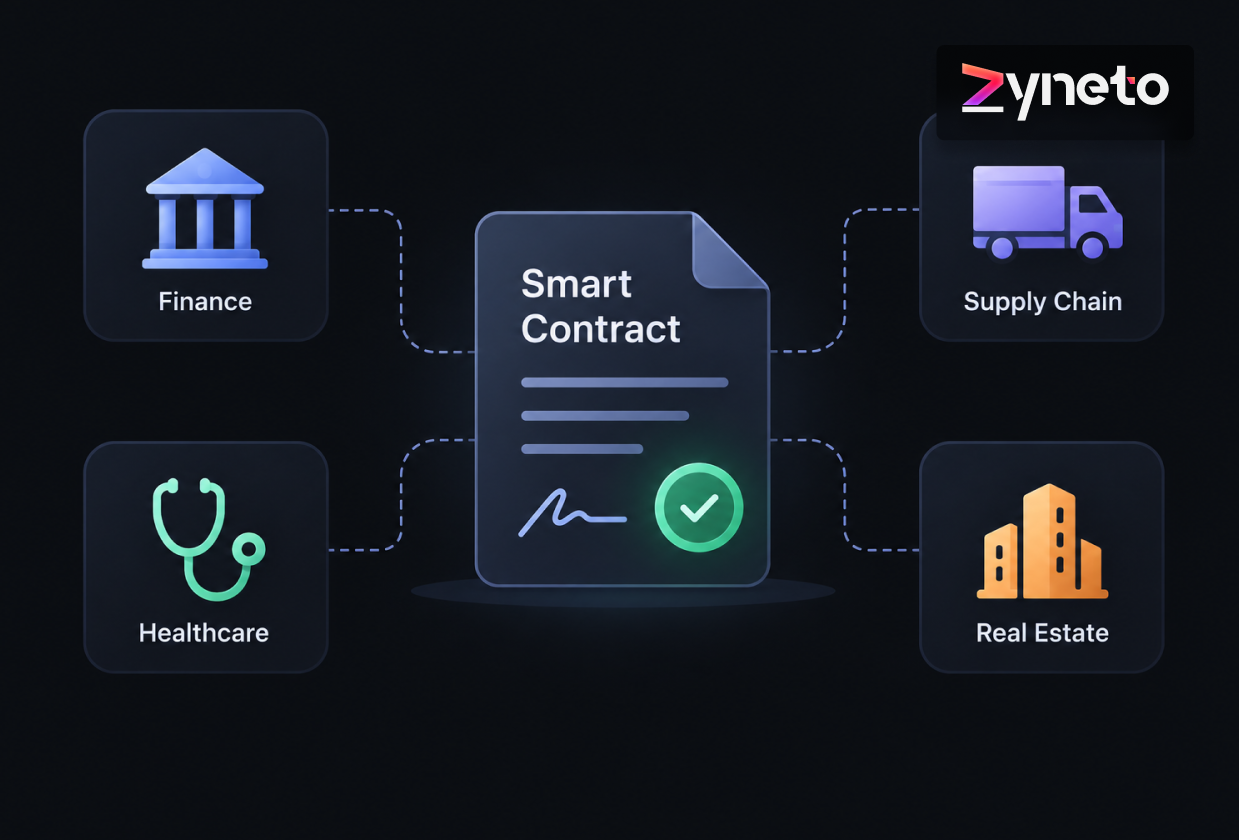
Ask ten people how smart contracts are used in industries, and you'll get ten versions of the same answer: banking, supply chain, healthcare, done.
That list is technically correct and completely useless, because it never explains the part that decides whether a project works, what kind of process can actually be automated by code, and what kind can't.
So, this isn't just a list of smart contract applications. It's a closer look at how they actually work.
We'll explore what needs to be true about your workflow before a smart contract can add value. We'll also look at the industries where this technology genuinely fits.
You'll see what's already being used in production, along with real examples of billion-dollar projects that failed and the reasons behind those failures.
The name is one of the worst in computing history, and it has caused a decade of confused executive meetings.
Nick Szabo coined the term in the 1990s, long before Bitcoin existed. He wasn't describing legal documents. He was describing the humble vending machine, a device that takes an input, verifies a condition, and dispenses an output without a shopkeeper, a lawyer, or a court. Put in a coin, get a soda. No trust required in either direction.
A smart contract is that idea generalized. It's a small program deployed onto a blockchain.
When you create a smart contract, you're writing code that holds its own state, can hold value, and runs when someone pokes it. Its critical property isn't intelligence it has none but determinism plus immutability.
Given the same inputs, it produces the same outputs, forever, and nobody, including the person who wrote it, can quietly rewrite it afterwards.
Two implications flow from that, and almost every real-world design decision comes back to one of them:
So: not smart, not really contracts. What they are is an execution guarantee shared between parties who don't trust each other. That's the product. Everything else is detail, and it's why the strongest smart contract use cases always turn out to be the ones where that missing trust was costing somebody real money.
Every industry below shares one trait: somewhere in its workflow, a payment or an approval waits on a fact that a human has to manually confirm.
Just remember that recognizing the shape isn't the same as clearing the bar: the smart contract development cost, including audit and ongoing monitoring, only makes sense on processes that are high-value, high-volume, or both.
A securities trade agrees in milliseconds but settles in days. Capital sits frozen as collateral, counterparty risk accumulates, and each institution keeps its own ledger of the same transaction. Entire departments exist just to make those ledgers agree.
The solution with smart contracts:
Cross-border payments hop through correspondent banks, each adding a fee, a day of delay, and its own compliance check. A single letter of credit can involve dozens of paper documents, manually verified, with settlement measured in weeks.
The solution with smart contracts:
Traditional claims are assessed, not measured; an adjuster investigates, quantifies damage, applies exclusions, negotiates. That is subjective by design, so it is slow and adversarial. For small policies, it is impossible: inspecting a two-hectare farm costs more than the claim.
The solution with smart contracts:
Manufacturers, carriers, warehouses, customs brokers and retailers each run separate systems. Confirming a shipment arrived intact means emails, scanned paperwork, and manual cross-checking, and supplier payment waits on all of it.
The solution with smart contracts:
Freight involves layered subcontracting: a shipper hires a forwarder, who hires a carrier, who hires a haulier. Each layer adds an invoice and a delay. Demurrage charges are argued over for months because nobody agrees on when a container actually arrived.
The solution with smart contracts:
A property deal involves brokers, two sets of lawyers, an escrow agent, a title insurer, a lender, and a registrar. It takes weeks and burns several percent of the value. Investment is also gated by size; commercial property needs capital most people don't have.
The solution with smart contracts:
A patient's data sits scattered across a hospital, two clinics, a lab,b and an insurer. Every access request is a bilateral negotiation, and nobody, least of all the patient, knows who has viewed what.
The solution with smart contracts:
Marketplaces exist largely to hold money while two strangers decide whether to trust each other, and they charge heavily for it. Refunds bounce between systems, loyalty points expire in silos, and sellers wait days for settlement on orders already delivered.
The solution with smart contracts:
Every item a player buys is a row in a publisher's database. The player doesn't own it, can't sell it outside the platform, and loses it entirely if the servers go dark. Creators earn nothing when their work is resold.
The solution with smart contracts:
One stream generates one payment that must fan out to co-writers, performers, producers, publishers, labels, and sample holders. It passes through several intermediaries, each taking time and a cut, and artists routinely wait a year to see money.
The solution with smart contracts:
Energy markets need constant low-value transfers between producers, consumers, and the grid, but billing systems are built for monthly cycles. It's the settlement problem most often brought to a blockchain development company today.
The solution with smart contracts:
Smart contracts in real estate solve a very specific kind of mess.
A mortgage takes weeks to approve and involves a lender, a valuer, a title insurer, and two sets of lawyers verifying documents nobody can quickly cross-check.
Rental income leaks through agents, deposits get withheld without explanation, and every party keeps its own version of what was agreed.
The solution with smart contracts:
Every service you sign up for stores its own full copy of your identity documents, which is why breaches are both catastrophic and endlessly repetitive. Proving one fact about yourself usually means handing over ten.
The solution with smart contracts:
Most projects don't fail at deployment. They fail in the week before anyone opens a code editor, when nobody asks whether the trigger was actually objective.
That's where we start. Zyneto is a smart contract development company that treats your workflow as the brief, not the blockchain.
We map the process, identify the trigger, pressure-test the data source, and confirm the settlement can genuinely execute on-chain.
Sometimes the honest answer is that conventional software will serve you better, and we'll say so before you spend a rupee.
When the fit is real, we build all of it: contract architecture, oracle and IoT integration, security review against known attack classes, key management, ERP integration, and interfaces your users can operate without ever seeing a wallet.
Smart contracts were never going to replace lawyers or dissolve banks. That prediction was made loudly in 2017, and it aged badly.
What actually happened is smaller and far more durable.
One specific class of problem, automating agreements between parties who don't share a database and don't fully trust each other, now has a better tool than it had before.
That class covers more ground than it first appears: settlement in capital markets, insurance for the previously uninsurable, financing for suppliers banks ignore, and energy trades too small to bill.
It also excludes plenty. Anything needing judgement. Anything the physical world can't measure honestly.
The companies winning here didn't decide to "do blockchain." They found one expensive, objective, repetitive process and automated exactly that.
The ones actually running at scale are securities settlement and lending in finance, parametric insurance payouts, supply chain financing, royalty distribution in music and entertainment, and tokenised real estate. What they share is an objective trigger and a settlement that can execute on-chain. Anything requiring human judgement tends to stay manual.
Financial services, because the asset and the payment both already live in a database , there's no physical object to verify, so the oracle problem barely applies. Insurance is a close second, since parametric products were redesigned around exactly what code can do rather than retrofitted onto an old process.
No. Mature deployments pair contract code with a conventional legal agreement that references it. The code handles execution; the paper defines intent, governing law, and what happens when the two diverge. Enforceability also varies by jurisdiction, so legal review is part of the build, not an optional extra.
The oracle, not the code. More value has been lost through manipulated data feeds than through flaws in contract logic. The second biggest risk is immutability itself: a deployed contract cannot be patched, and the standard upgrade-proxy workaround hands control back to whoever holds the key.
Run the five questions above: multiple parties without a shared database, an objective trigger, a reliable truth source, a settlement that can execute on-chain, and value high enough to justify build and audit costs. Score five out of five, and you have a strong candidate. Two or fewer and conventional software will serve you better.
Sudhanshi has several years of experience in digital marketing and now works on growth at Zyneto. Her work covers SEO, content strategy, organic lead generation, social media and paid campaigns across Google, LinkedIn, Instagram and Facebook. She has run B2B technology and SaaS campaigns for international audiences, helping brands get found in search and stay found, and works day to day in Google Analytics, Search Console, Ahrefs, SEMrush, Screaming Frog and Canva. She follows AI driven marketing, changing search behaviour, content automation and social growth closely, and turns audience and search data into plans a team can actually run. She writes about SEO, content strategy and the tactics that still earn traffic as search keeps shifting.
Share your details and we will talk soon.
Be the first to access expert strategies, actionable tips, and the trends actually shaping the digital world. No fluff - just practical insights delivered straight to your inbox.
Dive into our blog and stay ahead of the curve with expert perspectives, future-ready trends, and tech tips written for decision-makers and doers alike.