


















National Distribution CompanyFMCG distribution and wholesale

FMCG distribution software for Oman: what we shipped for National Distribution Company

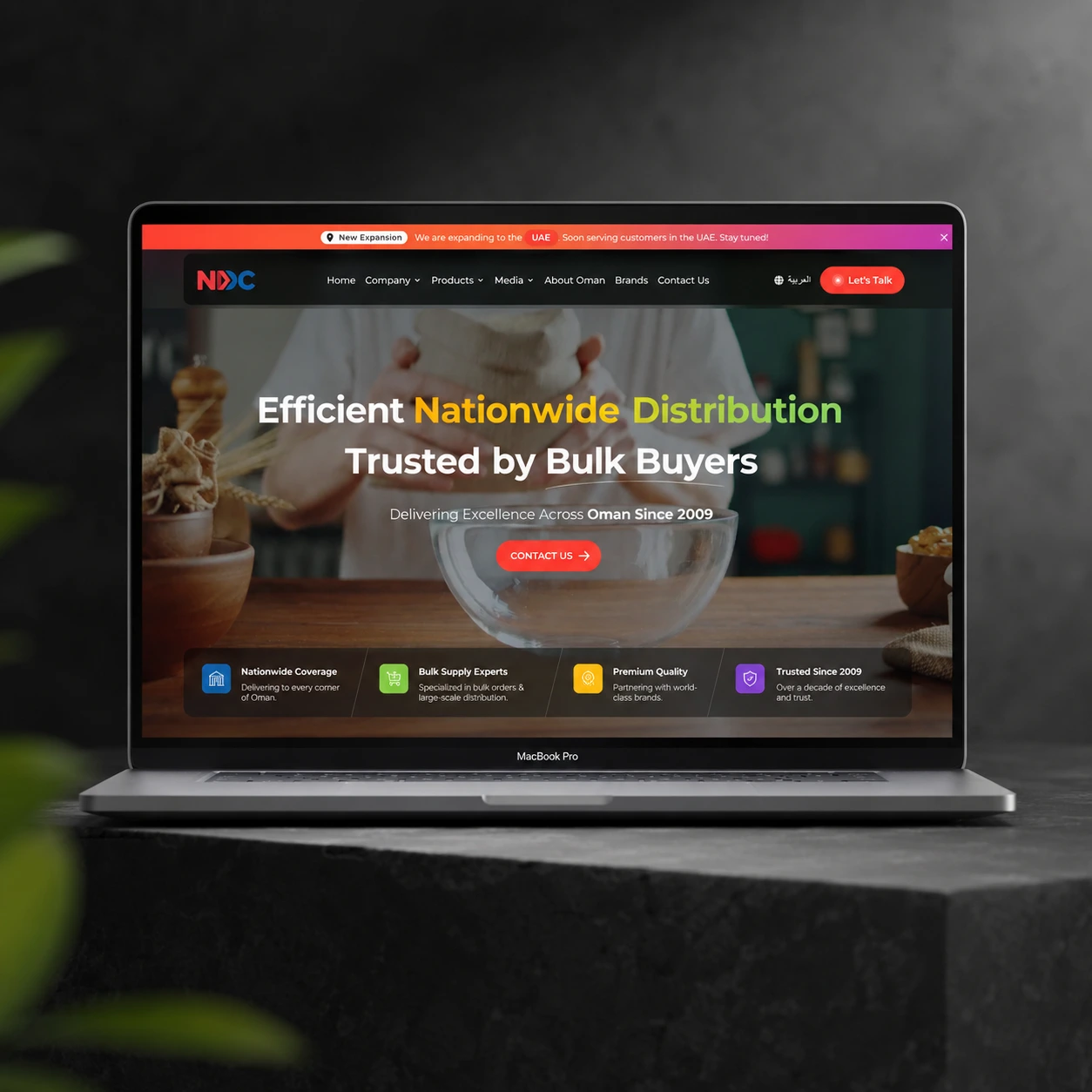
National Distribution Company sources, warehouses and distributes FMCG brands across Oman. We built the platform its trade buyers and brand principals use to browse the catalogue, read the network and warehousing story, and raise an enquiry. It is an FMCG distribution platform rather than a shop, so trade buyer portal development set the shape of every screen.

Read the study

Build fingerprint

Where it runs, how we engaged, and what it was built on.

See it livendcmuscat.com
Market
Oman
Engagement
Dedicated team
Platforms
Web
Stack
7 technologies

Technologies

  • Next.js
  • TypeScript
  • Tailwind CSS
  • Node.js
  • CMS
  • Media management
  • Analytics

Trusted by
Global Industry Leaders

Al Amri Express
Cheer Sagar
MRO Supply
BankSathi
DoraDori
Kroolo
StyleBank
Hire Right
Cintas
Up in the Air
Famepilot
Swedishness
Corrib Coil
iCare Heal
TWAM
NDC: National Distribution Company Oman
Moneteo
Algora
Numerology
G4Girl

What makes FMCG distribution software different

What makes this problem genuinely hard - before any client name enters the page.

What sits between a brand principal and a shelf

A principal manufactures. The distributor takes title to the stock, clears customs, holds it at the right temperature, breaks pallets into cases, runs a salesman past a few hundred outlets, executes the promotion the principal funded, extends credit to the trade, chases collection, and reports sell out data back. Its margin is the spread between landed cost and trade price, minus the cost of holding and moving.

A trade catalogue is a different object

There is no cart, and there should not be one. Price is contractual: it moves with the customer, the credit term, the volume band and whatever the principal funds this quarter. Publish a number and you hand every buyer a starting position. The job is discovery instead. A buyer confirms you carry the brand in the pack they stock, then starts a conversation. Filter, compare, enquire. The measure is qualified enquiries, not conversion rate.

Two languages, and one of them mirrors

Arabic is the official language, English is common in trade, so both are load bearing. The Arabic side is a layout problem before it is a translation one. Brand names stay in Latin script inside Arabic sentences, and those mixed runs reorder under the bidirectional algorithm unless interpolated text is isolated. Search also has to normalise alef and taa marbuta variants or Arabic queries return nothing.

Brand partnerships carry the commercial argument

The logo wall is the credential. A principal weighing an appointment reads it for channel conflict, checking whether a competitor already sits in the portfolio. A retailer reads it to work out how many brands one purchase order covers. Both arrive asking about a named brand, so brands need to be structured records carrying category, origin and pack range, not an image grid. Treat it as decoration and your most commercial page becomes unsearchable.

The situation, and what we built

National Distribution Company sources, warehouses and distributes FMCG products across Oman. It faces two directions: up towards brand principals who need national coverage here, and down towards retailers, wholesalers and institutional buyers who order from it. One site serves both. A principal wants network reach, warehousing and category fit before opening a conversation. A trade buyer wants one answer quickly: do you carry this brand, in what pack. Both arrive on a brand name in search, and both leave through the same enquiry form.

A catalogue built for enquiry, not checkout

Browsable by brand, category and pack, with enough detail for a trade buyer to identify the item they stock. No cart, no price, no account wall.

Brand records with their own URLs

Each partnership is a record carrying category, origin and related products, on its own page. That is where a brand query should land.

CMS ownership of what changes

Catalogue entries, brand records and media are edited by staff, not developers. A delisted SKU is an editorial action, not a release.

Media and the SEO structure around it

A distributor site is photograph heavy, and photographs are what make it slow. Media handling, metadata and page structure were part of the build, not a pass at the end.

Tradeoffs

Decisions, and what each one cost

Every choice closed off something else. Those costs are stated, not hidden.

No cart and no public prices

Instead of: A B2B storefront with logged in customer price lists. Pricing is contractual per customer, and a login wall hides the catalogue from the brand searches that bring buyers in.

What we acceptedNo self serve reorder, so repeat orders still go through a salesperson and the site cannot attribute revenue.

Next.js with a CMS behind it, not a commerce platform

Instead of: A hosted ecommerce platform. The requirement is listing, filtering and enquiry, and a commerce platform charges you in complexity for a checkout nobody uses.

What we acceptedAdding buyer ordering with account pricing later is a build, not a settings change.

Brands modelled as records, not page content

Instead of: One partners page with a grid of logos. The brand name is the query, so it needs a URL, related products and metadata.

What we acceptedMore editorial work per brand at launch, and a half filled record reads worse than none, so the CMS needs required fields and an owner.

Reusable

Trade catalogue against consumer catalogue: what changes in the model

The model we work from on distributor builds.

Field or behaviourConsumer ecommerceDistributor trade catalogue
PricePublic, one per SKUContractual, by customer and volume band
Unit of saleEachCase, layer or pallet
Buyers search onProduct nameBrand, then category, then pack
Success metricConversion rateQualified enquiries by brand and buyer type
Who edits itMerchandisingBrand and sales managers, so CMS is mandatory
Refresh cycleContinuous, feed drivenBursty, tied to listing wins and delistings

The last row is the one teams underestimate.

Delivery

What shipped

Capabilities delivered and the scope of the build - not results attributed to it.

Capabilities

  • Products, brands, services and company information
  • Catalogue browsing by brand, category and pack
  • Brand partner records, each individually addressable
  • CMS ownership of catalogue, brand and media content
  • Media delivery with SEO structure and analytics
  • Enquiry capture for retailers, wholesalers and institutional buyers

Scope

  • Client operating scale, not engagement results: 400 plus products
  • 300 plus employees
  • Brand partnerships spanning 20 plus countries

Scope of the build, not results attributed to it.

Building something with the same constraints?

Bring us the part you think is hardest.

Risk, ownership and commercials

Content ownership

Catalogue, brand records and media are edited by the client's team through the CMS. Nothing routine needs a developer.

Infrastructure ownership

Hosting and the domain sit with the client, so changing supplier is a commercial decision.

After launch

The platform is public, with no customer accounts or payment data, so the security surface stays small.

Engagement model
Dedicated team
Rate band
$40 to $100 per hour by role. Content and QA near the floor, architecture near the ceiling. Mixed teams blend to $60 to $70.
How we quote
No fixed price before discovery. Anyone quoting firm on a first call has either padded it or plans to reprice at change request time.

Reflection

What we would do differently

Catalogue decay is the real long term risk and we underweighted it. FMCG listings change every quarter, and a public catalogue still showing a delisted brand costs credibility with principals and buyers at once. We would now put a last reviewed date on every brand and product record, and surface a stale queue in the CMS, rather than trusting editorial discipline. We would also instrument enquiry outcomes from day one, so reporting says which brands generate contact, not which pages generate traffic.

Why does a distributor catalogue carry no prices or cart?

Trade pricing is not a published number. It moves with the customer, the credit term, the volume band and the promotional support the principal funds. A public figure hands every buyer a starting position. The catalogue confirms the brand and pack are carried, then hands off to a conversation.

Is Arabic support translation work or build work?

Build work. A fully Arabic page mirrors cleanly, but distributor content mixes scripts, because brand names and pack codes stay in Latin. Those runs reorder under the bidirectional algorithm, so a correctly stored string still displays wrong. Retrofitting costs several times more.

Why does the brand partner section matter more than the product catalogue?

It is what both audiences assess first. A principal reads the portfolio for channel conflict before discussing an appointment. A retailer reads it to gauge how much of its order book one supplier covers.

Context

Where this sits in our work

Talk to an engineer, not a salesperson

Tell us what your operation runs on today.

Our Success Stories

Real feedback from the people we've proudly partnered with.

Brooklyn Foster profile

Brooklyn Foster

Sales Director |Cintas

United States

GoodFirms
"

Zyneto Global Technologies provided excellent project management and technical expertise throughout the engagement. The team was responsive, collaborative, and adaptive, ensuring the project met our expectations and set a strong foundation for future growth.

"
Verified Review
Rating: 5 out of 5
Krystian Chlebek profile

Krystian Chlebek

Founder & CEO |Moneteo

TechBehemoths
"

We engaged Zyneto to design and develop a custom web platform for Moneteo, aimed at improving project management, data tracking, and collaboration across internal teams and external partners. Their work included full-stack web development, custom modules for workflow automation, API integration, and comprehensive testing.

"
Verified Review
Rating: 5 out of 5
Kevin Scott profile

Kevin Scott

CEO |E-Commerce Platform

Clutch
"

Overall, their responsiveness and timely deliveries contributed positively to the project's success. The client achieved better data management and quality. The service provider delivered the project on time and ensured prompt responsiveness throughout the engagement. Their innovative approach was outstanding.

"
Verified Review
Rating: 5 out of 5
WhatsApp
Email
Book a Meeting