


















Al Amri ExpressQuick commerce and grocery

Grocery delivery app development for Oman: what we shipped for Al Amri Express

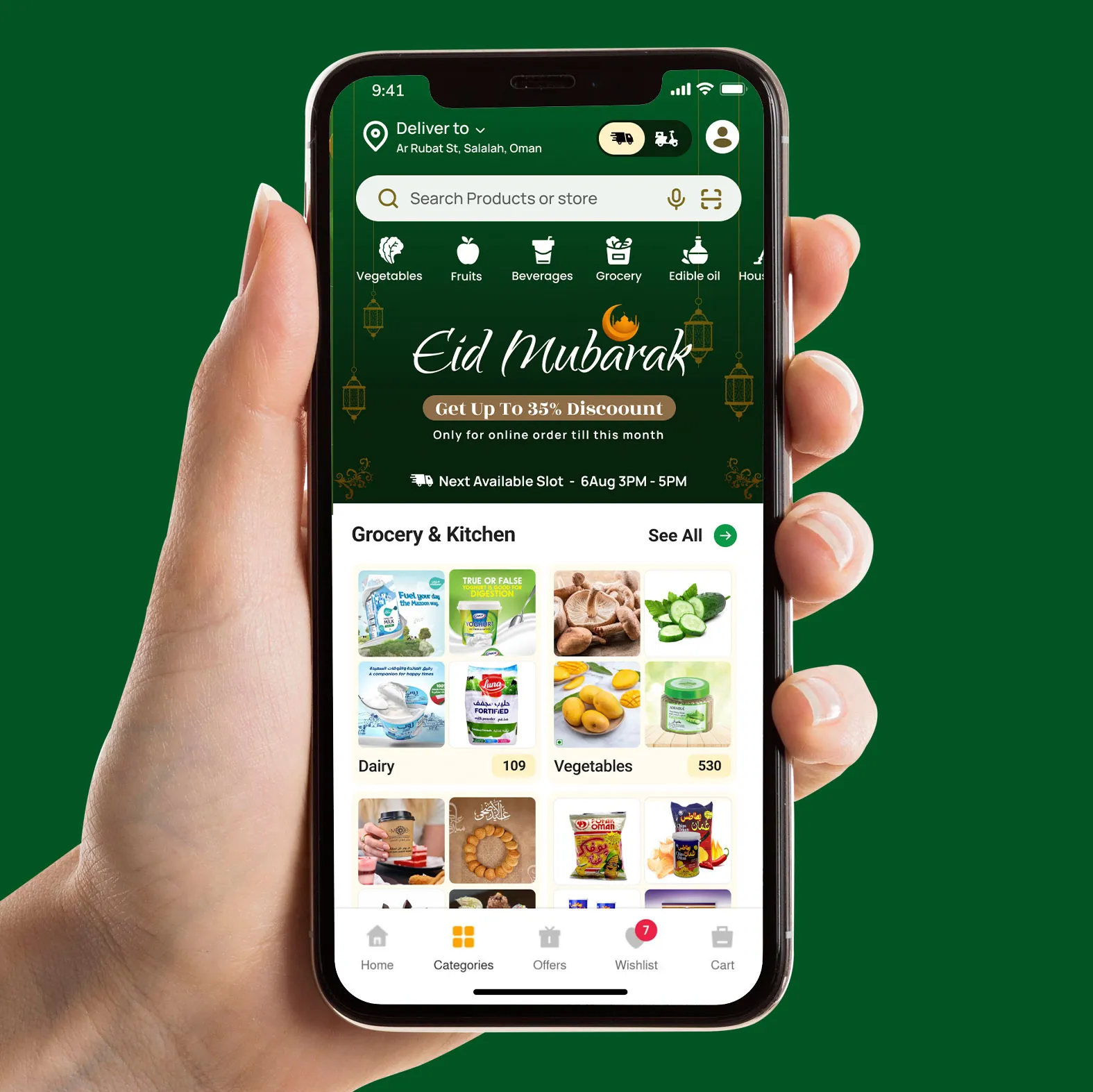
Al Amri Express delivers groceries and daily essentials across Oman. We built two apps: the storefront customers order from, and the operations app the warehouse and delivery teams run on. Quick commerce app development and the grocery delivery platform behind it are one system, and the warehouse app is the harder half.

Read the study

Build fingerprint

Where it runs, how we engaged, and what it was built on.

Market
Oman
Engagement
Dedicated team
Platforms
iOS · Android
Stack
6 technologies

Technologies

  • React Native
  • Laravel
  • Elasticsearch
  • MySQL
  • AWS
  • Websockets

Trusted by
Global Industry Leaders

Al Amri Express
Cheer Sagar
MRO Supply
BankSathi
DoraDori
Kroolo
StyleBank
Hire Right
Cintas
Up in the Air
Famepilot
Swedishness
Corrib Coil
iCare Heal
TWAM
NDC: National Distribution Company Oman
Moneteo
Algora
Numerology
G4Girl

What makes grocery delivery app development hard in Oman

What makes this problem genuinely hard - before any client name enters the page.

There is no postcode to route on

Oman's addressing standard excludes a location based post code. The codes in circulation belong to post office boxes, and street names are only unique within a wilayat. So the pin drop is the primary key and the text is commentary. Zones get drawn as polygons, and the landmark a customer types is a field the rider reads verbatim.

Cash at the door changes the ledger

The rial carries three decimal places, so money must be stored in integer minor units with an exponent of three. Anything defaulting to two truncates silently. Cash also makes refusal partial: a shopper rejects one substituted item, not the order, so the door needs per item accept and reject that reprices collection on the spot.

Cost per order barely moves, basket value does

Picking, packaging and rider time are near fixed whether the basket holds three items or twenty. Contribution scales with basket size while cost scales with order count, so the levers are batch picking, drop clustering, and slot capacity set by picking throughput rather than rider headcount.

Two languages in one interface, and one of them mirrors

A layout problem before a translation one. Mixed Arabic and Latin runs reorder at render time under the bidirectional algorithm, so a correctly stored order number displays scrambled unless interpolated values are wrapped in isolates. Search must normalise alef and taa marbuta variants, and both numeral sets must parse on input.

The situation, and what we built

Al Amri Express sells groceries across Oman, delivered by its own operation rather than a marketplace of third party riders. That made the customer app and the warehouse one system, because a promise made at checkout is kept or broken by whoever picks the order.

Catalogue and search

A bilingual catalogue with search over Elasticsearch, so a query in either language returns the same shelf. Relevance carries grocery, where customers arrive knowing what they want.

Ordering and reorder

Cart, checkout and one tap reorder from previous baskets, the highest value interaction in grocery because weekly shops repeat.

Live order tracking

Order state pushed over websockets rather than polled, so the customer sees picking, dispatch and arrival as they happen.

The operations app behind the storefront

A separate staff application with access split across admin, packer and delivery. Orders move through picking, packing and ready for dispatch, with staff assignment and dispatch tracking.

Tradeoffs

Decisions, and what each one cost

Every choice closed off something else. Those costs are stated, not hidden.

Elasticsearch for catalogue search rather than database full text search

Instead of: MySQL full text indexes. Bilingual search needs analyzer level control over Arabic normalisation, which a database index does not give you.

What we acceptedA second datastore to keep in sync, and an indexing path that drifts from the source of truth if unmonitored.

A separate application for staff rather than one app with a role switch

Instead of: A single app that changes mode by permission. The audiences share almost no screens, and warehouse staff repeat one flow on a shared device. One app would couple very different release cadences.

What we acceptedDuplicated shell code and a second release process to maintain.

Websockets for order state rather than polling

Instead of: Interval polling from the client. Status changes cluster during the delivery window, so polling either wastes requests or lags.

What we acceptedConnection state becomes the client's problem on flaky networks, so the UI needs a reconnect path and a truthful last known state.

Reusable

Address capture options, and what each actually costs you

Every Gulf delivery build makes this call early, and it is hard to reverse once orders carry stored addresses.

MethodWorks in OmanWhat it costs you
Street address, geocodedUnreliable outside planned districtsRouting failures that look like rider error
Pin drop plus landmark noteYes, and it matches how people give directionsA map interaction at signup, which adds friction
Postal code lookupNo, there is no location based postcodeRewriting serviceability logic later
Plus code or mapcodeSupported by the national standardLow familiarity, so it works better rider side

Whichever you pick, store the coordinate with its capture source and deduplicate by proximity, not string match.

Delivery

What shipped

Capabilities delivered and the scope of the build - not results attributed to it.

Capabilities

  • Bilingual customer app on iOS and Android
  • Search, one tap reorder, subscriptions and loyalty
  • Live tracking through picking, dispatch and delivery
  • Role separated operations app for warehouse and delivery

Scope

  • Two applications on a shared backend
  • Delivery across Muscat and the regions

Scope of the build, not results attributed to it.

Building something with the same constraints?

Bring us the part you think is hardest.

Risk, ownership and commercials

Access and data

Roles are separated in the staff app, so people see only what their role covers. Data sits in the client's own AWS account.

Ownership

The client holds the hosting account and both store listings, so changing supplier is a commercial decision, not a technical one.

After launch

The customer app shipped first and the operations app followed, so each entered production against something stable.

Engagement model
Dedicated team
Rate band
40 to 100 USD per hour by role, blending to 60 to 70
How we quote
No fixed price before a discovery that produces the integration inventory

Reflection

What we would do differently

Starting again, we would design the substitution flow before checkout rather than after. Substitution is the only part of a grocery order the customer did not choose, it moves ratings more than delivery speed does, and deciding late forces that question to be answered around code that already exists.

Why not use a postcode for delivery zones in Oman?

Because there is not one. Oman's addressing standard states there is no location based post code, and the codes in circulation are post office routing codes. Zones get drawn as polygons over coordinates.

What breaks when you add Arabic to an existing app?

Usually the mixed content. A purely Arabic screen mirrors cleanly, but an order number inside an Arabic sentence reorders under the bidirectional algorithm and displays wrong even though the stored string is correct. Isolating interpolated values is far cheaper at build time than as a retrofit.

Do you need a separate app for warehouse staff?

Not always. The audiences share almost no screens and release on different cadences, so we split them here. For a smaller operation, a role gated section inside one app is defensible.

Context

Where this sits in our work

Talk to an engineer, not a salesperson

Tell us what your operation runs on today.

Our Success Stories

Real feedback from the people we've proudly partnered with.

Brooklyn Foster profile

Brooklyn Foster

Sales Director |Cintas

United States

GoodFirms
"

Zyneto Global Technologies provided excellent project management and technical expertise throughout the engagement. The team was responsive, collaborative, and adaptive, ensuring the project met our expectations and set a strong foundation for future growth.

"
Verified Review
Rating: 5 out of 5
Krystian Chlebek profile

Krystian Chlebek

Founder & CEO |Moneteo

TechBehemoths
"

We engaged Zyneto to design and develop a custom web platform for Moneteo, aimed at improving project management, data tracking, and collaboration across internal teams and external partners. Their work included full-stack web development, custom modules for workflow automation, API integration, and comprehensive testing.

"
Verified Review
Rating: 5 out of 5
Kevin Scott profile

Kevin Scott

CEO |E-Commerce Platform

Clutch
"

Overall, their responsiveness and timely deliveries contributed positively to the project's success. The client achieved better data management and quality. The service provider delivered the project on time and ensured prompt responsiveness throughout the engagement. Their innovative approach was outstanding.

"
Verified Review
Rating: 5 out of 5
WhatsApp
Email
Book a Meeting