AI Copilot Development: What It Costs Per Seat and Where It Stops



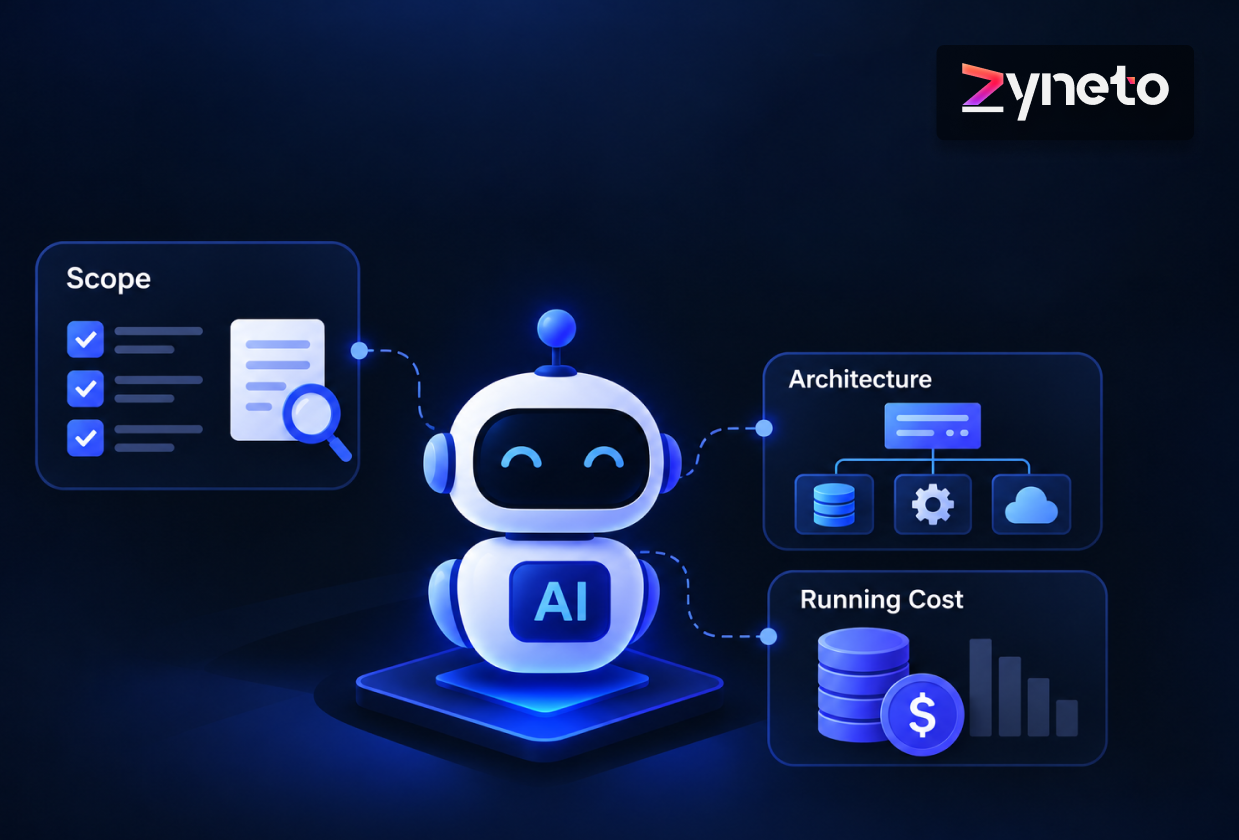
Most pages from an AI copilot development company describe features. Suggests, summarises, drafts. That tells you nothing about whether to spend the money, because the questions that decide it are what the thing costs per seat every month, how fast it has to respond, and what it has to score before a customer is allowed to see it.
So this is the version with those numbers in it. Per seat running cost at three rollout sizes with the arithmetic shown. The build broken into stages with hours. A latency budget, which is the constraint most proposals ignore. And four evaluation gates, each with a number attached.
Everything below is a planning assumption written out so you can substitute your own. Illustrative, not a claim about any particular project.
A copilot sits inside a screen somebody is already using and offers help on the task in front of them. It suggests. A person accepts, edits or ignores. That acceptance step shapes the whole design.
Three things follow from it, and they shape the entire build.
The context is the product. A copilot that cannot see the record the user is looking at gives generic advice, and generic advice gets ignored within a week. Most of the engineering goes into assembling the right context for each suggestion, not into the model call.
Latency is a feature. A suggestion that arrives after the user has finished typing is worse than no suggestion, because it interrupts. More on the budget below.
The metric is acceptance, not accuracy. A copilot can be technically correct and still useless if people dismiss it. Acceptance rate is what you instrument on day one and what you report on afterwards.
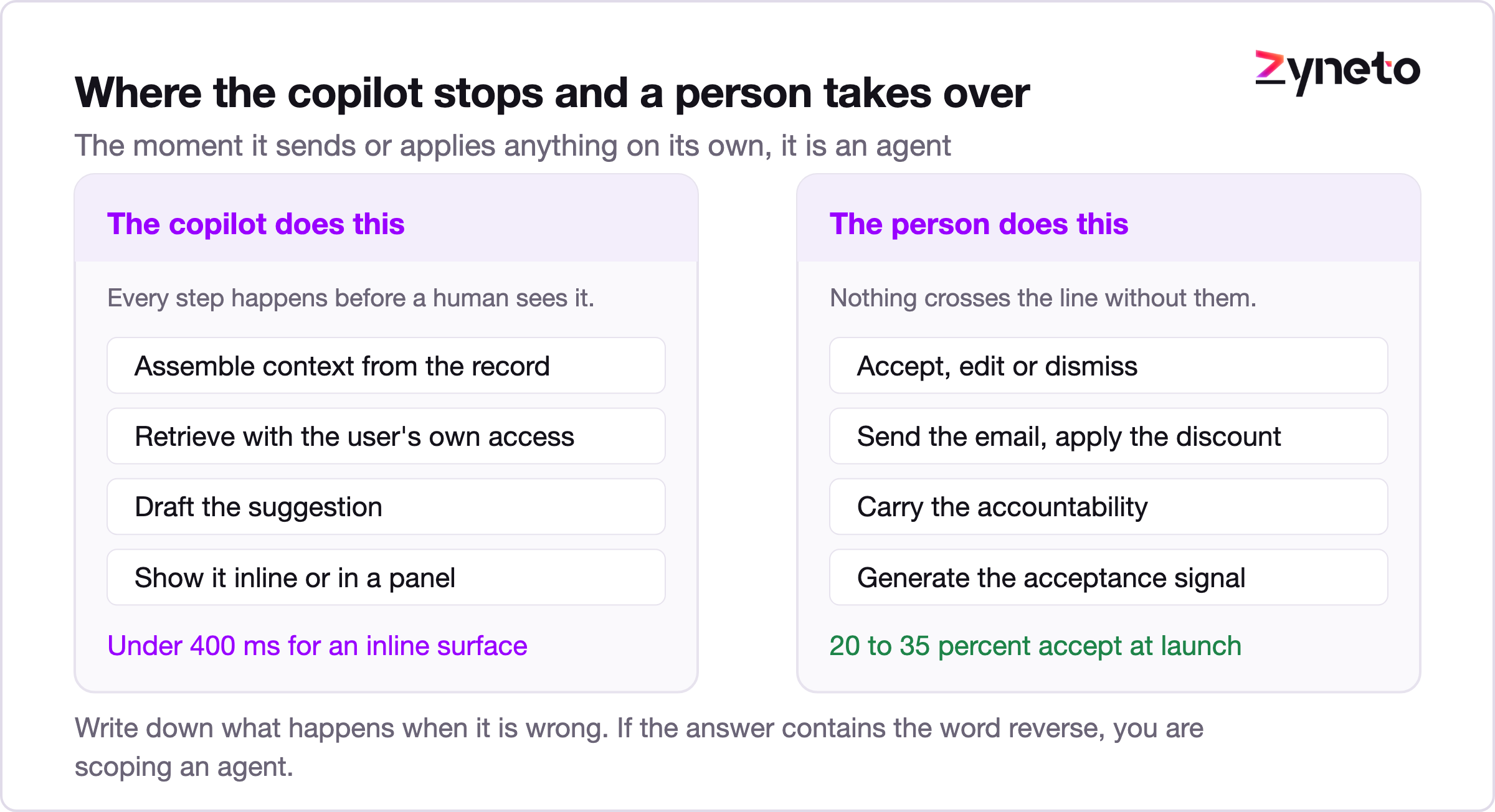
And the boundary: a copilot does not act on its own. It drafts the email, the person sends it. It proposes the discount, the person applies it. The moment it sends or applies anything without a person, it has stopped being a copilot, which brings us to the decision that actually sets the budget.
These two words get used interchangeably in sales material and they describe very different builds.
|
|
Copilot |
Agent |
|
Trigger |
A person, inside a screen |
A goal, often on a schedule |
|
Output |
A suggestion |
An action taken |
|
Failure cost |
Someone ignores it |
Something changed that should not have |
|
Needs rollback |
No |
Yes |
|
Needs audit trail |
For compliance only |
Always |
|
Unit of cost |
Per seat |
Per task |
|
Typical first build |
5 to 9 weeks |
8 to 16 weeks |
The rollback line is where the money is. A copilot suggests, so the worst case is a bad suggestion nobody takes. An agent writes to systems, so it needs idempotency, reversal and an approval path. Those three requirements are most of the gap between five weeks and sixteen. Custom AI agent development is a materially larger commitment and should be priced as one.
A practical test. Write down what happens when the thing is wrong. If the answer is "the user sees something unhelpful and moves on", build a copilot. If the answer involves the word "reverse", you are scoping an agent whether you meant to or not.
Most teams should build the copilot first. It puts the same retrieval and grounding work in place, it collects real acceptance data, and that data is what makes an agent safe to build later.
|
Stage |
Hours |
What it covers |
|
Discovery and context mapping |
60 to 110 |
Which records, fields and documents a suggestion needs |
|
Retrieval and grounding |
90 to 160 |
Index, chunking, freshness, permissions |
|
Suggestion surface in the UI |
70 to 140 |
Inline, panel or both. Accept, edit, dismiss, undo |
|
Evaluation set and scoring |
60 to 120 |
Cases with known good answers, plus the scoring run |
|
Guardrails and permissions |
50 to 90 |
What it may see, per user, and what it must never say |
|
Telemetry |
30 to 60 |
Acceptance, edit distance, latency, dismissals |
Work the middle of those ranges and the total lands near 520 hours. At two engineers that is roughly 7 weeks, which matches the 5 to 9 week band above.
Permissions are the stage that surprises people. A copilot inherits the user's access or it leaks. If your underlying systems have coarse permissions, the copilot exposes that immediately and in front of everyone. Budget the fix, or scope the copilot to data everyone can already see.
Put a number on the permissions stage so it is not the thing that slips. If a copilot serves 6 record types and each needs its access rule expressed in the retrieval layer, that is 6 rules to write and 6 to test, which at 4 to 7 hours a pair is 24 to 42 hours before anyone writes a prompt. Teams that treat this as configuration rather than engineering find it in week five.
Retrieval is the stage that decides quality. A suggestion grounded in the right three documents beats a suggestion from a larger model with the wrong context, every time. If a proposal spends more hours on prompting than on retrieval, it was priced from a demo.
Copilots are rolled out to people, so model the seat rather than the task.
Planning assumptions: each active user triggers about 35 suggestions a working day, 22 working days a month, 2,500 input tokens of assembled context per suggestion and 200 output tokens, at a blended 3 USD per million input and 12 USD per million output. Substitute your provider's current rates.
|
Seats |
Suggestions a month |
Inference |
Per seat |
|
40 |
30,800 |
about 305 USD |
about 7.60 USD |
|
200 |
154,000 |
about 1,525 USD |
about 7.60 USD |
|
1,000 |
770,000 |
about 7,625 USD |
about 7.60 USD |
Work the first row through. 40 seats at 35 suggestions across 22 days is 30,800 calls. At 2,500 input tokens each that is 77 million input tokens, which at 3 USD per million is 231 USD. The 200 output tokens each give 6.16 million output tokens, at 12 USD per million that is 74 USD. Total 305 USD, so about 7.60 USD per seat per month.
Inference is close to linear. The other three costs are not.
Retrieval infrastructure is mostly fixed. A managed vector store for a mid sized corpus runs in the low hundreds a month whether you have 40 seats or 1,000, so per seat it falls sharply as you grow.
Context assembly is the line that quietly doubles the bill. If a suggestion needs 2,500 tokens of context today and someone adds two more source documents next quarter, it becomes 4,000 and your inference cost rises 60 percent with no feature change. Cap the context budget in code and alert when it is hit.
Human time on evaluation is fixed per release, not per seat. Budget a day a month for someone to review the scored run and the dismissal samples.
A reasonable planning figure for a 200 seat rollout is inference near 1,525 USD, retrieval a few hundred, and a day of review time. Anyone quoting a per seat price under a dollar has either a much smaller context budget than 2,500 tokens or has not measured it yet.
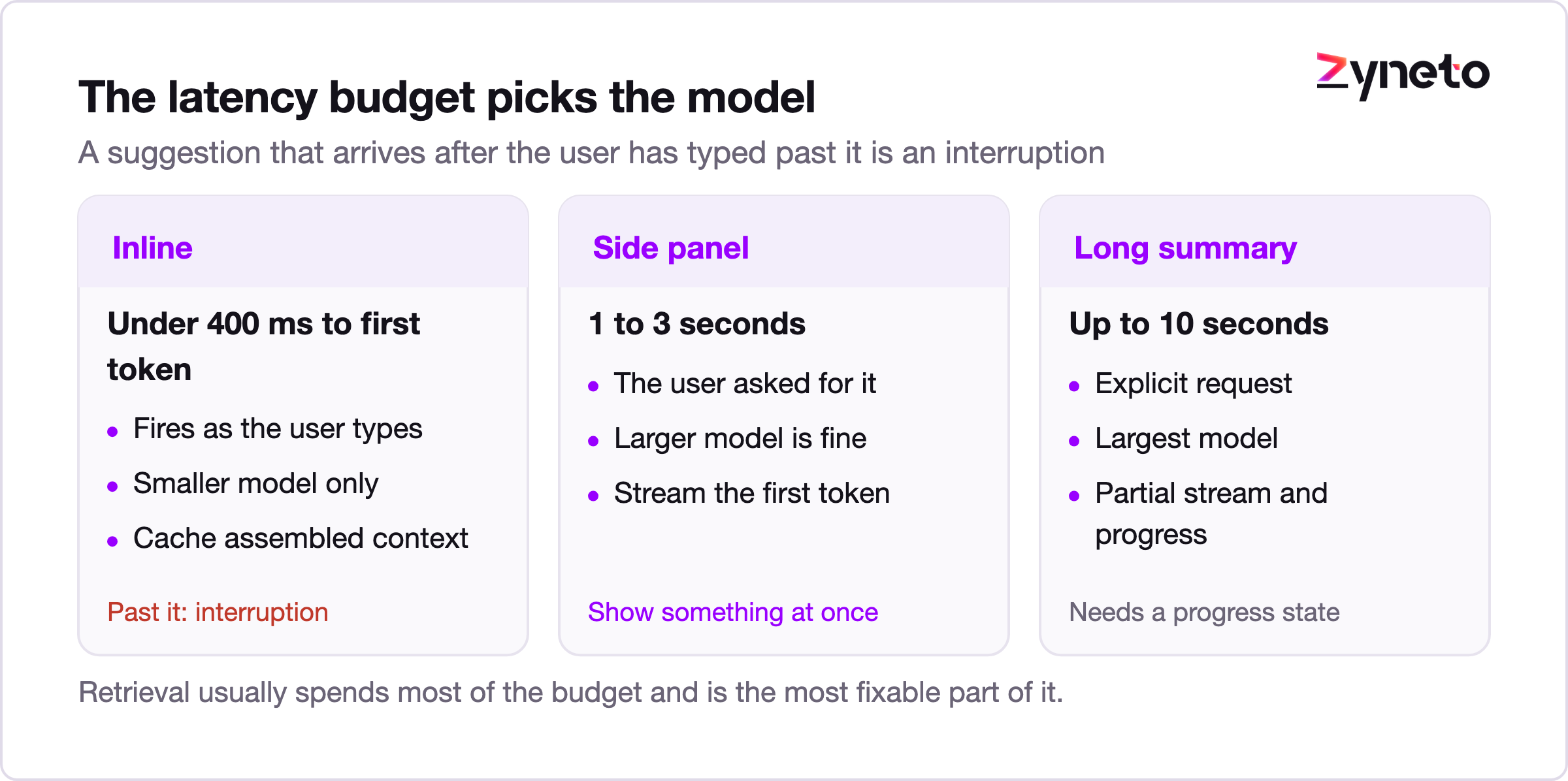
This is the section missing from almost every proposal, and it decides adoption more than quality does.
|
Surface |
Budget |
What happens past it |
|
Inline suggestion as the user types |
under 400 ms to first token |
The user has typed past it. Suggestion is an interruption |
|
Side panel, user asked |
1 to 3 seconds |
Tolerable if something appears immediately |
|
Long summary on request |
up to 10 seconds |
Fine with a progress state and a partial stream |
The budget drives the model choice, not the other way round. A larger model that answers in 1.2 seconds is the wrong model for an inline surface no matter how much better its output is. Teams discover this after they have built around the larger model, which is an expensive week.
Three things spend the budget: assembling the context, the round trip, and generation. Retrieval is usually the biggest and the most fixable. Cache the assembled context per record, stream the first token rather than waiting for the full response, and keep the inline surface on a smaller model with the larger one reserved for the panel.
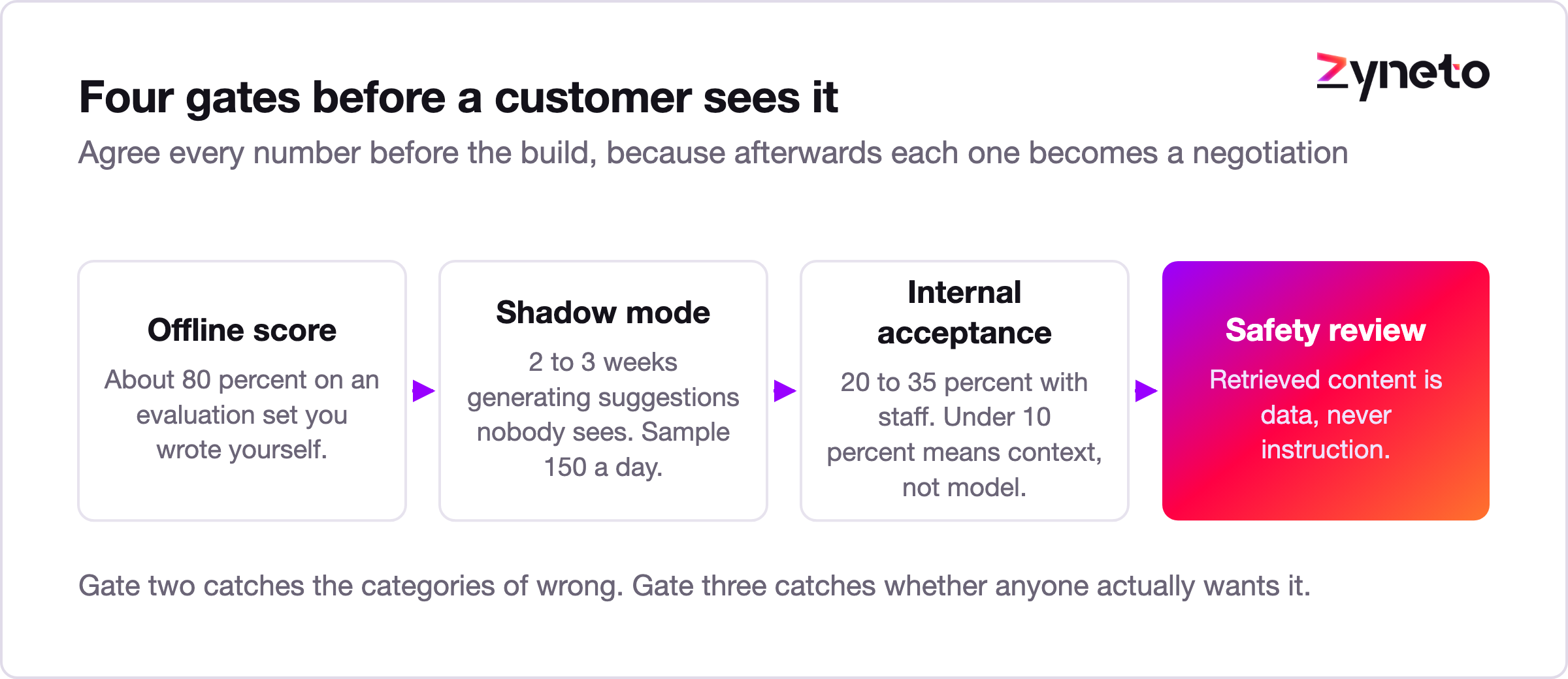
Four gates, each with a number. Agree them before the build, not after, because after the build every number becomes a negotiation.
Gate one, offline score. Run the evaluation set and score it. A copilot that cannot reach roughly 80 percent on cases you wrote yourself will not survive contact with real inputs. This gate is cheap and catches the worst problems.
Gate two, shadow mode. Generate suggestions and show them to nobody for two to three weeks. Sample and review. You are looking for the categories of wrong, not the rate.
Size the shadow sample properly rather than eyeballing it. At 200 seats and 35 suggestions a day you generate 7,000 a day, and reviewing 150 of them gives you a rate accurate to roughly plus or minus 4 points, which is enough to tell 12 percent from 28. Reviewing 20 tells you nothing and takes a fortnight to prove it.
Gate three, internal acceptance. Release to staff. A well tuned copilot typically lands between 20 and 35 percent acceptance at launch. Below 10 percent something is wrong with the context rather than the model, and shipping it anyway teaches people to ignore it.
Gate four, the safety review. Prompt injection through your own content is the one that gets missed. A customer writes an instruction into a free text field, the copilot reads it as an instruction. Treat everything retrieved as data, never as instruction, and keep privileged instructions out of reach. Securing enterprise AI belongs in the build, not in a later phase.
Acceptance decays quietly. It starts at 28 percent and drifts to 14 over two quarters as content changes and nobody notices. Chart it weekly with a named owner or it will not be noticed until someone asks why the copilot is switched off.
Cost the decay so it gets an owner. On a 200 seat rollout at 7,000 suggestions a day, acceptance falling from 28 percent to 14 is about 980 fewer accepted suggestions a day. If each saved a person 40 seconds, that is roughly 11 hours a day of benefit gone, and the monthly inference bill has not moved at all. The copilot costs the same and delivers half as much, which is exactly the shape of problem that survives unnoticed for two quarters.
Context goes stale. The index was built once and the documents moved on. The copilot confidently cites a policy that was replaced in March. Schedule incremental re-indexing rather than a quarterly rebuild.
The permission leak. A user sees a suggestion drawn from a record they should not have access to. This is the one that ends projects. It comes from retrieval running with a service account rather than the user's own access.
Suggestion fatigue. Firing on every keystroke produces more dismissals than accepts and trains people to ignore the surface. Fewer, better timed suggestions beat more of them, and the dismissal rate tells you which you have. A useful threshold: if dismissals run above 3 for every accept, the trigger is too eager rather than the output being poor. Raising the confidence floor usually recovers acceptance within a fortnight and cuts the inference bill at the same time, because you are making fewer calls. It is the only change on this list that improves quality and cost together.
The context budget creeps. Covered above, and worth repeating because it shows up as a cost problem months before anyone traces it back to a content change.
When the task is not on a screen. A copilot helps someone doing something in a UI. Batch processing with no human in the loop is a different build entirely.
When the data is not accessible. A copilot cannot ground a suggestion in a folder of scanned documents nobody indexed. Fix retrieval first. That work is useful on its own and it is the bulk of the copilot anyway.
When permissions are coarse. If your systems cannot answer "what may this user see", a copilot will expose that. Fix it first or scope to open data.
When you cannot measure the before. Capture current handling time and error rate before anything ships. A copilot that lifts acceptance to 30 percent proves nothing if nobody recorded what the task took in week zero, and that is the number finance will ask for in month four.
When nobody asked for it. Adoption is the whole game. A copilot inserted into a workflow whose owners did not want it reaches single digit acceptance and gets turned off, which is an expensive way to learn something a conversation would have told you.
When an agent is what you actually need. If the value is in the thing being done rather than suggested, scope the agent and price it accordingly. AI copilots for business are the cheaper build, but only when suggesting is genuinely enough.
An AI copilot sits inside a screen someone is already using, suggests, and lets a person accept or ignore. It does not act alone. That boundary is what separates a 5 to 9 week build from the 8 to 16 weeks an agent needs, and the difference is almost entirely rollback, audit and approval.
Running cost is modelled per seat. On the assumptions above, 35 suggestions a day at 2,500 tokens of context lands near 7.60 USD per seat per month in inference, close to linear across 40, 200 and 1,000 seats. Retrieval is largely fixed, so it gets cheaper per seat as you grow. The context budget is the line to watch, because it rises without anyone deciding to raise it.
Latency decides adoption. Under 400 milliseconds to first token for an inline surface, one to three seconds for a panel. The budget picks the model, not the other way round.
And four gates before a customer sees it: 80 percent on your own evaluation set, two to three weeks in shadow mode, 20 to 35 percent internal acceptance, and a safety review that treats every retrieved document as data rather than instruction.
A first copilot typically runs 5 to 9 weeks of engineering, or roughly 450 to 600 hours across discovery, retrieval, the suggestion surface, evaluation, guardrails and telemetry. Retrieval and context assembly usually take more hours than the model work, and permissions take more than teams expect.
On planning assumptions of 35 suggestions per user per working day, 2,500 input and 200 output tokens each, and a blended 3 USD per million input and 12 USD per million output, inference lands near 7.60 USD per seat per month. That is close to linear, so 200 seats is about 1,525 USD. Add retrieval infrastructure, which is largely fixed, and a day a month of review time.
A copilot suggests inside a screen a person is already using and waits for them to accept. An agent takes a goal and acts on its own. The practical consequence is that an agent needs rollback, an audit trail and an approval path, which is most of the difference between a 5 to 9 week build and an 8 to 16 week one.
A well tuned copilot generally lands between 20 and 35 percent at launch. Below 10 percent the usual cause is context rather than the model: the copilot cannot see what the user can see. Chart acceptance weekly, because it decays quietly as content changes.
An inline suggestion needs to start returning inside about 400 milliseconds or the user has typed past it. A side panel the user asked for tolerates one to three seconds. A requested long summary can take up to ten with a progress state. Pick the model to fit the surface.
Only if it was built to. Retrieval must run with the user's own access rather than a service account. This is the single most damaging failure in a copilot rollout, and it comes from a design shortcut rather than from the model.
When the work does not happen on a screen, when the underlying data is not indexed or accessible, when your systems cannot express per user permissions, or when the team whose workflow it enters did not ask for it. The last one looks like a people problem and ends more projects than the other three.

Vikas has around fifteen years of experience building software and now builds generative AI systems at Zyneto. His work covers retrieval augmented generation, agentic AI, knowledge graphs, AI memory, and the evaluation and guardrails that decide whether any of it is safe to put in front of customers. He has shipped enterprise copilots, document AI, chatbots and predictive analytics for e-commerce, fintech and marketing teams, and works day to day in Python, JavaScript and SQL. He follows multimodal models, business process automation and enterprise AI security closely, and mentors engineers moving into AI. He writes about architecture, inference cost and the failure modes that only show up at production scale.
Share your details and we will talk soon.
Be the first to access expert strategies, actionable tips, and the trends actually shaping the digital world. No fluff - just practical insights delivered straight to your inbox.
Dive into our blog and stay ahead of the curve with expert perspectives, future-ready trends, and tech tips written for decision-makers and doers alike.