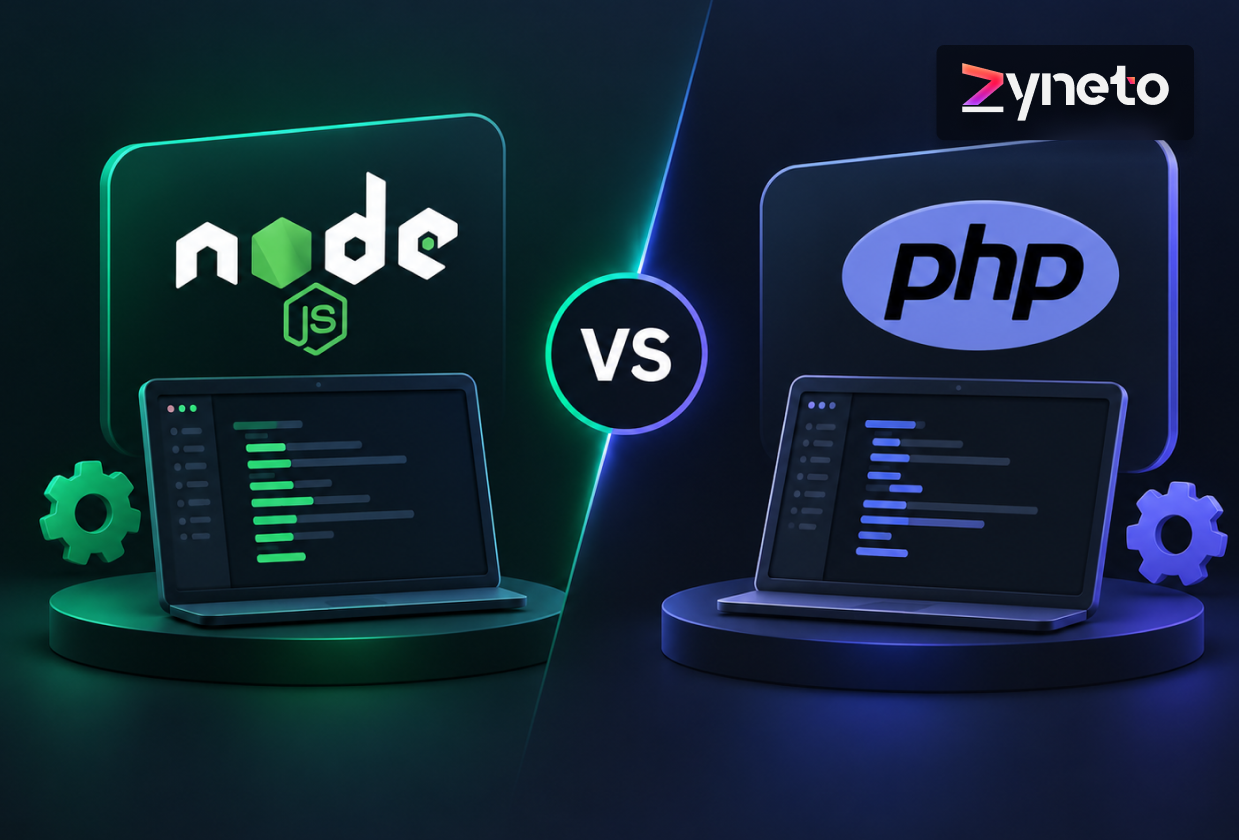
Node.js vs PHP: Which Is Better for Backend Development?


Choosing a backend technology can feel like a technical decision that your development team should handle.
In reality, it can affect almost everything that happens after development begins.
Your backend influences how quickly your application responds, how it handles growing traffic, how easily new features can be introduced, how much infrastructure you need, and how difficult the application becomes to maintain over time.
That is why the Node.js vs PHP debate matters.
Both technologies have been used to build successful web applications, APIs, platforms, and digital products. But they approach server-side development differently, which means they are better suited to different types of projects.
Node.js is known for its event-driven, non-blocking architecture and has become a popular choice for APIs, real-time systems, microservices, and applications with significant concurrent activity.
PHP, on the other hand, has decades of web development behind it. Its mature ecosystem, broad hosting support, established PHP frameworks, and strong presence in content-driven websites and business applications continue to make it a practical backend option.
So, should you choose Node.js or PHP?
There isn't one answer that works for every project.
The right choice depends on what you are building, how users will interact with it, your expected traffic, your existing technology stack, your team's expertise, your scalability plans, and your long-term development priorities.
This detailed Node.js vs PHP comparison looks beyond the basic differences.
We will compare architecture, performance, scalability, security, databases, hosting, development speed, costs, and real-world use cases so you can make a decision based on your product rather than simply choosing whichever technology is currently getting more attention.

If you don't want to get into the technical details just yet, here's a quick overview of PHP vs Node.js.
|
Factor |
Node.js |
PHP |
|
Technology |
JavaScript runtime |
Server-side scripting language |
|
Architecture |
Event-driven, asynchronous |
Traditionally request-response oriented |
|
Language |
JavaScript |
PHP |
|
Performance |
Strong for I/O-heavy and concurrent workloads |
Strong for traditional web workloads |
|
Real-Time Applications |
Excellent fit |
Possible, but generally not its primary strength |
|
Scalability |
Well suited to distributed and service-based architectures |
Can scale effectively with the right architecture and infrastructure |
|
Database Support |
Strong SQL and NoSQL support |
Strong SQL support with broad database compatibility |
|
Development |
Useful for JavaScript-based full-stack teams |
Mature and efficient for web-focused development |
|
Hosting |
Widely available across modern cloud platforms |
Extremely broad and often straightforward |
|
Ecosystem |
npm and JavaScript ecosystem |
Composer and mature PHP ecosystem |
|
Popular Use Cases |
APIs, real-time apps, microservices, streaming systems |
CMS, eCommerce, content platforms, business web applications |
|
Learning Considerations |
Familiar to JavaScript developers, but asynchronous patterns require care |
Relatively approachable for traditional web development |
This table gives you the broad picture, but it should not be used as a simple scorecard.
For example, saying Node.js performs better in a particular type of workload doesn't automatically mean it will make your application better.
Likewise, PHP being traditionally associated with websites does not mean it cannot support large or complex applications.
Your architecture and implementation matter just as much as the underlying technology.
Let's look at both options more closely.
Node.js is an open-source, cross-platform JavaScript runtime that allows developers to execute JavaScript outside a web browser.
Before Node.js became popular, JavaScript was primarily associated with frontend development.
Node.js changed that.
Developers could now use JavaScript on both the frontend and backend, making it possible to build much of a web application's technology stack around one programming language.
But that isn't the only reason Node.js development became popular.
Its event-driven architecture and non-blocking I/O model make it particularly useful when an application needs to manage many operations without waiting for each one to finish before moving to the next.
Think about a live chat application.
One user sends a message while hundreds or thousands of other users are connecting, receiving notifications, updating their status, loading conversations, or making API requests.
A backend designed around asynchronous operations can handle these interactions efficiently.
This makes Node.js particularly attractive for applications where users expect immediate updates or where the server frequently communicates with external systems.
Node.js is commonly used for:
That doesn't mean Node.js should automatically be your backend.
Its architecture creates significant advantages in the right environment, but your developers need to understand asynchronous programming, error handling, dependency management, and application architecture properly.
PHP is a server-side scripting language built specifically around web development.
It has been part of the web for decades and continues to power a huge range of websites and applications.
If you have used WordPress, worked with a Laravel application, managed an eCommerce website, or interacted with a content-heavy online platform, there is a good chance you have encountered PHP somewhere in the technology stack.
Traditional PHP backend development follows a straightforward request-response pattern.
A user makes a request.
The server receives it.
PHP executes the required application logic, communicates with databases or other services when necessary, generates a response, and sends it back.
This model is easy to understand and works extremely well for many types of web applications.
PHP has also evolved significantly.
Modern PHP development is not simply about placing PHP scripts inside HTML pages. Mature frameworks, package management, testing tools, architectural patterns, caching technologies, queues, containers, and cloud infrastructure allow development teams to create sophisticated PHP applications.
Common PHP use cases include:
PHP's long history shouldn't be viewed as a disadvantage by itself.
What matters is whether its architecture and ecosystem match what you need to build today.
This is where the Node.js vs PHP comparison becomes more useful.
Instead of asking which technology has more features, you need to understand how their differences affect your product.
Let's compare them across the areas that matter most during web development.
The biggest Node.js vs PHP architecture difference comes from how the two technologies traditionally handle work.
Node.js uses an event-driven architecture built around asynchronous, non-blocking operations.
Suppose your application needs information from a database.
Node.js can initiate that operation and continue handling other work while it waits for the database response.
This model can be highly effective when an application spends significant time waiting for network, database, file-system, or API operations.
PHP traditionally takes a more synchronous request-response approach.
A request comes in, PHP processes the necessary logic, sends the response, and that request completes.
Modern PHP infrastructure can still handle large numbers of requests through process management, caching, queues, load balancing, and horizontal scaling.
So the difference isn't simply:
"Node.js is modern and PHP is old."
That would be misleading.
The real question is what execution model works better for your workload.
If your application involves constant connections, real-time communication, or many simultaneous I/O operations, Node.js has architectural characteristics that can make it a natural fit.
If you're developing a conventional web application where most interactions follow a predictable request-response cycle, PHP can be highly effective.
Node.js vs PHP performance is probably one of the first comparisons you will encounter while researching the two.
But performance needs context.
A benchmark showing one technology completing a particular operation faster doesn't tell you how your entire production application will perform.
Your database queries, API design, caching strategy, code quality, server configuration, network latency, frontend performance, third-party integrations, and infrastructure can all affect the final result.
That said, Node.js performs particularly well in I/O-intensive environments.
Its non-blocking architecture allows it to manage multiple operations without waiting for every task to complete sequentially.
This is one reason Node.js performance is attractive for real-time applications, APIs, streaming platforms, and systems handling many simultaneous connections.
PHP performance can also be excellent for traditional web workloads.
Modern PHP runtimes, opcode caching, application caching, CDNs, optimized databases, and appropriate infrastructure can deliver very fast web experiences.
So when people ask about Node.js vs PHP speed, the better question is:
"Faster at doing what?"
For high-concurrency, I/O-heavy applications, Node.js often has an architectural advantage.
For conventional web pages and request-response applications, PHP can deliver more than enough performance.
Your actual workload should drive the decision.
Your application may work perfectly with 500 users.
What happens when you have 50,000?
Or when one feature suddenly generates several times your normal traffic?
That's why Node.js vs. PHP scalability deserves attention before development starts.
Node.js works well with architectures designed to distribute workloads across services and instances.
It is frequently used in cloud-native environments, microservices, APIs, and applications that need to handle significant concurrent activity.
This makes Node.js scalability one of its strongest selling points.
But that doesn't mean PHP applications cannot scale.
They absolutely can.
Large PHP systems can use load balancing, horizontal scaling, caching layers, database replication, queues, CDNs, cloud infrastructure, and service-oriented architectures.
The difference is often how naturally the technology aligns with your chosen architecture.
If you expect real-time connections and highly concurrent API traffic to become central to your product, Node.js may provide a more natural foundation.
If you're building a content-heavy platform, business application, eCommerce system, or conventional web product, PHP can scale effectively when the application is engineered correctly
The Node.js vs PHP development comparison also depends heavily on your team.
Suppose your developers already use React, Vue, Angular, or another JavaScript-heavy frontend stack.
Using Node.js on the backend allows them to work within the broader JavaScript/TypeScript ecosystem.
That can simplify knowledge sharing and make full-stack development more consistent.
Node.js also has a large package ecosystem, so teams rarely need to build every capability from scratch.
PHP offers a different kind of productivity.
Frameworks such as Laravel provide many common web application features in a structured environment.
Authentication, routing, database operations, queues, email handling, validation, migrations, caching, and testing can be implemented efficiently using established conventions.
For a standard business application, an experienced Laravel team can move extremely quickly.
So don't choose based on which technology is supposedly "faster to develop with."
Ask which one your team understands better and which ecosystem already solves more of your application's problems.
A Node.js vs PHP security discussion needs some caution.
Neither technology is secure simply because you chose it.
And neither is inherently unsafe.
Security problems usually emerge from application code, outdated dependencies, poor access controls, insecure APIs, weak authentication, configuration mistakes, exposed credentials, inadequate validation, or poor infrastructure practices.
Node.js applications require careful dependency management because projects may rely on many third-party packages.
Teams should monitor dependencies, apply security updates, validate inputs, secure APIs, protect secrets, implement appropriate authentication and authorization, and follow secure coding standards.
PHP requires the same discipline.
Modern frameworks provide built-in protections and tools for common security concerns, but developers still need to configure and use them correctly.
When evaluating PHP vs Node.js, look at the security capability of your development team rather than expecting the technology to solve security automatically.
A properly engineered application in either technology can be secure.
A poorly engineered application in either technology can create serious vulnerabilities.
Node.js vs PHP hosting used to be a much easier comparison.
PHP historically had a major advantage because inexpensive shared hosting supported it almost everywhere.
That advantage still matters for smaller websites.
However, modern cloud infrastructure has made Node.js deployment much more accessible.
Node.js applications can run on virtual servers, containers, managed cloud services, serverless environments, and modern application platforms.
PHP is similarly flexible.
It can run on inexpensive traditional hosting as well as sophisticated cloud infrastructure using containers, managed databases, load balancers, queues, and autoscaling.
For a serious commercial application, you should think beyond basic hosting prices.
Consider:
A cheap hosting plan doesn't necessarily result in a lower total operating cost.
There's no universal answer to which technology costs less.
The initial development quote is only part of the equation.
Your total cost can include:
development, infrastructure, cloud services, third-party APIs, database hosting, monitoring, maintenance, security updates, scaling, DevOps, bug fixing, future features, and developer hiring.
A PHP application may be economical when your requirements align closely with an established framework or CMS ecosystem.
A Node.js application may reduce complexity when your product requires extensive APIs, asynchronous processing, or JavaScript across the entire stack.
The wrong technology can become expensive even if the initial development cost looks attractive.
That's why architecture should be decided before comparing quotations based solely on price.
Node.js has plenty of advantages, but it isn't the right answer to every backend problem.
1. Strong for asynchronous workloads
Node.js handles I/O-intensive operations efficiently, making it suitable for applications involving frequent database, network, and API interactions.
2. Well suited to real-time functionality
Chat, notifications, collaboration, live dashboards, gaming features, and streaming-related systems can benefit from its event-driven architecture.
3. JavaScript across the stack
Teams can use JavaScript or TypeScript on both frontend and backend, potentially simplifying development workflows.
4. Large ecosystem
The npm ecosystem gives developers access to packages for an enormous range of application requirements.
5. API-friendly
Node.js is a popular choice for REST APIs, GraphQL services, backend-for-frontend layers, and microservices.
6. Cloud and microservices compatibility
Its relatively lightweight service model works well in many distributed and cloud-native architectures.
Node.js isn't automatically ideal for every CPU-intensive operation.
Heavy computational work can interfere with the event loop if the architecture isn't designed appropriately.
The enormous package ecosystem also creates dependency-management challenges.
Using too many unnecessary or poorly maintained packages can increase security and maintenance risks.
Flexibility can create another issue.
Without clear development standards, Node.js projects can become inconsistent and difficult to maintain.
Strong architecture matters.
PHP remains a practical option for many web projects, but it also has trade-offs.
1. Built around the web
PHP has been designed and refined around server-side web development for years.
2. Mature frameworks
Laravel, Symfony, and other frameworks provide proven tools and patterns for building modern applications.
3. Strong CMS ecosystem
WordPress and other PHP-based platforms make PHP particularly useful for content-driven projects.
4. Wide hosting support
Finding infrastructure capable of running PHP is generally straightforward.
5. Large talent pool
Businesses have access to a broad global community of PHP developers.
6. Fast development for conventional web applications
Experienced PHP teams can build standard business applications efficiently using established framework capabilities.
PHP's traditional execution model may not be the most natural fit for applications built around persistent real-time connections.
Its flexibility and long history also mean the quality of PHP codebases varies enormously.
Legacy PHP applications can sometimes contain outdated architecture, inconsistent coding standards, or old dependencies.
But that's a legacy-development problem rather than proof that modern PHP itself is unsuitable.
A properly architected modern PHP application can look very different from a PHP codebase written many years ago.
You now understand the technical differences.
But technology selection becomes much easier when you connect those differences to an actual product.
Let's look at Node.js vs PHP for web development across several common scenarios.
Both technologies can support modern web development.
The right choice depends on the type of website or web application you're creating.
PHP can be an excellent fit for content-heavy websites, business portals, CMS-based projects, and conventional web applications.
Node.js becomes particularly attractive when your web application behaves more like an interactive product than a traditional website.
Think dashboards, collaboration platforms, communication tools, marketplaces, or applications involving frequent API calls and live updates.
Don't ask which technology is "better for websites."
Define what your website actually needs to do.
For Node.js vs PHP for backend, start with your backend responsibilities.
If your backend primarily manages CRUD operations, authentication, content, administrative workflows, payments, and conventional business logic, either technology can work well.
If your backend needs extensive asynchronous processing, real-time connections, microservices, or high-volume API communication, Node.js may offer architectural advantages.
Your existing ecosystem matters too.
If you already operate PHP systems and have experienced PHP developers, switching to Node.js without a clear business reason can introduce unnecessary complexity.
Likewise, if your frontend and engineering organization are heavily JavaScript-based, adopting PHP may create an additional language boundary that you don't need.
Node.js has become particularly popular for API development.
Its asynchronous model fits naturally with APIs that spend significant time retrieving data from databases or communicating with other services.
It also works well when APIs form part of a microservices architecture.
PHP frameworks can build excellent APIs too.
Laravel and Symfony provide mature tools for routing, authentication, validation, database operations, serialization, and other API requirements.
If your API supports an existing PHP application, staying within the same ecosystem may be simpler than introducing another backend technology.
If real-time communication is central to your product, Node.js deserves serious consideration.
Examples include:
Node.js's event-driven model is naturally suited to systems that maintain frequent or persistent communication between clients and servers.
PHP can implement real-time functionality with supporting technologies, but it is generally not the first architecture developers reach for when real-time behavior dominates the product.
Node.js works particularly well for many microservices architectures because services can remain relatively lightweight and independently deployable.
Different services can handle authentication, payments, messaging, notifications, analytics, search, or other capabilities.
But don't choose microservices simply because they sound scalable.
A startup building its first MVP may be better served by a well-structured monolith.
Breaking a small application into 20 services can create operational complexity without delivering meaningful benefits.
PHP can also participate in service-oriented and microservices architectures.
The architecture should follow the problem rather than the trend.
Choose Node.js when its architecture solves a real requirement rather than because your competitors are using it.
Node.js may be the stronger option when:
You need a flexible backend for a modern SaaS product.
Your development team already has strong Node.js experience.
For these projects, Node.js backend development can provide a foundation that aligns naturally with how the application behaves.
But don't select Node.js merely because scalability appears somewhere in your requirements.
Almost every serious application needs to scale eventually.
The important question is how it needs to scale.
PHP may be the better choice when your application fits naturally into its mature web ecosystem.
Consider PHP when:
Good PHP development isn't about using PHP because it is familiar.
It is about using its mature ecosystem, where that ecosystem gives your project an advantage.
If PHP already solves 80% of your architectural requirements cleanly, replacing it with another technology simply because that technology is newer or more fashionable may not create any business value.
So we arrive at the question behind almost every "Node.js vs PHP which is better" search.
Which one should you actually choose?
Don't start with the technology.
Start with your product.
Are you building a corporate website?
A marketplace? A SaaS application? A real-time collaboration platform? A CMS? A streaming application? Or something else.
Different products create very different backend workloads.
If live messaging, notifications, collaboration, tracking, or persistent connections are central to the experience, Node.js should be high on your shortlist.
If those features are minor or nonexistent, they shouldn't determine your entire backend architecture.
Traffic numbers alone aren't enough.
Understand what users will actually be doing.
Ten thousand users reading cached content create a different infrastructure challenge from ten thousand users simultaneously sending messages or updating shared data.
Technology doesn't exist in isolation.
If you already have infrastructure, databases, applications, APIs, and development teams, your new backend needs to fit into that environment.
Introducing another language or ecosystem has a cost.
Make sure the benefits justify it.
The best technology can still become the wrong choice when nobody on your team knows how to use it properly.
Experience affects architecture, security, code quality, testing, deployment, debugging, and maintenance.
A strong PHP team may build a better application in PHP than an inexperienced Node.js team could build in Node.js.
The reverse is equally true.
Budget isn't simply the hourly rate of a developer.
Think about total cost of ownership.
That includes:
Development, infrastructure, maintenance, DevOps, security, monitoring, scaling, developer recruitment, upgrades, and future changes.
The cheapest stack to launch may not be the cheapest stack to own.

The Node.js vs. PHP decision ultimately depends on what you are building, how your application will operate, and where you expect it to grow.
Node.js is well suited to real-time, API-driven, and highly interactive applications, while PHP remains a practical choice for content-focused websites, business platforms, and established web ecosystems.
Instead of choosing based on popularity, evaluate performance requirements, scalability, security, integrations, developer expertise, and long-term maintenance.
Both technologies can support reliable applications when implemented with the right architecture.
The better choice is the one that solves your current requirements without creating unnecessary complexity as your digital product evolves.
Node.js suits real-time and API-driven applications, while PHP works well for content-focused platforms. Your application requirements, architecture, and team expertise should guide selection.
Node.js can perform better for concurrent, I/O-heavy workloads, while PHP delivers strong performance for traditional web applications when properly optimized and supported by infrastructure.
Choose Node.js for asynchronous, real-time, or API-heavy systems. Consider PHP for conventional web applications, CMS platforms, structured business workflows, and established PHP environments instead.
Both technologies can scale effectively. Node.js naturally supports highly concurrent applications, while PHP can scale through caching, load balancing, cloud infrastructure, and optimized architecture approaches.
Yes. PHP remains relevant for modern web development, particularly for CMS platforms, eCommerce, business applications, and projects benefiting from its mature frameworks and ecosystem today.
Sudhanshi has several years of experience in digital marketing and now works on growth at Zyneto. Her work covers SEO, content strategy, organic lead generation, social media and paid campaigns across Google, LinkedIn, Instagram and Facebook. She has run B2B technology and SaaS campaigns for international audiences, helping brands get found in search and stay found, and works day to day in Google Analytics, Search Console, Ahrefs, SEMrush, Screaming Frog and Canva. She follows AI driven marketing, changing search behaviour, content automation and social growth closely, and turns audience and search data into plans a team can actually run. She writes about SEO, content strategy and the tactics that still earn traffic as search keeps shifting.
Share your details and we will talk soon.
Be the first to access expert strategies, actionable tips, and the trends actually shaping the digital world. No fluff - just practical insights delivered straight to your inbox.
Dive into our blog and stay ahead of the curve with expert perspectives, future-ready trends, and tech tips written for decision-makers and doers alike.