















TvamConsumer astrology and personal insight apps

Astrology app development on iOS and Android: what we built for Tvam

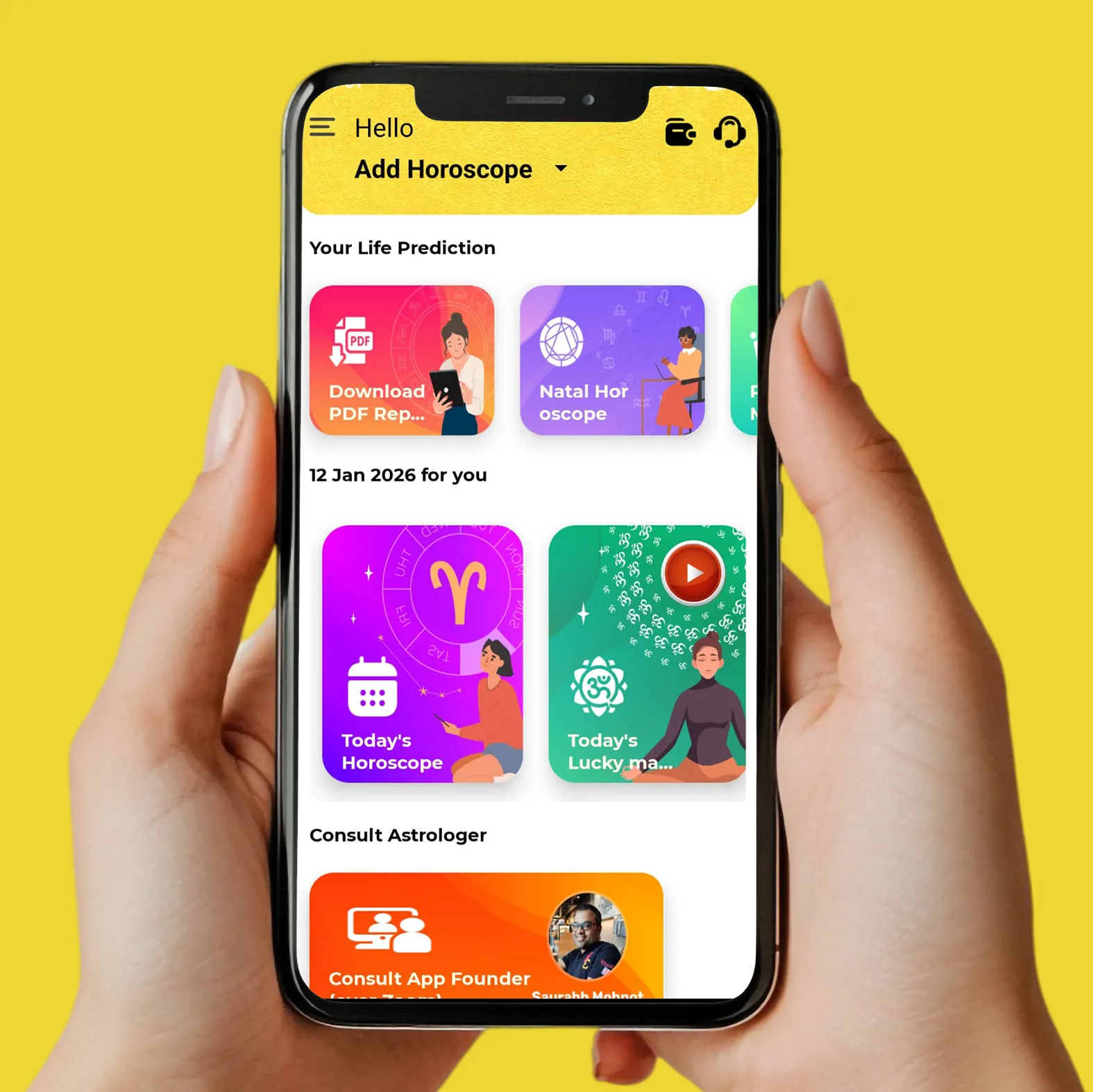
Tvam turns a birth date, time and place into an interactive Vedic chart on iOS, Android and the web. We built the calculation layer behind it, two regional chart renderers, and the dasha timeline that drives its notifications. Horoscope app development is the visible half; the vedic astrology platform underneath is ephemeris maths that has to be exact.

Read the study

Build fingerprint

Where it runs, how we engaged, and what it was built on.

Market
India
Engagement
Dedicated team
Platforms
iOS · Android · Web
Stack
5 technologies

Technologies

  • Swift
  • Kotlin
  • Java
  • PHP
  • MySQL

Trusted by
Global Industry Leaders

Al Amri Express
Cheer Sagar
MRO Supply
BankSathi
DoraDori
Kroolo
StyleBank
Hire Right
Cintas
Up in the Air
Famepilot
Swedishness
Corrib Coil
iCare Heal
TWAM
NDC: National Distribution Company Oman
Moneteo
Algora
Numerology
G4Girl

What makes astrology app development hard: chart calculation

What makes this problem genuinely hard - before any client name enters the page.

Positions come from an ephemeris, and the corrections cost more than the lookup

Reading a planetary longitude out of a numerical ephemeris and interpolating it is the easy part. The corrections are not: civil time converted to the ephemeris time scale, position adjusted for the observer, then the sidereal shift. Sidereal systems subtract an ayanamsa from the tropical longitude, and the common variants disagree by around a degree. That is enough to move a planet across a sign boundary, so the ayanamsa is a stored input, never a constant.

The birth instant is the weakest link in the chain

The ascendant travels the whole zodiac in a day, averaging a degree every four minutes and moving unevenly, so minutes of clock error reorder houses. The offset turning a local clock reading into an instant is historical too: India ran a wartime offset in the 1940s and local mean time before standardisation. Normalise to UTC at capture and you freeze whichever rules were current.

Two regional conventions mean two layout engines

The North Indian chart fixes houses and moves sign numbers between them. The South Indian chart fixes signs in a ring and moves houses. Same data, incompatible geometry: one reads anticlockwise from a top centre diamond, the other clockwise from the ascendant's cell. Cells are triangles and quadrilaterals in one and rectangles in the other, so hit testing a tapped planet differs per format.

Nested cycles that have to stay right for decades

Vimshottari splits a 120 year cycle into periods, then subdivides each proportionally, several levels deep. The entry point is a fraction set by the Moon's position in its nakshatra, and every level inherits its parent's rounding. Pick the wrong day length constant and the top drifts by days while the fourth level lands on the wrong date. Each user's next boundary is a distinct future timestamp, so there is no shared schedule to fire from.

The situation, and what we built

Tvam is a consumer product in India, where a birth chart is not a novelty screen. Users have usually seen their kundali before, often on paper from a family astrologer, and they check a new app against it. That sets the bar early: the chart has to agree with what someone already believes is correct, in the regional format they grew up reading, and keep agreeing over years. The product does more than draw a chart. It stores charts without a cap, runs Ashtakoota comparisons, explains what is on screen with video, and puts a person on live chat when that is not enough. All of it reads from the same computed state, so the calculation is the spine rather than a per screen convenience.

The calculation service every surface reads from

One server side service resolves the birth event, computes longitudes under the selected ayanamsa, derives house cusps and produces the divisional charts. All three surfaces read its output.

One chart model, two regional renderers

It emits one structure of planets, signs and houses. Clients draw that twice, as a North Indian diamond grid and a South Indian ring, tappable in both.

The dasha timeline and the notification queue behind it

Vimshottari periods are computed as a nested timeline rather than a single current value, so any point in a life is addressable, and each chart's next boundary becomes a scheduled event.

Matching, saved charts and the consultation surface

Ashtakoota compares two saved charts and scores the koota points. Around it: unlimited saved kundalis, video explanations tied to chart concepts, live chat, and generated consultation reports.

Tradeoffs

Decisions, and what each one cost

Every choice closed off something else. Those costs are stated, not hidden.

Compute on the server, not on the device

Instead of: An on device ephemeris library in each app. Two native codebases would have to agree numerically forever, and every data correction would ship at app store review speed.

What we acceptedThe core screen depends on connectivity and our latency, so offline needs deliberate caching.

Store the birth event, derive the instant on read

Instead of: Normalising to a UTC instant at capture. Timezone history gets corrected, and a stored instant freezes whichever rules were current.

What we acceptedResolution work on every read, and place records nobody can quietly edit without invalidating what was derived from them.

One chart structure, two renderers

Instead of: A separate computation path per format. The conventions disagree about layout, not content.

What we acceptedThe renderers absorb every difference, so each new divisional chart is drawn twice and checked twice.

Reusable

Which inputs a chart is actually sensitive to

Most reported wrong chart complaints trace back to one of five inputs, not the ephemeris.

InputError to expectWhat it movesVisible
Clock time of birthMinutes, from memory or a handwritten recordThe ascendant, a degree per four minutesYes, layout shifts at a sign boundary
Timezone rule for that dateA full hour, when wartime or pre standard rules are missedThe instant, so everything downstreamYes, and it reads as a bug
Ayanamsa selectionAbout a degree between common variantsSign placement near a cuspYes, users compare other software
Birth coordinatesA few kilometres, when a locality resolves to a city centreAscendant and house cusps, slightlyRarely, except near a boundary
Day length constant in dasha mathsFractions of a day, compounding down levelsDasha start and end datesYes, notifications fire wrong

Store the inputs and settings that produced a chart, not only the output. Any row here can be corrected later, and a chart you cannot recompute is one you cannot defend.

Delivery

What shipped

Capabilities delivered and the scope of the build - not results attributed to it.

Capabilities

  • Native iOS and Android apps, plus a web product
  • Birth charts with clickable planets and houses, in North and South Indian formats
  • All major divisional charts and snapshot views of planetary states
  • Vimshottari dasha timeline with change notifications
  • Ashtakoota matchmaking between saved charts
  • Video explanations tied to chart concepts, live chat, and consultation reports

Scope

  • Scope of the product, not results claimed by Zyneto: three surfaces, web, iOS and Android
  • Two chart conventions from one data model
  • Unlimited kundali storage per account
  • Live chat around the clock, staffed by the client

Scope of the build, not results attributed to it.

Building something with the same constraints?

Bring us the part you think is hardest.

Risk, ownership and commercials

Ownership

The store listings, the domain and the hosting all sit with the client. We set them up, configure them and run them, so nothing about leaving requires our cooperation.

Correctness is a regression problem, not a launch problem

Astronomical code fails silently, so a fixed set of birth data with known output is the only practical defence. A wrong chart never looks like a crash.

Nothing in the calculation layer is locked to us

Ephemeris data, ayanamsa selection and dasha rules are configuration and documented arithmetic, verifiable by any team independently of who wrote the code.

The data ages, so someone owns the updates

Timezone databases and ephemeris data get revised. Owning this product means owning a recurring data update, not only a codebase.

Engagement model
Fixed scope
Rate band
40 to 100 USD per hour by role, blending to 60 to 70
How we quote
No fixed price before a discovery that establishes the calculation scope and the chart formats in play.

Reflection

What we would do differently

We treated birth time as given. Plenty of users do not know theirs to the minute, and the app has no way to say so: a chart drawn from an approximate time looks exactly as confident as one drawn from a hospital record. Starting again, we would carry an uncertainty flag on the birth event from capture, and let the interface show which parts of a chart hold steady across a plus or minus window and which do not. Retrofitting that touches every screen reading a house.

Why do two astrology apps put the same planet in different signs?

Almost always the ayanamsa. A sidereal longitude is the tropical longitude minus that offset, and the common variants, Lahiri, Raman and Krishnamurti among them, differ by around a degree, so a planet near a cusp lands in different signs. Lahiri is what the Indian government's Rashtriya Panchang follows.

How exact does the birth time need to be?

It depends which part you care about. Sign placements, the Moon aside, barely move over a few minutes. The ascendant crosses all twelve signs in a day, so minutes shift it and can reorder every house.

Why does a birth in 1940s India need special handling?

The offset was different then: a wartime shift during those years, and local mean time before standardisation. Applying today's plus five thirty can put such a birth an hour out, enough to change the ascendant, so the offset must come from historical timezone data keyed on date and place.

Context

Where this sits in our work

Talk to an engineer, not a salesperson

Tell us what your operation runs on today.

Our Success Stories

Real feedback from the people we've proudly partnered with.

Brooklyn Foster profile

Brooklyn Foster

Sales Director |Cintas

United States

GoodFirms
"

Zyneto Global Technologies provided excellent project management and technical expertise throughout the engagement. The team was responsive, collaborative, and adaptive, ensuring the project met our expectations and set a strong foundation for future growth.

"
Verified Review
Rating: 5 out of 5
Krystian Chlebek profile

Krystian Chlebek

Founder & CEO |Moneteo

TechBehemoths
"

We engaged Zyneto to design and develop a custom web platform for Moneteo, aimed at improving project management, data tracking, and collaboration across internal teams and external partners. Their work included full-stack web development, custom modules for workflow automation, API integration, and comprehensive testing.

"
Verified Review
Rating: 5 out of 5
Kevin Scott profile

Kevin Scott

CEO |E-Commerce Platform

Clutch
"

Overall, their responsiveness and timely deliveries contributed positively to the project's success. The client achieved better data management and quality. The service provider delivered the project on time and ensured prompt responsiveness throughout the engagement. Their innovative approach was outstanding.

"
Verified Review
Rating: 5 out of 5
WhatsApp
Email
Book a Meeting