



















FamepilotReputation management and customer experience software

Reputation management software across locations: what we shipped for Famepilot

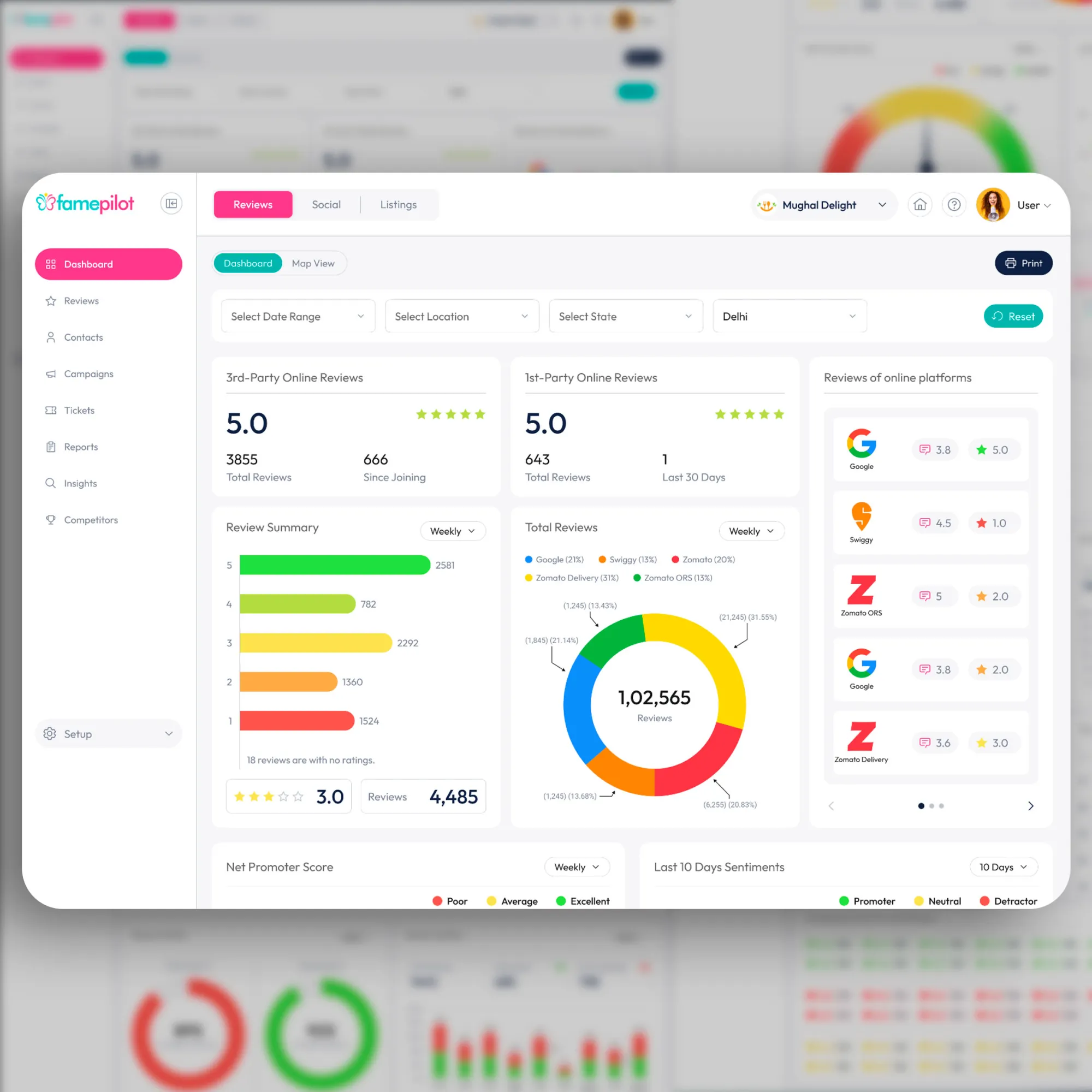
Famepilot centralises reviews and feedback from more than 25 platforms into one dashboard, classifies each one by sentiment, and drafts a reply. We built the ingestion, the classification and the workflow that turns a review into a published response. Multi location review management and review response automation are the two jobs, and the second only works if the first is honest.

Read the study

Build fingerprint

Where it runs, how we engaged, and what it was built on.

See it livefamepilot.com
Market
Global
Engagement
Dedicated team
Platforms
Web
Stack
6 technologies

Technologies

  • React
  • Python
  • Django
  • PostgreSQL
  • Terraform
  • CI/CD pipeline

Trusted by
Global Industry Leaders

Al Amri Express
Cheer Sagar
MRO Supply
BankSathi
DoraDori
Kroolo
StyleBank
Hire Right
Cintas
Up in the Air
Famepilot
Swedishness
Corrib Coil
iCare Heal
TWAM
NDC: National Distribution Company Oman
Moneteo
Algora
Numerology
G4Girl

What makes reputation management software hard to build

What makes this problem genuinely hard - before any client name enters the page.

Every review source disagrees with every other one

Each platform ships a different API shape, auth model and rate limit, and they disagree on what a review even is: a star value only, sub ratings, one owner reply, or a thread. Mutability catches people out. Reviews get edited, hidden by the platform, or deleted by their author weeks later, and deletions rarely arrive as an event you can subscribe to. A connector that only pulls new records drifts, and the drift surfaces as a count that no longer matches the platform's own.

Short text is the worst case for sentiment

Reviews are fragments. Sarcasm reads as praise, one review holds a compliment about the food and a complaint about the parking, and vocabulary flips by industry: quiet is good for a hotel room and bad for a bar. Transliterated text is harder again, where someone types Hindi in Latin script. A single polarity label also discards what an operator needs: the aspect that caused the rating, not its direction.

Listings consistency is a data quality problem

Local search has to resolve a business to one entity before it can rank it. Name, address, phone and category recorded inconsistently across directories create competing records, and the wrong ones outlive the correction. For a group with dozens of sites, the expensive version is two listings for one store splitting its review count.

Response latency is the metric that moves ratings

A reply sent a month later is an archive entry. Replies landing while the author still has the notification are the ones with any chance of prompting an edit, and an owner reply stays visible to future readers whenever written. So the engineering problem is queueing, assignment and drafting rather than model quality. A suggestion arriving after the window closes is worth what no suggestion is worth.

The situation, and what we built

Famepilot sells to brands operating in more than one place: restaurant groups, clinics, retail chains, hotels. Their reputation problem is never a single listing but dozens, each with its own manager, review volume and quality of local data. Without a platform the work is a person opening tabs, because Google, Facebook, Yelp, TripAdvisor and Zomato each want a separate login. Two questions stay unanswerable: which locations are getting worse, and which reviews are still unanswered. The remit was to make both readable from one screen, then make the reply fast enough to be worth sending.

Ingestion across 25 plus review and listing sources

One adapter per platform, normalised into a single review record, so a Zomato review and a Google review sort in one list.

Sentiment classification and response drafting

Feedback is classified positive, neutral or negative, and the platform drafts a contextual reply, so the response box is never empty.

Review request campaigns and contact management

Contacts live in the platform and automated campaigns run against them, so review volume is something a brand influences rather than awaits.

Listings optimisation across directories

Listing data is managed next to the review data, so a correction and the reviews it affects sit in one place.

Multi location analytics and competitor benchmarking

Performance per location, rolled up for the group, with competitor benchmarking beside it.

Tradeoffs

Decisions, and what each one cost

Every choice closed off something else. Those costs are stated, not hidden.

A normalised relational core in PostgreSQL rather than one shape per source

Instead of: A document store holding each platform's raw payload as delivered. Reporting is the product, and group rollups, per location trend and benchmarking all need joins across one review record.

What we acceptedNormalisation is lossy at the edges, and a new source becomes a schema conversation.

Response suggestions as drafts a person sends, not replies the system publishes

Instead of: Automatic posting above a confidence threshold. A public reply carries the brand's name, and short text is where a classifier is least reliable.

What we acceptedLatency stays bounded by human availability, so the metric the product exists to improve depends on someone being logged in.

Infrastructure defined in Terraform with CI/CD from early on

Instead of: Environments provisioned by hand and released manually. A product whose value is external integrations releases often, and rebuilds environments when a provider changes something unannounced.

What we acceptedSetup time before any feature shipped, and infrastructure changes go through review rather than a console click.

Reusable

Five questions to answer per review source before writing the adapter

Each answer changes the design, and each is cheaper now than in production.

Question per sourceWhat it decidesCost of getting it wrong
Are deletions reported, or only current records?Append versus windowed reconciliationDrift from the platform's own count
Rate limit per token or per location?Sync schedule, accounts per groupA backfill starves the live sync
Is the review id stable across edits?The dedupe keyEdits arrive as new reviews
Are listing fields writable or read only?Listings management, real or advisoryA feature that becomes a checklist
Is the token held by the brand or the location?Onboarding and renewalA location stops syncing, with no error

Answer these per source, not once per project.

Delivery

What shipped

Capabilities delivered and the scope of the build - not results attributed to it.

Capabilities

  • Unified review inbox across sources
  • Sentiment classification and response suggestions
  • Contact management and automated review request campaigns
  • Listings management across directories
  • Multi location analytics with competitor benchmarking

Scope

  • Scope, not results: 25 plus review and listing sources
  • Global customer base
  • Multi location brands, analytics rolled up across a group

Scope of the build, not results attributed to it.

Building something with the same constraints?

Bring us the part you think is hardest.

Risk, ownership and commercials

Access and data

The platform holds contact data and review history, so access is separated by role and location.

Ownership

Infrastructure is described in Terraform, so what exists is written in code rather than remembered. Platform credentials belong to the brand.

Standing maintenance

Every connector is a dependency on somebody else's roadmap. Sources deprecate endpoints and change response shapes, which is running cost rather than defect.

Engagement model
Fixed scope, priced by module
Rate band
40 to 100 USD per hour by role, blending to 60 to 70
How we quote
No fixed price before discovery, which produces the source inventory, because per source integration effort sets the number, not the feature list.

Reflection

What we would do differently

Sentiment is still one label per review. Reviews carry two opinions more often than not, and a single polarity flattens them, so the aspect that drove the rating stays invisible to whoever writes the reply. Aspect level classification should have been the first target, not a later refinement. The other change is sequencing: non English and transliterated text was treated as an extension of the English path, and it is closer to a separate problem with its own evaluation set.

Which review sources does Famepilot cover?

More than 25, including Google, Facebook, Yelp, TripAdvisor and Zomato. For a restaurant or hotel group the vertical specific sources matter as much as the general ones. The current list is on famepilot.com.

How accurate is sentiment classification on review text?

Accurate enough to triage, not to publish unattended. Short text with mixed sentiment is the hard case, and sarcasm and industry vocabulary both produce confident mistakes. The label decides what a person sees first, nothing more.

Does replying to a review improve the rating?

Not directly. A reply does not change the star value, but it can prompt the author to edit theirs, and it stays visible to everyone reading the listing later. The part under your control is latency, which is why response time is the number worth managing.

Context

Where this sits in our work

Talk to an engineer, not a salesperson

Tell us what your operation runs on today.

Our Success Stories

Real feedback from the people we've proudly partnered with.

Brooklyn Foster profile

Brooklyn Foster

Sales Director |Cintas

United States

GoodFirms
"

Zyneto Global Technologies provided excellent project management and technical expertise throughout the engagement. The team was responsive, collaborative, and adaptive, ensuring the project met our expectations and set a strong foundation for future growth.

"
Verified Review
Rating: 5 out of 5
Krystian Chlebek profile

Krystian Chlebek

Founder & CEO |Moneteo

TechBehemoths
"

We engaged Zyneto to design and develop a custom web platform for Moneteo, aimed at improving project management, data tracking, and collaboration across internal teams and external partners. Their work included full-stack web development, custom modules for workflow automation, API integration, and comprehensive testing.

"
Verified Review
Rating: 5 out of 5
Kevin Scott profile

Kevin Scott

CEO |E-Commerce Platform

Clutch
"

Overall, their responsiveness and timely deliveries contributed positively to the project's success. The client achieved better data management and quality. The service provider delivered the project on time and ensured prompt responsiveness throughout the engagement. Their innovative approach was outstanding.

"
Verified Review
Rating: 5 out of 5
WhatsApp
Email
Book a Meeting