


















KrooloAI and productivity software

AI work OS development for Kroolo: multi-tenant SaaS with AI inside the product

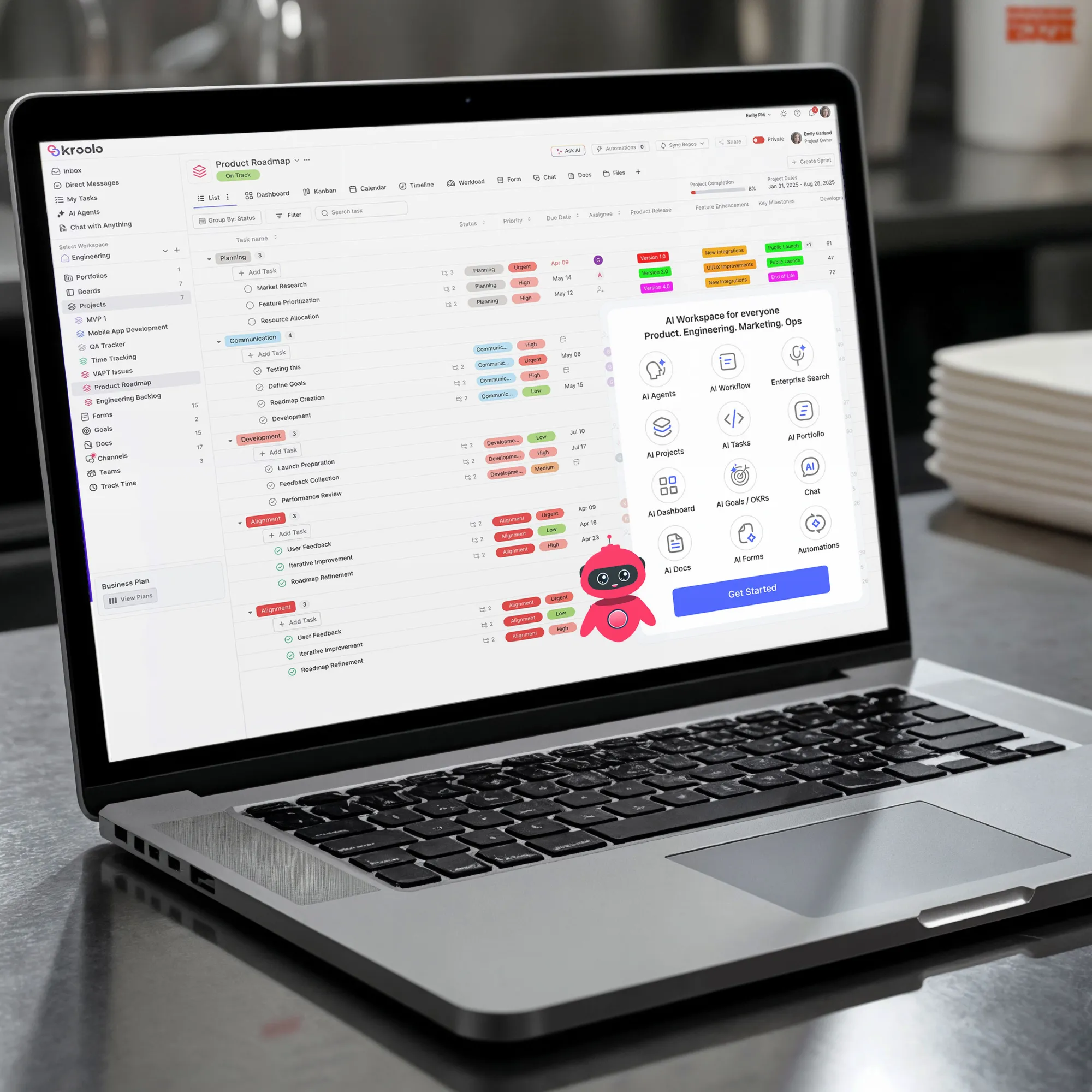
Kroolo is an AI work operating system: projects, tasks, goals and documents in one workspace, with generation and agents built into the work itself. We sat with Kroolo's team for the length of the project and built the AI layer inside it: prompt to project generation, the agent catalogue and the automations that write back into the workspace, across web, Android and iOS. The brief sat between work management platform development and AI productivity platform work, and the tenant boundary decided both.

Read the study

Build fingerprint

Where it runs, how we engaged, and what it was built on.

Market
Global
Engagement
Dedicated team
Platforms
Web · Android · iOS
Stack
8 technologies

Technologies

  • React
  • Next.js
  • Node.js
  • Python
  • MongoDB
  • GenAI
  • Docker
  • Kubernetes

Trusted by
Global Industry Leaders

Al Amri Express
Cheer Sagar
MRO Supply
BankSathi
DoraDori
Kroolo
StyleBank
Hire Right
Cintas
Up in the Air
Famepilot
Swedishness
Corrib Coil
iCare Heal
TWAM
NDC: National Distribution Company Oman
Moneteo
Algora
Numerology
G4Girl

What makes AI work OS development hard inside a multi-tenant product

What makes this problem genuinely hard - before any client name enters the page.

The tenant boundary has to survive retrieval

In a relational store the tenant filter is one predicate the ORM will not let you forget. Move that data into a vector index and the boundary becomes a metadata filter, and a filter applied after the nearest neighbour search is weaker than one applied inside it. Embeddings are derived copies, so deletion and permission changes have to reach the index, not just the row.

Inference cost follows behaviour, seats do not

Per seat pricing assumes cost per account stays flat. Put a model call inside a feature people use all day and cost tracks usage instead, with a thin slice of accounts generating most of it. You need metering at the unit the price is set on, a budget enforceable mid request, and a degraded answer rather than a failure when it is hit.

Non-deterministic output breaks the test suite

The same input will not return the same answer twice, so assertions stop being the safety net. A fixed evaluation set scored before release replaces them, plus production signals: how often a draft gets edited, regenerated or abandoned. None of it is attributable unless prompt and model version are stored with the output. Latency counts here too, because a call inside a click has the interaction's budget, not the API's.

Autonomy is a permissions design first

An agent that creates tasks and edits documents needs its own identity, scoped to what the person invoking it could already do, never a service account. Every action wants an audit row naming the agent and the human behind it. And whatever an agent does, a human has to be able to reverse.

The situation, and what we built

Kroolo sells an AI work operating system to teams anywhere: projects, tasks, goals, documents and collaboration in one workspace, on the web and both mobile stores. What separates it from a task tracker is where the AI sits. Each workspace is its own tenant, and the retrieval behind an answer has to read that workspace and nothing past it. Multi-tenant SaaS problem and AI infrastructure problem at once, and the two refuse to separate.

Prompt to project generation

Turns a written brief into structured work: tasks, sub-tasks, owners and dates written as real records in the workspace, not chat text a user copies out.

Conversational retrieval over workspace content

The surface behind Chat with Anything, answering from a user's own projects, tasks and documents, scoped to the asking workspace.

The agent layer

Agents that act on work items rather than describe them: drafting, updating, summarising, writing results back into the workspace.

Dashboards over the live work graph

Analytics computed from the records the agents write, plus workflow that adapts to observed team patterns. One graph, both directions.

Tradeoffs

Decisions, and what each one cost

Every choice closed off something else. Those costs are stated, not hidden.

Python next to Node rather than one runtime

Instead of: Everything in Node, calling models over HTTP. The model side moves at its own pace in a Python ecosystem, so an inference change need not force an API release.

What we acceptedTwo runtimes, two dependency chains, a boundary crossed on a hot path.

MongoDB as the primary store for the work graph

Instead of: A relational schema per entity type. Projects, tasks, goals and documents are heterogeneous, and generated content adds shapes no schema anticipated.

What we acceptedRelational guarantees now enforced in application code, and cross-entity reporting that costs more than a join.

Kubernetes rather than a managed platform

Instead of: A PaaS with per service scaling. Model serving and CRUD have different resource profiles, so splitting them at pod level stops a burst of generation starving the app.

What we acceptedA cluster to run, upgrade and secure, a standing cost paid every quarter.

Reusable

Tenant isolation checkpoints for an AI feature

Six layers where a multi-tenant AI feature can leak, and what escapes at each one if the check is missing.

LayerWhat enforces isolationWhat leaks if you skip it
RequestWorkspace resolved server sideA client-supplied workspace id
RetrievalTenant id as a pre-filter, not a post-filterNeighbours from another tenant, silently ranked
Prompt assemblyChunk permissions re-checked at query timeA document revoked yesterday, quoted today
Model callNo cache keyed on prompt text aloneOne tenant's answer served to another
Agent actionAgent inherits the invoking user's rightsAn agent writing where the human cannot
DeletionEmbeddings on the record's delete pathData outliving its own deletion request

Retrieval is the row most often missed, because a post-filter looks correct in every test that only queries one tenant.

Delivery

What shipped

Capabilities delivered and the scope of the build - not results attributed to it.

Capabilities

  • Prompt to project generation, written as real records
  • Conversational query over projects and documents
  • Agent automation writing back into the workspace
  • Live dashboards, document creation and search

Scope

  • One workspace across projects, tasks, goals, documents and collaboration, built with Kroolo's team throughout, with the AI layer as our build scope
  • More than forty agents in the catalogue
  • Generation from a prompt in around ten seconds
  • The AI features ship on web, Android and iOS, sold globally

Scope of the build, not results attributed to it.

Building something with the same constraints?

Bring us the part you think is hardest.

Risk, ownership and commercials

Isolation

A retrieval bug in a multi-tenant product is a disclosure, not a display fault, so isolation is tested at every layer in the table above.

Ownership

The product and both store listings sit with Kroolo, and running on Kubernetes keeps the deployment portable rather than tied to one vendor's primitives.

Handover

The split between API services and model serving is also the handover line.

Engagement model
Dedicated team
Rate band
40 to 100 USD per hour by role, blending to 60 to 70
How we quote
No fixed price before discovery, which for AI features has to produce the retrieval scope, expected calls per active user, and the evaluation criteria

Reflection

What we would do differently

Evaluation is what we would do differently. We treated it as something to add once the AI features settled, which is backwards: a frozen evaluation set is cheapest to build while a feature is new and people are still arguing about what a good answer looks like. Retrofit it and you are reconstructing intent from prompts already in production. Cost attribution is the other gap: spend per feature per workspace is what pricing needs, and one user action can fan out into several calls.

Which platforms did Kroolo ship on?

Three. Web at kroolo.com, Android as com.kroolo.app, iOS as App Store id6740263578. All three are public listings, so the claim is checkable without asking us.

How do you stop an AI feature reading another tenant's data?

Filter during the search, not after it. A tenant predicate applied to the results of a nearest neighbour query is weaker than one applied inside it. Then re-check document permissions at query time rather than trusting index time.

How do you test a feature that answers differently every time?

You score instead of asserting. A fixed input set with graded expectations, run every release, plus what users do next: edits, regenerations, abandonment. Store prompt and model version or a regression cannot be traced.

Context

Where this sits in our work

Talk to an engineer, not a salesperson

Tell us what your operation runs on today.

Our Success Stories

Real feedback from the people we've proudly partnered with.

Brooklyn Foster profile

Brooklyn Foster

Sales Director |Cintas

United States

GoodFirms
"

Zyneto Global Technologies provided excellent project management and technical expertise throughout the engagement. The team was responsive, collaborative, and adaptive, ensuring the project met our expectations and set a strong foundation for future growth.

"
Verified Review
Rating: 5 out of 5
Krystian Chlebek profile

Krystian Chlebek

Founder & CEO |Moneteo

TechBehemoths
"

We engaged Zyneto to design and develop a custom web platform for Moneteo, aimed at improving project management, data tracking, and collaboration across internal teams and external partners. Their work included full-stack web development, custom modules for workflow automation, API integration, and comprehensive testing.

"
Verified Review
Rating: 5 out of 5
Kevin Scott profile

Kevin Scott

CEO |E-Commerce Platform

Clutch
"

Overall, their responsiveness and timely deliveries contributed positively to the project's success. The client achieved better data management and quality. The service provider delivered the project on time and ensured prompt responsiveness throughout the engagement. Their innovative approach was outstanding.

"
Verified Review
Rating: 5 out of 5
WhatsApp
Email
Book a Meeting