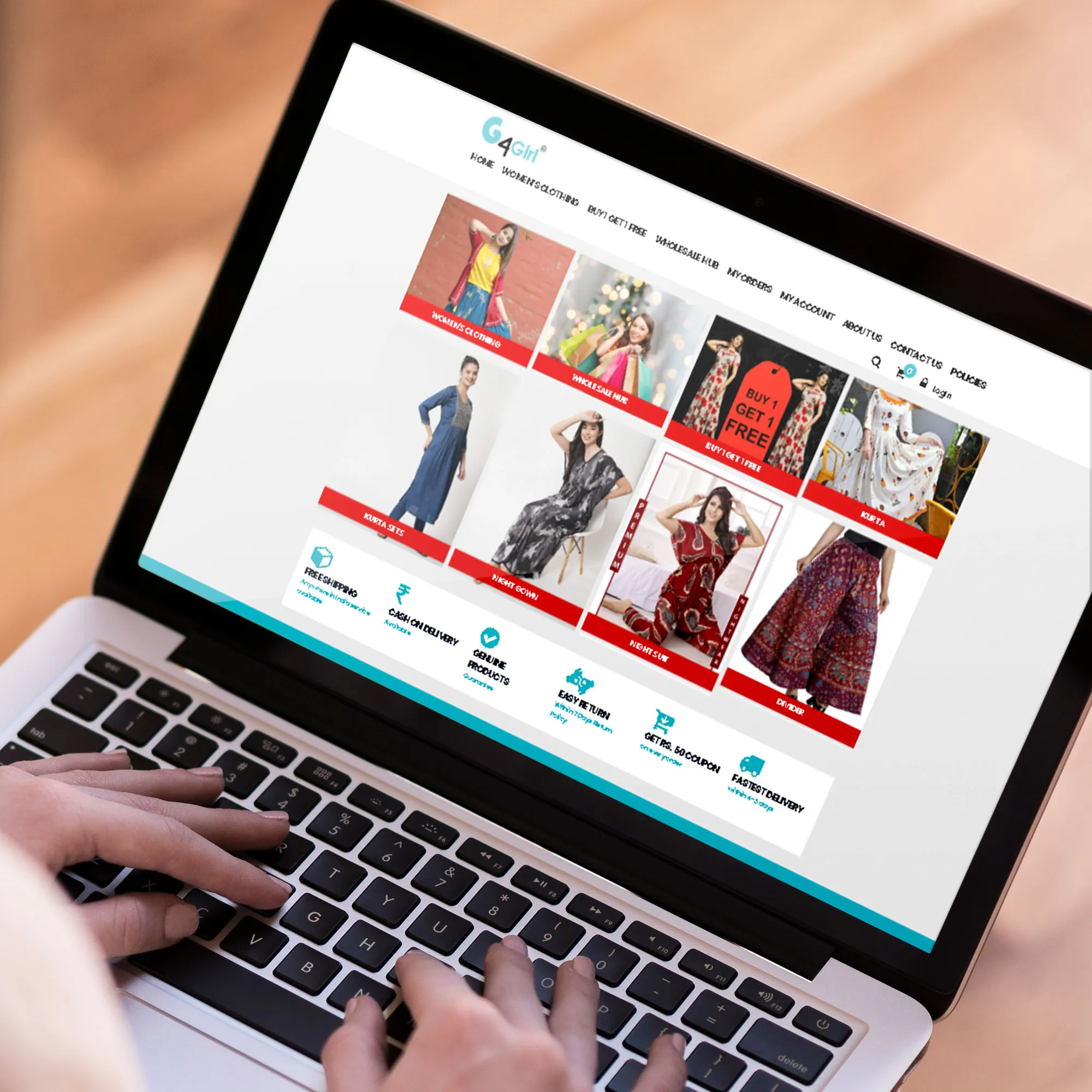




















G4GirlD2C fashion and apparel ecommerce

Fashion ecommerce app development in India: the storefront we built for G4Girl

G4Girl is a women's everyday wear brand selling nightwear, kurta sets, dupattas and outerwear across India. We built the storefront it trades on, hosted on AWS with error monitoring watching the paths where a failure costs a sale. This is a fashion ecommerce platform build, and apparel storefront development is where the size and variant model earns its keep.

Read the study

Build fingerprint

Where it runs, how we engaged, and what it was built on.

Market
India
Engagement
Project delivery
Platforms
Web
Stack
5 technologies

Technologies

  • WordPress
  • PHP
  • MySQL
  • AWS
  • Sentry

Trusted by
Global Industry Leaders

Al Amri Express
Cheer Sagar
MRO Supply
BankSathi
DoraDori
Kroolo
StyleBank
Hire Right
Cintas
Up in the Air
Famepilot
Swedishness
Corrib Coil
iCare Heal
TWAM
NDC: National Distribution Company Oman
Moneteo
Algora
Numerology
G4Girl

What makes fashion ecommerce app development hard in India

What makes this problem genuinely hard - before any client name enters the page.

A fit return is an exchange that got refunded by mistake

Most apparel returns are fit returns: the buyer wanted the garment and wants another size. A cart that only reverses a payment turns a swap into a lost sale and two shipping legs. The cheaper path offers the exchange where the reason is captured, with the other size's stock visible. That needs a structured reason code stored against the style, not free text on the order.

Cash on delivery moves the failure earlier

With cash on delivery, the order can fail before it is ever a sale. The parcel is refused at the door and goes back to origin, both legs paid by the seller. No return window opens, because nothing was delivered. Address quality at checkout and a confirmation step before dispatch therefore do more for margin than any returns policy, and repeat refusals are a customer signal, not an order one.

Speed is part of the checkout on mobile-first traffic

Indian ecommerce traffic arrives overwhelmingly on phones, much of it mid-range Android over mobile networks. Fashion is the worst category for it: the product page is mostly imagery and the imagery is the product. Every merchandising script, review widget and pixel added later lands on that page. Page weight is not a concern sitting next to conversion; it is an input to it.

Generic variant models do not fit garments

A general purpose cart models a variant as an attribute combination carrying its own stock, close enough for shoes and wrong for apparel. Size runs differ by style, a colourway changes the photography rather than a swatch, and the chart belongs to the garment, since a kurta and a night suit cut from different blocks do not share one. A dupatta has no size axis, so the model must let the axis be absent rather than default.

The situation, and what we built

G4Girl sells everyday womenswear built around comfort: night dresses and night suits, kurtas and kurta sets, dupattas, and outerwear. Seasonal collections move at accessible price points, with promotions frequent enough that merchandising is continuous work. Two kinds of buyer arrive at one catalogue: shoppers who browse a style, check a size and buy a piece or two, and wholesale buyers who care about a full size run. The trading promises sit on the product page, where the decision happens and a mobile-first build has least room to be careless.

The catalogue, and where size lives inside it

A structure covering nightwear, kurta sets, dupattas and outerwear, where a style carries its own size run and imagery per colourway, and an item with no size axis is normal rather than an exception.

One catalogue serving retail and wholesale buyers

Both read the same product data and want different things from it, so one source of truth presents availability differently to a buyer purchasing in quantity.

Collections and promotions the brand runs without us

Seasonal drops and recurring promotions are content operations, not deployments. Nobody waits on an engineer to change the front page.

Trading promises stated at the point of decision

Free India-wide delivery, the product guarantee and the returns path appear on the product page, not only a policy footer.

AWS hosting with Sentry on the money paths

Hosted on AWS, with Sentry reporting errors so a checkout breaking for one browser or payment route surfaces as an event, not a support message.

Tradeoffs

Decisions, and what each one cost

Every choice closed off something else. Those costs are stated, not hidden.

WordPress as the storefront base, not a bespoke PHP application

Instead of: A custom-built store with the catalogue modelled from scratch. The daily work is merchandising, not engineering, and the team owning it should not queue behind a release.

What we acceptedThe plugin surface joins our security and performance budget, and apparel structure is built on the platform rather than taken from it.

Self-managed AWS rather than commodity shared hosting

Instead of: A managed WordPress host with fixed resources. Traffic on a promotional catalogue is spiky by design, so we wanted caching control and room to size up for a sale.

What we acceptedPatching, backups and the hosting bill become somebody's named job, with no vendor absorbing it.

Sentry on the storefront rather than trusting server logs and customer reports

Instead of: Reading access logs after the fact. A checkout failing for one browser or payment path is invisible in aggregate traffic, surfacing weeks later as unexplained drop-off.

What we acceptedAn error stream needs triage discipline, or third-party script noise buries the real failures.

Reusable

Reading a failed apparel order: what the signal actually means

Fashion sellers in India log everything as a return. Most of it is not, and sorting by cost is the difference between fixing a size chart and refunding a customer who wanted the garment.

SignalWhat it actually isCheapest correct responseWhat you need in place first
Asks for a different sizeAn exchange, not a refundShip the replacement, one reverse pickupAlternate size stock visible at capture
Fit complaints cluster on a styleA grading or chart errorCorrect the chart, pause the styleReasons stored per style, not per order
Colour or fabric not as shownA photography or copy gapReshoot, rewrite the descriptionImage set bound to the colourway
Cash on delivery parcel refusedReturn to origin. No sale, both legs paidConfirm before dispatchAddress quality at checkout
Repeat refusals from one addressA pattern, not an incidentMove that buyer to prepaidRefusal history keyed to the customer
Wholesale order returned in partA trade dispute, different termsSettle against the wholesale agreementRetail and wholesale returns separated

Only the first three belong in a return rate. Rows four and five never became sales, so they never appear in returns reporting while still consuming freight both ways.

Delivery

What shipped

Capabilities delivered and the scope of the build - not results attributed to it.

Capabilities

  • Per style size runs and per colourway imagery
  • Collections and promotions editable by the brand's own team
  • Delivery, guarantee and returns terms on the product page
  • AWS hosting with Sentry on the transactional paths

Scope

  • Scope, not results: nightwear, ethnic wear, dupattas and outerwear
  • Delivery offered across India
  • One catalogue serving both individual and wholesale buyers

Scope of the build, not results attributed to it.

The client's published words

Quoted verbatim from a public review, linked to its source. Nothing here is a claim we make on our own behalf.

Thanks to Zyneto Global Technologies, the client increased sales by fivefold, streamlined their operations, and reduced manual efforts. The project was completed within four months. Their communication and understanding approach were hallmarks of their work. A highly professional team.
Jitender Khatri, Founder & CEO, G4Girl. Published on Clutch

Building something with the same constraints?

Bring us the part you think is hardest.

Risk, ownership and commercials

Ownership

The AWS account, the domain and the storefront sit with the client. We set them up, configure them and run them, which means moving supplier is a commercial decision rather than a migration.

Nothing here is proprietary to us

PHP, MySQL, WordPress and AWS. Any competent team in India reads this stack, and the hiring pool is the largest of any option on the table.

Failures are visible, not reported

Sentry means a broken path arrives as an event with a stack trace, not a customer message a week later, readable by whoever runs the site next.

Exit is a commercial decision

A standard platform in a standard cloud account, so changing supplier requires no rebuild.

Engagement model
Fixed scope
Rate band
40 to 100 USD per hour by role, blending to 60 to 70
How we quote
No fixed price before discovery. Scope here is decided by the variant model and the returns flow, both cheaper to size after seeing the range than to guess.

Reflection

What we would do differently

Two things we would sequence differently. Size charts belong to the garment rather than the store template, and settling that late turns one fit correction into an edit repeated across every product in the style. And a page weight budget is worth agreeing before the first marketing script, because every one after arrives with a business case attached and nobody owning the milliseconds. Neither is a WordPress problem, and both are cheaper to decide at the start than to unwind.

Why does a fashion store need exchanges and not just refunds?

Because the commonest return reason is size, and a size return is a customer who still wants the garment. Refund only, and you pay two shipping legs for no sale and stock back in the warehouse. Offering the alternate size at capture keeps the order for one reverse pickup.

What is RTO, and why does it matter more than the return rate?

Return to origin: a cash on delivery parcel refused or undeliverable and sent back. It never becomes a sale, so it never appears in return statistics, but the seller pays freight both ways. On a low average order value catalogue, a run of RTOs can outweigh the margin on orders that landed.

Is WordPress a reasonable base for a D2C fashion brand?

For a catalogue this size, yes, and the reason is operational: merchandising changes collections and promotions without waiting on a release. The limits are real. Plugin count becomes page weight, and page weight is conversion on mobile.

Context

Where this sits in our work

Talk to an engineer, not a salesperson

Tell us what your operation runs on today.

Our Success Stories

Real feedback from the people we've proudly partnered with.

Brooklyn Foster profile

Brooklyn Foster

Sales Director |Cintas

United States

GoodFirms
"

Zyneto Global Technologies provided excellent project management and technical expertise throughout the engagement. The team was responsive, collaborative, and adaptive, ensuring the project met our expectations and set a strong foundation for future growth.

"
Verified Review
Rating: 5 out of 5
Krystian Chlebek profile

Krystian Chlebek

Founder & CEO |Moneteo

TechBehemoths
"

We engaged Zyneto to design and develop a custom web platform for Moneteo, aimed at improving project management, data tracking, and collaboration across internal teams and external partners. Their work included full-stack web development, custom modules for workflow automation, API integration, and comprehensive testing.

"
Verified Review
Rating: 5 out of 5
Kevin Scott profile

Kevin Scott

CEO |E-Commerce Platform

Clutch
"

Overall, their responsiveness and timely deliveries contributed positively to the project's success. The client achieved better data management and quality. The service provider delivered the project on time and ensured prompt responsiveness throughout the engagement. Their innovative approach was outstanding.

"
Verified Review
Rating: 5 out of 5
WhatsApp
Email
Book a Meeting