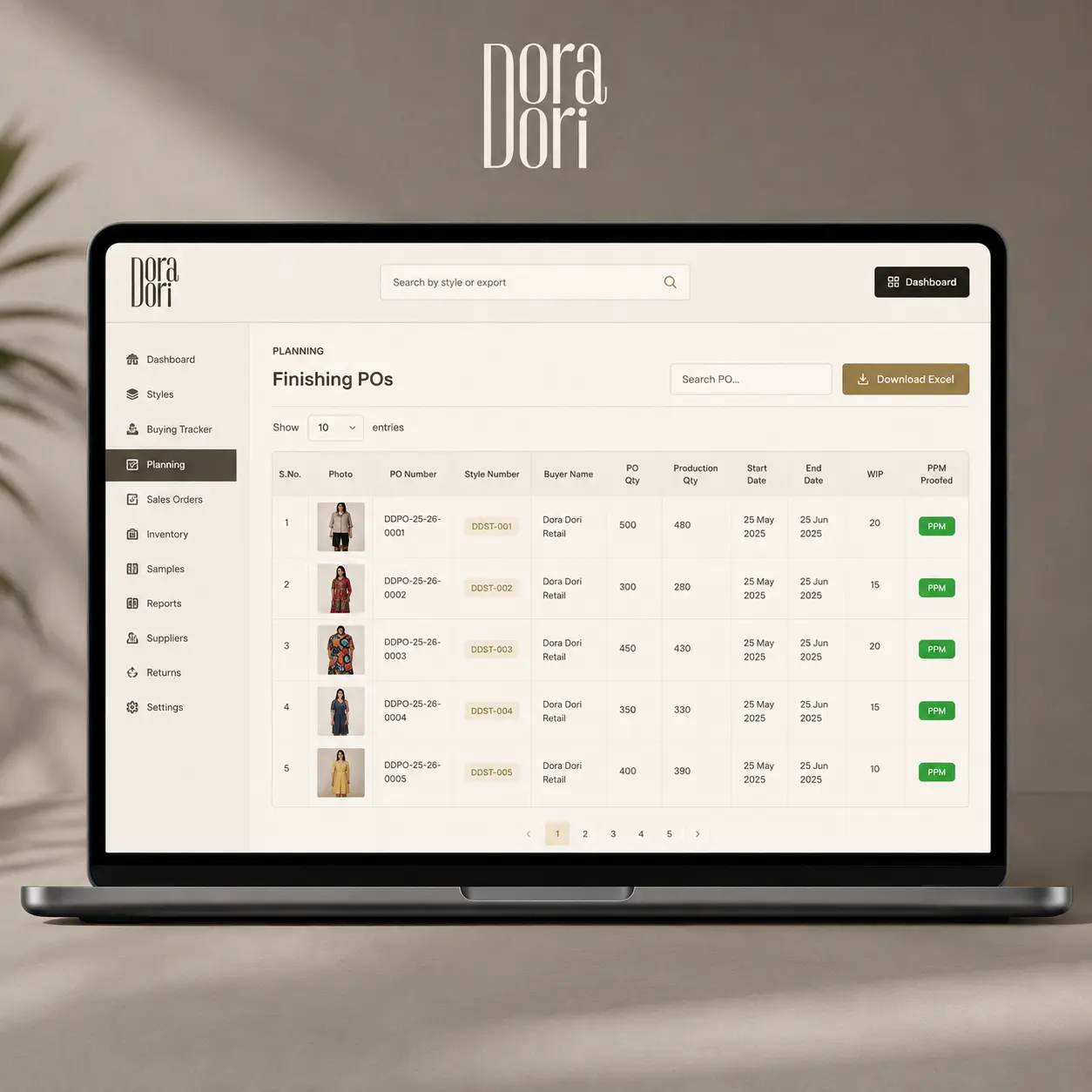




















DoraDoriApparel manufacturing

A garment ERP implementation on FastAPI and PostgreSQL: apparel costing for DoraDori

DoraDori is a garment ERP on FastAPI and PostgreSQL, integrated with Zoho and the client's internal CRM. Two published reads carry most of its integration surface: item summary, covering bill of materials and stock, and fabric stock valuation. Garment manufacturing ERP work lives or dies on cut order and marker software, because that is where fabric turns into cost.

Read the study

Build fingerprint

Where it runs, how we engaged, and what it was built on.

Market
Garment manufacturers and exporters
Engagement
Dedicated resources
Platforms
Web
Stack
5 technologies

Technologies

  • FastAPI
  • Python
  • PostgreSQL
  • Zoho integration
  • Internal CRM integrations
Duration:
Three years
Public links:
None. Internal manufacturing software.

Trusted by
Global Industry Leaders

Al Amri Express
Cheer Sagar
MRO Supply
BankSathi
DoraDori
Kroolo
StyleBank
Hire Right
Cintas
Up in the Air
Famepilot
Swedishness
Corrib Coil
iCare Heal
TWAM
NDC: National Distribution Company Oman
Moneteo
Algora
Numerology
G4Girl

What makes a garment ERP implementation hard

What makes this problem genuinely hard - before any client name enters the page.

No SKU list, three levels

There is no flat item master in apparel, there are three levels. A style carries the tech pack, bill of materials, cost sheet and season code. Style and colour, the colourway, is what the trade calls the SKU and what merchandisers plan at. Only style, colour and size physically exists, so it is the only countable level. A shirt in 12 colours and 7 sizes is 1 style, 12 SKUs, 84 variants, and denim multiplies faster because size there is waist by inseam.

Size curves and broken runs

Demand across a size run follows a curve, say 1-2-3-3-2-1. Buy against the wrong one and units remain but not in sellable sizes, so stock reads healthy while the order cannot be filled. Roll that to style level and the problem vanishes from the report, which is why the stock view stays at variant level.

Cost is decided on the cutting table

Fabric is the largest line on most cost sheets, and its number comes off the marker, the nesting of pattern pieces across the cuttable width. Consumption is size dependent, so one figure per garment is already wrong, and wastage compounds: end loss, splice loss, relaxation shrinkage, cutting waste, sewing rejects. Labour costs in standard allowed minutes against a target line efficiency.

Bundles, and shade that has to survive the cut

After cutting, pieces are numbered and bundled, and the bundle ticket is what the floor tracks and often what an operator is paid on. Shade must survive the cut too: every panel of one garment from the same dyelot, or the piece is a reject whatever the ledger says.

The situation, and what we built

Three years of dedicated resources is long enough that an ERP stops being a project and becomes the thing other systems ask questions of. Two of those questions matter most: what a style is made of and what is on hand, which is the item summary, and what fabric is worth rather than how much there is, which is the fabric stock valuation. Both are read from outside, so they are a contract rather than an internal function. The books are the third boundary: accounting in Zoho, commercial context in an internal CRM, and the ERP has to agree with both without becoming either.

A standalone service with its own schema

FastAPI over PostgreSQL, owned end to end rather than added as a module inside a general platform. Three levels, a size dimension and yield driven costing are expensive to bolt onto a flat item master.

Item summary, where the bill of materials meets stock

One read answers both halves: what a style consumes, and what exists underneath it. The BOM hangs off the style and the count sits at variant, so the summary crosses that boundary rather than pretending the catalogue is flat.

Fabric stock valuation as a separate read

Fabric behaves like bulk material, not a countable item: rolls in, issued against a marker, remnants back. This read is what other systems take when fabric has to be money rather than metres.

Zoho and the internal CRM on either side of the ledger

Accounting reconciles against Zoho, commercial records against the CRM, so the ERP holds the physical truth and neither has to be rebuilt inside it.

Tradeoffs

Decisions, and what each one cost

Every choice closed off something else. Those costs are stated, not hidden.

Build DoraDori as its own service on its own PostgreSQL schema

Instead of: Apparel as a vertical module inside a general product. Three levels, size curves and yield costing touch the item master, the stock model and the costing engine at once, forcing those changes onto products with no use for them.

What we acceptedTenancy, access control and deployment are solved again rather than inherited, and two codebases get patched instead of one.

Expose item summary as one read joining bill of materials to stock

Instead of: Separate BOM and stock endpoints, each caller joining them. The join is where the hierarchy knowledge lives, and pushing it out spreads apparel rules into systems with no reason to hold them.

What we acceptedA wider contract that moves when either side does, and a heavier read than a plain stock lookup.

Keep fabric valuation as its own read, not a column on stock

Instead of: One stock view carrying value for everything. Fabric and finished goods do not value the same way, and a merged view is defensible for neither.

What we acceptedTwo views that have to agree, and a reconciliation every time they do not.

Reusable

The five variances an apparel cost sheet needs

Generic ERP posts one material variance against the order. Apparel needs five: different owners, different fixes, and a combined figure tells nobody which to work on.

VarianceWhat it isolatesWhere the number comes fromWhat you change
Fabric yieldConsumption against cost sheetIssue against cut order BOMCosting assumption, or the BOM
MarkerNesting efficiencyMarker report per size ratioMarker making, ratio, fabric width
ShrinkageRelaxation lossRelaxed against received lengthFabric spec, supplier, relaxation time
Labour efficiencyMinutes earned against workedStandard allowed minutes against line outputLine balancing, skill mix
ReworkCost of pieces returnedRejects logged at the operationThe operation, not the order

If a costing system cannot say which of these lost the money, the post mortem is an argument about opinions.

Delivery

What shipped

Capabilities delivered and the scope of the build - not results attributed to it.

Capabilities

  • A garment ERP on FastAPI and PostgreSQL, maintained over three years
  • Item summary covering bill of materials and stock in one read
  • Fabric stock valuation exposed to integrating systems
  • Zoho for accounting, internal CRM for commercial records

Scope

  • Scope, not results: two ERP reads published for outside consumption
  • Three year engagement on dedicated resources

Scope of the build, not results attributed to it.

Building something with the same constraints?

Bring us the part you think is hardest.

Risk, ownership and commercials

The reads are a contract

Item summary and fabric valuation are consumed outside DoraDori, so altering either shape alters somebody else's system. Neither moves on the ERP's own schedule.

Two systems hold parts of the same truth

Zoho holds the books, the CRM the commercial record. When a figure is disputed the ERP is not automatically the winner, and knowing which system settles which question is part of running it.

What transfers at handover

Not the codebase alone. The product model and costing assumptions: which level each number lives at, and what the valuation counts as issued.

Engagement model
Dedicated team
Team
3 backend, 2 frontend, 1 QA, 0.5 DevOps and a part time project manager
Rate band
40 to 100 USD per hour by role, blending to 60 to 70
How we quote
No fixed price before discovery, which on ERP work is mostly an inventory of what the floor already does, and in what units.

Reflection

What we would do differently

The item summary says what is on hand without saying whether it is sellable, because sellable in apparel means a complete size run rather than a total. We would put size run completeness into that read at the start rather than leave each caller to work it out. The second is the Zoho boundary, drawn once early and never revisited, so a handful of figures have two plausible homes and which is authoritative is convention rather than design.

Why not model apparel with standard ecommerce product variants?

The variant ceiling is rarely the binding constraint, the option count is. Shopify raised its variant limit to 2,048 in October 2025, but the cap of three options per product did not move. Size, colour and one more is the budget, and denim needs waist, inseam, fit and wash.

What does item summary mean in a garment ERP?

One read returning what a style is made of and what exists underneath it. The BOM hangs off the style and stock exists only at style, colour and size, so it joins two levels. A flat item lookup cannot answer it.

Why does marker efficiency turn up in a costing conversation?

Because fabric is usually the biggest line in the cost sheet, and the nesting of pattern pieces across the cuttable width decides how much a garment consumes.

Context

Where this sits in our work

Talk to an engineer, not a salesperson

Tell us what your operation runs on today.

Our Success Stories

Real feedback from the people we've proudly partnered with.

Brooklyn Foster profile

Brooklyn Foster

Sales Director |Cintas

United States

GoodFirms
"

Zyneto Global Technologies provided excellent project management and technical expertise throughout the engagement. The team was responsive, collaborative, and adaptive, ensuring the project met our expectations and set a strong foundation for future growth.

"
Verified Review
Rating: 5 out of 5
Krystian Chlebek profile

Krystian Chlebek

Founder & CEO |Moneteo

TechBehemoths
"

We engaged Zyneto to design and develop a custom web platform for Moneteo, aimed at improving project management, data tracking, and collaboration across internal teams and external partners. Their work included full-stack web development, custom modules for workflow automation, API integration, and comprehensive testing.

"
Verified Review
Rating: 5 out of 5
Kevin Scott profile

Kevin Scott

CEO |E-Commerce Platform

Clutch
"

Overall, their responsiveness and timely deliveries contributed positively to the project's success. The client achieved better data management and quality. The service provider delivered the project on time and ensured prompt responsiveness throughout the engagement. Their innovative approach was outstanding.

"
Verified Review
Rating: 5 out of 5
WhatsApp
Email
Book a Meeting