Apparel PLM Software: What It Holds, and When to Build Rather Than Buy


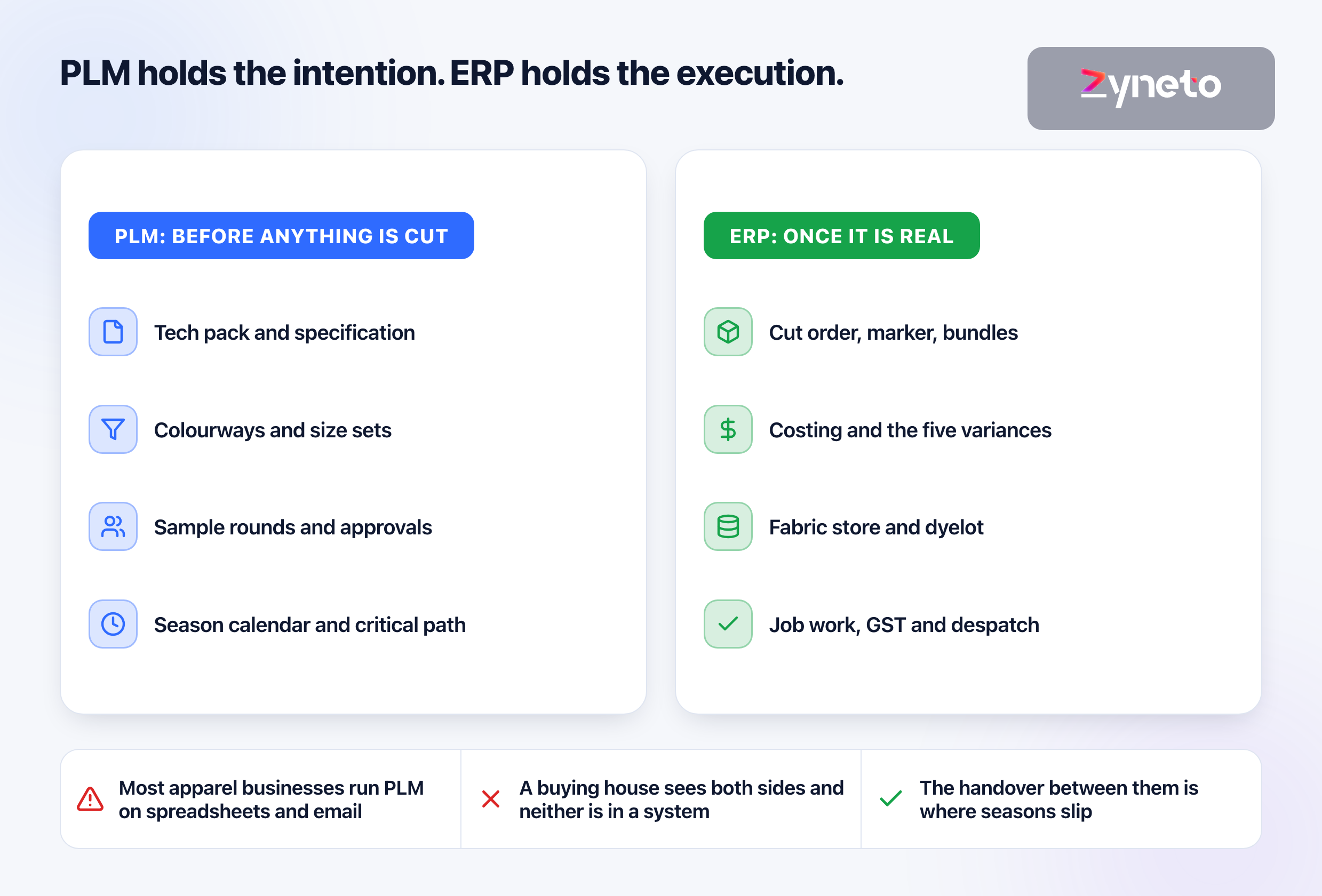
PLM holds the intention. ERP holds the execution. That one line resolves most of the confusion in this category, and it is the boundary that decides what you should buy, what you should build, and which of the two systems a given argument belongs in.
Product lifecycle management in apparel covers everything before the fabric is cut: the tech pack and specification, the colourways and size sets, the sample rounds and who approved which version, and the season calendar that every other date hangs off. Once a style is real and moving — cut order, marker, bundles, costing, fabric, job work — you are in ERP territory, which is a different system with a different price.
Here is the honest position most of this industry is in. A great many apparel businesses run their PLM on spreadsheets and email, and it mostly works until a season is late and nobody can establish which version of a spec was actually cut. Our own view of the systems landscape treats a PLM or tech pack tool as one of the things you already have alongside CAD and marker software, an accounting system and a GSP — something to integrate with rather than something every business should build.
The sharpest version of the problem sits with buying houses and sourcing agents: you carry the buyer's tech pack and the vendor's capacity, you are the only party who can see both, and none of it is in a system either side can read.
The reason this boundary matters is that both systems hold the same three-level item hierarchy, and that shared vocabulary makes them look like one system to anyone who has not run both.
A style carries the tech pack, the bill of materials, the cost sheet and the season code. Style and colour together form the colourway, which the trade calls the SKU and which merchandisers plan at. Only style, colour and size physically exists, which is why it is the only countable level. PLM and ERP both need those three levels — but PLM needs them before anything exists, and ERP needs them to count things that do.
That difference is not academic. In PLM a colourway can be proposed, revised and dropped without anything being wrong. In ERP a colourway that was dropped but has stock against it is a data error. Building one system to do both means either the catalogue permits nonsense or the design process cannot iterate, and in practice teams solve it by abandoning the system for the part it serves badly.
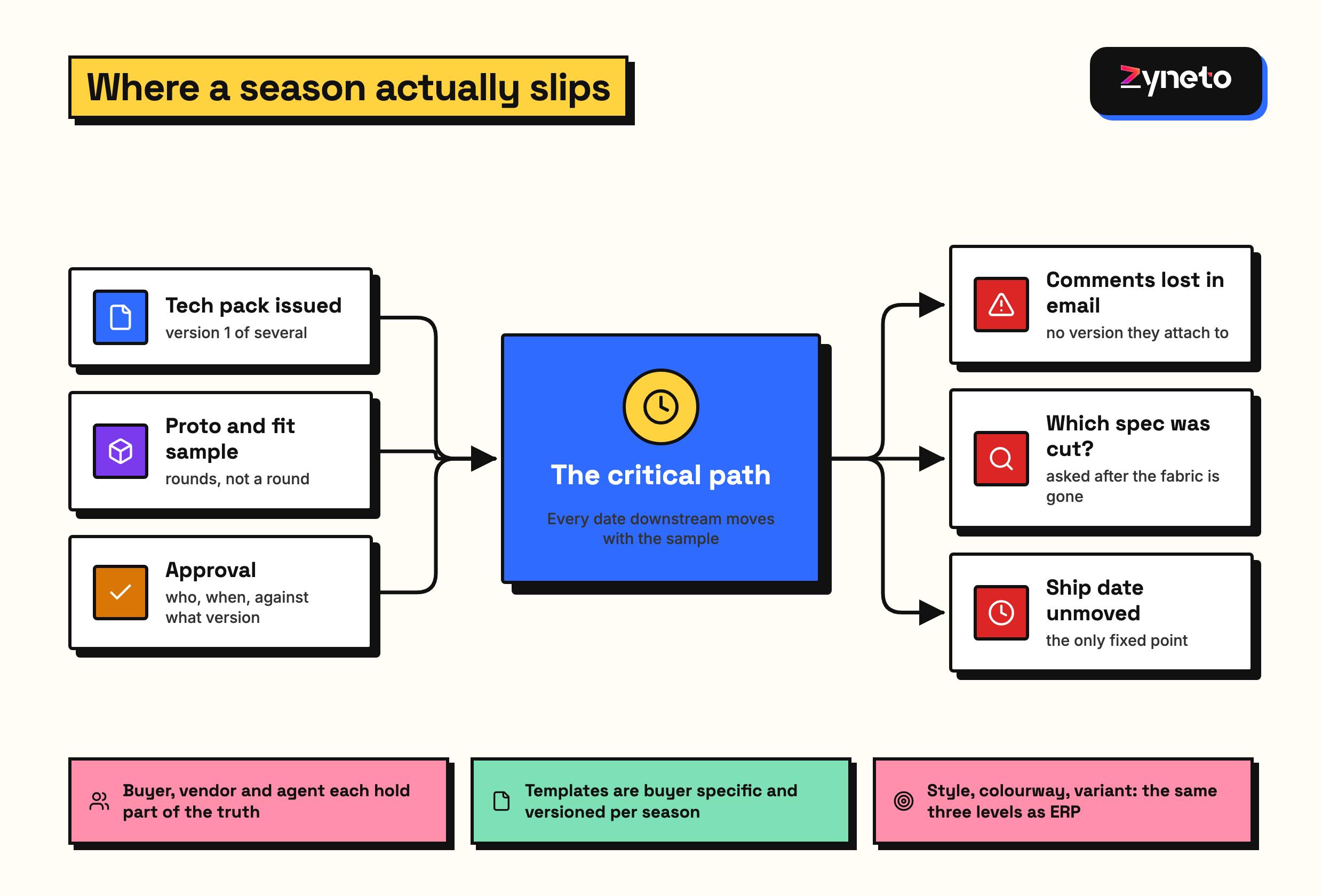
The ship date is the only fixed point in an apparel season. Everything else is negotiable until it is not, and the mechanism by which seasons go late is almost always the same.
A tech pack is issued, and it is version one of several. A proto sample comes back, comments are made, a fit sample follows, more comments, perhaps a size set. Each round is a version of the specification, and each comment attaches to a version rather than to the style in general.
When that history lives in email, three failures follow. Comments arrive without a version they attach to, so a correction made against the proto gets applied to a spec that already moved on. Nobody can answer "which spec was actually cut" without a search, and the question is usually asked after the fabric is committed. And because the ship date does not move, every day lost in sampling is taken out of production, which is where quality problems come from.
The fix is unglamorous: versioned specs, comments bound to versions, and approvals recorded as who approved what, when, against which version. That is the core of what a PLM is for, and it is the part spreadsheets cannot do at all.
Every round of samples costs fabric, trims, labour and freight, and almost no apparel business can say what its sampling actually costs per style.
The reason is that sampling is treated as overhead rather than as a cost attached to a style. It is charged to a development budget, not to the product it develops, so a style that took five rounds and one that took two look identical in the cost sheet and in the margin analysis afterwards.
That matters commercially, because rounds are not randomly distributed. They cluster — on particular buyers whose comments are vague, on particular vendors whose first attempts are poor, and on particular garment types that are genuinely hard. Attaching the cost to the style makes the pattern visible, and the pattern is actionable: a buyer whose styles average four rounds is more expensive to serve than one whose average is two, regardless of what either pays per piece.
Capturing it needs nothing clever. A round is an event against a style, with a date, a vendor, a reason code and a cost. Sum it per style, per buyer, per vendor. The analysis that follows is some of the most useful in the business and it is almost never available.
Fashion colour management is a specialised corner that generalist systems handle badly, and it is worth knowing about because it generates its own approval cycle.
A colour is specified as a standard, matched by a dyehouse, submitted back as a lab dip, assessed and either approved or rejected. That is a complete approval loop running in parallel to the fit approval loop, on its own schedule, with its own failure mode: a style can be fit-approved and colour-rejected, or the reverse, and neither blocks the other until production needs both.
Then shade has to survive into production, where every panel of one garment must come from the same dyelot or the piece is a reject whatever the paperwork says. That requirement belongs to the ERP side, which is exactly why the PLM record of what colour was approved, against which standard, has to reach it.
If colour matters to your product — and in apparel it usually does — ask specifically how a system handles lab dips, because the answer separates products built for apparel from general-purpose PLM that has been pointed at it.
Most of this post describes a business with several buyers, several vendors and a season calendar. A ten-style brand working with one factory has a different problem, and it is worth saying what the answer is for them.
They do not need a PLM. They need three things done consistently: a specification that is versioned rather than overwritten, comments that are attached to the version they refer to, and a single place where approval is recorded. Those can live in a shared document system with a naming discipline, and for a small enough operation that is genuinely sufficient.
The point at which it stops being sufficient is identifiable in advance: a second buyer with a different template, a second factory that needs the same pack in a different form, or a season where two people are issuing specs independently. Any of the three and the spreadsheet becomes a liability rather than a tool.
Knowing which side of that line you are on is worth more than any product comparison, and most businesses cross it a season before they notice.
A detail that catches people building their first system, and a strong argument for buying rather than building.
A manufacturer or buying house working with several retail buyers does not have one tech pack format. It has one per buyer, each with its own fields, its own measurement points, its own tolerance conventions and its own approval stages. Those templates change per season, and a system that hard-codes a single template will be abandoned the first time a buyer changes theirs.
So the requirement is not "a tech pack form". It is a template engine, versioned per buyer and per season, with the data captured once and rendered into whatever shape each buyer demands. That is a meaningful amount of engineering, and established PLM products already do it well.
This is the strongest case for buying a PLM rather than building one. You are not buying the concept of a specification, which is easy. You are buying a decade of accumulated template handling, and reproducing that is a poor use of a first budget.
Three cases, and none of them is "we want our own PLM".
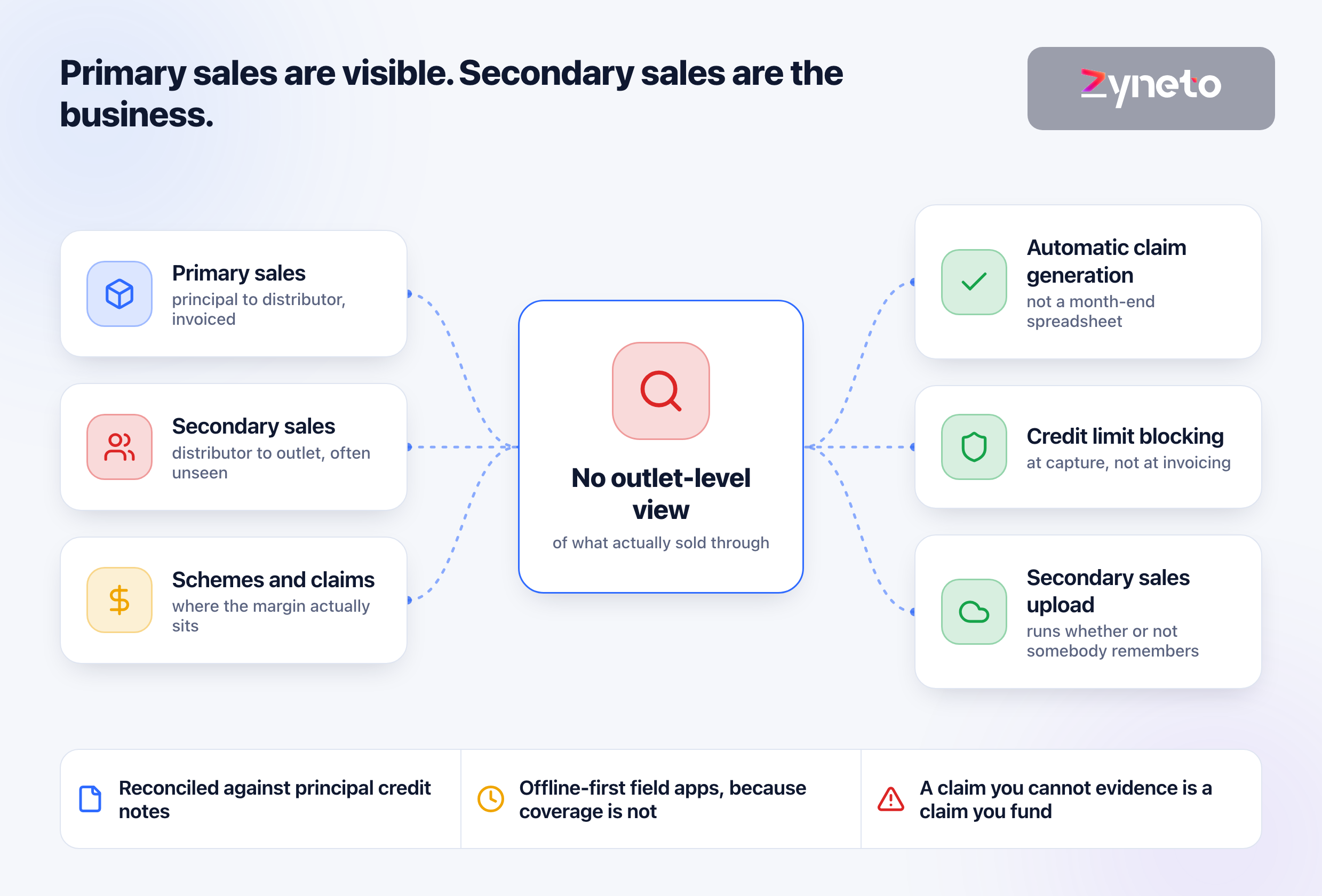
When you are the party in the middle. A buying house or sourcing agent sits between a buyer's tech pack and a vendor's capacity and is the only one who can see both. Off-the-shelf PLM is generally built for one side of that relationship — a brand managing vendors, or a manufacturer serving buyers. The agent's view, where several buyers and several vendors have to be reconciled without either side seeing the other's commercial terms, is genuinely under-served.
When the handover is the problem rather than the lifecycle. If you have a PLM and an ERP and the pain is that nothing passes cleanly between them, the build is an integration, not a second product system. That is a much smaller piece of work and it addresses the actual complaint.
When your process is the differentiator. If how you develop product is why customers choose you — a fast-turn business, a made-to-order model, a vertically integrated operation — then encoding that in someone else's workflow means adopting their assumptions about how a season runs.
Outside those three, buy it. The category is mature and the products are good.
One qualifier on the middle case, because it is the one most often misdiagnosed. A handover problem presents exactly like a PLM problem: people complain that the system does not reflect reality, that data has to be entered twice, that nobody trusts the numbers. Those symptoms point at the gap, not at either system, and the way to tell is to ask where the duplicate entry actually happens. If it is between two systems, you have an integration to build. If it is inside one of them, you may genuinely have the wrong product.
If you take one practical recommendation from this post, make it this: the expensive gap in most apparel businesses is not inside PLM or inside ERP. It is between them.
A style approved in PLM has to arrive in ERP as something countable, with its bill of materials, its colourways, its size curve and its costing assumptions intact. When that transfer is manual, it is re-keyed, and re-keying a bill of materials is how a costing is wrong before production starts.
The transfer also has a direction problem. Costing feedback flows backwards: the ERP learns what a style actually consumed, and that should inform the next season's cost sheet in PLM. Almost nobody closes that loop, which is why development teams keep costing with last year's assumptions while production has better numbers sitting unused.
An integration that carries styles forward and actuals backward is a contained, well-defined piece of work with an obvious payback. It is also the thing that most often gets deferred, because it is nobody's system and therefore nobody's budget.
There is a sequencing argument too. Build the handover before you improve either end. A better PLM feeding a manual transfer produces better data that still gets re-keyed, and a better ERP receiving the same manual transfer is working from the same re-keyed figures. The integration is the cheapest of the three pieces of work and the one that makes the other two worth doing, which is the reverse of the order most organisations tackle them in — usually because the integration has no obvious owner and therefore no sponsor.
Five questions, in the order that matters.
Can templates differ per buyer and per season, configured rather than coded? Covered above, and the most likely reason a product gets abandoned.
Do comments attach to a version of a spec, or to the style? If the latter, the sample history will not survive contact with a real development round.
What does the approval record contain? Who, when, against which version, and is it exportable as evidence.
How does it hand over to an ERP? Specifically which objects, in which direction, and whether actuals can come back.
Who owns the data and can you get it out? A decade of specifications and sample history is the asset, and a product you cannot leave is a product that stops improving.
Rarely on the software, which is mature.
They fail on adoption, because designers and merchandisers judge a system by whether it is faster than the spreadsheet it replaces, and a PLM configured to capture everything is slower on day one and therefore unused by day thirty. They fail on templates, when a buyer changes format and the system cannot follow. They fail when sample comments were never bound to versions, so the history exists but cannot answer the one question it was bought for.
And they fail quietly at the ERP boundary, where a successful PLM implementation hands over to production by email and spreadsheet, which means the organisation paid for structure and then discarded it at the moment it mattered most.
Configure for the smallest set of fields that makes the season traceable, and add later. Every apparel business that has rolled out a PLM successfully did it that way, and most that failed tried to capture the ideal specification on the first attempt.
The test for whether a field belongs in that first set is whether somebody downstream will be blocked without it. A measurement point a factory needs to cut belongs in. A merchandising attribute that would be useful in a report next year does not, and can be added once the system is already part of how people work rather than an argument about it.
Product lifecycle management for apparel covers everything before production: the tech pack and specification, colourways and size sets, sample rounds and approvals, and the season calendar that other dates hang off. It holds the intention, where an ERP holds the execution — cut order, marker, bundles, costing, fabric and job work. Both use the same three-level hierarchy of style, colourway and variant, which is why they are often confused, but PLM needs those levels before anything exists and ERP needs them to count things that do.
Buy, in most cases. The category is mature and what you are really buying is accumulated template handling — tech pack formats that differ per buyer and change per season — which is a poor use of a first budget to rebuild. Building makes sense in three cases: when you are a buying house or agent sitting between buyers and vendors, a position off-the-shelf products serve badly; when the real problem is the handover to ERP rather than the lifecycle itself; or when how you develop product is genuinely your differentiator.
Timing and purpose. PLM runs before anything is cut and deals in proposals that may change or be dropped: a colourway can be revised or abandoned without anything being wrong. ERP runs once production is real and deals in things that must be countable: a dropped colourway with stock against it is a data error. Building one system to do both means either the catalogue permits nonsense or the design process cannot iterate, and teams solve that by abandoning whichever part is served badly.
Because the ship date is the only fixed point and sampling absorbs the slack. A tech pack is version one of several, each sample round produces comments, and when that history lives in email the comments arrive without a version they attach to. Corrections get applied to specs that already moved on, nobody can say which spec was actually cut until after fabric is committed, and every day lost in sampling comes out of production — which is where quality problems originate.
Because a manufacturer or buying house working with several retail buyers has one format per buyer, each with its own fields, measurement points, tolerance conventions and approval stages — and those change per season. A system that hard-codes a single template gets abandoned the first time a buyer changes theirs. The requirement is a template engine, versioned per buyer and per season, capturing data once and rendering it into whatever shape each buyer demands.
Styles forward and actuals backward. A style approved in PLM should arrive in ERP as something countable with its bill of materials, colourways, size curve and costing assumptions intact, because manual re-keying of a bill of materials is how costing goes wrong before production starts. The return direction is the one almost everyone skips: the ERP learns what a style actually consumed, and that should update the next season's cost sheet rather than sitting unused while development costs with last year's assumptions.
On adoption rather than software. Designers and merchandisers judge a system by whether it beats the spreadsheet it replaces, and a PLM configured to capture everything is slower on day one and unused by day thirty. The implementations that succeed configure the smallest set of fields that makes a season traceable and add later. The others fail on templates a buyer changed, on comments never bound to spec versions, or at the ERP boundary where structure is discarded into email at the moment it matters most.

Vikas has around fifteen years of experience building software and now builds generative AI systems at Zyneto. His work covers retrieval augmented generation, agentic AI, knowledge graphs, AI memory, and the evaluation and guardrails that decide whether any of it is safe to put in front of customers. He has shipped enterprise copilots, document AI, chatbots and predictive analytics for e-commerce, fintech and marketing teams, and works day to day in Python, JavaScript and SQL. He follows multimodal models, business process automation and enterprise AI security closely, and mentors engineers moving into AI. He writes about architecture, inference cost and the failure modes that only show up at production scale.
Share your details and we will talk soon.
Be the first to access expert strategies, actionable tips, and the trends actually shaping the digital world. No fluff - just practical insights delivered straight to your inbox.
Dive into our blog and stay ahead of the curve with expert perspectives, future-ready trends, and tech tips written for decision-makers and doers alike.