Live Streaming App Development Cost: What an Hour of Video Actually Bills


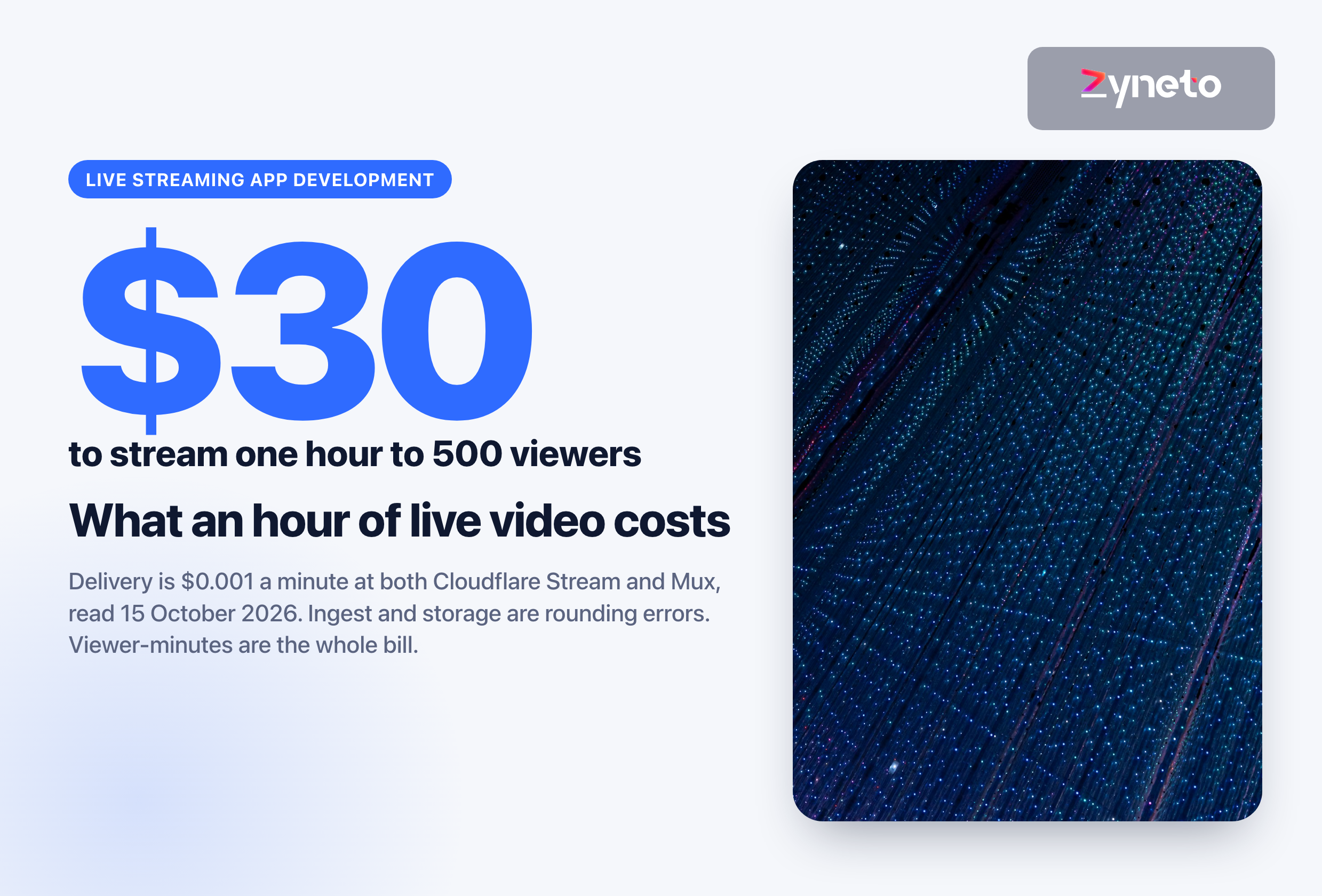
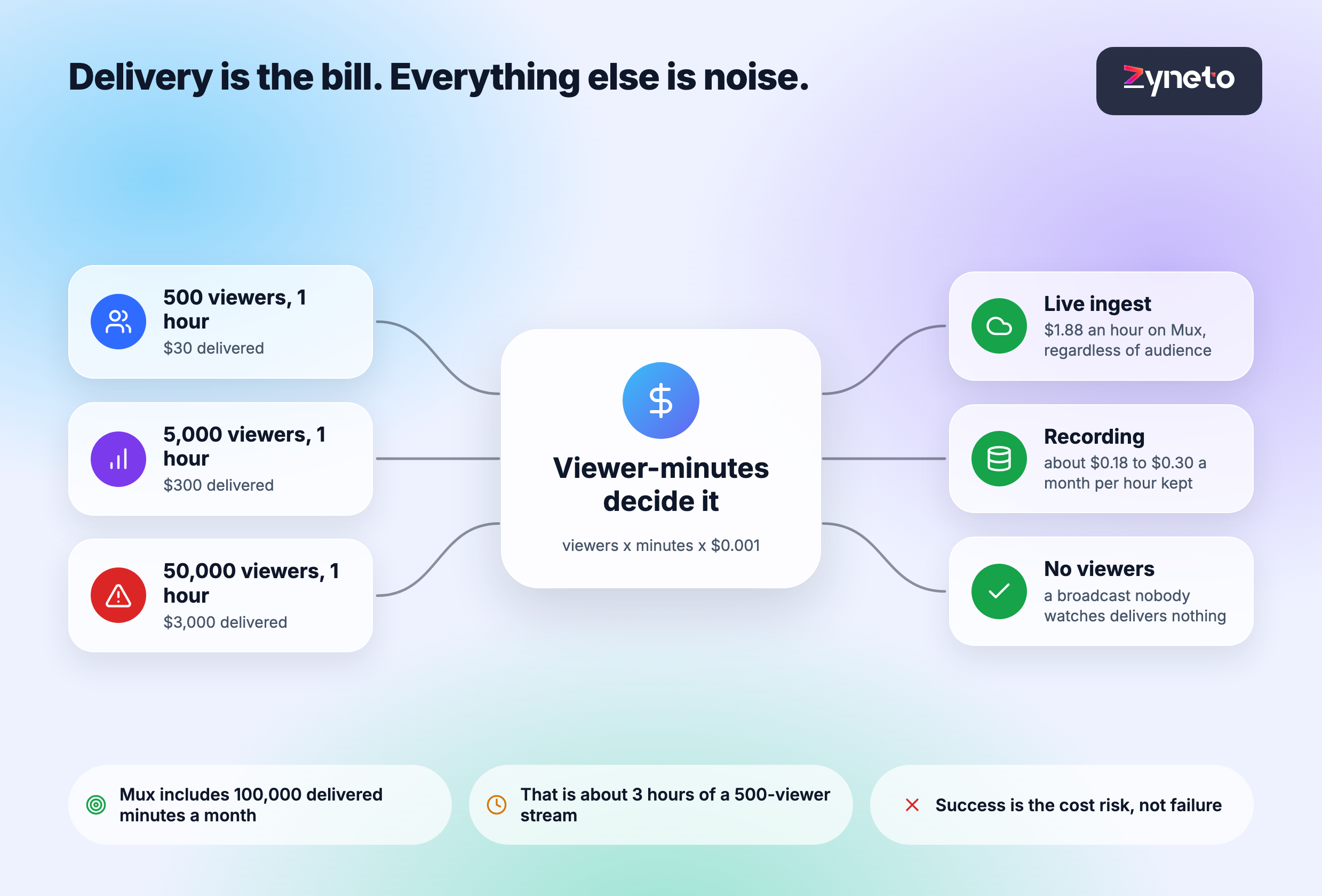
One hour of live video streamed to 500 concurrent viewers costs about $30 in delivery. To 5,000 viewers, $300. To 50,000, $3,000 — for a single hour, for a single event.
That figure comes from the two vendors that publish rates. Read on 15 October 2026, Cloudflare Stream charges $1 per 1,000 minutes delivered and Mux charges $0.001 per minute, which is the same price. Delivery is not where vendors differentiate, and it is where almost all of your bill comes from.
Everything else is a rounding error by comparison. Mux bills live ingest at $0.03125 a minute, which is $1.88 for an hour of broadcast regardless of how many people watch. Storing the recording costs $0.003 a minute per month at Mux and $0.005 at Cloudflare — about 18 to 30 cents a month for an hour kept. Cloudflare bills on-demand and live identically, and a broadcast nobody watches delivers nothing and therefore costs nothing.
So the cost model has one variable that matters: viewers multiplied by minutes. Which means the financial risk in a live streaming product is not failure. It is success, arriving faster than the pricing model you built around it.
Concurrent viewers | Delivered minutes, 1 hour | Delivery cost |
100 | 6,000 | $6 |
500 | 30,000 | $30 |
5,000 | 300,000 | $300 |
50,000 | 3,000,000 | $3,000 |
Mux includes 100,000 delivered minutes a month, which sounds generous until you convert it: that is about three hours of a 500-viewer stream, or twenty minutes of a 5,000-viewer one. It covers development and a pilot. It does not cover a product.
Note what the table does not vary: the per-minute rate. There are no volume tiers published by either vendor, though both mention that committed contracts lower the price. At the point where your bill is large enough to hurt, it is also large enough to negotiate, which is the one piece of good news in the model.
Most streaming cost estimates start from the wrong unit. They ask how many streams, or how many hours of content, because those are the numbers a content business tracks.
Neither predicts the bill. A thousand hours of content nobody watches costs storage and nothing else. One hour watched by fifty thousand people costs $3,000. The meter runs on consumption, not production, which inverts the intuition of anyone coming from a media background where producing is the expensive part.
The practical consequence is that your unit economics have to be expressed per viewer-hour, not per stream or per subscriber. If a subscriber pays $10 a month and watches twenty hours, they have consumed $1.20 of delivery at list price — fine. If they watch two hundred hours, they have consumed $12 and you are losing money on your most engaged customer, which is a uniquely demoralising way to fail.
Model the heavy user, not the average one, and put a figure on what consumption level turns a subscriber unprofitable. That number is the single most useful output of a pricing exercise in this category.
It also reframes which growth you should want. In most software, more usage per customer is unambiguously good — it predicts retention and justifies a price rise. Here, usage has a direct marginal cost, so engagement and margin pull against each other in a way that is unusual outside infrastructure businesses. That is not an argument against engagement; it is an argument for knowing the number at which it stops paying, and for having a plan that is not simply hoping.
The per-minute rates above are for 1080p. Mux states that 720p is lower and that 2K, 4K and premium tiers are higher, without publishing those figures.
That makes resolution the most direct lever on the bill, and it is one most products set once and never revisit. A fitness class, a webinar, a language lesson and a sports feed do not need the same resolution, and defaulting all of them to the highest available is a decision nobody consciously took.
Adaptive bitrate complicates it usefully. A viewer on a poor connection receives a lower rendition, which costs less to deliver, so your average cost per viewer-minute is below the headline rate in practice. But it also means your bill varies with your audience's network conditions, which is not a variable you control and is worth modelling as a range rather than a point.
There is a second decision hiding beside it: which renditions you encode at all. Every ladder rung you publish is a version that may be delivered, and offering 4K to an audience watching on phones produces an expensive stream almost nobody benefits from. Match the ladder to the devices your analytics actually show, and revisit it once a year rather than inheriting a vendor default forever.
Audio-only deserves naming too. For talk formats, podcasts recorded live, and language tuition, an audio rendition is a fraction of the delivered bytes and is the right default on mobile data. Products that offer it see a meaningful share of their audience choose it, which is a cost reduction and a usability improvement at the same time — rare enough to be worth the afternoon it takes.
How far behind live your viewers are is not a technical detail, it is a product choice, and it changes both what you build and what you pay.
Standard HLS or DASH delivery runs roughly 15 to 30 seconds behind. That is fine for a concert, a conference talk, a church service or anything where nobody in the audience is interacting with the moment. It is also the cheapest and most reliable mode, because it uses ordinary segmented delivery over a normal CDN.
Low-latency modes bring that to a few seconds, which is what you need when chat reacts to what is on screen. A viewer commenting on a goal twenty seconds after everyone else has seen it is a broken experience, and in practice the fix is either low latency or deliberately delaying the chat to match the video.
Sub-second requires WebRTC, and that is a different product. It is what interactive formats need — a live auction, a tutor correcting a student, a two-way show. Cloudflare notes that WebRTC delivery billing began on 15 October 2026 and that WebRTC broadcasts cannot currently be recorded, which means choosing it costs you the recording unless you run a parallel pipeline.
The rule worth carrying into a specification: pick the highest latency your product can tolerate. Each step down costs money, constrains your vendor choice and adds failure modes, and most products ask for sub-second because it sounds better rather than because anything depends on it.
The part of a live product most likely to fall over is not the video, because the video is somebody else's commodity infrastructure with somebody else's on-call team. It is the chat.
Video delivery scales linearly and predictably: more viewers, more delivered minutes, a bigger bill, no architectural change. Chat scales badly in a specific way — every message has to reach every connected viewer, so traffic grows with messages multiplied by participants, and a room of fifty thousand people sending even occasional messages produces a fan-out that a naive implementation cannot serve.
That is why large streams slow or sample chat rather than delivering every message to everyone. Deciding which approach you take — slow mode, sampling, showing only a subset, or separating a "stage" of visible participants from a silent majority — is a product decision with an architectural consequence, and it is much cheaper decided early.
Moderation is the other half and it is the one that creates obligation. A live stream carries user-generated content in real time, which means a reporting path, a way to remove a message or a participant immediately, and a record of what was removed and by whom. In many markets that is a legal requirement rather than a feature, and the record matters as much as the removal.
The practical sequencing we would argue for: ship the stream with minimal chat, instrument the fan-out, and add richness once you know your real concurrency. Building a sophisticated chat for an audience you do not yet have is the most common way this category wastes its first budget.
The distinction that decides the build estimate, because a great deal of what people imagine building is a purchase.
Bought, almost always: ingest, transcoding, adaptive bitrate packaging, the delivery network and the player. These are commodity infrastructure with published prices, and building them means operating media servers, handling network adaptation and carrying an on-call rotation for real-time infrastructure during live events. The vendor fees above are small against the engineering salary required to do that properly.
Built, because it is your product: the catalogue and scheduling of what goes live and when, entitlements deciding who may watch what, the chat, reactions and moderation layer, the recording and clip workflow, discovery and notifications, and the analytics the business actually runs on.
Note that none of the built list is streaming engineering. It is ordinary product work, which is good news for the estimate and bad news for anyone who assumed the hard part was the video.
An honest gap, and worth stating plainly in a post whose title promises a cost.
Our published industry pages carry module hours for manufacturing, logistics, retail, healthcare, insurance, real estate and media. None of them prices a live streaming product, because the media page prices rights, royalty calculation and statements — a licensing and payments system, not a streaming one.
So this post prices the part that is knowable to the cent, which is the running cost, and refuses to invent the part that is not. What can be said about the build without a figure: the bought components above carry no build hours at all, the product layer is ordinary application work sized like any other, and the two genuinely hard engineering problems are entitlements at scale and moderation throughput during a live event.
An estimate for your specific product comes out of discovery. A number in a blog post for "a live streaming app" would be a different product's number, and you would plan against it.
What we can offer instead of a fabricated total is the shape of the question. Ask any supplier to split their estimate into three parts: the integration with a streaming vendor, which should be small and bounded; the product layer, which should be itemised like any other application build; and the two scale problems above, entitlements and chat fan-out, which should be sized against a stated concurrency target rather than left implicit. An estimate that cannot be split that way has not been thought about, and the number it produces is a guess wearing a decimal point.
Three patterns, none of them technical.
The flat-rate subscription with no consumption ceiling. Covered above, and the most common. The fix is not usually a cap, which customers hate, but a tier structure where the heaviest users are on a plan that reflects what they consume.
The free tier that succeeds. A generous free allowance is a marketing cost that scales with adoption, and in this category it scales with the one metric that drives your bill. Free viewers cost exactly as much to serve as paying ones.
The event that goes viral. A single stream reaching fifty times its expected audience produces a bill fifty times larger, in an hour, with no opportunity to intervene. Budget alerts are not enough — by the time one fires, the minutes are delivered. If that risk is material, the mitigation is a hard concurrency ceiling with a graceful message, which is a product decision made before it is needed rather than after.
Four numbers, all cheap to instrument and expensive to reconstruct later.
Delivered minutes per stream, which is your bill. Delivered minutes per user per month, which tells you who is unprofitable. Average concurrent viewers against peak, because the gap between them is your overprovisioning in any component you do build. And average rendition delivered, which tells you what your real per-minute rate is as opposed to the headline one.
None of these needs a data warehouse. They need to exist from the first week, because the alternative is discovering the shape of your cost base from an invoice.
Pair them with one forecast rather than a dashboard: delivered minutes for next month at current growth, against the month after. Two numbers, refreshed weekly, visible to whoever owns the budget. The failure mode this prevents is the common one — nobody looks at consumption until the bill is surprising, and by then the decision that caused it is three months old and embedded in the pricing page.
Both Cloudflare Stream and Mux deliver at $0.001 a minute, so the choice turns on everything else.
Mux separates live ingest as its own meter at $0.03125 a minute and includes 100,000 delivered minutes a month. Storage is $0.003 a minute per month. It publishes rates for 1080p and says other resolutions differ without giving figures.
Cloudflare Stream bills live and on-demand identically, charges $5 a month per 1,000 minutes of storage capacity — prepaid in increments rather than metered on use — and does not separate ingest. It notes that WebRTC delivery billing began on 15 October 2026, and that WebRTC broadcasts cannot currently be recorded and so consume no storage.
The storage models differ more than the figures suggest: Cloudflare sells capacity you prepay, Mux meters what you store. A library that grows steadily suits one; a product that stores little suits the other. Neither difference will matter next to your delivered minutes, which is the point of this post.
Delivery dominates, and it is viewers multiplied by minutes. At $0.001 per delivered minute — the published rate at both Cloudflare Stream and Mux as of 15 October 2026 — one hour streamed to 500 concurrent viewers costs about $30, to 5,000 viewers $300, and to 50,000 viewers $3,000. Live ingest on Mux is $0.03125 a minute, about $1.88 an hour regardless of audience. Storing the recording is roughly 18 to 30 cents a month per hour kept.
We do not publish a figure, because none of our industry pages prices a streaming product and inventing one would give you a different product's number to plan against. What can be said: ingest, transcoding, packaging, delivery and the player are bought rather than built, so they carry no build hours. The build is the product around them — catalogue, entitlements, chat and moderation, recording workflow, discovery and analytics — which is ordinary application work sized in discovery.
Almost never. Running your own media servers means handling transcoding, adaptive bitrate packaging, network adaptation and an on-call rotation for real-time infrastructure during live events. The vendor fees are small next to the engineering salary that requires. The exception is genuine scale, where delivery costs run to six figures a year and a dedicated team becomes cheaper than the margin you are paying — and at that volume you would also be negotiating a committed rate rather than paying list.
Success. A flat-rate subscription with no consumption ceiling loses money on its most engaged customers, a generous free tier scales its cost with adoption, and a single event reaching fifty times its expected audience produces a bill fifty times larger within the hour. Budget alerts do not help, because by the time one fires the minutes are already delivered. If that risk is material, a hard concurrency ceiling with a graceful message is a product decision to make before you need it.
Yes, and it is the most direct lever you control. The published rates are for 1080p; Mux states 720p is lower and 2K, 4K and premium are higher without publishing those figures. Most products set resolution once and never revisit it, yet a webinar, a fitness class and a sports feed do not need the same quality. Adaptive bitrate also means viewers on poor connections receive cheaper renditions, so your effective rate sits below the headline one — model it as a range.
Both deliver at $0.001 a minute, so delivery is not the deciding factor. Mux meters storage at $0.003 a minute per month, separates live ingest at $0.03125 a minute, and includes 100,000 delivered minutes monthly. Cloudflare sells storage capacity you prepay at $5 per 1,000 minutes a month, bills live and on-demand identically, and does not separate ingest. The storage models differ more than the numbers: one sells prepaid capacity, the other meters usage.
Four things. Delivered minutes per stream, which is your bill. Delivered minutes per user per month, which identifies unprofitable customers. Average concurrent viewers against peak, which shows overprovisioning in anything you do run yourself. And the average rendition delivered, which tells you your real per-minute rate rather than the headline one. All four are cheap to add at the start and expensive to reconstruct from invoices later.

Vikas has around fifteen years of experience building software and now builds generative AI systems at Zyneto. His work covers retrieval augmented generation, agentic AI, knowledge graphs, AI memory, and the evaluation and guardrails that decide whether any of it is safe to put in front of customers. He has shipped enterprise copilots, document AI, chatbots and predictive analytics for e-commerce, fintech and marketing teams, and works day to day in Python, JavaScript and SQL. He follows multimodal models, business process automation and enterprise AI security closely, and mentors engineers moving into AI. He writes about architecture, inference cost and the failure modes that only show up at production scale.
Share your details and we will talk soon.
Be the first to access expert strategies, actionable tips, and the trends actually shaping the digital world. No fluff - just practical insights delivered straight to your inbox.
Dive into our blog and stay ahead of the curve with expert perspectives, future-ready trends, and tech tips written for decision-makers and doers alike.