EOS vs Ethereum: Which Blockchain Takes the Smart Contract Crown?


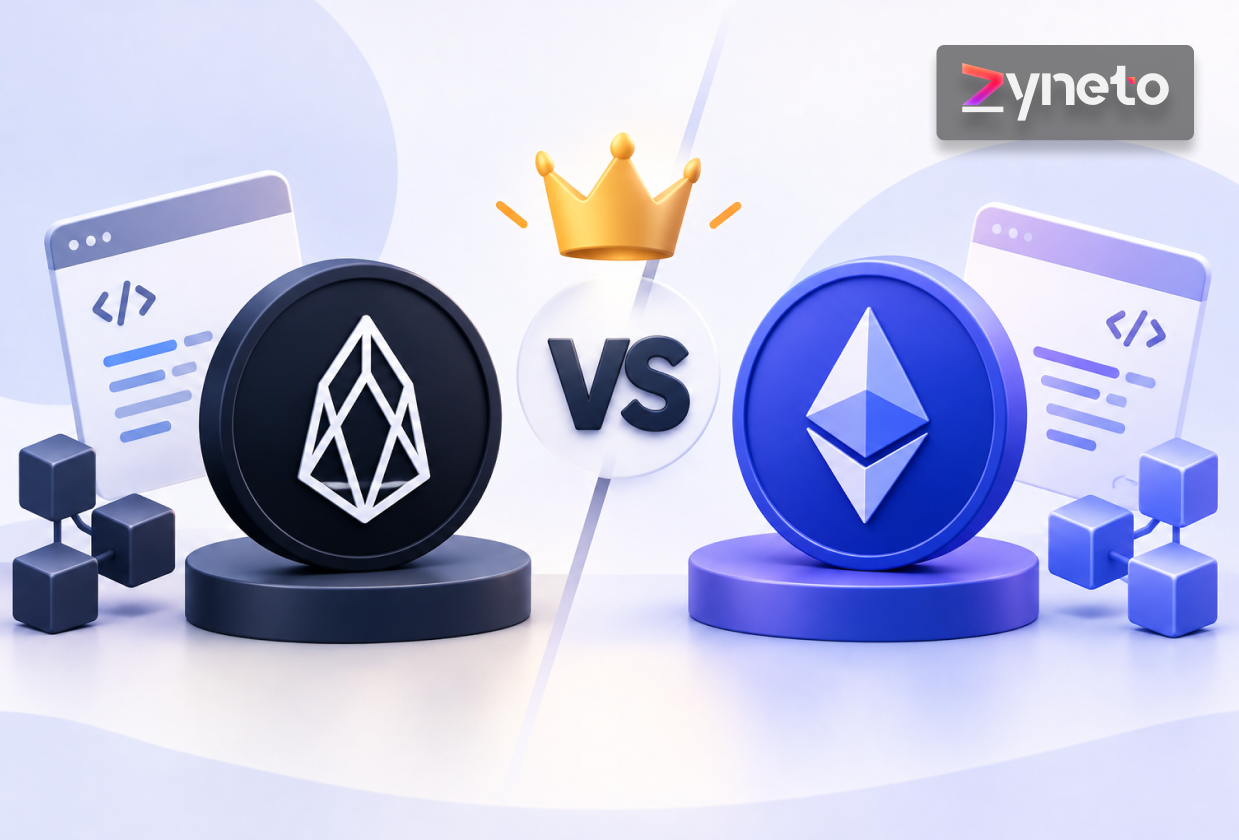
What if the future of smart contracts isn’t just about being the biggest blockchain, but about being the fastest, most affordable, and most developer-friendly?
In the ever-evolving world of Web3, EOS and Ethereum represent two different approaches to building the next generation of decentralized applications (dApps).
Ethereum has established itself as a leading smart contract ecosystem, powering decentralized finance (DeFi), NFTs, and thousands of blockchain projects. EOS, meanwhile, aims to stand out with high transaction throughput, low fees, and an alternative infrastructure designed for performance.
But does Ethereum’s established ecosystem outweigh EOS’s performance-focused design? Or can EOS offer a compelling alternative for developers seeking speed and scalability?
Let’s compare their technology, performance, costs, and ecosystems to discover which blockchain deserves the smart contract crown.
So, if you're trying to understand which one could be the best smart contract platform for your project, this detailed comparison will help you look beyond basic transaction numbers and understand what actually matters.
Before getting into the technical details, here is a quick look at EOS vs Ethereum:
|
Factor |
Ethereum |
EOS |
|
Primary Purpose |
General-purpose decentralized applications and smart contracts |
High-performance decentralized applications and smart contracts |
|
Consensus Approach |
Proof of Stake |
Delegated/block-producer-based architecture |
|
Smart Contracts |
Primarily Solidity and EVM-based |
Traditionally C++/WebAssembly-based |
|
Transaction Cost Model |
Gas-based |
Resource-oriented model |
|
Transaction Speed |
More limited on Layer 1; significantly expanded through Layer 2 networks |
Designed for high-throughput transactions |
|
Scalability Strategy |
Layer 2 rollups and ongoing protocol improvements |
High-performance base-layer architecture |
|
Developer Ecosystem |
Very large |
Smaller and more specialized |
|
Decentralization |
Broad validator participation |
Smaller block-producer set |
|
Governance |
Community and protocol-level coordination |
More explicit on-chain/block-producer governance |
|
Popular Use Cases |
DeFi, NFTs, DAOs, gaming, tokenization, dApps |
High-throughput applications, gaming, finance and Web3 applications |
At first glance, EOS may look attractive when transaction speed and predictable resource usage are your priorities.
Ethereum, however, brings something equally important: network effects.
It has a much larger developer community, mature tooling, widely adopted token standards, extensive infrastructure, and a broad ecosystem of applications.
That is why the question shouldn't simply be, “Which blockchain is faster?”
A better question is:
Which blockchain architecture fits the application you actually want to build?
The answer becomes much clearer once you understand how the two networks work.
Ethereum is a decentralized blockchain platform that enables developers to build and run programmable applications using smart contracts.
Unlike traditional blockchains designed primarily for transferring digital currencies, Ethereum supports applications that can automatically execute predefined rules without relying on centralized intermediaries.
Its Proof of Stake consensus mechanism, Ethereum Virtual Machine (EVM), and extensive developer ecosystem have made it a major platform for decentralized finance (DeFi), NFTs, gaming, DAOs, and tokenized assets.
Ethereum also uses Layer 2 networks to improve scalability and reduce transaction costs while maintaining connections to its underlying blockchain.
Before you explore anything else, you should know the features of Ethereum that set it apart from the crowd:
Ethereum smart contracts are self-executing programs that operate according to predefined rules stored on the blockchain.
They automatically perform actions when specific conditions are satisfied, reducing the need for intermediaries.
Developers use these contracts to create decentralized exchanges, lending protocols, NFT marketplaces, gaming platforms, and automated payment systems with transparent and verifiable execution.
Ethereum uses Proof of Stake (PoS) to secure its blockchain and validate transactions.
Following its transition from Proof of Work in September 2022, the network replaced energy-intensive mining with validators who stake ETH to participate in consensus.
This mechanism significantly reduces energy consumption while helping maintain network security, decentralization, and transaction finality.
The Ethereum Virtual Machine provides a standardized execution environment for smart contracts across the Ethereum network.
It ensures that contract operations follow consistent rules across participating nodes.
EVM compatibility also supports a broad range of development tools, wallets, testing frameworks, and blockchain applications, making it easier for developers to build, deploy, and maintain decentralized solutions.
Solidity is the primary programming language used to develop Ethereum smart contracts.
It allows developers to define application logic, manage digital assets, and automate blockchain transactions.
Ethereum also offers a mature collection of development frameworks, libraries, debugging tools, security auditing services, and testing environments, helping development teams build and deploy smart contracts more efficiently.
Ethereum supports a diverse ecosystem of decentralized applications across several industries.
Developers build DeFi protocols, NFT platforms, decentralized autonomous organizations (DAOs), blockchain games, digital identity solutions, and tokenization services.
Its established infrastructure and extensive developer community enable applications to interact with existing protocols, encouraging innovation and expanding opportunities for users, businesses, and blockchain startups.
Ethereum smart contracts allow you to automate transactions and application processes using code stored on the blockchain.
From writing contract logic to deploying and executing it, Ethereum provides the infrastructure you need to build decentralized applications. Here's how the process works.
You begin by writing a smart contract that defines how your application should behave.
Ethereum primarily uses Solidity for smart contract development, allowing you to create rules for payments, digital assets, lending platforms, and other decentralized applications.
Once your contract is written and tested, you deploy it to the Ethereum blockchain.
After deployment, it receives a contract address that users and applications can interact with to execute its functions.
When someone interacts with your smart contract, they submit a transaction that triggers a specific function.
Ethereum processes the transaction through its execution environment, applying the contract's rules and updating the blockchain state when the transaction succeeds.
The Ethereum Virtual Machine executes smart contract code according to Ethereum's protocol rules.
It provides a consistent execution environment across network nodes, helping ensure that contract operations produce the same results when executed under the same conditions.
Ethereum uses gas to measure the computational resources required to execute transactions and smart contracts.
You pay gas fees for applicable on-chain operations, and the total cost depends on the computational work required and prevailing network conditions.
Ethereum uses Proof of Stake (PoS) to maintain agreement across the blockchain.
Validators stake ETH to participate in consensus, helping secure the network and ensure that valid transactions and state changes are recorded consistently.
Once deployed, Ethereum smart contracts can power decentralized applications such as DeFi platforms, NFT marketplaces, blockchain games, and DAOs.
With the right blockchain development services, you can build secure Ethereum smart contracts that support your business goals and deliver reliable decentralized applications.
EOS is a blockchain platform designed to help you build and run decentralized applications (dApps) and smart contracts efficiently.
Unlike traditional platforms that may experience high transaction fees or network congestion, EOS focuses on providing fast transactions, low costs, and a developer-friendly environment.
With EOS, you can create applications that automate transactions, manage digital assets, and execute predefined rules without depending on centralized intermediaries.
EOS supports native smart contract development using C++ and WebAssembly (WASM), while EOS EVM also allows you to deploy Ethereum-compatible smart contracts using familiar tools such as Solidity.
Whether you're building a blockchain game, a decentralized finance application, or a digital asset platform, EOS offers infrastructure designed to support scalable blockchain experiences.
EOS comes with several features designed to make blockchain development easier and more efficient.
Let’s explore the functionalities:
EOS is designed to process transactions quickly, making it suitable for applications that require frequent user interactions.
Its performance-focused architecture helps you build responsive blockchain experiences, particularly for gaming, digital marketplaces, and decentralized applications where delays can affect the user experience.
EOS focuses on keeping transaction costs low, helping you create applications that are more accessible to everyday users.
Affordable transactions can make frequent interactions more practical, especially for blockchain games, digital asset transfers, and applications where users need to perform multiple actions without facing high fees.
EOS allows you to develop smart contracts that automatically execute predefined instructions on the blockchain.
Using these contracts, you can build decentralized applications, automate digital asset transfers, and implement application logic without depending on centralized intermediaries.
This flexibility supports a wide range of blockchain-based use cases.
EOS supports native smart contract execution through WebAssembly (WASM), providing developers with an environment for running blockchain application logic.
You can use C++ to develop native smart contracts and build applications that benefit from EOS's execution architecture.
This approach gives developers flexibility when designing performance-focused blockchain solutions.
EOS uses Delegated Proof of Stake (DPoS) to coordinate block production and maintain network consensus.
Token holders can participate in selecting block producers, who are responsible for producing blocks and processing transactions.
This consensus model is designed to support efficient operations while providing a governance mechanism for network participants.
The EOS smart contract platform lets you build and run blockchain applications using automated programs that execute predefined instructions.
From deploying smart contracts to processing transactions, EOS provides the infrastructure you need to create decentralized applications. Here's how the process works.
The process begins with smart contract development, where you define how your blockchain application should work.
EOS supports native smart contract development using C++ and WebAssembly (WASM), giving you the flexibility to build and run decentralized applications.
Once your contract is developed and tested, you deploy it to the EOS blockchain.
After deployment, the contract's functions can be called through transactions, allowing your application to execute its predefined rules on the network.
When you interact with an EOS-based application, your actions may trigger transactions that call smart contract functions.
The network processes these transactions according to its execution rules, allowing applications to update blockchain data and perform supported operations.
EOS uses Delegated Proof of Stake (DPoS) to coordinate block production.
Token holders can vote for block producers, who are responsible for producing blocks and helping the network reach consensus on transaction records.
EOS uses a resource model to support blockchain operations, including CPU and network bandwidth.
As a developer, you need to consider the resources your application consumes. Proper resource planning helps you manage transaction execution and deliver a smoother experience for your users.
Once deployed, your smart contract follows the rules written into its code whenever its functions are called.
For example, you can create a contract that transfers digital assets, manages in-game items, or applies specific conditions to a transaction without requiring a centralized intermediary to execute the logic manually.
Finally, you can connect your smart contracts to a user-facing application, such as a marketplace, blockchain game, or decentralized finance platform.
Your users interact with the application interface, while the smart contracts handle the blockchain operations behind the scenes. This allows you to build applications with transparent, programmable functionality.
The EOS vs Ethereum comparison highlights two different approaches to building and running blockchain applications. Ethereum focuses more on decentralization, security, and its extensive developer ecosystem, while EOS was designed around faster transactions and higher network performance.
These differences can influence everything from application scalability and development complexity to transaction fees and smart contract cost. Understanding the core differences can help you decide which platform better matches your project requirements.
Now that we've covered the architecture, development model, speed, costs, and governance, let's make the EOS vs Ethereum decision easier.
So, which blockchain wins the EOS vs Ethereum debate?
The answer depends on what you're building and what matters most to your project.
Ethereum stands out for its established ecosystem, extensive developer tools, and access to decentralized finance (DeFi) applications.
EOS, on the other hand, is worth considering when transaction speed, affordability, and performance-focused infrastructure are important to your application.
Before choosing a platform, you should look beyond individual features and evaluate how well each blockchain fits your project's long-term goals:
Ultimately, Ethereum is often the stronger choice for projects that prioritize ecosystem depth, while EOS deserves consideration for applications focused on performance and transaction efficiency.
The best blockchain is the one that aligns with your application's technical requirements, security needs, and business goals.
The future of EOS vs Ethereum will be shaped by how effectively both ecosystems respond to growing demands for scalability, lower transaction costs, stronger security, and better user experiences. Ethereum continues to expand its Layer 1 and Layer 2 scaling strategy, while the EOS ecosystem’s transition to Vaulta reflects a broader shift in its technology and market direction.
Choosing between EOS vs Ethereum is only the beginning. Turning that decision into a secure, scalable product requires the right architecture, smart contracts, integrations, testing, and deployment strategy.
Zyneto, as a trusted smart contract development company, helps businesses plan and build blockchain solutions around real product requirements rather than forcing every idea onto the same technology stack.
Whether you need smart contract development, custom dApp development, token integration, blockchain architecture, or an Ethereum-based application, our team can help you evaluate the right approach and develop it from concept to deployment.
We focus on building practical blockchain products that balance performance, security, usability, scalability, and long-term business requirements.
EOS prioritizes fast transactions, whereas Ethereum emphasizes decentralization, security, ecosystem maturity, and Layer 2 scaling solutions for long-term blockchain solutions.
Yes, EOS offers faster base-layer transactions, while Ethereum relies increasingly on Layer 2 networks to achieve higher throughput, lower costs, and improved overall blockchain scalability.
Ethereum suits projects needing mature infrastructure and broad integrations, while EOS can fit applications prioritizing high performance, efficient resources, and frequent blockchain-based user interactions.
Neither is universally better. Ethereum offers mature EVM tooling and integrations, while EOS provides performance-focused smart contracts suited to specific high-throughput decentralized application requirements.
Ethereum gas fees affect transaction and smart contract costs, varying with network demand, while EOS uses a resource-based model for managing blockchain computational requirements.
Yes. Ethereum supports dApp development with mature smart contract standards, extensive developer tools, strong infrastructure, wallet integrations, security resources, and a large global ecosystem.
Sudhanshi has several years of experience in digital marketing and now works on growth at Zyneto. Her work covers SEO, content strategy, organic lead generation, social media and paid campaigns across Google, LinkedIn, Instagram and Facebook. She has run B2B technology and SaaS campaigns for international audiences, helping brands get found in search and stay found, and works day to day in Google Analytics, Search Console, Ahrefs, SEMrush, Screaming Frog and Canva. She follows AI driven marketing, changing search behaviour, content automation and social growth closely, and turns audience and search data into plans a team can actually run. She writes about SEO, content strategy and the tactics that still earn traffic as search keeps shifting.
Share your details and we will talk soon.
Be the first to access expert strategies, actionable tips, and the trends actually shaping the digital world. No fluff - just practical insights delivered straight to your inbox.
Dive into our blog and stay ahead of the curve with expert perspectives, future-ready trends, and tech tips written for decision-makers and doers alike.