Karaoke App Development Cost: The Licence Nobody Can Compel


Every karaoke app quote you will receive prices the software. The software is not the problem. The problem is that the one legal mechanism that makes cover-song products affordable does not apply to you, and no amount of engineering changes that.
In the United States, section 115 of the Copyright Act gives you a compulsory mechanical licence: pay the statutory rate and you may reproduce someone else's composition without asking permission. That is how cover versions work at scale. It covers audio reproduction. It does not cover putting the lyrics on screen. In *Leadsinger, Inc. v. BMG Music Publishing* the Ninth Circuit held in 2008 that a karaoke device displaying lyrics creates an audiovisual work, placing it outside the compulsory licence and requiring a separately negotiated synchronisation licence.
Scrolling lyrics are the product. Remove them and you have an instrumental player. So the defining feature of a karaoke app is precisely the feature that strips away your right to compel a licence, and every track in your catalogue becomes a negotiation with whoever controls the publishing.
That turns catalogue into a headcount problem, not a software problem. You need someone whose job is clearing rights, and the clearing takes months. Budget for that person before you budget for a developer, because a karaoke app with twelve legally cleared songs is not a business and a karaoke app with ten thousand uncleared ones is a lawsuit.
The second constraint is latency, and it rules out the architecture most teams reach for first. Singers detect delay in their own voice at thresholds measured in single-digit milliseconds, which is less than a network round trip. Your audio processing happens on the device or it does not happen.
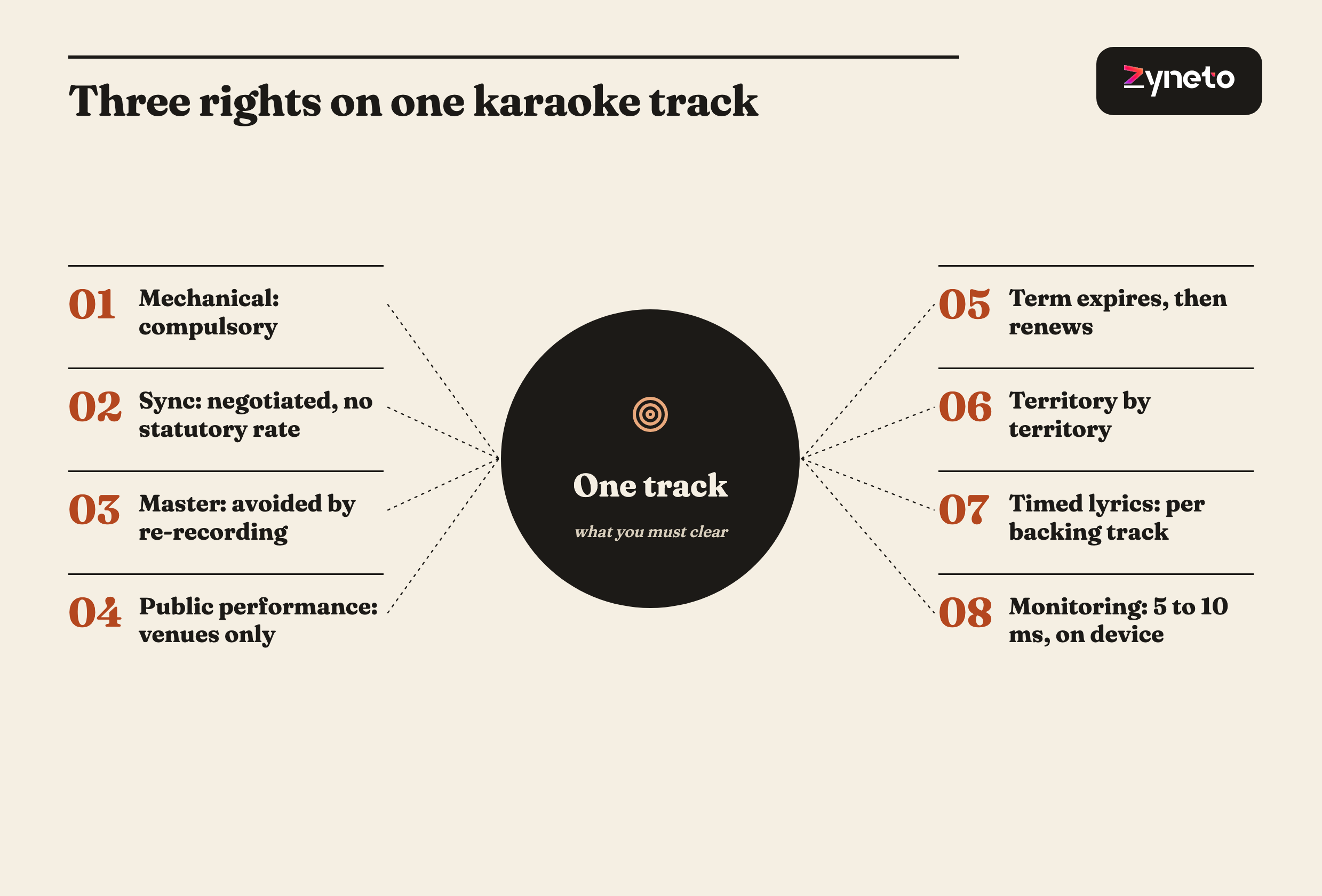
Three separate rights are in play on any karaoke track, and conflating them is how budgets go wrong.
The composition, meaning the song as written. Reproducing it in audio is covered by the section 115 compulsory licence at a statutory rate set by the Copyright Royalty Board. In the United States the Mechanical Licensing Collective administers a blanket version for eligible digital services. For lower volumes, HFA's Songfile handles one-off mechanicals at a published processing fee of $16 per song licence, dropping to $14 from the sixth song in a single transaction, on top of the statutory rate. The fee is charged per licence rather than per unit, so it does not grow with how often a song gets sung. Catalogue breadth moves this line; usage does not.
The synchronisation right, meaning the timed display of lyrics against the audio. This is the one *Leadsinger* put outside the compulsory licence. There is no statutory rate. A publisher can refuse, or price it at whatever they like, and you have no recourse.
The sound recording, meaning a specific master. Karaoke products generally sidestep this by using re-recorded instrumental backing rather than licensing original masters, which is why karaoke backing tracks sound almost but not quite like the record.
Public performance is a fourth right, and it applies the moment singing happens anywhere but a living room. A consumer app on a personal phone generally does not trigger it. A product sold to bars, restaurants or karaoke venues absolutely does, and that licence sits with a performing rights organisation rather than a publisher: PRS in the UK, ASCAP, BMI or SESAC in the United States, IPRS in India. If any part of your plan involves venues, that is a separate licensing track with separate counterparties, and it changes who your customer is.
There is one contrary decision, and it is weaker than founders want it to be. A Utah district court held in May 2007 that a product displaying only lyric text needs no synchronisation licence, treating the display as literary rather than audiovisual. That is a single district court. The Ninth Circuit identified it as the only court to have held that a karaoke device is not an audiovisual work, and declined to follow it, and the Second Circuit had already gone the other way a decade earlier. This is not a circuit split waiting to break your way. It is one outlier that two appellate courts have now stepped around. Get a music lawyer, in your launch market, before you write the cheque for the build.
Source separation has improved enormously, and the idea presents itself immediately: take the commercial master, remove the vocal, ship the instrumental. It works technically and it does not work legally.
An instrumental separated out of a master is made from that master. No court has blessed the technique, and the reasoning runs against it: you have not avoided licensing the recording, you have added a reproduction and an adaptation on top of it, and you have done so in a way that is trivially provable because the result is bit-correlated with the original. Treat it as unlicensed unless a lawyer in your market tells you otherwise.
Where separation genuinely helps is in your own licensed catalogue, producing practice stems, adjustable backing levels or guide vocals from recordings you already have the rights to. That is a real feature and a modest engineering cost. It is not a licensing shortcut, and any vendor who presents it as one is telling you something that will not survive a letter from a publisher.
A few hundred songs cover the overwhelming majority of what people actually sing, so a credible launch does not need a vast catalogue. The concentration cuts both ways: those same titles are controlled by a small number of major publishers, so your most expensive inventory is also your only essential inventory.
The catalogue question is the one founders answer last and should answer first, because it sets the licensing budget and the launch date together.
Nobody sings the long tail. Karaoke demand is extraordinarily concentrated: a few hundred songs cover the overwhelming majority of what people actually choose, and the same titles recur across every market with a local-language layer on top. This is the single most encouraging fact in this post. You do not need a hundred thousand tracks to launch a credible product. You need the right few hundred, which is a negotiation you can actually complete.
But concentration cuts the other way on price. The songs everybody wants are controlled by a small number of major publishers who know exactly what they are worth, and they are the hardest licences to get on favourable terms. A catalogue of obscure titles is cheap and worthless. The economics of this product are that your most expensive inventory is also your only essential inventory.
Territory multiplies everything. A synchronisation licence is granted for named territories. Launching in India, the Gulf and the UK is three negotiations per publisher, not one, and the local-repertoire requirement differs in each: an Indian product without film music is not a product, and that catalogue sits with different rights holders again.
Terms expire. Licences run for a period and then renew, at a price set by someone who can now see your usage data. Build the entitlement system on the assumption that tracks leave the catalogue, because they will, and a user whose saved favourite silently disappears needs an explanation rather than an error.
Plan the clearing timeline in months and start it before the build. Publisher negotiation is not a task that parallelises with development; it gates what development is for. The common failure is a finished app waiting on a catalogue, burning runway, with a team idle.
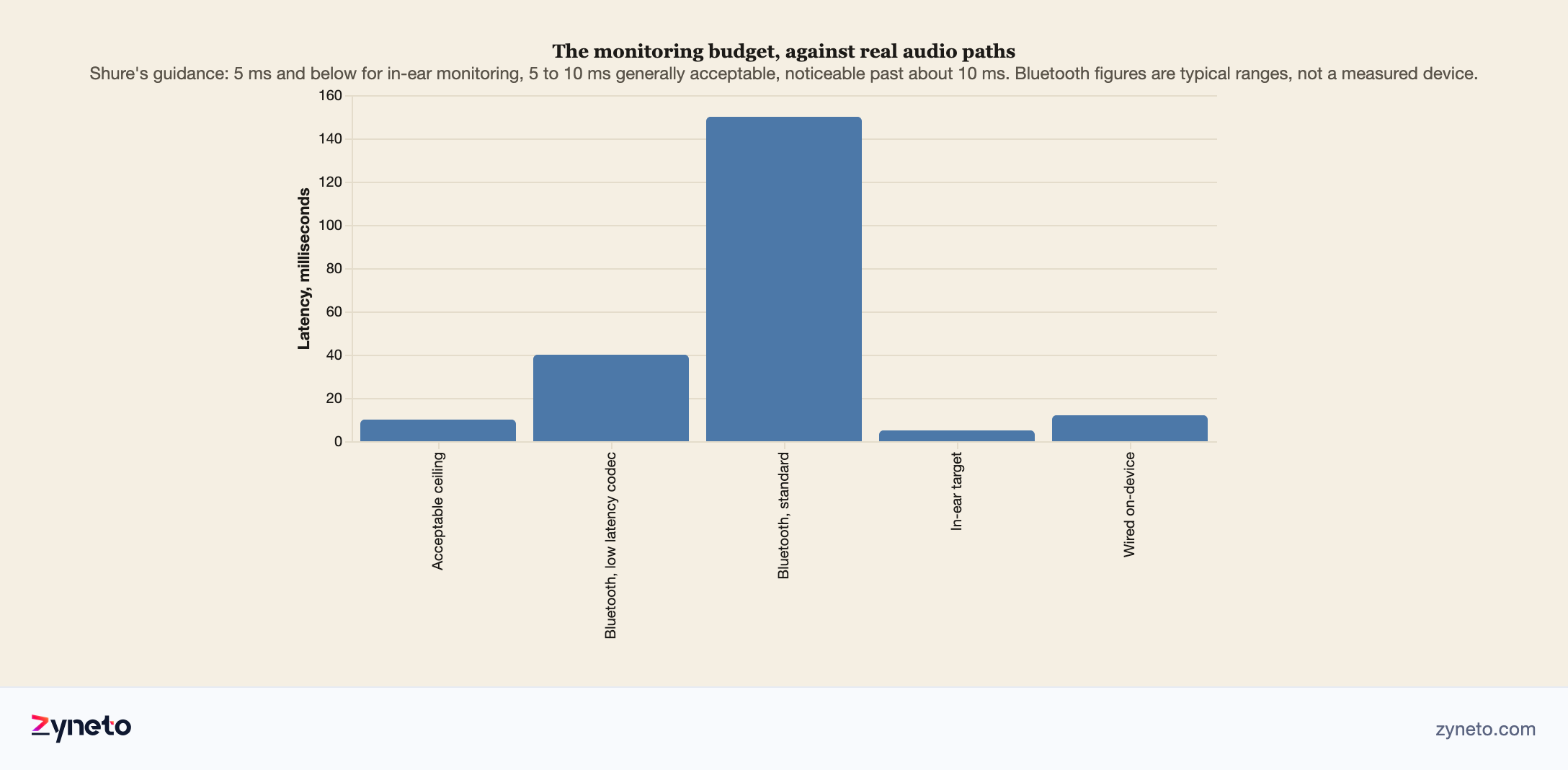
A singer hears their own voice twice: through the air and their own skull by bone conduction, and through the app. When those two arrive at different times the effect is disorienting in a way that is much worse than for an instrumentalist.
Shure's engineering guidance puts 5 to 10 milliseconds as generally acceptable for performers on stage monitors, with delay becoming noticeable past roughly 10 milliseconds, and recommends 5 milliseconds and below for in-ear monitoring. It also notes that singers are far more sensitive than other performers for exactly the bone-conduction reason.
No network path fits in that budget. A server round trip on good mobile data is tens of milliseconds before any processing. This has consequences that most feature lists never surface.
All real-time vocal processing runs on the device. Monitoring, reverb, pitch correction and level matching are native audio work against the platform's low-latency audio layer on each platform separately. This is one of the few product categories where a cross-platform framework does not save you much, because the part that decides whether the product feels good is platform-specific native code on both sides.
Bluetooth headphones are a product problem you cannot engineer away. Wireless audio adds latency far beyond the budget, and a large share of your users will have no wired option on their phone. The honest responses are to detect the output route and warn, to offer a calibration step that measures and compensates for the offset, and to accept that the experience on wireless is worse. Pretending otherwise generates reviews saying the app is broken.
Scoring and recording are separate problems from monitoring. Pitch detection for a score can tolerate latency because nobody hears it. Keep the two paths distinct, or you will degrade the monitoring path to serve the scoring one.
The moment a user records their performance, you have created a new object with a tangled rights position and a storage bill, and most feature lists treat it as a single checkbox.
A user recording contains the composition you licensed, the backing track you commissioned, and the user's own vocal. What you may do with that object depends on your publisher agreements. Private playback for the user who made it is usually straightforward. Public sharing inside the app is a different permission. Export to social platforms is a third, and it is the one users most want and the one most likely to be excluded, because it puts the composition onto a platform your licence does not cover.
Decide this before you build sharing, and state it in the product. The worst version is shipping an export button and removing it later, which reads to users as a feature being taken away and to publishers as evidence you were not paying attention.
Storage grows with engagement, not catalogue. This is the opposite of an audiobook platform and it changes the shape of the cost. A successful karaoke product accumulates user recordings indefinitely unless someone sets a policy. Decide retention early: how long recordings persist, whether users can download their own, and what happens on account deletion. Each of those is cheap as a rule at the start and expensive as a migration later.
Moderation becomes real the moment anything is public. A sharing feed means user-generated audio and video, which means reporting, review and takedown, and in several markets a legal obligation attached to them. If the product is private-by-default you avoid this entirely in phase one, which is a legitimate and substantially cheaper choice.

Lyrics scrolling in time with the music require word-level or line-level timing against a specific backing track. That data does not arrive with the licence.
You either buy timed lyric data, or you produce it. Commercial lyric providers license synchronised lyrics, which is the fast path and a recurring per-track cost. Producing it in-house means an alignment pass followed by human correction, because automated alignment is good and not good enough, and a line that highlights half a beat late is immediately obvious to someone trying to sing along.
Quality here is visible in a way most software quality is not. A user cannot tell whether your backend is well architected. They can tell instantly when the highlight is late, and they will blame the app rather than the data.
Every re-recorded backing track needs its own timing. Timing belongs to the pairing of lyrics and a specific audio file, not to the song. Change the backing track and you redo the alignment.
This is a per-track operational cost that scales with catalogue, which makes it structurally different from the build. A thousand-song catalogue is a thousand alignment passes, and that number should appear in your plan as a line with a unit cost against it.
Per-song purchase matches the licensing structure, since you pay per track and charge per track. It fails commercially because the user is asked to decide at exactly the moment they want to sing, and friction at that moment kills the session.
Subscription wins because karaoke usage is bursty and social. People sing for an hour and then not for three weeks. Metered pricing punishes the behaviour you want. A subscription also gives you a predictable number to set against licence costs that are themselves periodic rather than per-use.
Watch the gap between what you pay and how you charge. If licences are per-play and revenue is per-month, a heavy user is a loss, and your most engaged users are your most expensive. That is survivable and it must be modelled before launch, not discovered from an invoice.
Having said what is hard, most of a karaoke product is well-trodden and should be priced as such.
Catalogue browse and search, user accounts, recording and playback of performances, a social feed if you want one, duets, leaderboards, subscriptions and in-app purchase are all standard mobile and backend work. Our published rate band is $40 to $100 an hour by role, blending to $60 to $70 for a mixed team, and this portion of the work sits nearer the floor than the ceiling.
Storage and delivery are modest compared with an audiobook or video product, because backing tracks are short. User recordings are the growth item, and they grow with engagement rather than catalogue, so decide early how long you retain them and whether users can download their own.
The part that deserves senior time is the audio engine, for the reasons above, and the entitlement logic that decides which tracks a given user can access given your patchwork of per-publisher deals. That second one is routinely underestimated: licences differ by territory and by term, so "which songs can this user see today" is a real rules engine, not a boolean on a row.
Clear a small catalogue before building anything. Ten to twenty tracks, properly licensed for both mechanical and synchronisation in your launch territory, with the paperwork done. This is the only sequence that tells you what the product can actually be, and it is the step everyone wants to skip because it is slow and produces nothing visible.
Build the audio path second, as a prototype, before any product work. Monitoring latency on real devices with real headphones is a yes-or-no question with a measurable answer, and it determines whether the product is viable on the hardware your users own. A two-week spike here is the cheapest risk reduction available on the whole project.
Catalogue operations third, meaning ingest, timing data, entitlement rules and the admin tooling for a rights person to work in. This is the system your business runs on and it is invisible to users, which is why it gets deferred and then becomes the bottleneck.
The consumer-facing product last, which will feel backwards and is not. Everything users see depends on answers from the three stages above, and none of those answers is a design question.
We do not put a fixed total on a karaoke build before a discovery, because the single largest variable is not in the software at all. It is how many publishers have said yes, in which territories, and on what terms. A team that quotes you a number before asking that question has not understood the product they are pricing.
The software is conventional mobile and backend work at our published rate band of $40 to $100 an hour by role, blending to $60 to $70 for a mixed team, with the device-side audio engine needing senior time. The dominant cost is not the build. It is licensing: synchronisation rights for on-screen lyrics are negotiated per publisher with no statutory rate, which means a rights-clearing role and a timeline measured in months before launch.
Yes, and it is a separate licence from the one that covers the audio. In *Leadsinger, Inc. v. BMG Music Publishing* (2008) the Ninth Circuit held that displaying lyrics makes a karaoke product an audiovisual work, which falls outside the section 115 compulsory mechanical licence and requires a negotiated synchronisation licence. A Utah district court reached a different conclusion for text-only display in May 2007, but it stands alone: the Ninth Circuit named it as the only court to have held otherwise and declined to follow it, and the Second Circuit had already required the licence. Treat the point as settled against you, and take a music lawyer's opinion in your launch market.
No. An instrumental produced by separating a commercial master is a derivative work of that master, so you have added an unlicensed use rather than avoided one, and the result is trivially provable as derived. Source separation is genuinely useful inside a catalogue you have already licensed, for producing practice stems or adjustable guide vocals. It is not a licensing shortcut.
Low enough that a singer does not hear their own delayed voice. Shure's guidance puts 5 to 10 milliseconds as generally acceptable for performers and recommends 5 milliseconds or below for in-ear monitoring, noting singers are more sensitive than other performers because they also hear themselves through bone conduction. No network round trip fits in that budget, so all real-time monitoring and effects must run on the device in native audio code on each platform.
Not well, and you cannot fix it in software. Wireless audio adds latency far beyond the monitoring budget. The workable responses are to detect the output route and warn the user, to offer a calibration step that measures the offset and compensates where possible, and to set expectations in the product. Any vendor claiming a software fix for Bluetooth monitoring latency is overselling.
Either you license synchronised lyric data from a commercial provider as a recurring per-track cost, or you produce it with an automated alignment pass followed by human correction. Automated alignment alone is not accurate enough, because a line highlighting half a beat late is immediately obvious to someone singing. Timing belongs to a specific pairing of lyrics and backing track, so a new backing track means redoing the alignment.
Two things, and neither is the user interface. The device-side audio engine, because the latency budget forces native platform-specific work on both iOS and Android and determines whether the product feels right. And the entitlement engine, because licences differ by publisher, territory and term, so deciding which tracks a given user can see today is a rules problem rather than a flag on a database row.

Vikas has around fifteen years of experience building software and now builds generative AI systems at Zyneto. His work covers retrieval augmented generation, agentic AI, knowledge graphs, AI memory, and the evaluation and guardrails that decide whether any of it is safe to put in front of customers. He has shipped enterprise copilots, document AI, chatbots and predictive analytics for e-commerce, fintech and marketing teams, and works day to day in Python, JavaScript and SQL. He follows multimodal models, business process automation and enterprise AI security closely, and mentors engineers moving into AI. He writes about architecture, inference cost and the failure modes that only show up at production scale.
Share your details and we will talk soon.
Be the first to access expert strategies, actionable tips, and the trends actually shaping the digital world. No fluff - just practical insights delivered straight to your inbox.
Dive into our blog and stay ahead of the curve with expert perspectives, future-ready trends, and tech tips written for decision-makers and doers alike.