Audiobook App Development Cost: Where the Rights Model Eats the Budget


An audiobook app and a podcast app look like the same product. Both stream long-form spoken audio to a phone, both need offline download, both need a resume position. Commercially they are opposites, and the difference is worth more than every feature decision you will make.
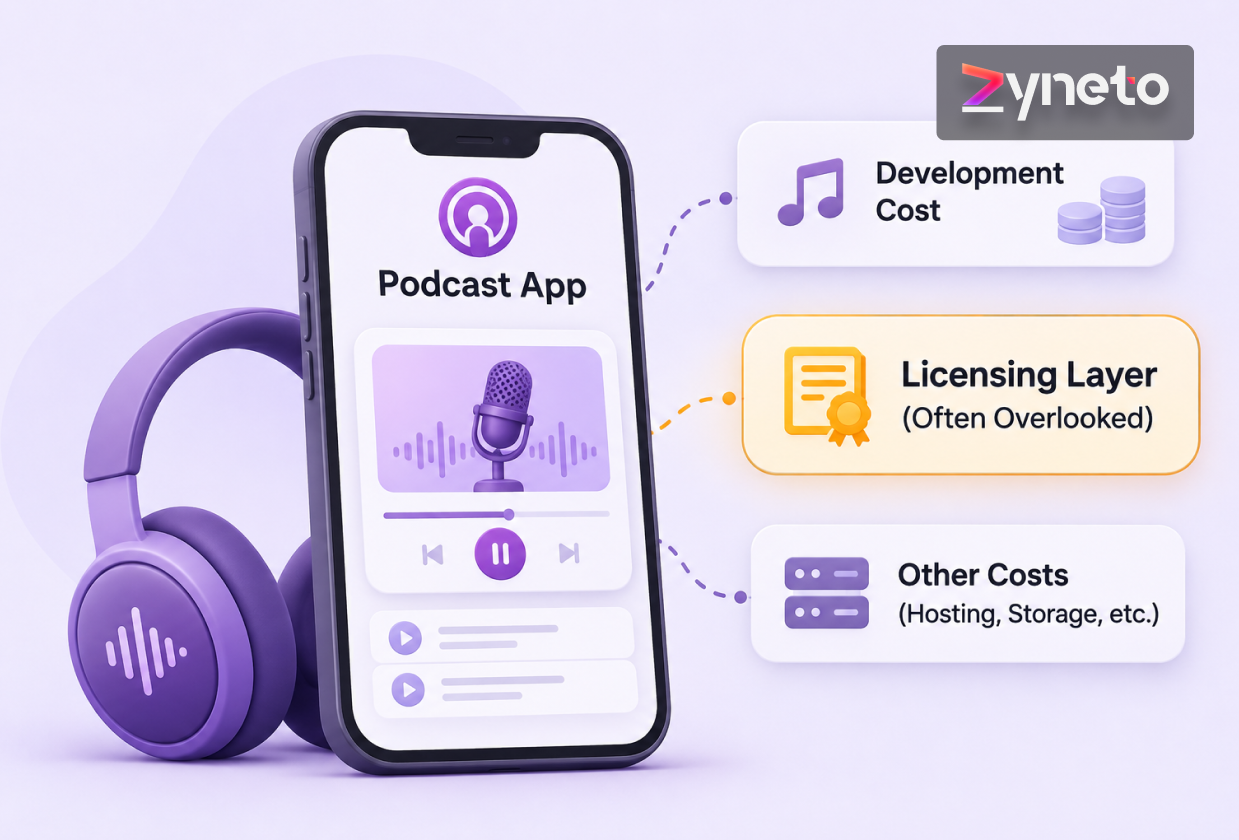
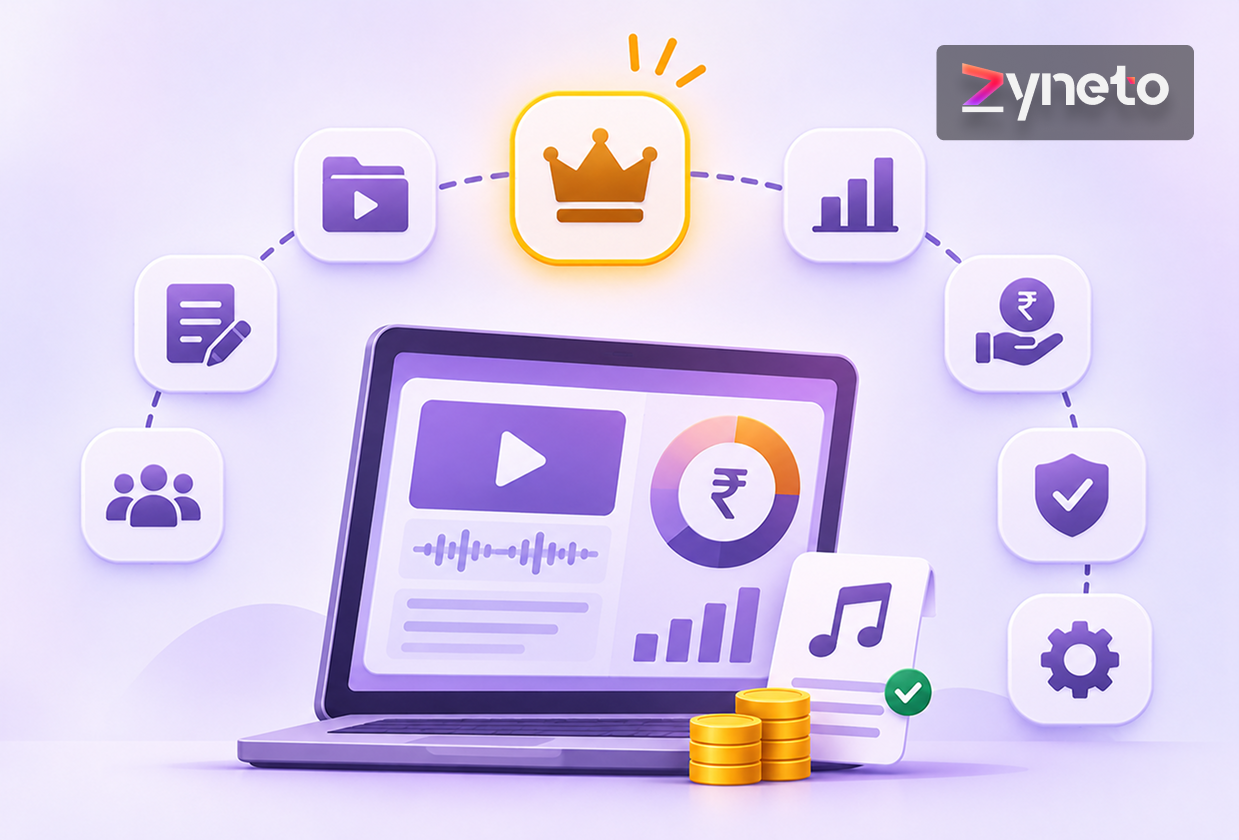
A podcast app deletes the rights layer. An audiobook app pays for all of it and then adds encryption on top. Our media software development page puts a rights and royalty platform at 1,480 hours of phase one work across seven modules, $59,200 to $148,000 at our published band of $40 to $100 an hour by role. A podcast app skips four of those modules. An audiobook app skips none of them, because every title has an author, a narrator and a publisher with contractual shares, sold on per-territory deals, under rates that change.
Then there is delivery, where the arithmetic is brutal. A 45-minute podcast episode at a normal spoken-word bitrate is 21.6 MB. A 10-hour audiobook at the same bitrate is 288 MB, 13 times larger. An audiobook platform reaches the same CDN bill at 35,000 downloads a month that a podcast platform reaches at 475,000.
Three questions decide the number. How many parties share revenue on a title, and can your rate cards be versioned when a distributor changes terms mid-contract? Do you need real DRM or will a signed URL do? And is the catalogue sold, subscribed, or lent? Those three move the build by more than the entire front end costs.
On 26 May 2026, Audible moved to a new royalty model: 50% for exclusive distribution and 30% for non-exclusive, replacing legacy rates of 40% and 25%. Legacy titles keep the old rates until the end of the year, when the legacy model is discontinued. Titles enrolled in the new model switch on the first of the following month.
Read that as an engineering requirement rather than industry news, because it contains four separate things a rights system has to handle, and most first builds handle none of them.
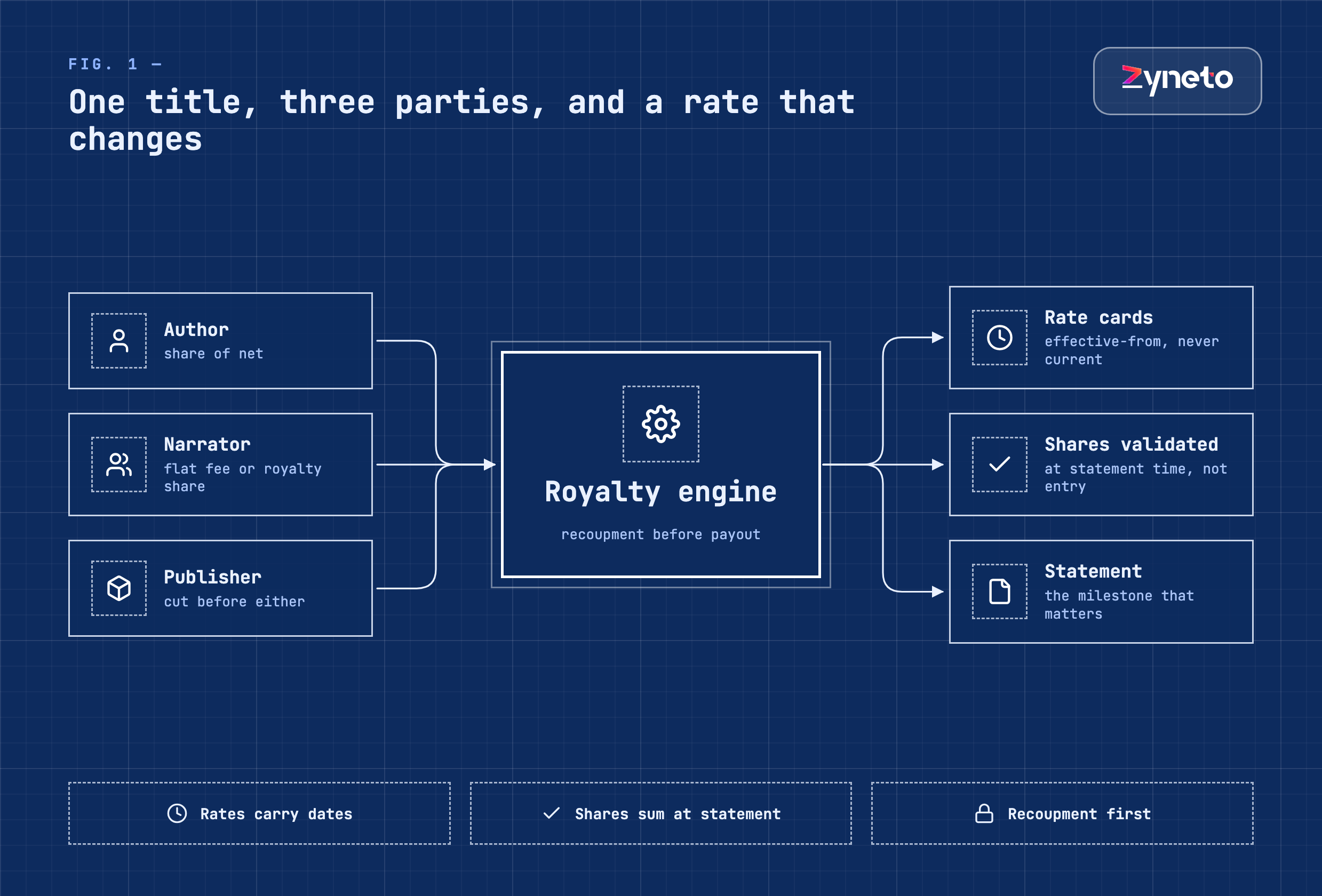
Rates are time-bounded, not current. A statement for April 2026 must calculate at 40% and a statement for July at 50%, forever, including when you regenerate April's statement in 2028 to correct an unrelated error. A rate stored as a single column on a contract row cannot do this. It needs an effective-from date and a history, which is why rate cards are a 240-hour module rather than a settings page.
Two titles under the same publisher can sit on different models simultaneously. Rates attach to titles and enrolment dates, not to accounts.
The switchover is mid-month for some titles and not others. Any system that aggregates a month and applies one rate produces wrong numbers for every title that moved on the 1st.
A deal type can be irreversible. Royalty-share titles require exclusive distribution and cannot be converted. If your data model lets an admin flip an exclusivity flag, you have built a button that silently breaches contracts.
None of this is Audible-specific. Every distributor you integrate will change terms eventually. The system either models time or it does not, and retrofitting time into a royalty engine after it has issued statements is the most expensive rework in this category of product.
Music rights are hard because a recording and a composition are different things with different owners. Audiobook rights are hard for a simpler reason that catches teams out just as badly: the narrator is a party with a financial interest, and often a percentage rather than a fee.
A typical title has an author or rightsholder, a narrator who may be on flat fee or royalty share, and a publisher or distributor taking a cut before any of it. Shares have to sum correctly, survive recoupment against an advance, and still reconcile when a title is sold in a territory where the publisher's cut differs.
Recoupment is the thing that gets bolted on afterwards and should not be. A narrator on royalty share against a $2,000 advance earns nothing until the advance is recovered, and the point at which it is recovered depends on rates that change, as above. Our media page lists "recoupment bolted on after the first run" as a named failure mode, and it is named because it is common. Adding recoupment to an engine that already calculates straight from usage to payout means rewriting the engine.
Shares must be validated at statement time, not at entry time. A title whose shares sum to 97% because someone fat-fingered an edit should fail the statement run loudly, not quietly short-pay a narrator for eight months. This is a one-line check that nobody writes until it has already cost them a relationship.
Podcast paywalls are a token in a URL. There is no encryption, and the industry accepts that. Audiobooks are licensed content, and publishers will ask what protects their catalogue before they sign. That question has one acceptable answer and it is not "signed URLs".
Practically it means multi-DRM. Apple FairPlay covers Safari, iOS, iPadOS and tvOS, and nothing else covers them. Widevine covers Android, Chrome and most everything else. The reason this is tractable rather than ruinous is Common Encryption: you encrypt the audio once and package it for multiple DRM systems from the same encrypted source, rather than maintaining separate pipelines.
Offline is where DRM stops being a packaging exercise and becomes a product problem. Audiobook listening happens on planes, in cars and underground. Offline playback with DRM requires persistent licences with their own expiry, renewal and revocation, and a device limit that someone has to define. Every one of those is a support-ticket generator. What happens when a subscriber's licence expires mid-flight is a product decision, and the honest answer is usually to grant a grace period rather than stop playback at 30,000 feet.
Scope DRM early or not at all. It touches ingest, storage, the player on both platforms and the entitlement service. Adding it in phase two means revisiting all four.
A publisher does not send you a product. They send a folder of WAV or MP3 files named by chapter, a metadata spreadsheet, a cover image at whatever size their designer exported, and a contract PDF that nobody has transcribed into a system. Everything downstream depends on turning that into a consistent object, and this is the step that gets a week in the plan and takes a month.
Audio specifications are a real gate, not a formality. Retail distributors enforce measurable technical floors: a consistent sample rate across every file in a title, peak levels below a ceiling, RMS inside a narrow band, and a noise floor quiet enough that a listener on headphones does not hear the room. A title that fails any of these is rejected after upload, which means your ingest pipeline either measures and reports these on receipt or you discover the problem days later from a distributor rejection email. Measuring on receipt is a day of work. The alternative is a support process.
Chapter structure is metadata, not file names. Listeners navigate by chapter, resume by chapter and skip by chapter. If the only chapter information is Chapter_07_final_v2.mp3, somebody is going to parse that string, and that parser will meet Chapter_07_final_v2 (fixed).mp3 within the first month. Chapters need explicit titles, explicit order and explicit durations, stored as data at ingest. The same structure drives the playback UI, the position sync and any transcript work later.
Run loudness normalisation at ingest and store the original. Titles arrive from different studios at different levels, and a listener moving from one book to the next should not have to touch the volume. Normalise on the way in, and keep the untouched upload permanently, because you will change your transcode settings and re-encoding a lossy file into another lossy file compounds artefacts. Archive storage is the cheapest line in the entire budget.
Budget for the contract transcription nobody mentions. Every title's commercial terms, meaning who gets what share, against what advance, in which territories, from which date, exist in a PDF and have to become rows. For a catalogue migration of any size this is the single largest manual task in the project, and it is the one that decides whether your royalty engine produces correct numbers or confident ones.
Our media page lists "identifiers treated as editable" as a named failure mode. For audiobooks it is the one that quietly destroys reporting.
An audiobook edition is a distinct product with its own ISBN, separate from the print and ebook editions of the same work. An unabridged and an abridged recording are separate editions again. A re-recording with a different narrator is another. Teams that model a title as one row with a format column discover the problem when a publisher asks why two narrations are reporting as one product, by which time the statements have already gone out.
Distributor identifiers are not yours and will change. A retailer's own product identifier is assigned by them, can be reassigned, and is the wrong thing to use as your primary key. Keep an internal immutable identifier, map external identifiers onto it, and never let an admin screen edit either. The failure mode is not a bug report. It is a reconciliation that does not balance and nobody can explain.
Work, edition and file are three levels and collapsing them costs you later. The work is the book. The edition is this narration of it. The file is the artefact you serve, which changes every time you re-encode. Position sync binds to the edition, royalties bind to the edition, delivery binds to the file, and discovery binds to the work. One table cannot carry all four without a rewrite.
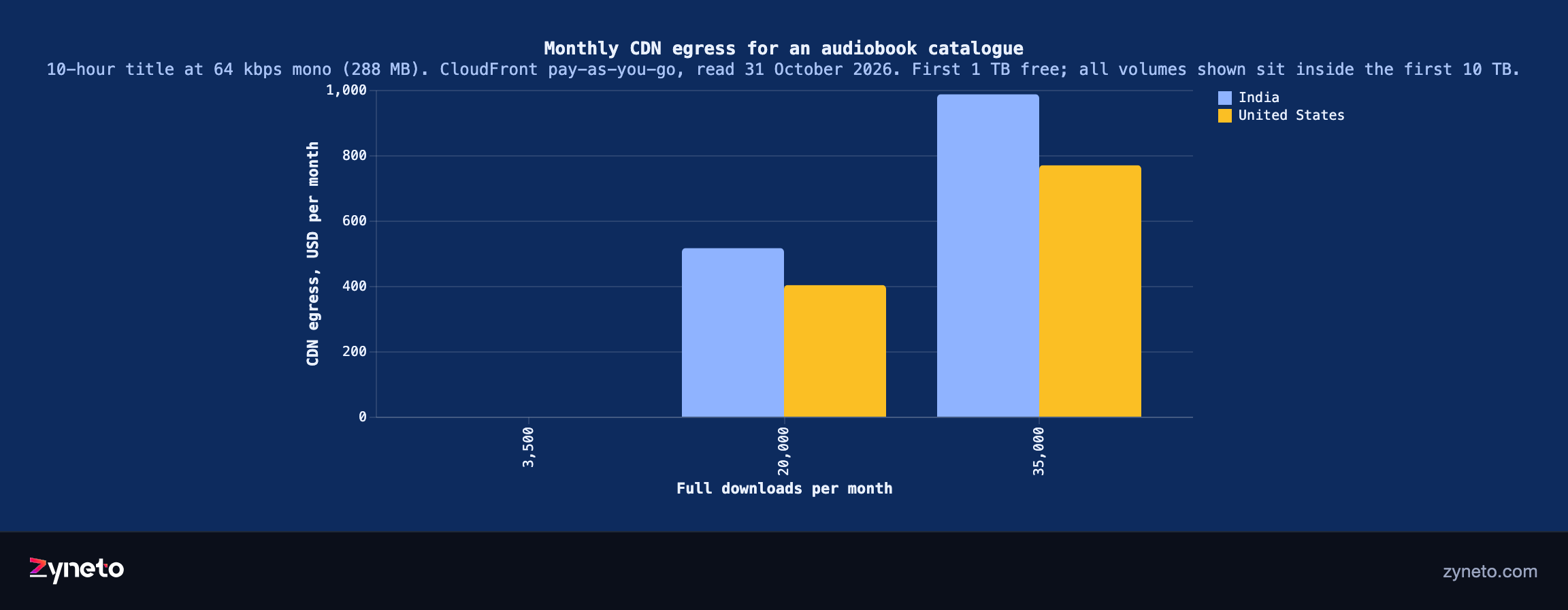
CloudFront's pay-as-you-go rates, read from the AWS pricing page on 31 October 2026: the first 1 TB a month is free in every region, then the next 9 TB bills at $0.085 per GB in the United States, Mexico and Canada and across Europe, Israel and Türkiye, $0.109 in India, and $0.110 across the Middle East and much of Africa.
At 64 kbps mono, a 10-hour audiobook is 288 MB.
|
Downloads per month |
Egress |
Billable after free tier |
US |
India |
|---|---|---|---|---|
|
3,500 |
1,008 GB |
0 GB |
$0 |
$0 |
|
20,000 |
5,760 GB |
4,736 GB |
$403 |
$516 |
|
35,000 |
10,080 GB |
9,056 GB |
$770 |
$987 |
The free tier covers about 3,600 full downloads a month and then stops. For a podcast platform that threshold sits near 47,000. This single ratio is why audiobook unit economics are different, and why nearly every audiobook business is a subscription rather than a per-title purchase: you need predictable revenue per listener because you have predictable, large cost per listener.
Drop the bitrate to 32 kbps mono and the whole table halves. For single-voice narration at typical listening conditions this is defensible, and it is the first lever to pull. It is also a decision that belongs to you rather than to your developer, because it trades audio quality against a recurring cost that scales with success.
Do not let anyone quote you "hosting is cheap" without arithmetic. It is cheap for a podcast. It is a line item for an audiobook platform.
The feature that makes people stay is resuming at the right second on a different device. The feature that makes people leave is resuming at the wrong second, because a listener who loses their place in hour seven of a book does not trust the product again.
The hard part is conflict resolution, not storage. A listener who plays offline on a phone during a flight and also listens on a car system that syncs immediately produces two positions for the same title, both legitimately later than the last synced state. Last-write-wins silently discards one. The usual answer is to keep the furthest position and let the listener jump back, but that is a product decision that someone has to make explicitly.
Store position against an immutable identifier, never a byte offset. Re-encoding a title at a different bitrate changes every byte offset in it, and a platform that stored offsets has just moved every listener's bookmark. Store elapsed time against a stable title and chapter identifier, which is also what makes chapter navigation work.
Sync frequency is a battery and bandwidth trade-off. Every few seconds is wasteful, on pause only loses the position when the app is killed. Most implementations settle on a periodic write plus a write on every pause, seek and backgrounding event.
Public-library distribution runs on a one-copy-one-user model: a library buys a licence, one patron borrows it, everyone else queues. Some licences expire after a fixed number of loans or a fixed period.
That is inventory management with waiting lists, holds, automatic returns and licence expiry, and it is a substantially different product from a consumer subscription. It is a legitimate and under-served market, especially outside the US, and it should be a deliberate phase rather than something absorbed into a general build. Scope it separately or leave it out.
Build the rights and party model first, with time-bounded rates, because every other number derives from it and statements cannot be corrected cheaply once issued. DRM and the entitlement service come second, together. Position sync comes third and should not slip past launch. Lending, recommendations and social features defer cleanly.
The rights and party model comes first, with time-bounded rates, because every other number in the business is derived from it and because it is the only part that cannot be corrected cheaply after it has issued statements. The measure of done is not a screen. It is a statement a narrator would accept.
DRM and the entitlement service come second, together, because they are the same decision seen from two sides and because retrofitting either one means touching ingest, storage and both players.
Position sync comes third and should not be deferred past launch, which is the one thing on this list people regularly get wrong in the other direction. It looks like a small feature and it is the one that decides whether anyone finishes a book on your platform.
Library lending, recommendations and social features defer cleanly. None of them changes the shape of anything built before them.
Our rate band is published: $40 to $100 an hour by role, blending to $60 to $70 for a mixed team, with rights modelling and royalty calculation sitting near the ceiling rather than the floor because that is where the risk is. We do not put a fixed total on a build like this before a discovery that establishes the party model, the DRM requirement and the distribution model, because those three answers change the work by more than the entire client application costs. What we can tell you before any discovery is which module your money goes into, and it is not the one you are picturing.
Our published rate band is $40 to $100 an hour by role, blending to $60 to $70 for a mixed team. For scale, we publish a full rights and royalty platform at 1,480 hours of phase one work, or $59,200 to $148,000, and an audiobook app needs essentially all seven of those modules plus DRM, which a pure rights platform does not include. Delivery is a separate recurring cost: at 64 kbps a 10-hour title is 288 MB, so CDN egress runs about $403 a month in the US at 20,000 downloads.
Three reasons, all structural. Audiobooks are licensed content, so you build the full rights model — parties, shares, territory deals, royalty calculation and statements — which a podcast app skips entirely. Publishers require DRM, which podcasting has none of. And files are roughly 13 times larger per download, so delivery costs cross into real money at about 3,600 downloads a month rather than 47,000.
If you are licensing catalogue from publishers, yes, and they will ask before signing. In practice that means multi-DRM: Apple FairPlay for Safari, iOS, iPadOS and tvOS, and Widevine for Android, Chrome and most other platforms. Common Encryption lets you encrypt once and package for multiple systems from the same source. If you own all the content yourself, signed URLs with rate limits may be enough, which is a materially cheaper build.
Since 26 May 2026, Audible's new royalty model pays 50% for exclusive distribution and 30% for non-exclusive. The legacy model paid 40% and 25% and is discontinued at the end of the year. Existing titles enrolled in the new model switch on the first of the following month. If you are building a platform that reports against these rates, the important detail is that both models are live simultaneously, so rates must be stored with effective dates rather than as a single value.
A 10-hour audiobook at 64 kbps mono is 288 MB. On CloudFront's published rates as of 31 October 2026, the first 1 TB a month is free in every region, then $0.085 per GB in the US and Europe, $0.109 in India and $0.110 across the Middle East. That gives roughly $0 at 3,500 downloads a month, $403 at 20,000 and $770 at 35,000 in the US. Halving the bitrate to 32 kbps halves every one of those figures.
Store elapsed time against a stable title and chapter identifier, never a byte offset, because re-encoding a title changes every offset and would move every listener's bookmark. Write the position periodically during playback plus on every pause, seek and backgrounding event. The genuinely hard part is conflict resolution when a listener plays offline on one device and online on another, producing two valid later positions; most platforms keep the furthest and let the listener jump back.
Subscription suits the cost structure best, because delivery cost per listener is large and predictable and you want revenue that matches it. Per-title sales work but expose you to heavy users with no offsetting revenue. Library lending is a one-copy-one-user inventory model with holds, waiting lists, automatic returns and licence expiry, which is a genuinely different product and should be scoped as its own phase rather than absorbed into a consumer build.

Vikas has around fifteen years of experience building software and now builds generative AI systems at Zyneto. His work covers retrieval augmented generation, agentic AI, knowledge graphs, AI memory, and the evaluation and guardrails that decide whether any of it is safe to put in front of customers. He has shipped enterprise copilots, document AI, chatbots and predictive analytics for e-commerce, fintech and marketing teams, and works day to day in Python, JavaScript and SQL. He follows multimodal models, business process automation and enterprise AI security closely, and mentors engineers moving into AI. He writes about architecture, inference cost and the failure modes that only show up at production scale.
Share your details and we will talk soon.
Be the first to access expert strategies, actionable tips, and the trends actually shaping the digital world. No fluff - just practical insights delivered straight to your inbox.
Dive into our blog and stay ahead of the curve with expert perspectives, future-ready trends, and tech tips written for decision-makers and doers alike.