Predictive Analytics for Business: What It Is, How It Works, and Where It Pays Off


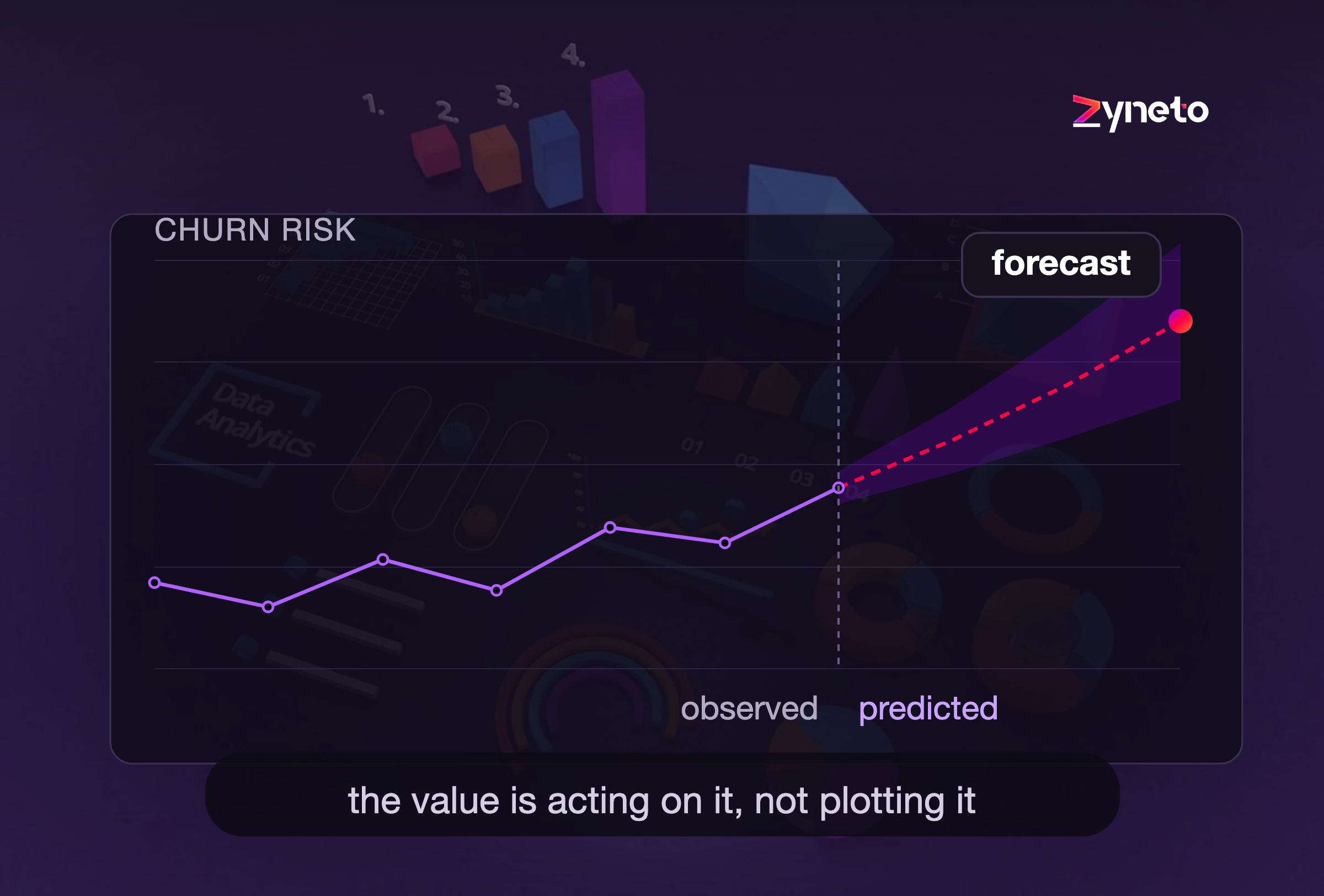
Every business already predicts the future. A manager guesses next month's demand, a rep senses which deal is going cold, a finance lead eyeballs the cash position and frowns. Predictive analytics for business does the same thing with data instead of gut, using your history to forecast what is likely to happen next, with the odds attached. Done well, it tells you which customers are about to leave, which machine is about to fail, and how much stock to order, early enough to actually do something. Done badly, it produces a gorgeous dashboard nobody acts on. This guide is about the first one.
Predictive analytics uses your historical data and statistical models to estimate what happens next. Not with certainty. With probability. It reads thousands of past examples, learns the patterns that led to an outcome, and applies those patterns to today to say, in effect, "customers who behaved like this one usually left within ninety days."
That is the shift that matters. It does not hand you the future. It hands you the odds, early, while the outcome is still yours to change. A churn score is only useful because you can call the customer before they cancel. A prediction you cannot act on in time is just a fact you learned too late.
It helps to put predictive analytics next to its cousins, because the labels get muddled.
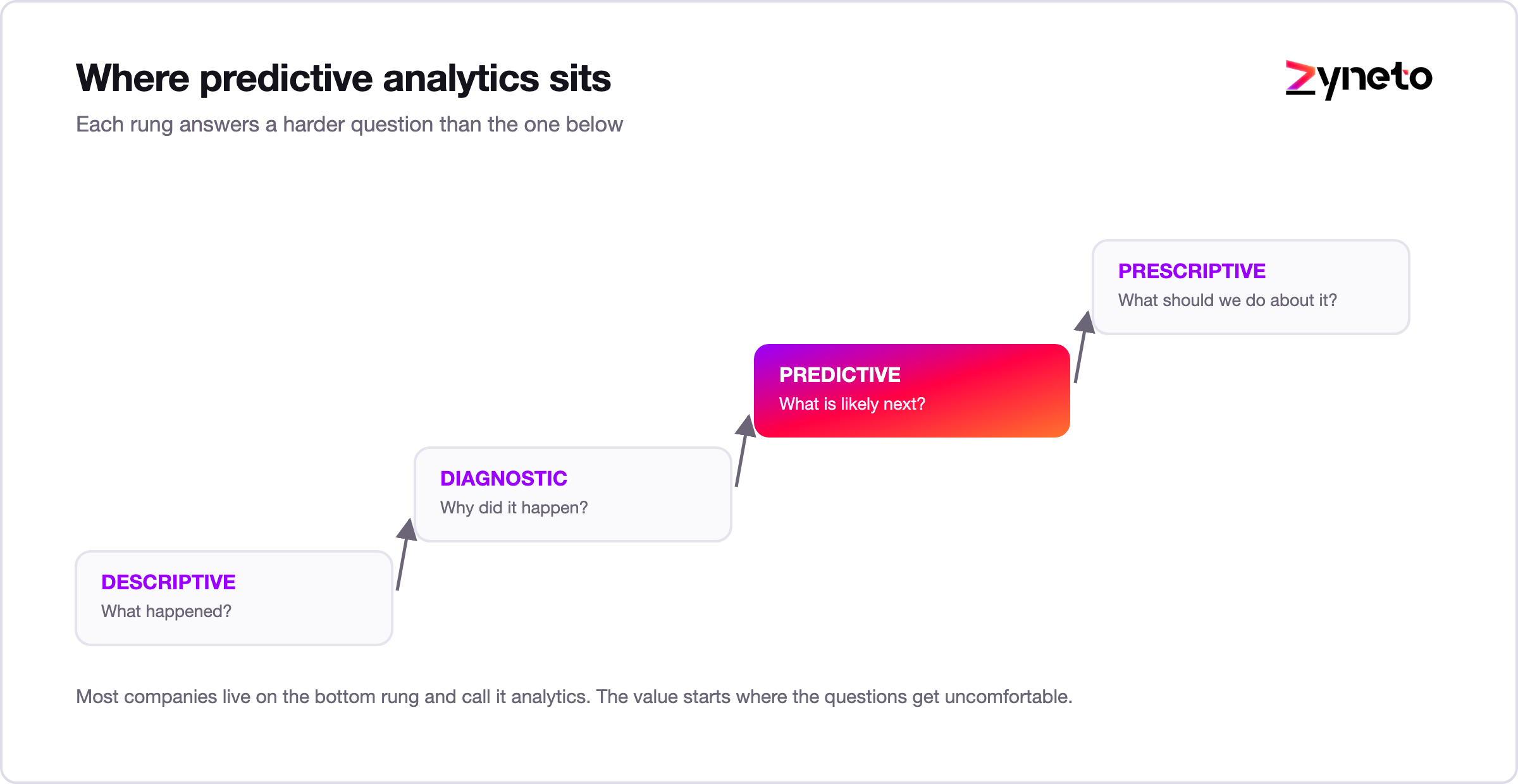
Descriptive analytics tells you what happened. Last quarter's revenue, this week's tickets. Diagnostic analytics tells you why it happened. Predictive analytics tells you what is likely to happen next. And prescriptive analytics takes the last step, recommending what to do about it.
Most companies live comfortably on the bottom rung. They have dashboards full of what already occurred, a tidy rear-view mirror. Predictive is the rung that turns that mirror into a windshield, and it is usually where the money sits, because knowing what is coming beats knowing what already came and went.
Strip the jargon away and the process is the same every time. It even has a name, CRISP-DM, published in 1999 and still the shape most projects follow, 6 phases running from understanding the business to deploying the model.
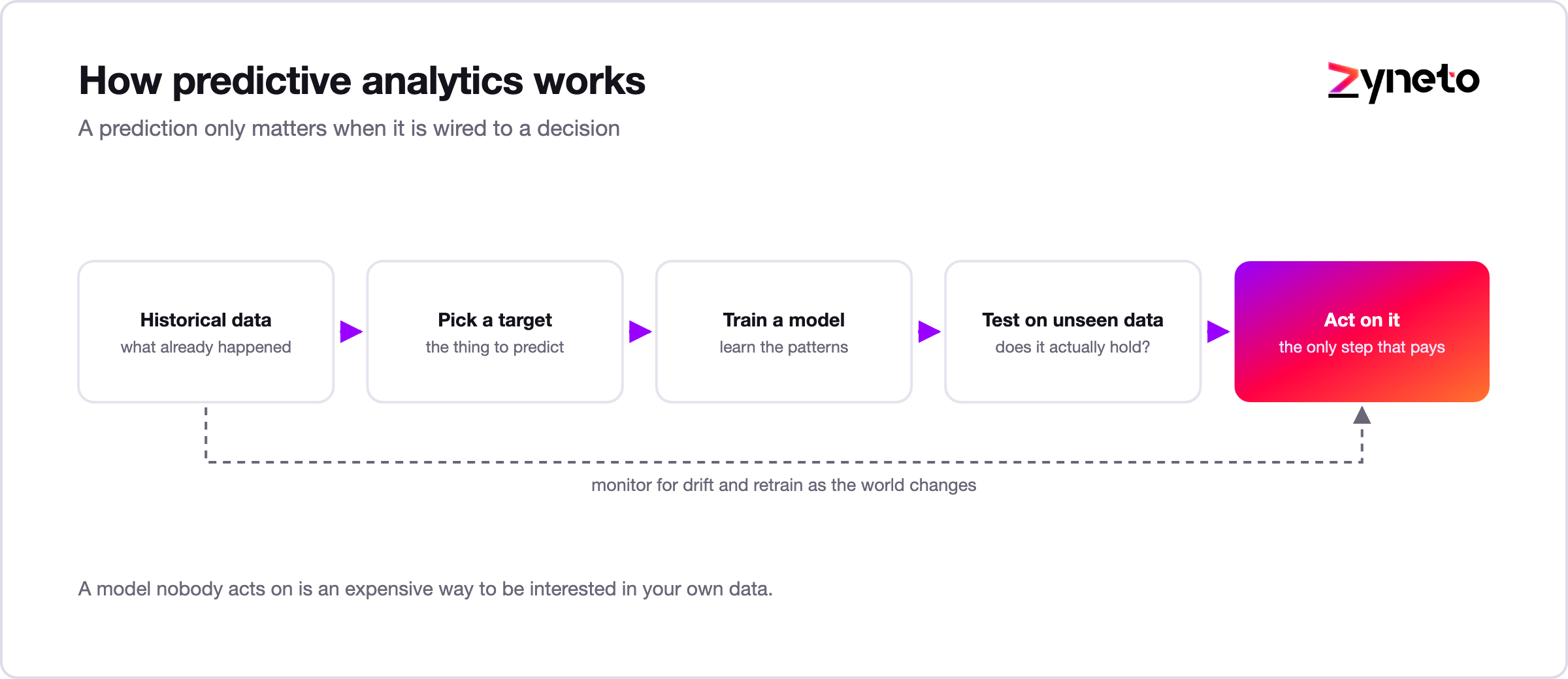
It starts with data, usually a lot of it, pulled from your systems and scrubbed, because real business data is a mess. Then you pick one clear thing to predict, a target: will this customer churn, how many units will sell, is this transaction fraud. A model learns from your history, teasing out the patterns that separated the churners from the stayers. You test it against data it has never seen, usually by holding back 20% to 30% of the history, to check it actually learned something rather than just memorized the past. That test matters more than it sounds, because accuracy on its own will lie to you: if 3% of your customers churn, a model that predicts nobody ever churns is 97% accurate and completely useless, which is why this work is judged on precision and recall instead of one headline number. The usual summary score, AUC, runs from 0.5 for a coin flip to 1.0 for perfect. You deploy it, so it scores new cases as they arrive. And then you watch it, because the world drifts, and a model that was sharp last year can quietly go dull.
The step everyone underrates is the one right before value: connecting the prediction to an action. A score sitting in a report changes nothing at all. A score that fires a retention offer changes the number on the board.
You do not need to build one to sponsor one, but a feel for the toolkit helps. Most predictive work leans on a handful of model types. Regression predicts a number, like next month's sales or a customer's lifetime value. Classification predicts a category, like churn or not-churn, fraud or clean. Time-series models predict values that unfold over time, which is what demand forecasting and cash flow rely on. And under the modern label of machine learning sit models that find patterns too tangled for a person to write down by hand. Which one fits depends on the question, and a good partner reaches for the simplest model that does the job rather than the flashiest. The Netflix Prize is the cautionary tale: the contest ran from 2006 to 2009 and paid 1 million dollars for a 10.06% improvement on the existing recommender, and Netflix never put the winning ensemble into production because it was too complicated to be worth running. Simpler models are easier to trust, explain, and keep running, which counts for more in production than a fractional bump in accuracy.
The wins are concrete, and they turn up right across the business.
Predict how much of each product will sell, by location and by season, and you stop drowning in overstock or bleeding sales to empty shelves. This is one of the oldest and steadiest wins, because the data is rich and the action is obvious: order more, or order less.
Score every customer on how likely they are to leave, and you can act on the ones worth saving before they go, instead of finding out at the cancel button. The clever part is not the score. It is having a retention play loaded and ready to fire the moment that score climbs.
Flag the transactions, claims, or applications that look risky, in real time, so a person reviews the suspicious few instead of wading through everything. Banks and insurers have run on this for years. It is now well within reach for much smaller companies.
Read the signals coming off equipment and call a failure before it happens, so you fix a machine on a quiet Tuesday instead of in the middle of a production halt. For anyone running expensive kit, this one alone can pay for the whole program.
Score leads on how likely they are to buy, and estimate a customer's lifetime value, so your team pours its energy where it will actually pay off rather than chasing every name with equal hope.
Forecast cash flow, model a few scenarios, and see a shortfall coming with weeks to plan rather than days to panic. Finance teams were doing a crude version of this in spreadsheets long before anyone called it analytics.
Some sectors have run on prediction for decades. Retail and ecommerce forecast demand and personalize offers. Banks and insurers score risk and fraud. Manufacturing and logistics predict failures and delays. Healthcare forecasts patient risk and the load on services. Telecom and subscription businesses live and die by churn. If your industry sits somewhere in that list, the real question is not whether to use predictive analytics. It is whether your competitors already do. In most of these, they do.
A quick picture, because "predictive" can float off into the abstract. This one is illustrative, not a specific client.
Picture a subscription business that keeps losing customers and only hears about it at the cancel screen. They build a churn model on two years of usage and billing history. Now, every Monday, a list of the fifty accounts most likely to leave in the next month lands with the success team, each one tagged with the reason the model flagged it. The team calls the savable ones with a targeted offer. Same product, same people, but they are acting a month earlier, on the right accounts, for a reason. That is the entire game. Not a cleverer forecast. An earlier decision.
Or take a plant with a dozen expensive machines. Sensors on each one stream temperature, vibration, and load all day. A model learns what the readings tend to look like in the weeks before a breakdown, and starts flagging a machine the moment it drifts into that danger zone. Maintenance now happens on a planned Tuesday morning, not in the middle of a Thursday rush with the line down and everyone shouting. The machines did not change. The timing did.
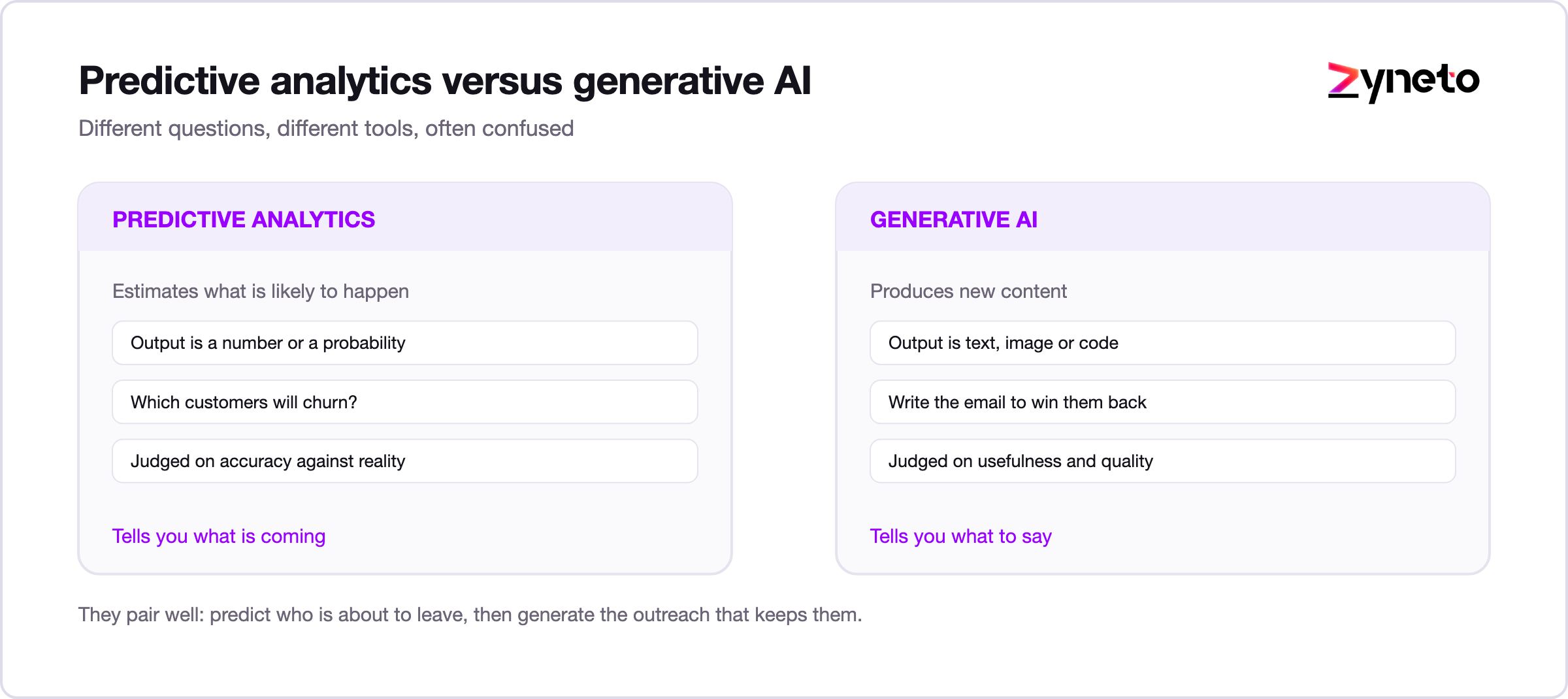
These two get bundled together as "AI," and they do nearly opposite things. Generative AI creates: text, images, code. Predictive analytics forecasts: a number, a probability, a category. One writes the win-back email. The other tells you who to send it to, and when. They pair well, and plenty of modern systems use both, but do not mix them up when you are scoping a project. If it is the creating side you are after, our guide to generative AI for business covers that ground.
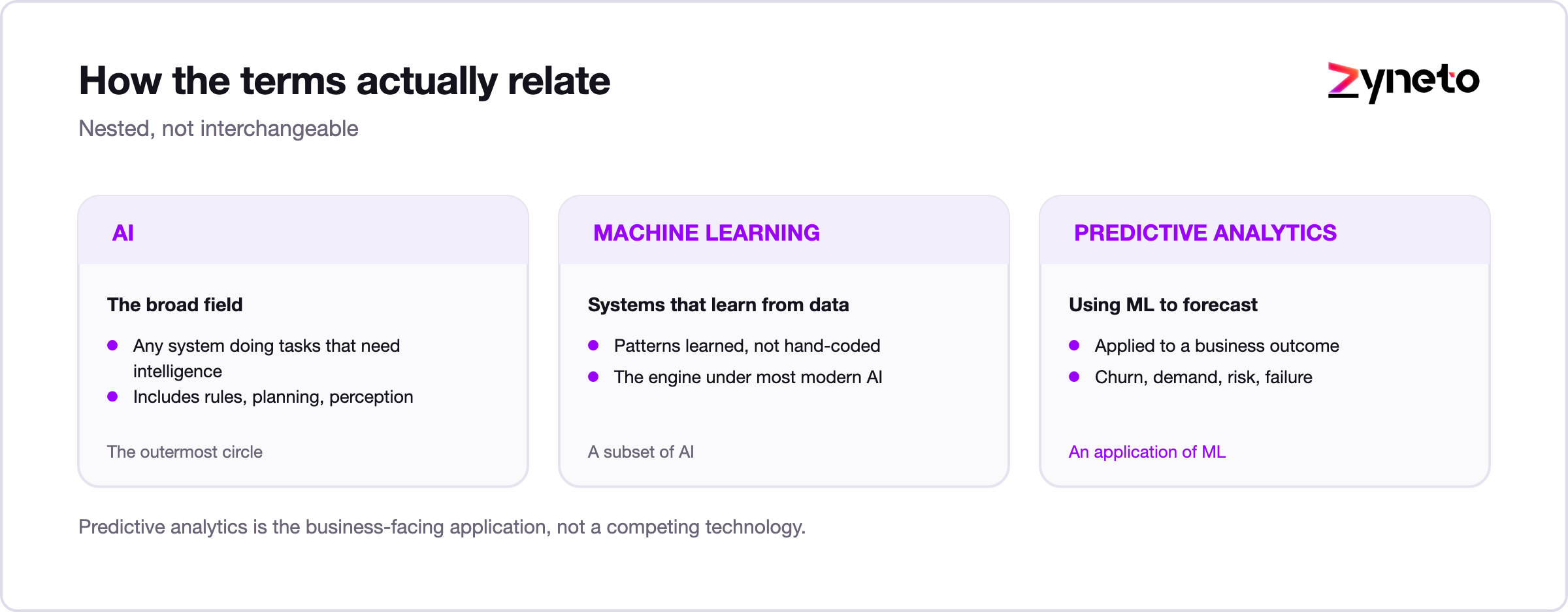
These three get used as if they mean the same thing, and the loose talk leads to bad decisions. Artificial intelligence is the broad umbrella, any system doing something that looks intelligent. Machine learning is a slice of AI, models that learn patterns from data instead of being programmed by hand. Predictive analytics is a job you do, often using machine learning, to forecast an outcome. So predictive analytics usually runs on machine learning, which is a form of AI, but the point is never the technique. It is the decision it improves. When a vendor pitches you machine learning, ask what it will predict and what you will do differently because of it. That one question cuts through most of the noise.
Here is the part the sales decks skip. Predictive analytics is only as good as the data behind it. You need enough history, relevant to what you want to predict, reasonably clean and consistent. Predict churn with two years of solid usage data and you have a real shot. Predict it with six patchy months and you have a random number generator wearing a confident face. So a genuine chunk of any project is not modeling at all. It is finding, cleaning, and joining the data. Teams that skip that step and then blame the model are blaming the wrong thing entirely.
Predictions come with sharp edges, and pretending they do not gets people burned.
They are probabilities, not promises. A model right eighty percent of the time is still wrong one time in five, and you build the process around that fact, not against it. Models drift, because the world moves: a forecast trained before a market shift can be confidently obsolete, which is why you monitor and retrain rather than set and forget. Correlation is not causation, so a model can latch onto a pattern that is real but useless, or worse, one that quietly punishes the wrong people. And then there is over-trust, the soft danger of a number in a box that looks so authoritative nobody dares question it. A prediction is an input to a decision. It is not the decision.
The teams that succeed start narrow and practical.
Pick one prediction that would actually change a decision, and where you already have decent data. Churn, demand, a maintenance signal. Build a first model. Check whether it beats the guess you make today, because if it does not, it is not worth deploying. Most importantly, wire it to an action, so somebody does something different because of the score. Then measure whether that action improved the outcome, not just whether the model was accurate. Expand to the next prediction only once the first one earns it. The projects that fail nearly always try to predict everything at once, or build a beautiful model that feeds a report nobody opens.
You do not always have to build from scratch. For common predictions, plenty of platforms and off-the-shelf tools give you demand forecasting or churn scoring with little setup, and as a first step that can be plenty. The limits show up when your question is specific to your business, your data lives across your own systems, or the prediction needs to plug into your workflow to be worth anything. That is when a custom build over the right models earns its cost, because a generic tool cannot know your customers, your products, or your definition of a good outcome. The rule is the same as everywhere else in this guide: start with the cheapest thing that answers the question, and build custom only when the off-the-shelf answer stops fitting. Most companies begin by buying and grow into building as the stakes climb.
The return is better decisions made earlier, and it shows up as money in a few shapes. Less waste, from ordering and staffing at the right level. More revenue kept, from customers saved before they walked. Less loss, from fraud and failures caught in time. And a lot less firefighting, because you saw the thing coming.
To build the case, take one costly decision you make on gut today, and estimate what getting it right a little more often, a little earlier, is worth over a year. That number funds the pilot. Prove it on one decision, and the next one sells itself.
The failures rhyme. Building a model with no action attached, so the prediction just sits and glows. Trusting a score without ever questioning it. Skipping the data work and expecting the model to rescue the project. Never retraining, so accuracy rots in silence. And measuring the model's accuracy instead of the outcome it was meant to improve. None of these are technical failures. They are discipline failures wearing a technical costume.
Predictive analytics is not for every business or every question. If you do not have enough relevant history, put the data house in order first, because there is nothing for a model to learn from. If the decision it would inform is one nobody will actually change their behavior over, skip it, since a prediction nobody acts on is theater. And for rare, one-off events with no pattern behind them, prediction has no ground to stand on. It shines when the past genuinely rhymes with the future, and someone is ready to act on the forecast.
Predictive analytics is getting cheaper to build and quicker to deploy, and it is increasingly wired straight into the tools where decisions actually happen, so the score shows up at the moment of the choice rather than in a monthly deck. It is also blending with the rest of AI: a model predicts, an automation acts on the prediction, and a generative layer explains the why in plain language. The direction has not changed in a hundred years of business, only the speed. See it coming, and do something about it in time.
Predictive analytics turns your history into a forecast of what is likely next, with the odds attached and, crucially, enough lead time to act. It pays off in demand planning, churn, risk, maintenance, and finance, but only when three things line up: enough clean data, a model that beats your current guess, and a real action wired to the prediction. Start with one decision worth changing, prove it, and grow from there. Treat the forecast as the front end of a smarter, earlier decision rather than a crystal ball, and it earns its keep.
If you want to turn your data into decisions you can act on, Zyneto builds predictive analytics development grounded in your data and tied to the choices your team actually makes. Book a free consultation and we will start with the decision the prediction has to serve.
It is using your past data to forecast what is likely to happen next, with a probability attached. It does not predict the future for certain; it gives you the odds early enough to act, like scoring which customers are likely to leave soon.
Generative AI creates new content, such as text or images. Predictive analytics forecasts an outcome, such as a number or a probability. One writes the email; the other tells you who to send it to and when.
Enough clean, relevant history for what you want to predict. Two years of solid usage data gives a churn model a real chance; a few patchy months does not. A large part of any project is finding and cleaning that data.
Demand and inventory forecasting, customer churn prediction, fraud and risk scoring, predictive maintenance on equipment, lead scoring and lifetime value in sales, and cash flow forecasting in finance.
It deals in probabilities, not guarantees. A good model beats human guesswork and gives you a useful edge, but it is wrong some of the time, and you design the process around that. Accuracy also fades over time, so models need monitoring and retraining.
Pick one prediction that would change a real decision and where you already have decent data. Build a model, check it beats your current guess, wire it to an action, and measure whether that action improved the outcome. Then expand.

Vikas has around fifteen years of experience building software and now builds generative AI systems at Zyneto. His work covers retrieval augmented generation, agentic AI, knowledge graphs, AI memory, and the evaluation and guardrails that decide whether any of it is safe to put in front of customers. He has shipped enterprise copilots, document AI, chatbots and predictive analytics for e-commerce, fintech and marketing teams, and works day to day in Python, JavaScript and SQL. He follows multimodal models, business process automation and enterprise AI security closely, and mentors engineers moving into AI. He writes about architecture, inference cost and the failure modes that only show up at production scale.
Share your details and we will talk soon.
Be the first to access expert strategies, actionable tips, and the trends actually shaping the digital world. No fluff - just practical insights delivered straight to your inbox.
Dive into our blog and stay ahead of the curve with expert perspectives, future-ready trends, and tech tips written for decision-makers and doers alike.