Generative AI for Business: What It Is, Where It Helps, and How to Adopt It


Two years ago, generative AI was a party trick people shared for a laugh. Now it drafts the marketing email, writes the first pass of the code, and answers the support ticket before an agent ever sees it. The hype ran ahead of reality, as it always does, and then reality caught up fast. So the useful question is no longer whether generative AI works. It is where generative AI helps your business, where it quietly hurts, and how to adopt it without getting burned. That is what this guide is about.
Most AI you have used sorts and predicts. It flags the spam, recommends the film, scores the loan. Generative AI does something different. It makes new things: text, images, code, audio, even realistic fake data for testing. You hand it a prompt, and it produces something that did not exist a second earlier. The category went from research to boardroom quickly: ChatGPT opened to the public on 30 November 2022 and was reckoned to have reached 100 million users inside about two months, which is most of why every strategy deck since has carried a slide about it.
Under the hood, these are large models trained on enormous piles of examples, which is how they picked up the patterns of language, or design, or a programming syntax. Scale is the point: GPT-3 already carried 175 billion parameters in 2020, and the models since have gone further. That same training is the source of most of the risks, which we will get to. For now, the one-line version: generative AI creates, where older AI mostly judged.
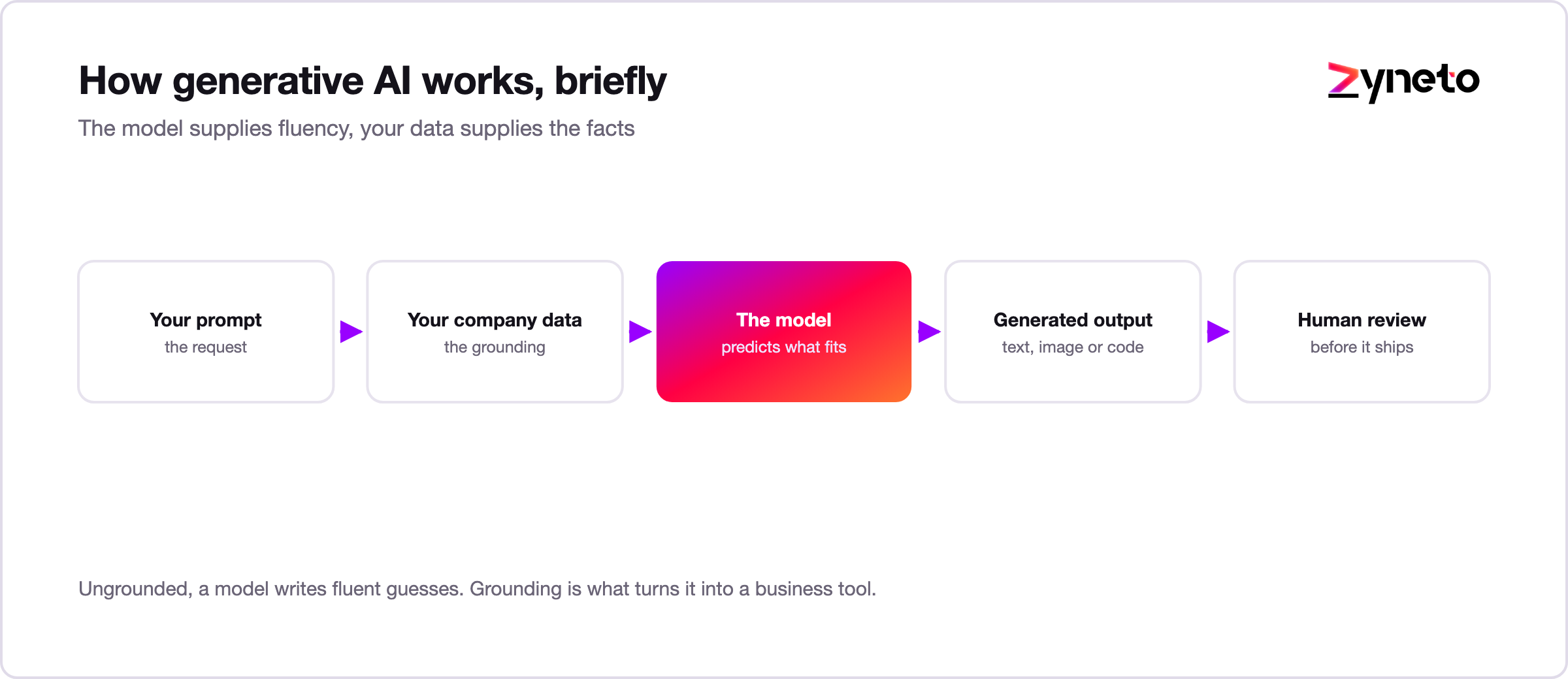
You do not need the math to use it well, but the shape helps. A generative model learned by reading a vast amount of examples and getting very good at one thing: predicting what comes next. The next word, the next pixel, the next line of code. String those predictions together and you get a paragraph, an image, a working function. That is why it can sound fluent about almost anything, and also why it can be fluently wrong. It is a very good guesser, not a filing cabinet of facts. The architecture under nearly all of it traces to one 2017 paper, Attention Is All You Need, which introduced the transformer, and the years since have largely been that same idea trained on more data with more compute. To make it reliable for your business, you point it at your own information at the moment it answers, an approach named retrieval-augmented generation in a 2020 paper and now the default way serious systems stay grounded, so its fluent output stays anchored to something true rather than to whatever it happened to absorb in training.
The range is wider than most people picture.
Text is the obvious one. Drafting, summarizing, rewriting, translating, answering questions. This is where the bulk of business value sits today, simply because so much work is moving words around.
Images and design come next. Marketing visuals, product mockups, ten variations on a concept, produced in seconds instead of an afternoon.
Code is a quiet giant. Developers lean on it to draft functions, explain unfamiliar code, and write tests, which is why engineering teams were among the first to feel the change in their day.
Then there is audio and voice, and even synthetic data, invented but realistic records that let teams test a system without ever touching a real customer's information.
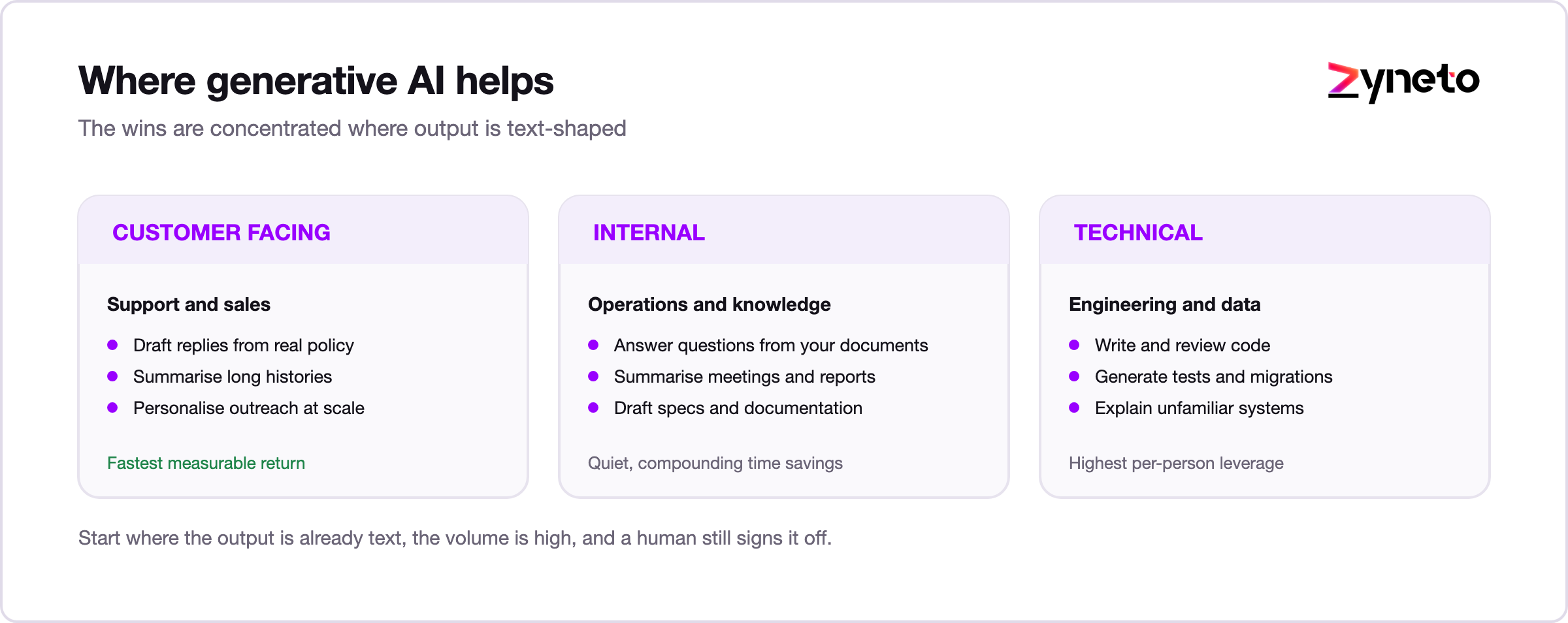
Strip the hype away and the wins cluster in a few honest places. Here is where teams see real value, function by function.
The blank page stops being a problem. Teams draft campaigns, product descriptions, ad variations, and social posts in minutes, then spend their hours editing and choosing rather than starting cold. A marketer launching two hundred product pages can have first drafts by the afternoon instead of two weeks out. The catch is voice. Without grounding in a brand guide, the output drifts generic, which is why the good setups feed the model your style and your facts before it writes a single line.
Support is one of the clearest wins. The model answers the routine questions, summarizes a long ticket history so an agent starts halfway to a solution, and drafts replies a human approves before they go out. Built for resolution rather than raw deflection, it trims response times without leaving customers stuck arguing with a wall.
Reps use it to personalize outreach at scale, summarize an account before a call, and turn a scrappy set of notes into a clean follow-up. The admin that used to eat an hour between meetings now takes a few minutes, and that time goes back into actually selling.
Code was one of the first places the change landed. Developers draft functions, explain unfamiliar code, and write tests with an assistant right in the editor, which keeps them in flow instead of switching to search. It does not replace judgment about architecture or security. It just removes a lot of the typing.
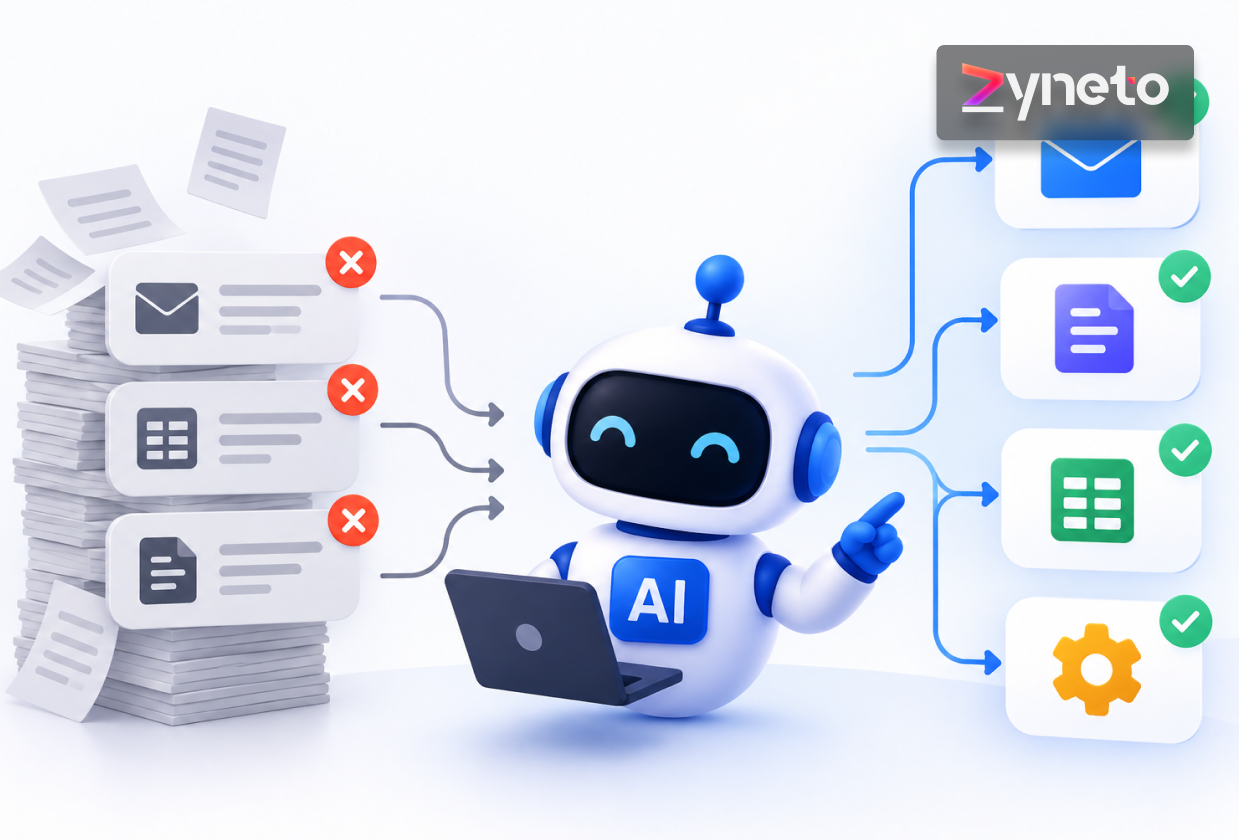
So much operations work is turning unstructured mess into structured data: reading invoices, pulling fields out of contracts, tidying records that never matched. Generative AI is well suited to exactly that, handling the format variation that breaks rule-based tools and flagging the odd cases for a person to check.
One thread runs through all of it. Generative AI is strongest on the first draft and the repetitive, and weakest on the final call. It carries you to eighty percent in a hurry, and a person takes it the rest of the way.
A quick picture, because "productivity" is a slippery word.
A marketer opens Monday with ten product descriptions to write. Old way, that is most of a day. With generative AI grounded in the brand guide and the product specs, the first ten drafts land in minutes, in the right voice, with the right details. She does not ship them raw. She reads, fixes the two that missed the mark, sharpens the rest, and moves on to the campaign she never had time for. Same person, same standards, a day handed back. That is the shape of a real win: not the machine replacing her, the machine clearing the runway.
Or picture a support lead on a Monday: two hundred tickets in the queue, and half of them the same three questions. The assistant clears those in the background, drafts replies for the next tier that agents wave through with a glance, and routes the genuinely hard ones up with the history already summarized. The team spends its day on the twenty tickets that actually need a human, instead of drowning in the hundred that never did.
"Generative AI" is the engine. What you actually deploy are the applications built on it, and a handful are worth naming.
A chatbot is generative AI pointed at your customers. A copilot is the same power built into a product to help your staff as they work. An agent is it wired up to take multi-step action on your behalf. And document AI, the retrieval approach, is it grounded in your own files so it answers from your content rather than the open internet. If you are working out where to start, those four are the practical shapes generative AI takes inside a business. Each has its own guide: AI chatbots, AI copilots, AI agents, and chatting with your documents.

It pays to be straight about both.
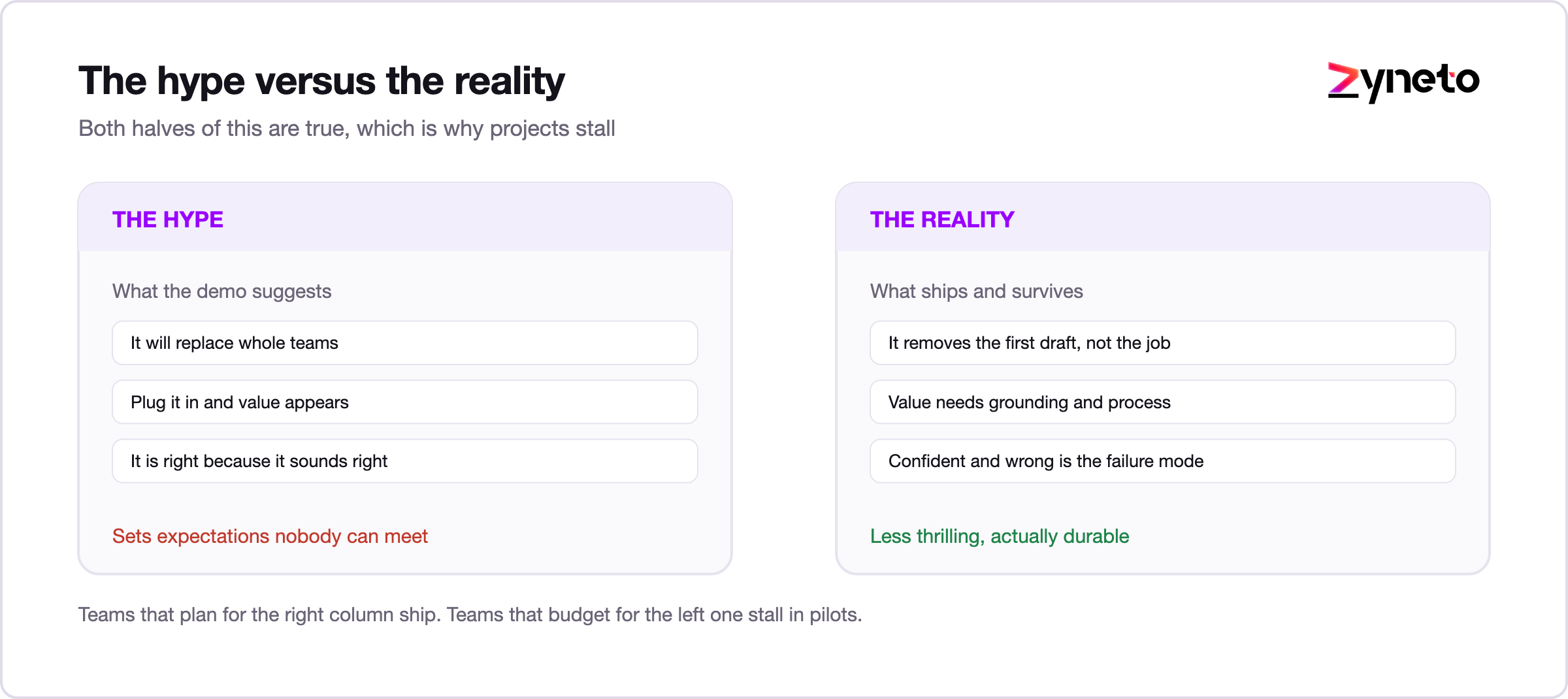
The hype says generative AI will replace whole teams and think for itself. It will not, at least not yet. What it actually does is compress the time between an idea and a first version, which is genuinely valuable and a lot less cinematic than the headlines.
The reality is closer to a fast, confident intern. Quick, tireless, occasionally brilliant, and every so often confidently wrong in a way that will embarrass you if nobody checks the work. Treat it like that intern, useful with supervision and risky without, and you get the upside while sidestepping most of the trouble.
This is the part the demos skip, and it is where enterprise projects are really decided.
Accuracy comes first. These models will state a false thing with the exact confidence of a true one. For anything that matters, you ground the model in your own verified data and keep a person on the final answer.
Then intellectual property. Two questions your legal team will ask: what was this model trained on, and who owns what it produces. The answers vary by tool, and "we never checked" is not one you want to be giving after launch. One part is already settled in the United States: the Copyright Office holds that material produced purely by a machine, with no human authorship, cannot be registered, a line it drew over the comic Zarya of the Dawn in February 2023, so what you can claim as your own depends on what a person actually contributed. A serious build comes with a defensible position on both.
Data privacy is next. Piping customer or confidential data into a third-party model can be a compliance problem all its own, which is why plenty of companies run models in their own cloud or on-premise instead.
And then consistency. One good output is easy, and partly luck, because these models sample rather than calculate and the same prompt can return a different answer twice; dropping the temperature setting toward 0 makes them repeat themselves more faithfully. Ten thousand outputs that all sound like your brand and none of which wander off a cliff is the harder standard, and the one that separates a slick demo from a system you can trust at volume.
And there is bias. A model reflects the data it learned from, warts and all, so it can quietly carry stereotypes into hiring language, marketing copy, or a decision if nobody is looking. For anything that touches people, a review step is not optional.
Good generative AI is not a one-time setup, it is a habit. A few practices separate the systems people trust from the ones they quietly abandon.
Keep a human in the loop where it counts, especially anything customer-facing or high-stakes. Give the model a clear brief: a style guide, a few examples of strong output, and the boundaries of what it should and should not say. Build a small set of test cases and re-run them whenever you change a prompt or swap a model, so you catch quality slipping before your users do. And read the real output regularly, because the gap between a demo and daily use only shows up in the messy live examples. None of this is glamorous. It is the difference between a tool that impresses once and one that keeps earning its place.
You do not have to build anything to benefit. There are three broad paths.
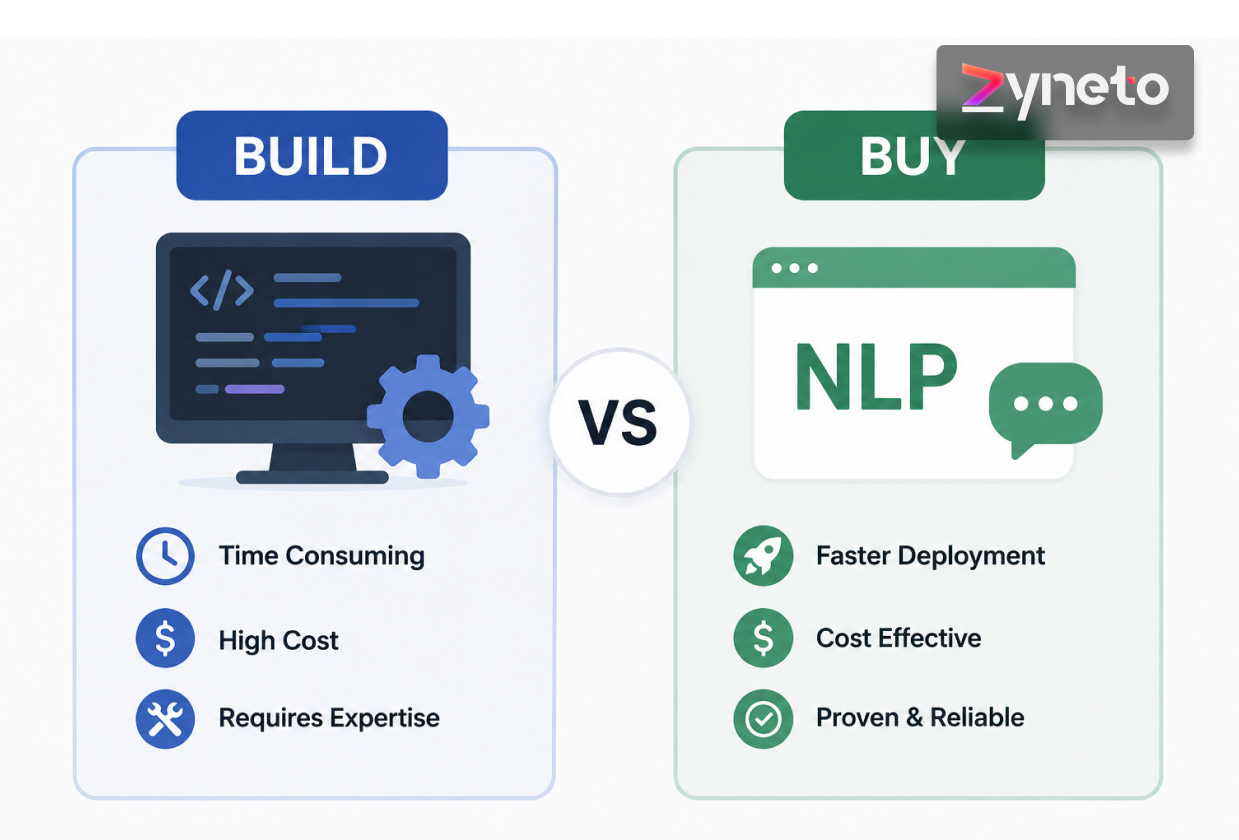
Buy the ready-made tools. For general writing and everyday tasks, off-the-shelf assistants get you moving today with zero engineering.
Build on top of a model. When you need it grounded in your data, matching your voice, and plugged into your systems, you build a custom layer over a foundation model. This is where most of the real business value shows up, and where the risks above actually get handled.
There is a ladder inside that build. The cheapest rung is prompting, just instructing an off-the-shelf model well. The next is grounding it in your data through retrieval, so it answers from your content instead of guessing. The top rung is fine-tuning, teaching it your voice or a narrow skill. Most business projects live on the first two rungs, and only climb to fine-tuning when they genuinely need a consistent style at scale. Start low, and go up only when the results ask for it.
Whichever path, start narrow. Pick one high-volume task, put generative AI on it with a person reviewing the output, measure whether the result is genuinely good, and grow from what works. The teams that try to transform everything at once tend to transform nothing.
Here is the unglamorous truth behind every good generative AI project: it is only as good as the data you feed it. A model grounded in a tidy, current knowledge base gives sharp answers. The same model pointed at a folder of outdated PDFs and half-finished wiki pages gives confident nonsense, because it faithfully mirrors the mess. So a real chunk of any serious project is not AI work at all. It is finding the right content, cleaning it, and keeping it fresh. Teams that skip that step and then blame the model are blaming the wrong thing. If you want one honest predictor of whether your generative AI will work, look hard at the state of the data it will draw from.
The return is mostly time and reach, not layoffs.
Time, because a first draft that took an hour now takes a minute, and your people spend the saved hours on judgment rather than blank pages. Reach, because a small team can suddenly produce more content, cover more tickets, and personalize more outreach than its headcount used to allow. And speed, because the gap between an idea and something you can react to shrinks to almost nothing.
To build the case, take one repetitive, writing-heavy task, measure what it costs in hours today, and estimate how much generative AI can carry with a person still reviewing. Prove that one, and funding the next is an easy conversation.
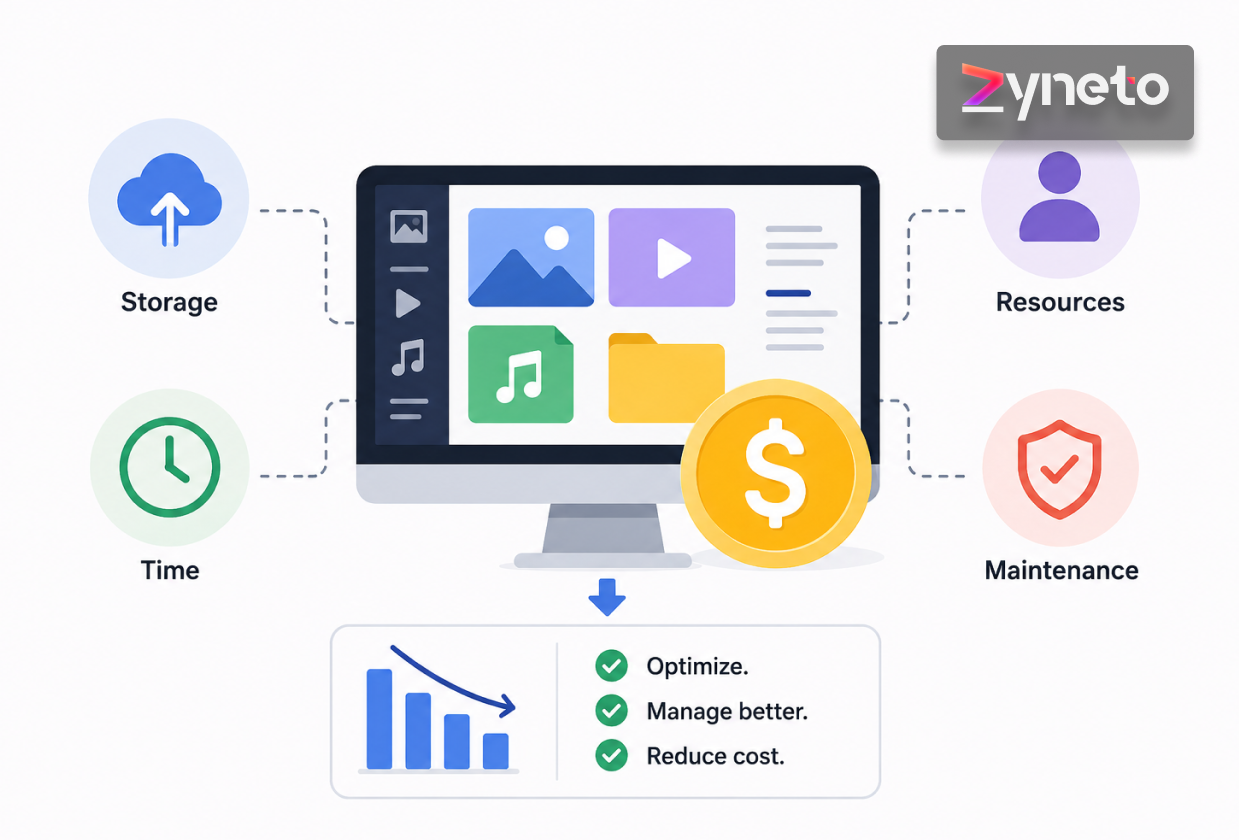
Generative AI is not free to run, and the bill surprises teams that skipped the math. Most tools charge by usage, and the unit is the token, roughly 4 characters or three-quarters of an English word, so a 2,000-word document is about 2,700 tokens going in before you pay for anything coming back. Every draft, answer, or image carries a small cost that adds up at volume. Building a custom system adds development, plus the ongoing cost of keeping it grounded and monitored. And do not forget the human time to review output, which is a feature rather than a bug, but still a line in the budget. None of this makes generative AI expensive next to the hours it saves. It just means you should know the cost per output, and make sure it lands well under what the same task costs by hand. A short pilot gives you that number before you commit to anything.
The failures rhyme. Shipping output straight to customers with no human check. Ignoring the IP and data questions until legal forces the issue. Chasing a flashy all-in transformation instead of one solid use case. Measuring activity instead of output quality. And treating a confident answer as a correct one. None of these are subtle. They are just what happens when the excitement outruns the discipline.
The trend runs from single outputs toward systems that chain generation together and take action, which is the move from a chatbot that answers to an agent that does. Models are getting cheaper and more multimodal too, handling text, images, and audio in one place. But the fundamentals hold: ground it in your data, keep a person on the important calls, and know where your model and its training came from. The teams building that discipline now are the ones who will scale generative AI safely later.
Generative AI creates rather than just classifies, and for a business that means fast first drafts and repetitive work handled at a scale a small team could not reach before. The value is real, and so are the risks: accuracy, IP, privacy, and staying consistent across thousands of outputs. Start with one high-volume task, ground the model in your own data, keep people on the final call, and grow from what actually works. Treat it as a capable intern rather than a replacement, and it earns its place.
If you want generative AI that stays on brand, on facts, and on the right side of your legal team, Zyneto builds generative AI development judged on output quality, grounded in your data, with clear answers on IP and training. Book a free consultation and we will pin down what good output actually means for your team.
It is AI that creates new content, text, images, code, audio, from a prompt, instead of only sorting or predicting like older AI. You describe what you want, and it produces something new.
Drafting marketing and sales content, answering and summarizing support tickets, assisting developers with code, turning messy documents into structured data, and powering chatbots, copilots, and agents.
Traditional AI mostly classifies and predicts, like flagging spam or scoring a loan. Generative AI produces new content. One judges, the other creates.
Confident but false output, unclear intellectual property and training-data rights, sending sensitive data to third-party models, and keeping output consistent and on-brand across high volume. Each is manageable with the right build.
Often yes, because off-the-shelf tools let a small team punch above its headcount on content, support, and outreach. Start with one high-volume task and keep a person reviewing the output.
Not always. Buy ready-made tools for general tasks. Build a custom layer when you need it grounded in your data, matched to your voice, and connected to your systems, which is where most real value shows up.

Vikas has around fifteen years of experience building software and now builds generative AI systems at Zyneto. His work covers retrieval augmented generation, agentic AI, knowledge graphs, AI memory, and the evaluation and guardrails that decide whether any of it is safe to put in front of customers. He has shipped enterprise copilots, document AI, chatbots and predictive analytics for e-commerce, fintech and marketing teams, and works day to day in Python, JavaScript and SQL. He follows multimodal models, business process automation and enterprise AI security closely, and mentors engineers moving into AI. He writes about architecture, inference cost and the failure modes that only show up at production scale.
Share your details and we will talk soon.
Be the first to access expert strategies, actionable tips, and the trends actually shaping the digital world. No fluff - just practical insights delivered straight to your inbox.
Dive into our blog and stay ahead of the curve with expert perspectives, future-ready trends, and tech tips written for decision-makers and doers alike.