Astrology App Development: Build One That Keeps Its Margin


An astrology app makes money when 3 decisions are right before anyone writes code: what you sell (live consultations, reports or subscriptions), which payment route each of those is allowed to use, and how the app earns trust in its charts. Get the payment route wrong and up to 30 per cent of every consultation goes to an app store instead of to you. Design live consultations as real-time, 1:1 and unrecorded, and both Apple's and Google's rules allow an ordinary payment gateway that charges about 2 per cent. Everything else is detail hanging off those 3.
The usual starting point is the feature list: horoscopes, kundli, matching, chat with an astrologer. That list is not a differentiator, and Apple's review guidelines already name fortune telling as a category it will not accept more of without a meaningfully different experience. The failure is ordinary: a founder adds a "replay your consultation" button because users asked for it, and that one feature can move every Android consultation out of the exemption and onto Google Play billing.
There are 3 things to sell, and they follow different rules. Live consultations with astrologers, charged by the minute or by the session. Digital products such as kundli reports, compatibility reports and yearly forecasts. And subscriptions for premium content. You can sell any mix of the 3, and each follows different payment rules.
The scale of the category is real. Astrotalk, one of the largest Indian platforms, states on its own site that it has served more than 4.3 crore customers through more than 13,000 astrologers and other experts in over 60 countries, with more than 1 lakh consultation minutes a day. Those are the company's own figures, but they show where the volume sits: in live conversation, not in static horoscopes.
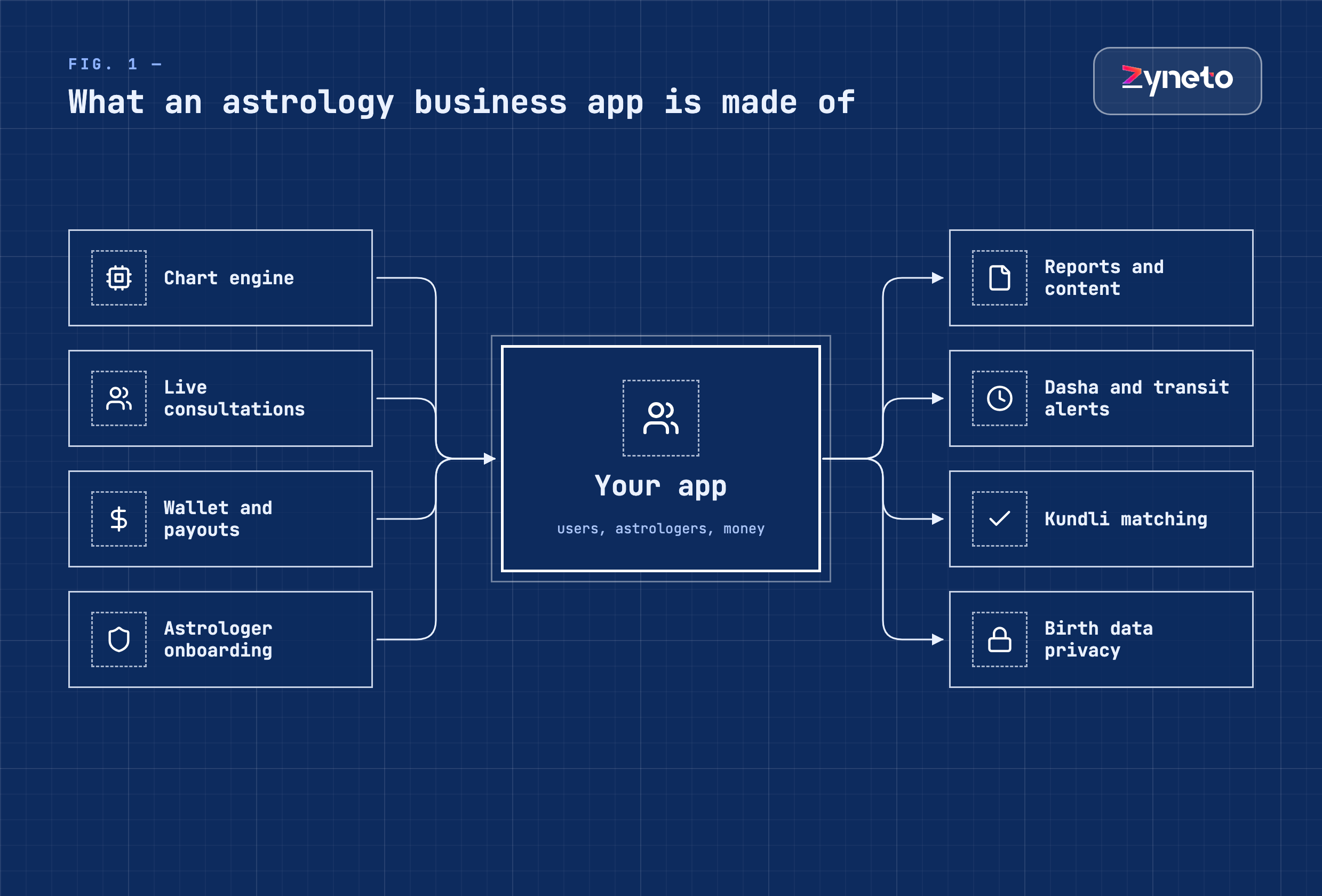
That makes your app a marketplace, not a calculator. You have 2 sets of users: people who want guidance and astrologers who supply it. The chart engine is the part users see first, but onboarding astrologers, routing calls, holding money and paying it out are where most of the build and most of the risk sit.
Decide your model before your screens. A consultation marketplace needs a wallet, live chat and calls, payouts and astrologer management. A reports business needs a strong chart engine and good writing. A content and subscription app needs a publishing workflow. The same feature list costs very different amounts depending on which of these you are.
Apple allows a payment gateway for real-time person-to-person services. Apple's App Review Guidelines, section 3.1.3(d), say that an app selling real-time services between 2 individuals may use purchase methods other than in-app purchase. Apple's own examples are tutoring, medical consultations, real estate tours and fitness training. The same section says one-to-few and one-to-many real-time services must use in-app purchase.
Google has a matching exemption with a condition you must design for. Google's guidance for developers of 1:1 online paid services says Play billing is not required when the service is between 2 individuals and the session is not available for replay afterwards in any app distributed on Google Play. Its examples include lessons, coaching and specialist advice.
Neither company names astrology. A live, private consultation with 1 astrologer fits both descriptions closely, but that is an interpretation, and you should confirm it against the current text before launch.
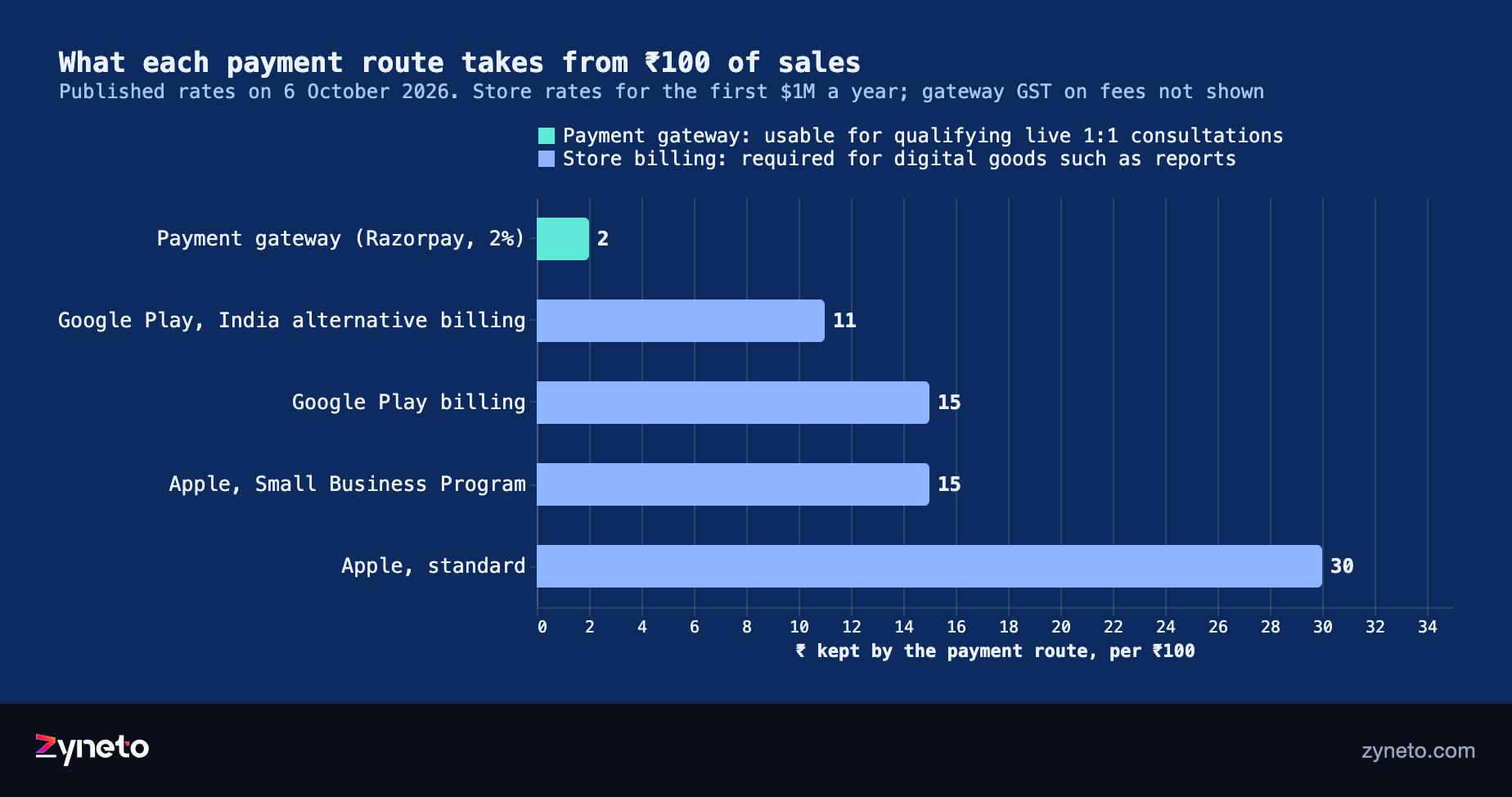
The difference is most of a business's margin. Razorpay's published rate on 6 October 2026 is 2 per cent per domestic transaction, plus 18 per cent GST on the fee. Apple's standard commission is 30 per cent, or 15 per cent under its Small Business Program for developers under $1 million a year. Google Play charges 15 per cent on the first $1 million a year in India, and 4 points less when an Indian user pays through alternative billing.
Reports and other digital goods do not qualify. A generated kundli report or a yearly forecast PDF is digital content, not a live service between 2 people, so on iOS and Android it goes through the store's billing. Price those products with the commission included, and push your consultation revenue through the route that qualifies.
Keep consultations live, private and unrecorded on Android. Google's condition is that the session is not available for replay or access afterwards in a Play-distributed app. A recording, or a chat history the user can reopen after the session, is a feature that can break it. For chat consultations this is the hardest design question in the app, so settle it before you build the chat screen. If users want a record, give them the astrologer's written summary as a separate product, priced through the store.
Keep group sessions separate from 1:1 sessions. A live group puja, a webinar with 1 astrologer and many viewers, or a broadcast Q&A is one-to-many. Apple's guidelines put those on in-app purchase. Build them as a distinct product with its own pricing instead of mixing them into the consultation wallet.
Design the wallet carefully, and take legal advice on it. Most consultation apps let users top up a balance and spend it per minute. The Reserve Bank of India's Master Directions on Prepaid Payment Instruments, updated to 30 September 2026, define a closed-system instrument as one issued by an entity for buying goods and services from that entity only, with no cash withdrawal and no use for third-party payments, and say such instruments are not regulated or supervised by the RBI. A wallet whose balance pays astrologers who are not your employees is the point to check with a lawyer before you build it.
Pay astrologers out with tax handled from day 1. Under the Income-tax Act 2025, section 393 carries the old 194-O rule: an e-commerce operator deducts 0.1 per cent of gross services from payments to participants, with an exemption for individuals under ₹5 lakh a year who have given their PAN or Aadhaar. Under GST, the tax collected at source by e-commerce operators under section 52 has been 0.5 per cent since 10 July 2024. Both belong in the payout logic, not in a spreadsheet at year end.
The call itself is the cheapest part. On 6 October 2026, Agora listed audio at $0.99 per 1,000 participant minutes and ZEGOCLOUD at the same price. A 1:1 call has 2 participants, so a 10 minute consultation uses 20 participant minutes: about 2 US cents. Twilio and 100ms list video at $0.004 per participant minute, so a 10 minute video consultation costs about 8 US cents.
Chat is priced by users, not by minutes. Chat services price by monthly active users. Stream's free plan covers 1,000 monthly users, and its next plan is $499 a month billed monthly for 10,000. Sendbird starts at $399 a month billed monthly for 5,000. CometChat starts at $239 a month billed annually. If chat is your main consultation channel, budget a monthly step cost from your first thousand users.
Payouts cost a fixed fee per transfer. Cashfree's published payout fees run from ₹3 for a small NEFT transfer to ₹15 for a large UPI or IMPS one, before GST. Batch payouts daily or weekly rather than per consultation, or the fixed fee eats small sessions.
Tax sits on top of everything. CBIC's rate notification taxes services not classified elsewhere at 18 per cent GST. Astrology consultations are generally treated under that heading, though no CBIC document names astrology. Confirm the classification with your tax adviser, because it sets the price the user actually pays.
Cost per 10 minute consultation | Amount | Source |
Audio call, 2 participants | about $0.02 | Agora or ZEGOCLOUD list price |
Video call, 2 participants | about $0.08 | Twilio or 100ms list price |
Payment gateway | 2% of the payment, plus GST on the fee | Razorpay pricing |
Store billing, if the session does not qualify | 11% to 30% of the payment | Google and Apple |
Astrologer payout | ₹3 to ₹15 per transfer, batched | Cashfree pricing |
Payment design outweighs delivery cost. Delivering a consultation costs cents. Choosing the wrong payment route costs a quarter of the revenue. Founders who spend their first meeting on the feature list instead of on payment design are optimising the wrong number.
Users check your chart against one they already trust. On our build for Tvam, a Vedic astrology app on iOS, Android and the web, the users had usually seen their kundali before, often on paper from a family astrologer, and compared the app against it. The chart has to agree with that from the first screen.
Compute charts on the server, not on the phone. For Tvam, 1 server-side service resolves the birth details, computes the positions under the selected ayanamsa, derives the houses and produces the divisional charts, and every app reads from it. The alternative, a calculation library inside each app, means 2 native codebases that must agree numerically forever, and every correction waits for app store review. The trade-off is that the core screen needs a connection, so offline use needs deliberate caching.
Store the birth details as entered, and derive the rest. Tvam stores the birth event, meaning the local date, time and place, and derives the instant when it reads it, because time zone history gets corrected and a stored instant freezes whichever rules applied on the day it was saved. The Tvam case study covers these decisions and the 2 regional chart formats, North and South Indian, drawn from 1 chart model.
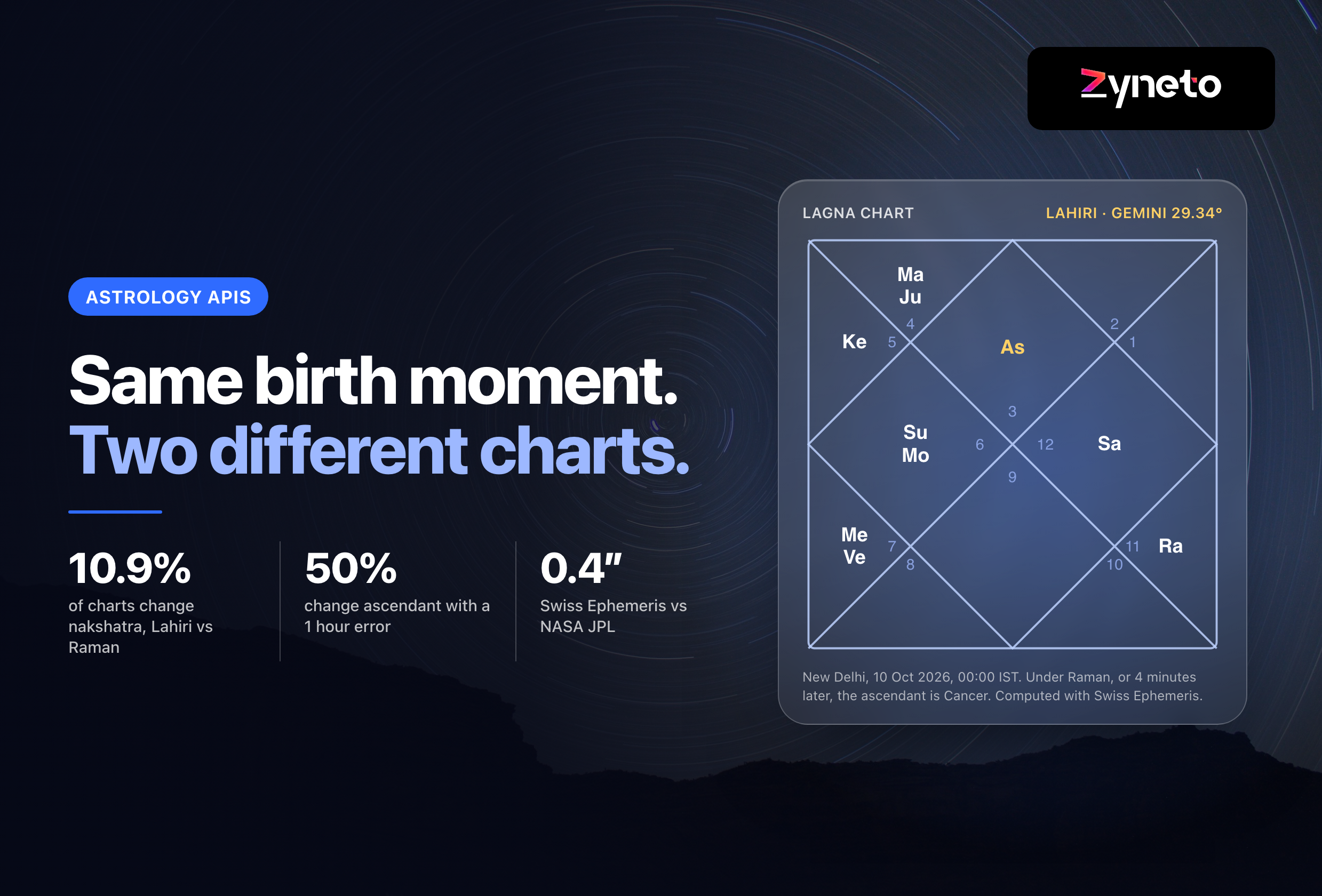
Choose the ayanamsa and the time zone handling deliberately. These, not the astronomy, are why 2 apps show different charts for the same person. Our astrology API post measures how often each changes a chart and what each API vendor does with them. If you use Swiss Ephemeris, decide between its AGPL licence and its CHF 700 professional licence before launch.
Dasha alerts give users a reason to come back. A Vimshottari dasha is a nested timeline: 9 major periods across 120 years, each split into 9 sub-periods, and so on. Every boundary is a date the app can notify a user about, and each user's dates are different, so there is no shared schedule.
The number of events grows by 9 at every level. Across the 120 year cycle there are 81 second-level periods, 729 at the third level and 6,561 at the fourth. That is about 0.7, 6 and 55 boundaries a year per user.
Alerts go down to | Boundaries per user per year | Per year for 100,000 users |
2nd level (antardasha) | 0.7 | 67,500 |
3rd level (pratyantardasha) | 6.1 | 607,500 |
4th level (sookshma) | 54.7 | 5,467,500 |
Decide the depth before you build the queue. At the 4th level, 100,000 users generate about 15,000 scheduled notifications a day, each tied to a specific person's chart and time zone. Tvam treats each chart's next boundary as a scheduled event rather than a daily batch, which is the design that scales. Decide whether your users want that many alerts at all, because the answer sets your notification costs and your uninstall rate.
Apple will ask what makes your app different. Guideline 4.3(b) lists fortune telling among categories that are well established on the App Store and says Apple will not accept more unless they offer "a meaningfully different or improved experience". Live consultations with verified astrologers, an accurate regional chart and real personalisation are a stronger case than another daily horoscope app. Prepare that case in your review notes before you submit.
Birth details are personal data under Indian law. The Digital Personal Data Protection Rules 2025 were notified on 13 November 2025. Most obligations, including the standalone consent notice and breach notification, apply from 13 May 2027. From then, a breach must be reported to affected users without delay and to the Data Protection Board with details within 72 hours, and penalties reach ₹250 crore for security failures.
Build for those rules now, not in 2027. Collect only what charts need, explain why in plain language at sign-up, let users delete their charts and consultations, and keep consultation content out of logs. Treat consultation content as sensitive data, because it is personal by design.
Plan for astrologer quality as a product feature. Onboarding with identity checks, ratings that users trust, and a way to remove astrologers who mislead or harass users are what make a marketplace safe to recommend. They are also part of the "meaningfully different" case Apple asks for.
Our rates are $40 to $100 an hour by role, and a mixed team blends to $60 to $70. We publish them so you can size the work before a proposal. The hours depend on which of the 3 businesses you are building, and we estimate them by module after discovery rather than quoting a range for "an astrology app".
These modules drive the hours, roughly from most to least. The consultation marketplace: live chat and calls, astrologer availability, per-minute billing, the wallet and payouts. Then the chart engine with 2 regional formats, matching and divisional charts. Then astrologer onboarding and moderation. Then dasha and transit notifications. Reports, horoscopes and content publishing are usually the lightest.
Some costs are fixed and published. Apple's developer programme is $99 a year and Google Play registration is $25 once. A Swiss Ephemeris professional licence is CHF 700 for 6 years. Calls cost about 2 cents per 10 minute audio consultation, and chat plans step up with monthly users as shown above.
The cheapest build is the one that skips what you do not sell yet. A consultation app does not need yearly forecast reports on day 1, and a reports app does not need a wallet. The mobile app development work we do starts by cutting the first release down to the business model, then adding the rest once users pay.
First release: the chart and the first astrologers. An accurate chart in your users' regional format, sign-up with birth details stored as entered, and a small set of verified astrologers on 1:1 chat. Payment through a gateway, with the qualification decision documented.
Then calls, the wallet and payouts. Add voice once chat consultations prove demand, then the wallet, batched payouts and the tax deductions. These touch money, so test them with real small amounts before you market them.
Then retention: alerts and matching. Dasha alerts at a depth you have chosen, transit notifications, and kundli matching, which serves couples and families.
Reports and group sessions last. Both go through store billing, so they carry the commission. Add them when the consultation business is already paying for itself.
The short version. An astrology app is a consultation marketplace with a chart engine at its front. Design live sessions as real-time, 1:1 and unrecorded, and both Apple and Google let you take payment through a gateway at about 2 per cent instead of a store commission of 15 to 30 per cent. A consultation costs cents to deliver, so the margin is decided by payment design, wallet design and payout tax, not by the feature list. Compute charts once on the server, store birth details as entered, choose your notification depth deliberately, and give Apple a reason your app is different.
It depends mostly on whether you are building a live consultation marketplace, a reports business or a content app. Zyneto's published rates are $40 to $100 an hour by role, blending to $60 to $70 for a mixed team, and hours are estimated by module after discovery. Fixed costs include $99 a year for Apple's developer programme, $25 once for Google Play, and CHF 700 for a 6 year Swiss Ephemeris professional licence if you use it.
Not necessarily. Apple's guideline 3.1.3(d) lets apps use other payment methods for real-time services between 2 individuals, and Google lets 1:1 online paid services skip Play billing if the session cannot be replayed afterwards. A live, private, unrecorded consultation with 1 astrologer fits both descriptions, though neither names astrology. Group sessions and digital reports must use store billing.
Where store billing applies, Apple takes 30 per cent as standard, or 15 per cent under its Small Business Program for developers earning under $1 million a year. Google Play takes 15 per cent on the first $1 million a year in India, and 4 points less when an Indian user pays through alternative billing. A payment gateway such as Razorpay charges about 2 per cent plus GST on the fee.
Very little. At published list prices on 6 October 2026, an audio call costs $0.99 per 1,000 participant minutes with Agora or ZEGOCLOUD, so a 10 minute 1:1 consultation costs about 2 US cents. Video at $0.004 per participant minute costs about 8 US cents. Payment fees and app store commission are far larger costs than the call itself.
Apple's guideline 4.3(b) names fortune telling among categories that are already well established on the App Store, and Apple turns away new ones that do nothing clearly better or different from what is already there. Apps that offer live consultations with verified astrologers, accurate regional charts and real personalisation have a stronger case than another daily horoscope app.
Start with an accurate birth chart in your users' regional format, sign-up that stores birth details as entered, and live 1:1 chat with a small set of verified astrologers, paid through a payment gateway. Add calls, the wallet and payouts next, then dasha alerts and kundli matching. Reports and group sessions come last because they go through store billing.
Yes. A person's date, time and place of birth identify and describe them, so they are personal data under the Digital Personal Data Protection Act 2023. The DPDP Rules 2025 were notified on 13 November 2025, and most obligations, including consent notices and reporting breaches to the Data Protection Board within 72 hours, apply from 13 May 2027.

Vikas has around fifteen years of experience building software and now builds generative AI systems at Zyneto. His work covers retrieval augmented generation, agentic AI, knowledge graphs, AI memory, and the evaluation and guardrails that decide whether any of it is safe to put in front of customers. He has shipped enterprise copilots, document AI, chatbots and predictive analytics for e-commerce, fintech and marketing teams, and works day to day in Python, JavaScript and SQL. He follows multimodal models, business process automation and enterprise AI security closely, and mentors engineers moving into AI. He writes about architecture, inference cost and the failure modes that only show up at production scale.
Share your details and we will talk soon.
Be the first to access expert strategies, actionable tips, and the trends actually shaping the digital world. No fluff - just practical insights delivered straight to your inbox.
Dive into our blog and stay ahead of the curve with expert perspectives, future-ready trends, and tech tips written for decision-makers and doers alike.